


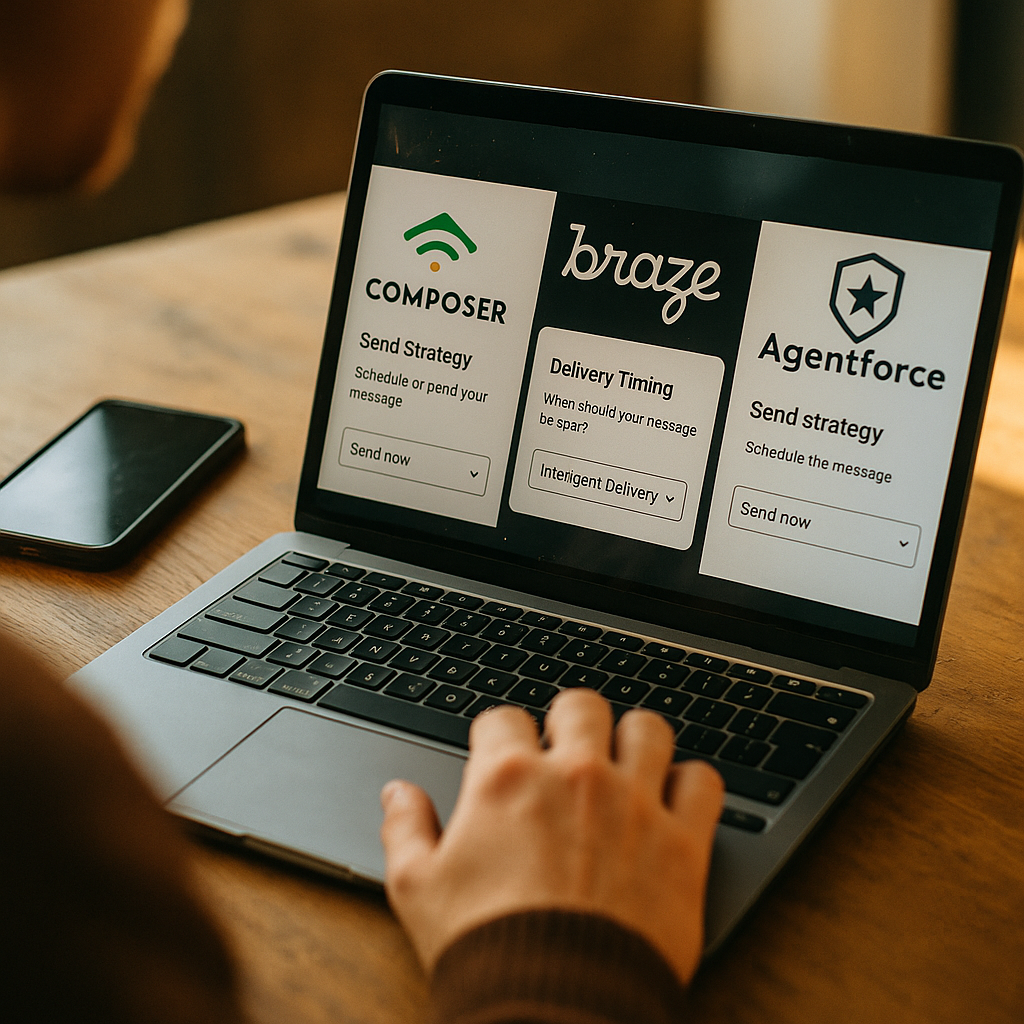
Send-time optimization used to mean a checkbox and a prayer. Now three major platforms claim their AI agents can decide not just when to send, but whether to send, what to say, and how to adjust mid-campaign. Agentic send-time optimization is the new battleground for lifecycle marketers, and the differences between Klaviyo Composer, Braze, and Salesforce Agentforce are bigger than any vendor deck admits.
If you’re evaluating a platform switch or renewal this cycle, the marketing copy will tell you all three “use AI.” What it won’t tell you is how much operational control you’re trading away, and where the risk actually sits when an autonomous agent gets it wrong.
What “Agentic” Actually Means Here
Traditional send-time optimization is a prediction model: it scores historical open behavior and picks a delivery window. Agentic send-time optimization goes further. The system doesn’t just predict a time, it makes a bounded decision, sometimes chaining multiple actions together (delay send, swap subject line, suppress a segment) without a human approving each step.
That distinction matters for compliance and budget owners. A predictive model fails quietly, you get a slightly worse open rate. An agentic system that’s misconfigured can fire at the wrong cadence, ignore suppression logic, or make a judgment call your legal team never signed off on. This is the same governance conversation we’ve been having about autonomous next-best-action platforms, just applied to the inbox instead of the whole customer journey.
The real risk in agentic send-time tools isn’t the AI being wrong occasionally. It’s the lack of a clear audit trail showing why it made a given decision.
Klaviyo Composer: Built for Speed, Thin on Governance
Klaviyo’s Composer sits inside its existing flow builder and leans hard into generative content plus timing decisions bundled together. The pitch is simple: describe the campaign goal, and Composer drafts copy, picks send windows per recipient, and iterates based on engagement signals within the flow.
For ecommerce brands running high-frequency lifecycle programs, this is genuinely useful. Composer’s send-time layer draws from the same recipient-level engagement data Klaviyo has always used for its predictive analytics, so there’s no new data pipeline to stand up. It’s fast to activate and doesn’t require a data science team.
The tradeoff: transparency is limited. Composer will tell you it adjusted a send time, but the reasoning trail is shallow compared to enterprise tools. If you’re a mid-market DTC brand, that’s a fair trade for speed. If you’re running regulated communications (financial services, healthcare-adjacent), the lack of granular decision logs is going to be a problem during a compliance review. Klaviyo has historically prioritized ease of use over auditability, and Composer inherits that DNA.
Another practical note: Composer’s agentic behavior is scoped tightly to email and SMS sends within Klaviyo’s own environment. It doesn’t reach out to orchestrate a decision across a paid channel or a support interaction. That’s a narrower blast radius, which is arguably a feature for risk-conscious teams, not a bug.
Braze: Mid-Weight Orchestration With Real Guardrails
Braze’s approach to agentic send-time optimization, layered through its Intelligent Selection and Canvas AI capabilities, sits between Klaviyo’s lightweight model and Salesforce’s enterprise stack. Braze lets marketers set explicit constraints (frequency caps, quiet hours, channel priority rules) that the agent must respect before it makes an autonomous timing call.
This matters more than it sounds. An agent that respects a hard-coded suppression rule is fundamentally safer than one that treats every rule as a soft preference. Braze’s architecture treats governance rules as a floor, not a suggestion, which is the right instinct for teams managing multi-brand or multi-market sends where legal requirements vary by geography.
Braze also exposes more of its decisioning logic through its dashboard, showing which variables (recency, channel affinity, predicted engagement) drove a given send-time decision. That’s not full explainability, nobody in this category has that yet, but it’s a meaningfully better audit trail than Klaviyo offers out of the box.
Where Braze lags: implementation complexity. Getting Intelligent Selection tuned properly requires clean event data and a reasonably mature data engineering function. Teams that haven’t invested in data freshness discipline will see the agent making decisions on stale signals, which defeats the entire point of “real-time” optimization. Braze is powerful, but it punishes sloppy data hygiene more than Klaviyo does.
Salesforce Agentforce: Enterprise Muscle, Enterprise Overhead
Agentforce is Salesforce’s attempt to make agentic decisioning a platform-wide capability, not just an email feature. Send-time optimization here isn’t isolated to Marketing Cloud, it’s meant to pull context from Sales Cloud, Service Cloud, and Data Cloud simultaneously. In theory, that means an agent deciding when to send a re-engagement email also knows if the customer just filed a support ticket or is mid-negotiation with a sales rep.
That cross-cloud context is Agentforce’s real differentiator, and it’s not a small one. Most send-time tools optimize in a vacuum, blind to what’s happening in adjacent systems. Agentforce’s design explicitly tries to close that gap, which aligns with the broader shift toward knowledge-graph-informed agent decisioning rather than siloed CDP lookups.
But enterprise muscle comes with enterprise overhead. Agentforce requires Data Cloud as connective tissue, and if your Salesforce implementation isn’t already unified across clouds, you’re taking on a significant integration project before the agent delivers any value. Salesforce’s own materials position Agentforce as requiring a “trust layer” configuration, permissions, guardrails, approved actions, which is the right architecture but adds real setup time. This isn’t a weekend deployment like Composer.
Agentforce’s cross-cloud context is the most sophisticated version of agentic send-time optimization on the market, but it’s only as good as the Salesforce data unification underneath it.
For enterprises already deep in the Salesforce ecosystem, this is likely the strongest long-term bet. For anyone without existing Data Cloud maturity, the switching cost and implementation timeline should be a serious factor in the decision, not an afterthought buried in the vendor’s SOW.
Where the Three Actually Diverge
Strip away the marketing language and three real differentiators emerge:
- Decision scope: Klaviyo optimizes within a single channel flow. Braze optimizes across channels within its own platform. Agentforce optimizes across your entire CRM footprint, assuming the data is unified.
- Governance depth: Braze’s hard-constraint model beats Klaviyo’s softer approach and, arguably, matches or exceeds Agentforce’s out-of-box guardrails unless you’ve invested serious time in Salesforce’s trust layer configuration.
- Time to value: Klaviyo wins on speed. Agentforce wins on depth, but only after a heavier lift. Braze sits in between, rewarding teams with decent data infrastructure already in place.
None of these differences show up clearly in a demo. They show up three months into production when a suppression rule gets ignored, or when the agent can’t explain why it delayed 40,000 sends during a product launch window.
The Data Quality Problem Nobody’s Solving For You
Here’s the uncomfortable truth vendors won’t lead with: agentic send-time optimization is only as trustworthy as the identity and engagement data feeding it. If your customer records are fragmented across systems, or your event tracking has gaps, the agent isn’t making a smart decision, it’s making a confident guess based on incomplete information.
This is why the identity resolution conversation and the agentic AI conversation are converging. Platforms like those compared in Klaviyo’s identity resolution benchmarks matter just as much as the AI layer sitting on top. An agent with perfect logic and bad inputs will still make bad calls, just faster and with more apparent authority than a human would.
Before signing off on any of these three platforms, ask your vendor a blunt question: what happens when the underlying identity graph has a 15% mismatch rate? None of them will have a great answer, because most haven’t been stress-tested at that level publicly. Recent eMarketer research on AI adoption in martech suggests data readiness, not model sophistication, remains the top blocker for agentic marketing tools reaching production scale.
Compliance Teams Should Be in This Conversation Early
Autonomous send decisions touch consent management, frequency regulations, and in some regions, explicit opt-in requirements. If an agent decides to increase send frequency based on predicted engagement, does that decision respect the consent scope the customer originally agreed to? This isn’t a hypothetical, regulators are increasingly scrutinizing automated decisioning in marketing communications.
The FTC’s guidance on automated decision-making and evolving frameworks from bodies like the UK’s Information Commissioner’s Office both signal that “the AI did it” won’t hold up as a defense. Build your governance review before deployment, not after an audit request lands on your desk.
Practically, this means whichever platform you choose needs a documented decision log, not just a marketing claim of “explainable AI.” Ask each vendor for a sample audit trail during the sales process. If they can’t produce one on the spot, that tells you something about how mature the feature actually is.
So Which One Should You Actually Choose?
If you’re a mid-market ecommerce or DTC brand running lean, Klaviyo Composer gets you agentic send-time gains fastest, with acceptable risk given your regulatory exposure is likely lower. If you’re managing multi-market or multi-brand programs and need real guardrails without a massive implementation project, Braze is the more balanced bet. If you’re a large enterprise already living inside Salesforce with Data Cloud maturity, Agentforce’s cross-cloud context is worth the setup cost, but don’t underestimate that cost.
The bigger strategic point: this category is moving fast, and today’s feature gap between these three platforms won’t hold for long. What will matter longer term is whether your underlying data infrastructure can support agentic decisioning at all, regardless of which vendor’s logo is on the contract.
Frequently Asked Questions
FAQs
What is agentic send-time optimization?
It’s a step beyond traditional predictive send-time models. Instead of just recommending a delivery window, an agentic system can autonomously make and execute decisions, like delaying a send, swapping content, or suppressing a segment, based on real-time signals and predefined constraints.
Is Klaviyo Composer suitable for regulated industries?
It can work, but its decision logging is shallower than Braze or Agentforce. Regulated brands (finance, healthcare-adjacent) should push Klaviyo for a detailed audit trail before relying on Composer for autonomous decisions at scale.
Does Braze’s agentic AI require a data science team to manage?
Not necessarily a dedicated data science team, but it does require clean, real-time event data. Teams with fragmented or stale data pipelines will see degraded performance from Braze’s Intelligent Selection features.
Why does Salesforce Agentforce need Data Cloud?
Agentforce’s differentiator is cross-cloud context, pulling signals from Sales Cloud and Service Cloud alongside Marketing Cloud. Data Cloud acts as the unification layer that makes that cross-cloud decisioning possible. Without it, Agentforce’s send-time optimization is far less powerful.
How do these platforms handle consent and compliance for autonomous sends?
None of them fully automate compliance review. Marketers remain responsible for ensuring autonomous decisions respect original consent scope and regional regulations. A documented decision log from the vendor is essential for demonstrating compliance during an audit.
Which platform is best for a company without a mature data infrastructure?
Klaviyo Composer generally has the lowest barrier to entry since it works within its own flow builder using existing engagement data. Braze and Agentforce both reward (and somewhat require) more mature data pipelines to perform reliably.
Before you commit budget to any of these three, run a 90-day pilot with a documented decision log requirement written into the contract, not as an afterthought. If the vendor can’t show you why the agent made a call, you’re not buying optimization, you’re buying a black box with a monthly invoice.
Top Influencer Marketing Agencies
The leading agencies shaping influencer marketing in 2026
Agencies ranked by campaign performance, client diversity, platform expertise, proven ROI, industry recognition, and client satisfaction. Assessed through verified case studies, reviews, and industry consultations.
Moburst

-
2

The Shelf
Boutique Beauty & Lifestyle Influencer AgencyA data-driven boutique agency specializing exclusively in beauty, wellness, and lifestyle influencer campaigns on Instagram and TikTok. Best for brands already focused on the beauty/personal care space that need curated, aesthetic-driven content.Clients: Pepsi, The Honest Company, Hims, Elf Cosmetics, Pure LeafVisit The Shelf → -
3

Audiencly
Niche Gaming & Esports Influencer AgencyA specialized agency focused exclusively on gaming and esports creators on YouTube, Twitch, and TikTok. Ideal if your campaign is 100% gaming-focused — from game launches to hardware and esports events.Clients: Epic Games, NordVPN, Ubisoft, Wargaming, Tencent GamesVisit Audiencly → -
4

Viral Nation
Global Influencer Marketing & Talent AgencyA dual talent management and marketing agency with proprietary brand safety tools and a global creator network spanning nano-influencers to celebrities across all major platforms.Clients: Meta, Activision Blizzard, Energizer, Aston Martin, WalmartVisit Viral Nation → -
5

The Influencer Marketing Factory
TikTok, Instagram & YouTube CampaignsA full-service agency with strong TikTok expertise, offering end-to-end campaign management from influencer discovery through performance reporting with a focus on platform-native content.Clients: Google, Snapchat, Universal Music, Bumble, YelpVisit TIMF → -
6

NeoReach
Enterprise Analytics & Influencer CampaignsAn enterprise-focused agency combining managed campaigns with a powerful self-service data platform for influencer search, audience analytics, and attribution modeling.Clients: Amazon, Airbnb, Netflix, Honda, The New York TimesVisit NeoReach → -
7

Ubiquitous
Creator-First Marketing PlatformA tech-driven platform combining self-service tools with managed campaign options, emphasizing speed and scalability for brands managing multiple influencer relationships.Clients: Lyft, Disney, Target, American Eagle, NetflixVisit Ubiquitous → -
8

Obviously
Scalable Enterprise Influencer CampaignsA tech-enabled agency built for high-volume campaigns, coordinating hundreds of creators simultaneously with end-to-end logistics, content rights management, and product seeding.Clients: Google, Ulta Beauty, Converse, AmazonVisit Obviously →