


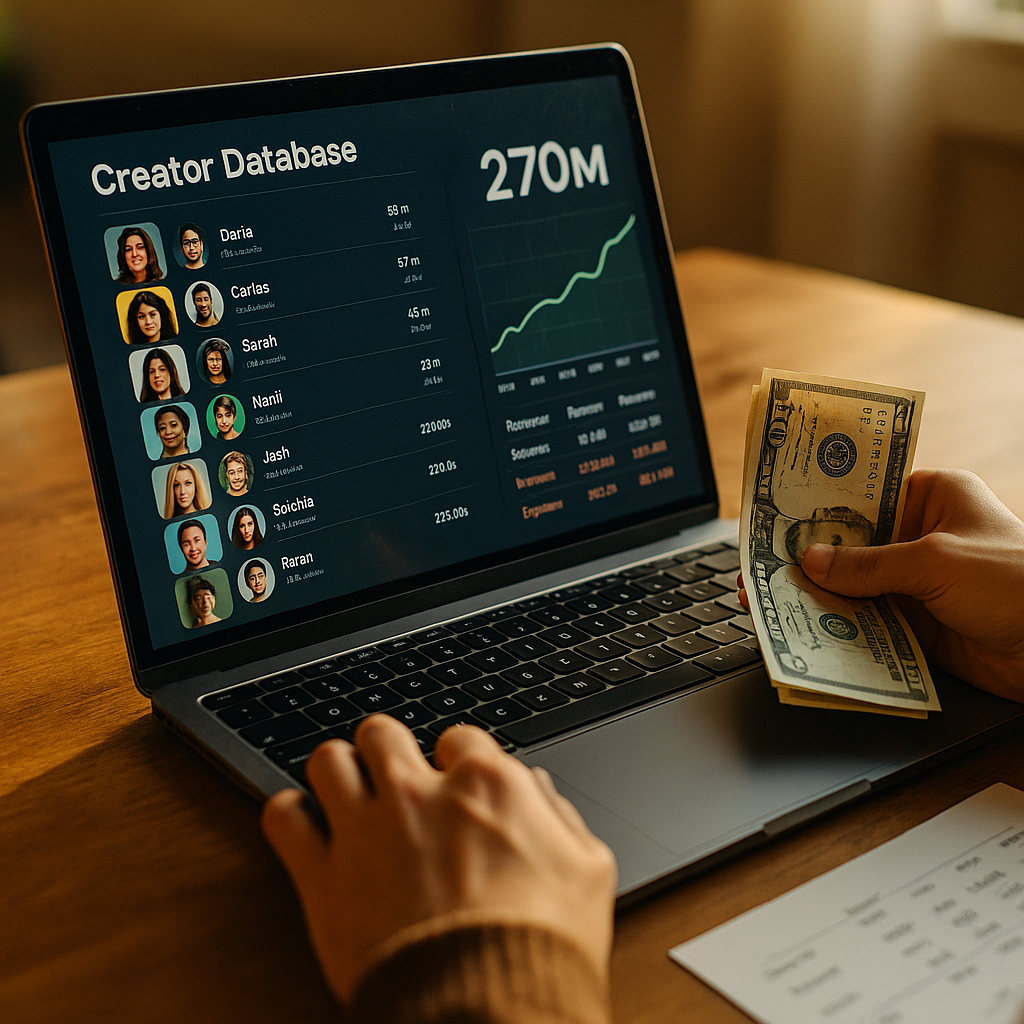
Mid-market brands spend an average of 15-20 hours a week just finding creators worth pitching. That’s before negotiation, vetting, or a single deliverable gets shipped. HypeClash claims its new matching engine, indexed against 270 million creator profiles, collapses that timeline to minutes. The bigger question isn’t whether the database is big — it’s whether creator discovery economics actually change when the haystack gets ten times larger.
Scale alone doesn’t solve a search problem. If anything, it makes precision harder. But HypeClash is betting that mid-market brands — the ones without in-house data science teams or six-figure influencer platform budgets — are the segment most starved for this kind of infrastructure. Let’s unpack whether that bet holds up.
The Discovery Cost Problem Nobody Talks About
Enterprise brands solved creator discovery years ago, mostly by throwing headcount and budget at it. Agencies like Billion Dollar Boy or in-house teams at brands like Unilever run dedicated creator ops functions. Mid-market brands don’t have that luxury. A marketing team of four is expected to run the same discovery, vetting, and outreach process as a team of forty, just with fewer tools and less time.
That’s where discovery costs quietly balloon. Manual searching across Instagram, TikTok, and YouTube, cross-referencing engagement rates, checking for bot followers, verifying brand safety — it’s not glamorous work, and it doesn’t scale. According to eMarketer, brands still cite creator vetting and discovery as the top operational bottleneck in influencer programs, ahead of budget approval or contract negotiation.
HypeClash’s pitch is straightforward: index everything, apply matching algorithms trained on performance data, and surface candidates ranked by fit rather than follower count. The 270-million figure matters less as a marketing stat and more as a proxy for coverage — it suggests the platform is pulling from micro and nano tiers across regions that legacy platforms historically ignored because the ROI on indexing them wasn’t obvious.
The real economic shift isn’t in database size. It’s in who gets access to creator intelligence that was previously reserved for brands with dedicated data teams.
What “270 Million” Actually Means for Matching Quality
Bigger pools sound impressive. But matching quality depends on data freshness and signal depth, not raw headcount. A creator database with stale engagement metrics from six months ago is worse than useless — it actively misleads budget decisions. This is the same trap identity resolution vendors have fallen into for years, promising scale while shipping outdated match rates. Influencers Time has covered this exact failure mode in match rate reliability conversations around martech consolidation, and the parallel here is direct.
HypeClash claims near-real-time refresh cycles on engagement and audience composition data, updating creator profiles every 48-72 hours rather than the monthly or quarterly cadence common among legacy platforms. If accurate, that’s the more meaningful differentiator, not the size of the index.
Brand teams evaluating this should ask three questions before signing anything: How often is audience data refreshed? What percentage of the 270 million profiles have verified (not self-reported) engagement metrics? And how does the platform handle creators who go dormant or delete content mid-campaign?
The Fraud Detection Question
Any database this size will include a meaningful chunk of fraudulent or low-quality accounts. The FTC has ramped up enforcement around undisclosed sponsorships and fake engagement, which means brands can’t outsource fraud risk entirely to a matching algorithm. HypeClash says it filters bot-driven engagement using behavioral signals rather than static follower-to-engagement ratios, but third-party audits of that claim haven’t surfaced publicly yet. Treat vendor fraud-detection claims the way you’d treat any attribution vendor claim: verify before you scale, not after.
Why Mid-Market Brands Specifically Benefit
Enterprise brands already have negotiating leverage with top-tier platforms and often run proprietary creator relationship databases built over years. Mid-market brands don’t have that history. They’re stuck choosing between expensive all-in-one platforms priced for enterprise budgets, or manual spreadsheet-based discovery that doesn’t scale past a handful of campaigns a quarter.
HypeClash’s pricing model, reportedly tiered by campaign volume rather than flat enterprise licensing, targets that exact gap. A brand running 15-20 campaigns a year gets access to matching capability that would otherwise require either a six-figure platform contract or a full-time creator ops hire. That’s the real economic shift: lowering the fixed cost of entry into data-driven creator discovery.
Compare this to how AI-native consolidation has played out elsewhere in martech. Influencers Time’s breakdown of suite versus best-of-breed ROI found that mid-market teams generally win more from focused point solutions than bloated suites, provided the point solution actually integrates cleanly with existing stacks. HypeClash will need to prove that integration story, particularly around CRM and attribution handoffs, or it risks becoming another isolated tool in an already fragmented stack.
The Integration Reality Check
Discovery is only the first step. A matching engine that finds great creators but doesn’t connect to your CRM, payment rails, or attribution stack just creates another data silo. Brands should push vendors hard on this during evaluation — not after signing a twelve-month contract.
Ask specifically about API access, webhook support for campaign status updates, and whether creator performance data flows back into existing attribution tooling. The MCP and A2A standards emerging in martech contracts are becoming the baseline expectation for how platforms should talk to each other. If HypeClash can’t support modern agent-to-agent protocols or at minimum robust API access, brands will end up doing manual exports anyway, which defeats the entire point of an AI-powered matching engine.
Payment infrastructure is another underrated piece. Creator payouts, especially across 270 million profiles spanning dozens of countries, involve currency conversion, tax compliance, and increasingly, stablecoin rails. Influencers Time’s coverage of stablecoin creator payouts is relevant here — if HypeClash handles matching but leaves payout complexity to the brand, that’s a hidden operational cost that erodes the efficiency gains on the front end.
Data Governance Can’t Be an Afterthought
A database spanning 270 million creator profiles necessarily includes personal data across jurisdictions with different privacy regimes. Brands operating in the UK or EU need to confirm how HypeClash handles data subject requests and cross-border transfers, particularly given ongoing scrutiny from bodies like the ICO. This isn’t a compliance afterthought — it’s a procurement requirement. Any vendor contract should specify data retention policies for creator profiles that opt out or request deletion.
A 270-million-profile database is a liability, not just an asset, if governance and consent tracking haven’t kept pace with the scale.
How This Compares to Existing Discovery Tools
HypeClash isn’t operating in a vacuum. Platforms like Upfluence, CreatorIQ, and Aspire have built discovery tools for years, typically layering matching on top of smaller, curated databases (often in the 5-30 million range) with heavier manual vetting built in. The trade-off has always been coverage versus curation depth.
HypeClash is making a different bet: massive coverage first, with AI doing the curation work that used to require human analysts. This mirrors a broader shift happening across marketing tech, where vertical machine learning models increasingly handle tasks that used to require dedicated analyst teams. Influencers Time examined a similar dynamic in CRM-native AI versus vertical ML approaches, and the pattern holds: purpose-built models trained on narrow, deep datasets tend to outperform generalist tools, but only when the training data itself is rigorously maintained.
Whether HypeClash’s matching algorithm outperforms curated alternatives is genuinely unclear without independent benchmarking. Brands should run parallel pilots, not just take the vendor’s case studies at face value. Request a 90-day trial against a live campaign brief and compare match quality directly against whatever tool you’re currently using, including manual search.
What Brands Should Actually Do Before Signing
- Request data refresh cadence documentation, not just marketing claims about database size
- Verify fraud detection methodology through a third-party audit or reference customer, not vendor self-reporting
- Confirm API and integration support for existing CRM and attribution tools before assuming seamless data flow
- Clarify payout infrastructure and international compliance handling upfront
- Run a parallel pilot against current discovery methods for at least one full campaign cycle
- Get data governance and deletion policies in writing, especially for EU and UK creator data
None of this is unique to HypeClash. It’s the same due-diligence discipline that should apply to any vendor promising to fix an operational bottleneck with scale and AI. Influencers Time’s attribution vendor due-diligence checklist covers a lot of the same ground and is worth running in parallel, since discovery and attribution failures tend to compound each other.
The Bottom Line for Budget Owners
The economics genuinely can shift for mid-market brands, but only if the underlying data quality matches the scale claims. A 270-million-creator index that’s poorly maintained is worse than a 10-million-creator index that’s rigorously curated and refreshed weekly. Don’t buy the headline number. Buy the operational discipline behind it.
Pilot before you commit budget, and insist on integration proof, not integration promises, before signing anything longer than a quarter.
Frequently Asked Questions
What makes HypeClash’s creator database different from existing discovery platforms?
The primary difference is scale and refresh frequency. HypeClash indexes roughly 270 million creator profiles, significantly more than the 5-30 million range typical of platforms like Upfluence or CreatorIQ, and claims to refresh engagement data every 48-72 hours rather than monthly.
Is a larger creator database actually better for brand matching?
Not automatically. Database size matters less than data freshness, fraud filtering accuracy, and how well the matching algorithm weighs audience quality over vanity metrics like follower count. Brands should verify these factors independently rather than assuming scale equals quality.
How should mid-market brands evaluate creator discovery tools before signing a contract?
Run a parallel pilot against your current discovery process for at least one campaign cycle, request documentation on data refresh cadence and fraud detection methodology, and confirm API integration with your existing CRM and attribution stack before committing to a longer contract term.
What are the hidden costs of AI-powered creator matching platforms?
Common hidden costs include manual data exports when integrations are weaker than advertised, payout infrastructure gaps for international creators, and compliance overhead if the vendor’s data governance doesn’t meet regional privacy requirements like GDPR or UK data protection standards.
Does creator database scale help with influencer fraud detection?
Scale alone doesn’t improve fraud detection. Effective fraud filtering depends on behavioral signal analysis and verified engagement data, not the total number of profiles indexed. Brands should request evidence of fraud detection methodology rather than assuming a large database is inherently cleaner.
Top Influencer Marketing Agencies
The leading agencies shaping influencer marketing in 2026
Agencies ranked by campaign performance, client diversity, platform expertise, proven ROI, industry recognition, and client satisfaction. Assessed through verified case studies, reviews, and industry consultations.
Moburst

-
2

The Shelf
Boutique Beauty & Lifestyle Influencer AgencyA data-driven boutique agency specializing exclusively in beauty, wellness, and lifestyle influencer campaigns on Instagram and TikTok. Best for brands already focused on the beauty/personal care space that need curated, aesthetic-driven content.Clients: Pepsi, The Honest Company, Hims, Elf Cosmetics, Pure LeafVisit The Shelf → -
3

Audiencly
Niche Gaming & Esports Influencer AgencyA specialized agency focused exclusively on gaming and esports creators on YouTube, Twitch, and TikTok. Ideal if your campaign is 100% gaming-focused — from game launches to hardware and esports events.Clients: Epic Games, NordVPN, Ubisoft, Wargaming, Tencent GamesVisit Audiencly → -
4

Viral Nation
Global Influencer Marketing & Talent AgencyA dual talent management and marketing agency with proprietary brand safety tools and a global creator network spanning nano-influencers to celebrities across all major platforms.Clients: Meta, Activision Blizzard, Energizer, Aston Martin, WalmartVisit Viral Nation → -
5

The Influencer Marketing Factory
TikTok, Instagram & YouTube CampaignsA full-service agency with strong TikTok expertise, offering end-to-end campaign management from influencer discovery through performance reporting with a focus on platform-native content.Clients: Google, Snapchat, Universal Music, Bumble, YelpVisit TIMF → -
6

NeoReach
Enterprise Analytics & Influencer CampaignsAn enterprise-focused agency combining managed campaigns with a powerful self-service data platform for influencer search, audience analytics, and attribution modeling.Clients: Amazon, Airbnb, Netflix, Honda, The New York TimesVisit NeoReach → -
7

Ubiquitous
Creator-First Marketing PlatformA tech-driven platform combining self-service tools with managed campaign options, emphasizing speed and scalability for brands managing multiple influencer relationships.Clients: Lyft, Disney, Target, American Eagle, NetflixVisit Ubiquitous → -
8

Obviously
Scalable Enterprise Influencer CampaignsA tech-enabled agency built for high-volume campaigns, coordinating hundreds of creators simultaneously with end-to-end logistics, content rights management, and product seeding.Clients: Google, Ulta Beauty, Converse, AmazonVisit Obviously →