


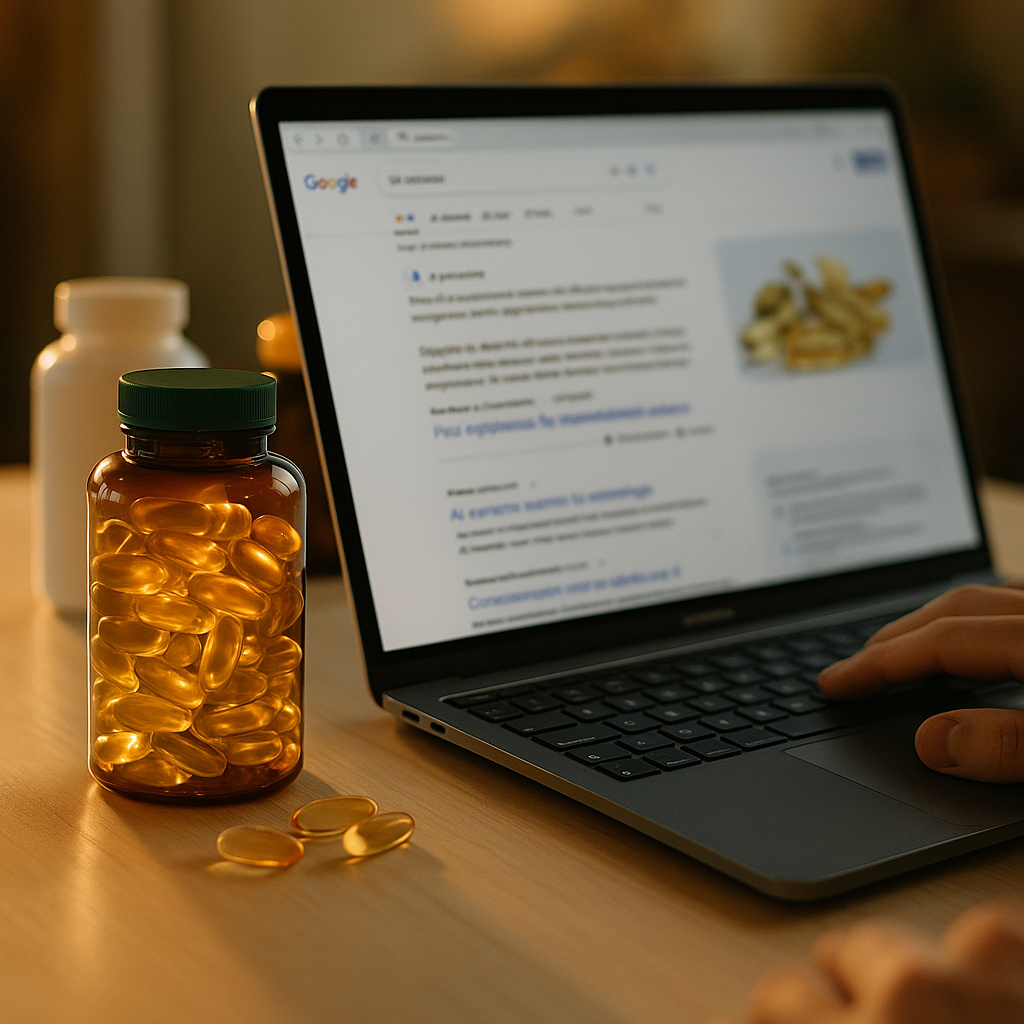
Ninety-seven percent. That’s how many supplement brand websites showed up in Google’s AI Overviews without any dedicated optimization effort, according to recent crawl data circulating among SEO practitioners. No schema hacks. No AI-specific content strategy. Just… there. If your supplement site is already getting cited, the obvious question isn’t “how do we get in” — it’s “does any of this actually move revenue?”
That’s the uncomfortable pivot brands need to make in 2026.
Why Supplements Became the AI Overview Default
Supplements sit in a strange sweet spot for generative search. The category is dense with structured, factual content — dosages, ingredient interactions, clinical citations, FAQ-style product pages. Google’s AI Overviews (and increasingly, Gemini and ChatGPT’s browsing mode) love that kind of content because it’s easy to extract, summarize, and attribute.
Compare that to categories like fashion or home decor, where value is subjective and visual. A supplement page answering “does magnesium glycinate help with sleep” is basically pre-formatted for an AI summary. The industry didn’t optimize for this. It just happened to already be structured the right way.
When 97% of a category appears in AI Overviews by default, the differentiator stops being visibility and starts being what happens after the click — or whether there’s a click at all.
This matters because supplement marketers have spent years chasing keyword rankings, backlinks, and domain authority. Turns out a huge chunk of that effort was solving for a problem AI search doesn’t really have anymore. The bottleneck has moved downstream.
The Real Risk: Citation Without Conversion
Here’s the part nobody wants to say out loud: appearing in an AI Overview doesn’t guarantee a visit, and a visit doesn’t guarantee a sale. Early data from eMarketer suggests zero-click search behavior is accelerating across health and wellness queries specifically, because users get exactly the reassurance they need (“yes, vitamin D and magnesium are generally safe to take together”) without ever landing on a brand’s domain.
So you’re cited. Great. But if the AI Overview answers the question completely, the user has no reason to click through. Your brand becomes a footnote in someone else’s synthesized paragraph, not a destination.
For supplement brands operating on thin margins and heavy customer acquisition costs, this is a genuine strategic problem. Citation is not traffic. Traffic is not conversion. And in a saturated category where nearly everyone shows up in the same AI summary, differentiation has to happen somewhere else in the funnel.
What Actually Drives Clicks in a Zero-Effort Citation Environment
- Branded trust signals — clinical study citations, third-party testing badges, dietitian bylines
- Specificity AI can’t fully summarize — personalized dosage calculators, interactive quizzes, subscription logic
- Post-click experience — if the AI Overview answers the “what,” your site needs to own the “how” and “why this brand”
- Community and UGC proof — reviews, before/after content, and creator testimonials that AI can reference but not replicate
Brands that treat AI Overview presence as a finish line are going to lose share to competitors who treat it as the starting gate. The work now happens after the citation, not before it.
Balanced Content Strategy Means Stopping the SEO-Only Reflex
For years, “content strategy” in supplements meant keyword clusters, pillar pages, and backlink campaigns aimed squarely at classic organic rankings. That playbook isn’t dead, but it’s incomplete. A balanced strategy in 2026 has to account for three simultaneous audiences: traditional search crawlers, AI Overview summarizers, and large language models like ChatGPT and Perplexity that increasingly browse live rather than relying on cached indexes.
These aren’t the same audience, and they don’t reward the same content. Our own reporting on how brands win citations in both AI Overviews and chat-based assistants found that structural clarity — clear headers, direct answers up top, minimal fluff — wins across all three. But depth and brand voice still matter for the humans who do click through.
So the strategy split looks something like this: structure for extraction, but write for retention. Optimize headers and schema for the machines, but keep the actual prose sharp enough that a human who lands on the page doesn’t bounce in four seconds.
This is also where sentiment-driven distribution starts to matter more than raw reach. If your content earns trust signals — positive sentiment, expert endorsement, low return rates reflected in reviews — AI systems increasingly weight that in what they choose to surface and how they frame it.
Compliance Is the Quiet Multiplier Nobody’s Pricing In
Supplements are one of the most heavily scrutinized categories for AI-generated summaries, and for good reason. The FTC has been explicit about health claim substantiation, and AI Overviews don’t always distinguish between a brand’s marketing copy and a peer-reviewed claim when synthesizing an answer. If your product page says “clinically shown to reduce joint pain” without a citation, that claim can get pulled into a summary the same way a verified claim would — and that’s a liability problem waiting to surface, not a content win.
Brand and legal teams need to be in the same room on this. A content strategy that gets you cited in an AI Overview with an unsubstantiated claim isn’t a growth win. It’s exposure risk. Every dosage claim, every “supports immune health” line, needs a citation trail that would survive an audit, because AI systems are effectively amplifying whatever claim density already exists on your site — accurate or not.
Getting cited by an AI Overview with a shaky health claim isn’t visibility — it’s a liability sitting in plain sight, amplified at scale.
Where Attribution Gets Messy (And What to Do About It)
If a user sees your brand mentioned in an AI Overview, doesn’t click, but later searches your brand name directly and buys — how does that get attributed? Most analytics stacks still struggle with this. Standard Google Analytics setups treat that as a fresh organic or direct session, completely disconnected from the AI Overview impression that actually drove the decision.
This is where probabilistic modeling starts to earn its keep. Teams working on probabilistic attribution models for AI search purchases are building frameworks that connect delayed, indirect conversions back to AI-driven discovery moments — even without a clean click-through path. Supplement brands with long consideration cycles (subscription decisions, stacking multiple products, waiting for a sale) are exactly the kind of buyer journey this approach was built for.
Pairing that with dashboards that isolate AI assistant traffic gives marketing teams something they’ve been missing: a way to prove that AI visibility, even without clicks, correlates with downstream revenue. Without that connective tissue, finance teams will keep asking why you’re investing content budget in something that shows “zero sessions.”
A Practical Checklist for 2026 Content Teams
- Audit existing product and blog pages for claim-to-citation ratio — flag anything unsubstantiated
- Restructure top-of-funnel content with direct-answer summaries in the first 100 words
- Build post-click experiences (quizzes, calculators, loyalty perks) that AI Overviews literally cannot replicate
- Layer in probabilistic or assisted-conversion attribution to capture delayed purchase paths
- Loop legal/compliance into content calendars, not just final review
None of this is exotic. It’s disciplined, unglamorous execution — the kind that doesn’t generate a viral LinkedIn post but does show up in Q3 revenue.
One more thing worth flagging: creator and UGC content is playing a bigger role in this ecosystem than brands often credit. AI systems are increasingly pulling sentiment signals from review platforms and creator content, not just brand-owned pages. That means your UGC production pipeline isn’t just a social asset anymore — it’s feeding the same trust signals that determine how AI frames your brand in a summary. Treat it accordingly.
The takeaway for supplement marketers heading into next year: stop measuring success by whether you show up in an AI Overview, because you probably already do. Measure it by what happens in the fifteen seconds after someone reads that summary and decides whether your brand deserves the click.
FAQs
Why do supplement sites appear in AI Overviews so easily compared to other industries?
Supplement content tends to be structured, factual, and answer-oriented by default — dosage info, ingredient benefits, and safety FAQs are naturally formatted for AI summarization, unlike more subjective categories like fashion or lifestyle.
Does appearing in an AI Overview guarantee more website traffic?
No. AI Overviews often satisfy the user’s question directly, which can suppress click-through rates even when your brand is cited. Visibility and traffic are increasingly separate metrics.
What compliance risks come with AI Overview citations for supplement brands?
Unsubstantiated health claims on product pages can get pulled into AI-generated summaries just like verified claims, creating regulatory exposure under FTC guidelines if the underlying content isn’t properly cited or reviewed.
How should brands measure ROI from AI Overview visibility if clicks are low?
Probabilistic attribution models and AI-assistant-specific analytics dashboards can help connect delayed or indirect conversions back to AI search visibility, even without a traditional click path.
What should supplement content teams prioritize going into next year?
Focus less on getting cited (it’s likely already happening) and more on claim substantiation, post-click experience design, and attribution frameworks that prove AI visibility’s downstream revenue impact.
Top Influencer Marketing Agencies
The leading agencies shaping influencer marketing in 2026
Agencies ranked by campaign performance, client diversity, platform expertise, proven ROI, industry recognition, and client satisfaction. Assessed through verified case studies, reviews, and industry consultations.
Moburst

-
2

The Shelf
Boutique Beauty & Lifestyle Influencer AgencyA data-driven boutique agency specializing exclusively in beauty, wellness, and lifestyle influencer campaigns on Instagram and TikTok. Best for brands already focused on the beauty/personal care space that need curated, aesthetic-driven content.Clients: Pepsi, The Honest Company, Hims, Elf Cosmetics, Pure LeafVisit The Shelf → -
3

Audiencly
Niche Gaming & Esports Influencer AgencyA specialized agency focused exclusively on gaming and esports creators on YouTube, Twitch, and TikTok. Ideal if your campaign is 100% gaming-focused — from game launches to hardware and esports events.Clients: Epic Games, NordVPN, Ubisoft, Wargaming, Tencent GamesVisit Audiencly → -
4

Viral Nation
Global Influencer Marketing & Talent AgencyA dual talent management and marketing agency with proprietary brand safety tools and a global creator network spanning nano-influencers to celebrities across all major platforms.Clients: Meta, Activision Blizzard, Energizer, Aston Martin, WalmartVisit Viral Nation → -
5

The Influencer Marketing Factory
TikTok, Instagram & YouTube CampaignsA full-service agency with strong TikTok expertise, offering end-to-end campaign management from influencer discovery through performance reporting with a focus on platform-native content.Clients: Google, Snapchat, Universal Music, Bumble, YelpVisit TIMF → -
6

NeoReach
Enterprise Analytics & Influencer CampaignsAn enterprise-focused agency combining managed campaigns with a powerful self-service data platform for influencer search, audience analytics, and attribution modeling.Clients: Amazon, Airbnb, Netflix, Honda, The New York TimesVisit NeoReach → -
7

Ubiquitous
Creator-First Marketing PlatformA tech-driven platform combining self-service tools with managed campaign options, emphasizing speed and scalability for brands managing multiple influencer relationships.Clients: Lyft, Disney, Target, American Eagle, NetflixVisit Ubiquitous → -
8

Obviously
Scalable Enterprise Influencer CampaignsA tech-enabled agency built for high-volume campaigns, coordinating hundreds of creators simultaneously with end-to-end logistics, content rights management, and product seeding.Clients: Google, Ulta Beauty, Converse, AmazonVisit Obviously →