


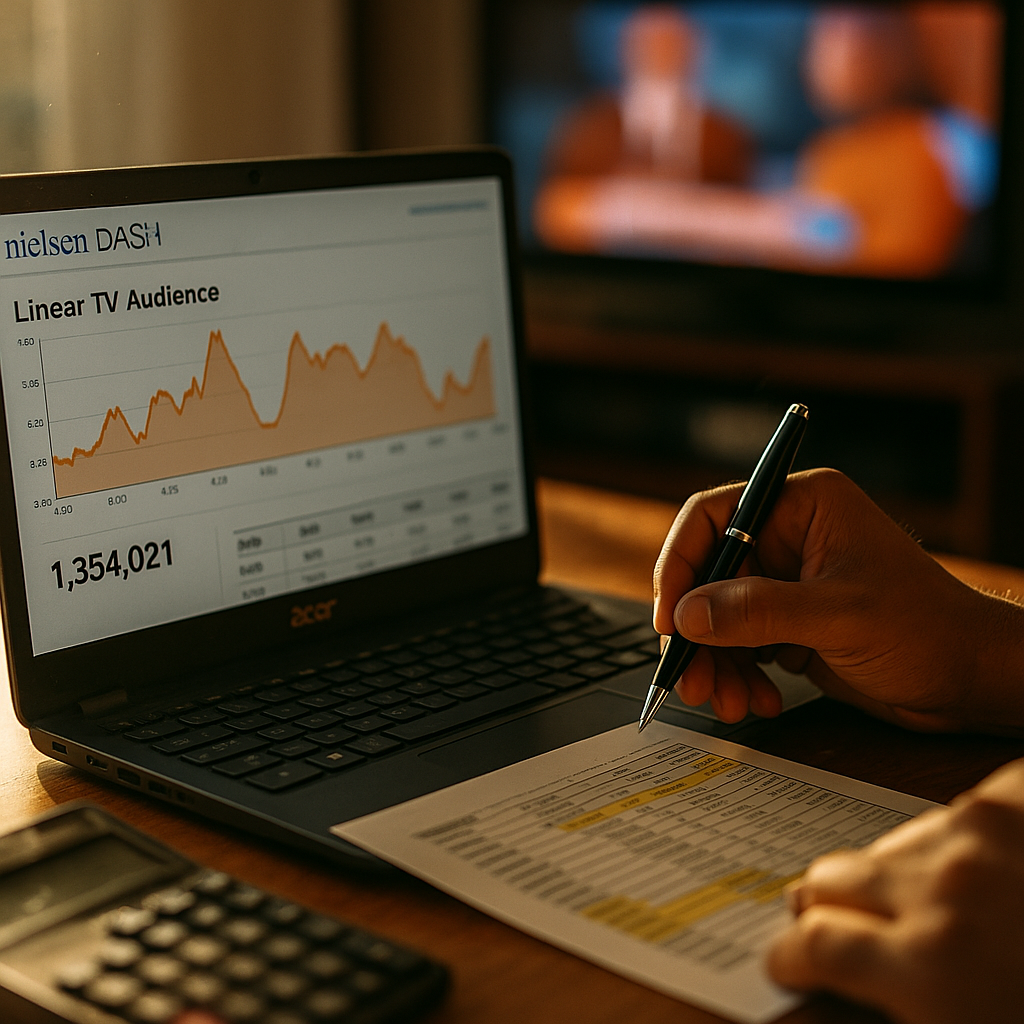
Streaming video buffers. Linear doesn’t. That half-second gap between a broadcast signal and a DASH-delivered stream has been quietly distorting cross-screen measurement for years — and Nielsen just decided to fix it. The Nielsen DASH latency adjustment is a technical correction with real budget consequences, and if you’re planning cross-platform buys without understanding it, you’re working with skewed numbers.
What Actually Broke in Cross-Screen Measurement
Dynamic Adaptive Streaming over HTTP, or DASH, is the backbone of most streaming video delivery. It’s how Hulu, Peacock, and dozens of connected TV apps chop video into segments and adjust quality based on bandwidth. The problem: DASH introduces latency. A live stream on a smart TV app can lag anywhere from a few seconds to nearly a minute behind the same broadcast feed airing over-the-air or via cable.
That lag doesn’t sound like a measurement issue until you consider how Nielsen (and most panels) timestamp exposure. Ad occurrence logs for linear are built off broadcast feed timing. Streaming exposure, historically, got measured against a similar clock — even though the actual ad the viewer saw arrived seconds or minutes later. Multiply that misalignment across millions of households and you get systematic minute-by-minute misattribution, especially for live sports, awards shows, and news events where synchronized second-by-second measurement matters most.
A 20-40 second latency gap during a live sporting event can shift ad-exposure counts between the wrong commercial pods entirely — inflating some placements and undercounting others.
Nielsen’s Fix: Recalibrating the Clock
Nielsen’s DASH latency adjustment essentially recalibrates the timing layer of its measurement so that streaming ad occurrences are matched against the actual moment content reached the viewer’s device, not the broadcast originating timestamp. Nielsen has been rolling this into its Big Data + Panel methodology, which already blends set-top box data, smart TV data, and panel-based measurement to produce national TV ratings.
In practice, this means Nielsen is applying device-and-platform-specific latency offsets. Different streaming apps buffer differently. A DASH-based delivery on one smart TV OS might run 8 seconds behind broadcast; another platform using a different CDN configuration might run 25 seconds behind. Nielsen’s adjustment accounts for these variances rather than applying a blanket correction, which is the detail that makes this update more than a rounding exercise.
For brands running simulcast campaigns — the same creative pushed across broadcast and streaming simultaneously — this is the difference between reporting that actually reflects reality and reporting that’s been quietly wrong for years without anyone flagging it.
Why This Matters More for Live Content
On-demand streaming doesn’t have this problem in the same way. If someone watches a show three hours after it airs, there’s no ambiguity about “real-time” alignment — the whole session is asynchronous by design. Live content is where latency creates chaos: live sports, live news, award shows, election coverage, anything sold on second-by-second ad pod guarantees.
Sports rights deals in particular ride on precise ad measurement. The NFL, NBA, and major streaming sports packages (Amazon’s Thursday Night Football, Netflix’s live sports push) all depend on advertisers trusting that a “live” ad exposure counted on a streaming device happened close enough to the linear broadcast to be treated as equivalent inventory. If DASH latency was silently shifting exposure into the wrong ad pod, brands could have been both overpaying for underperforming placements and underpaying for genuinely high-performing ones. Nobody wants to find that out in a post-campaign audit.
The Currency Question: Does This Change What You’re Buying?
Short answer: it changes what you thought you were measuring, not necessarily what you bought. Media currency — the agreed metric used to transact and guarantee campaigns — has been shifting toward Nielsen’s ONE Ad Ratings and cross-platform measurement products for a while now, partly in response to competitive pressure from Comscore and VideoAmp gaining ground in the “Big Three” measurement race that emerged after the MRC suspended and reinstated Nielsen’s accreditation over the past several years.
The DASH latency correction is Nielsen shoring up credibility in exactly the area competitors have used to poach business: streaming measurement precision. If your media plan already runs on Nielsen ONE, expect adjusted historical baselines. Comparing this quarter’s cross-screen reach numbers to last year’s without accounting for the recalibration will produce misleading trend lines. Ask your Nielsen rep directly whether reported baselines have been restated — don’t assume continuity.
Treat any pre-adjustment cross-screen benchmark as provisional. Rebuild your baseline once the recalibrated data is available, or you’ll be optimizing against a broken comparison point.
What Brands and Agencies Should Actually Do
- Audit live-event campaigns first. If you ran simulcast buys around major sports or award-show inventory, request a re-pull of exposure data under the adjusted methodology before finalizing post-campaign reporting.
- Re-baseline cross-screen KPIs. Don’t compare pre- and post-adjustment reach/frequency numbers directly. Flag the recalibration date in your reporting templates so analysts don’t misread a methodology shift as a performance shift.
- Push vendors for platform-level transparency. Ask which DASH latency offsets apply to which CTV platforms in your media mix. Not all streaming apps buffer equally, and your measurement partner should be able to explain the variance, not just the aggregate correction.
- Coordinate with attribution vendors. If you’re layering multi-touch attribution or marketing mix modeling on top of Nielsen data, this recalibration affects your input data quality. It’s worth reviewing how your MMM vendor handles updated exposure timestamps — similar to the diligence questions raised in MTA and MMM platform comparisons.
- Revisit governance around identity and exposure data. Timing corrections like this are a reminder that attribution infrastructure needs the same scrutiny as creative and targeting. The principles laid out in attribution governance frameworks apply directly here — measurement methodology changes should trigger a governance review, not just a shrug.
How This Fits the Bigger Measurement Overhaul
This isn’t happening in isolation. The entire cross-platform measurement landscape is being rebuilt in real time. YouTube overhauled its unified view counting methodology to standardize how views get counted across formats. Attribution vendors are racing to fix identity resolution gaps, as detailed in comparisons like identity resolution vendor breakdowns. Everyone is chasing the same goal: a measurement layer that doesn’t fall apart the moment content crosses from broadcast to streaming to mobile.
Nielsen’s DASH latency fix is a narrow, technical piece of that puzzle. But narrow technical fixes compound. A few seconds of misalignment on live sports, multiplied across a Super Bowl-sized media buy, is not a rounding error — it’s potentially millions of dollars of budget allocated against the wrong ad pods. According to eMarketer, CTV ad spend in the US continues to climb into the tens of billions annually, and every measurement gap at that scale has real financial weight behind it.
Marketers who treat this as “a Nielsen backend update, not my problem” are making a mistake. Your media buyers, your MMM vendors, and your internal reporting dashboards all inherit whatever Nielsen ships. If nobody on your team is tracking methodology changelogs, you’re flying blind on comparability.
A Note on Vendor Trust
Measurement credibility has been shaky industry-wide. The marketing analytics community has spent years debating whether any single vendor’s numbers can be trusted without independent verification, which is exactly why the Media Rating Council’s accreditation process exists and why brands increasingly run parallel measurement from Comscore or VideoAmp alongside Nielsen. The DASH latency adjustment is a step toward Nielsen closing a known credibility gap — not proof the system is now flawless. Verify, don’t assume.
Frequently Asked Questions
FAQs
What is the Nielsen DASH latency adjustment?
It’s a methodology update that recalibrates how Nielsen times ad exposure on DASH-delivered streaming platforms, aligning it with the actual moment content reaches a viewer’s device rather than the original broadcast timestamp.
Why does DASH streaming have latency compared to linear TV?
DASH breaks video into segments and adjusts quality based on available bandwidth, which introduces buffering delay. This delay can range from a few seconds to nearly a minute depending on the platform, device, and CDN configuration.
Which campaigns are most affected by this adjustment?
Live content is affected most: live sports, award shows, news, and election coverage, where second-by-second ad pod attribution matters. On-demand streaming is largely unaffected since there’s no real-time alignment expectation.
Should I compare pre- and post-adjustment reach numbers directly?
No. Treat the adjustment as a methodology reset. Re-baseline your cross-screen KPIs and flag the transition date in reporting so a measurement change isn’t misread as a performance change.
Does this affect Nielsen’s accreditation or credibility with the MRC?
The adjustment is part of Nielsen’s ongoing effort to improve cross-platform measurement precision, which has been under scrutiny amid competition from Comscore and VideoAmp. It strengthens Nielsen’s case for accuracy but doesn’t eliminate the need for independent verification.
What should brands ask their media and analytics vendors right now?
Ask whether historical baselines have been restated, which DASH latency offsets apply to your specific CTV platform mix, and how downstream attribution or MMM tools are handling the updated exposure timestamps.
Don’t wait for your Q3 report to discover your cross-screen numbers shifted underneath you. Pull your Nielsen rep into a call this month, ask directly whether your historical baselines have been restated, and rebuild your reporting templates before the next live-event campaign locks in.
Top Influencer Marketing Agencies
The leading agencies shaping influencer marketing in 2026
Agencies ranked by campaign performance, client diversity, platform expertise, proven ROI, industry recognition, and client satisfaction. Assessed through verified case studies, reviews, and industry consultations.
Moburst

-
2

The Shelf
Boutique Beauty & Lifestyle Influencer AgencyA data-driven boutique agency specializing exclusively in beauty, wellness, and lifestyle influencer campaigns on Instagram and TikTok. Best for brands already focused on the beauty/personal care space that need curated, aesthetic-driven content.Clients: Pepsi, The Honest Company, Hims, Elf Cosmetics, Pure LeafVisit The Shelf → -
3

Audiencly
Niche Gaming & Esports Influencer AgencyA specialized agency focused exclusively on gaming and esports creators on YouTube, Twitch, and TikTok. Ideal if your campaign is 100% gaming-focused — from game launches to hardware and esports events.Clients: Epic Games, NordVPN, Ubisoft, Wargaming, Tencent GamesVisit Audiencly → -
4

Viral Nation
Global Influencer Marketing & Talent AgencyA dual talent management and marketing agency with proprietary brand safety tools and a global creator network spanning nano-influencers to celebrities across all major platforms.Clients: Meta, Activision Blizzard, Energizer, Aston Martin, WalmartVisit Viral Nation → -
5

The Influencer Marketing Factory
TikTok, Instagram & YouTube CampaignsA full-service agency with strong TikTok expertise, offering end-to-end campaign management from influencer discovery through performance reporting with a focus on platform-native content.Clients: Google, Snapchat, Universal Music, Bumble, YelpVisit TIMF → -
6

NeoReach
Enterprise Analytics & Influencer CampaignsAn enterprise-focused agency combining managed campaigns with a powerful self-service data platform for influencer search, audience analytics, and attribution modeling.Clients: Amazon, Airbnb, Netflix, Honda, The New York TimesVisit NeoReach → -
7

Ubiquitous
Creator-First Marketing PlatformA tech-driven platform combining self-service tools with managed campaign options, emphasizing speed and scalability for brands managing multiple influencer relationships.Clients: Lyft, Disney, Target, American Eagle, NetflixVisit Ubiquitous → -
8

Obviously
Scalable Enterprise Influencer CampaignsA tech-enabled agency built for high-volume campaigns, coordinating hundreds of creators simultaneously with end-to-end logistics, content rights management, and product seeding.Clients: Google, Ulta Beauty, Converse, AmazonVisit Obviously →