


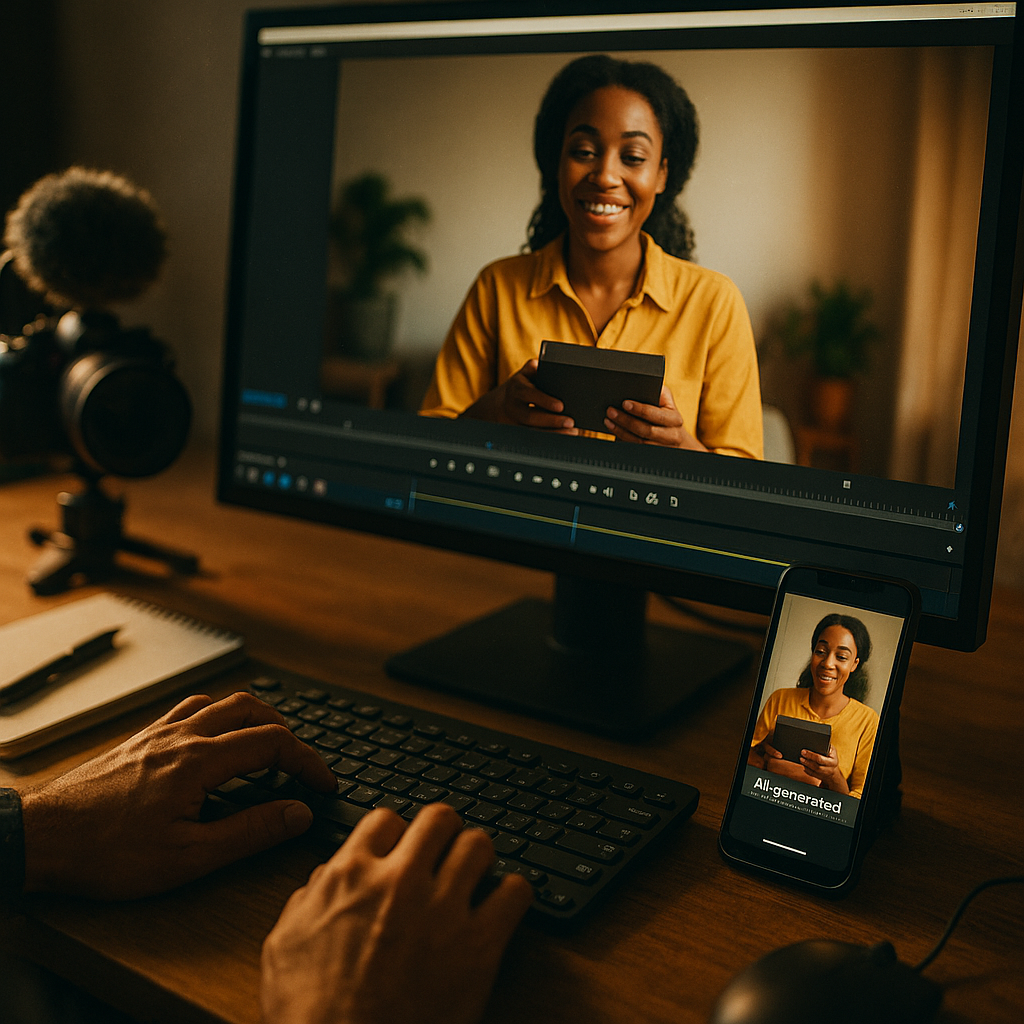
72% of marketers now use generative AI somewhere in their video ad production, according to recent industry surveys, yet most brands running YouTube’s Demand Gen campaigns still bolt on disclosure language as an afterthought. That gap is exactly where the FTC has said it will look first. FTC disclosure language for AI-generated video ads isn’t a checkbox anymore — it’s the difference between a clean campaign and a Section 5 investigation.
YouTube’s expanded Demand Gen suite now lets advertisers generate synthetic spokespeople, AI-voiced narration, and auto-assembled video variants at a scale that didn’t exist eighteen months ago. Google’s tooling makes it fast. It does not make it compliant. Brands are the ones holding liability when an AI avatar makes a claim, endorses a product, or appears in a testimonial format without proper disclosure.
Why This Suddenly Matters for Demand Gen Advertisers
Demand Gen replaced Discovery ads with a promise: broader reach across YouTube, Gmail, and Discover feeds, powered by creative that adapts automatically to placement. The expanded suite added generative video tools — image-to-video, AI voiceover, and automated script-to-scene assembly — directly inside Google Ads. Brands no longer need a production agency to create a “human-presenting” video ad. That’s the efficiency win everyone’s chasing.
It’s also the compliance blind spot nobody’s budgeting for. When an AI-generated presenter says “I’ve used this serum for three months and my skin has never looked better,” that’s a testimonial claim from an entity that doesn’t exist and has never used anything. The FTC’s Endorsement Guides don’t care whether the endorser is a person, a persona, or a rendered face. They care whether a reasonable viewer would believe they’re seeing a genuine experience or opinion.
If your AI-generated presenter implies personal experience, opinion, or endorsement, the FTC treats it as an endorsement claim — full stop, regardless of whether a human ever said those words.
This isn’t theoretical. The FTC has already brought enforcement actions tied to fake or fabricated endorsements, and its 2023 update to the Endorsement Guides explicitly addressed AI-generated and virtual influencer content. Google itself has tightened its advertising policies around synthetic media disclosure, which means brands now face two layers of risk: platform policy violations and federal enforcement.
What “Clear and Conspicuous” Means in a 15-Second Vertical Ad
The FTC’s standard hasn’t changed just because the format has. Disclosures must be clear and conspicuous — meaning unavoidable, unambiguous, and presented in the same modality as the claim. If the AI avatar speaks the endorsement, an audio disclosure matters as much as an on-screen one. A tiny caption at the bottom of a 9:16 vertical video that disappears in two seconds does not meet the standard, no matter how many brands are currently getting away with it.
Here’s the practical framework we recommend for structuring disclosure language across Demand Gen’s AI video formats:
- Placement: Disclosure text should appear within the first three seconds and persist for the full duration the AI-generated claim is on screen, not just at video open or close.
- Language specificity: Generic tags like “#ad” don’t cover synthetic media risk. Use explicit phrasing: “This video features an AI-generated spokesperson” or “Presenter generated using AI; not an actual customer.”
- Dual-modality delivery: Pair on-screen text with a spoken or captioned equivalent, especially since a large share of Demand Gen inventory autoplays muted.
- Consistent placement across variants: Demand Gen auto-generates multiple aspect ratios and crops from a single asset. Confirm the disclosure survives every crop, not just the master file.
- Landing page reinforcement: If the ad drives to a product page, repeat the disclosure near any AI-sourced testimonial or claim reproduced there.
Notice what’s missing from that list: burying the disclosure in the ad description field. Google allows advertisers to add descriptive text that rarely renders visibly across all placements. If your compliance strategy depends on text nobody sees, it isn’t a compliance strategy. It’s a liability waiting for a complaint.
The Synthetic Spokesperson Problem
Demand Gen’s generative tools make it trivially easy to produce a photorealistic presenter reading your script. Marketing teams love this because it removes talent costs and usage rights headaches. But a photorealistic AI presenter creates a specific disclosure obligation that generic “sponsored content” language doesn’t satisfy.
Ask yourself: would a viewer scrolling Discover feed at 1.5x speed reasonably understand this person isn’t real and isn’t a genuine customer? If the answer is no, your current disclosure isn’t doing its job. This is the same logic regulators have applied to undisclosed AI citations in other formats — see our breakdown of undisclosed AI citation risk for how this plays out beyond video.
Brands running influencer-adjacent campaigns should also revisit how script control affects material connection disclosures. Even when a human creator is involved, heavy AI-assisted script editing can create the same disclosure obligations as full AI generation. We covered this in detail in script editing and material connection risk, and the same logic extends directly to Demand Gen’s AI-assisted creative tools.
Building the Disclosure Language Into Your Creative Workflow
Retrofitting disclosure language after a campaign launches is expensive and slow. The better move is building disclosure requirements into your creative brief before anyone touches the Demand Gen generative tools. That means:
- Flagging any asset using AI voice, AI avatar, or AI-assembled testimonial format at the brief stage.
- Assigning a specific disclosure template per format (short-form vertical, in-stream, Gmail placement) since character and duration limits differ.
- Routing every AI-generated variant through legal or compliance review before it enters Google’s automated asset rotation.
- Logging disclosure placement decisions in a shared audit trail, so if Google or the FTC asks questions later, you have documentation, not guesswork.
That audit trail matters more than most teams realize. Regulatory inquiries rarely start with a single ad. They start with a pattern, and the brands that survive scrutiny are the ones that can show a documented, consistent process rather than a one-off fix. If your organization doesn’t already have an escalation path for creative that fails compliance review, our compliance escalation matrix for vertical media ads is a useful starting structure to adapt for Demand Gen specifically.
Who’s Actually on the Hook — Brand, Agency, or Google?
Short answer: the brand. The FTC has been consistent that advertisers bear primary responsibility for endorsement compliance, even when a third-party platform or vendor generated the creative. Google’s terms of service don’t change this. Neither does the fact that Demand Gen’s AI tools are Google’s own products.
Agencies share exposure too, particularly if they built the creative without flagging disclosure requirements to the client. This is exactly the kind of liability gap we’ve seen play out with automated creative approval systems more broadly — worth reviewing alongside our piece on liability without a human review clause if your team is running AI-assisted approvals at scale.
Contracts with production vendors and freelance creators supplying AI-generated assets should explicitly assign disclosure responsibility and require documentation of what’s synthetic versus real. Don’t assume a vendor’s “AI-generated content” label in their deliverable file is sufficient; it needs to travel with the asset into the ad itself.
What Regulators and Platforms Are Signaling Next
The direction of travel is unambiguous. The FTC has signaled increased scrutiny of AI-generated endorsements across every channel, not just influencer content. Google has been steadily expanding disclosure requirements for synthetic media across its ad products, following pressure from advertisers and watchdog groups alike. Industry data from eMarketer shows AI-generated video ad spend climbing sharply, which means enforcement attention will scale right alongside it.
Expect three things over the next several quarters: platform-level disclosure prompts built directly into ad creation tools, expanded FTC guidance specifically addressing generative video (beyond the 2023 Endorsement Guide update), and state-level attorneys general picking up cases the FTC doesn’t prioritize. Brands that build robust disclosure practices now won’t need to scramble when any of that lands. For teams building broader AI compliance documentation, our AI ads compliance checklist covers adjacent frameworks worth cross-referencing.
One more thing worth tracking: platform trust and safety signals increasingly factor into ad delivery costs. Google has hinted that ads flagged for policy risk — including inadequate AI disclosure — may see reduced delivery or higher costs per result. That’s a business case for compliance even before you get to legal risk. Resources like HubSpot’s and Sprout Social’s marketing compliance guides are useful supplementary reading as your team builds internal training materials.
Next step: audit every active Demand Gen campaign this week for AI-generated presenters, voiceovers, or testimonial-style claims, and confirm disclosure language meets the clear-and-conspicuous standard in every aspect ratio Google auto-generates — not just your master creative file.
FAQs
Does the FTC require different disclosure language for AI-generated video ads versus human-presented ads?
The core legal standard is the same — disclosures must be clear and conspicuous — but AI-generated content typically requires additional disclosure specifying that the presenter or voice is synthetic, since viewers can’t otherwise reasonably infer that.
Is a text disclosure in the YouTube ad description sufficient?
No. Description text often doesn’t render across all placements and doesn’t satisfy the “clear and conspicuous” standard if a viewer can reasonably miss it. Disclosures should appear directly in the video creative itself.
Do Demand Gen’s automatically generated aspect ratio variants each need their own disclosure check?
Yes. Google’s system can crop or reformat assets automatically, and disclosure text placed near an edge in the master file may be cut off in a different aspect ratio. Each variant should be manually reviewed before launch.
Who is liable if an agency’s AI tool generates an undisclosed synthetic testimonial?
The advertising brand carries primary FTC liability regardless of which party generated the creative. Agencies and vendors can share exposure, but contracts should explicitly assign disclosure responsibility to avoid disputes after the fact.
How is this different from disclosure rules for human influencer content?
Human influencer disclosure focuses on material connection (paid partnerships, free products, affiliate relationships). AI-generated video disclosure adds a second layer: making clear the presenter or testimonial itself isn’t a real person or genuine customer experience.
Top Influencer Marketing Agencies
The leading agencies shaping influencer marketing in 2026
Agencies ranked by campaign performance, client diversity, platform expertise, proven ROI, industry recognition, and client satisfaction. Assessed through verified case studies, reviews, and industry consultations.
Moburst

-
2

The Shelf
Boutique Beauty & Lifestyle Influencer AgencyA data-driven boutique agency specializing exclusively in beauty, wellness, and lifestyle influencer campaigns on Instagram and TikTok. Best for brands already focused on the beauty/personal care space that need curated, aesthetic-driven content.Clients: Pepsi, The Honest Company, Hims, Elf Cosmetics, Pure LeafVisit The Shelf → -
3

Audiencly
Niche Gaming & Esports Influencer AgencyA specialized agency focused exclusively on gaming and esports creators on YouTube, Twitch, and TikTok. Ideal if your campaign is 100% gaming-focused — from game launches to hardware and esports events.Clients: Epic Games, NordVPN, Ubisoft, Wargaming, Tencent GamesVisit Audiencly → -
4

Viral Nation
Global Influencer Marketing & Talent AgencyA dual talent management and marketing agency with proprietary brand safety tools and a global creator network spanning nano-influencers to celebrities across all major platforms.Clients: Meta, Activision Blizzard, Energizer, Aston Martin, WalmartVisit Viral Nation → -
5

The Influencer Marketing Factory
TikTok, Instagram & YouTube CampaignsA full-service agency with strong TikTok expertise, offering end-to-end campaign management from influencer discovery through performance reporting with a focus on platform-native content.Clients: Google, Snapchat, Universal Music, Bumble, YelpVisit TIMF → -
6

NeoReach
Enterprise Analytics & Influencer CampaignsAn enterprise-focused agency combining managed campaigns with a powerful self-service data platform for influencer search, audience analytics, and attribution modeling.Clients: Amazon, Airbnb, Netflix, Honda, The New York TimesVisit NeoReach → -
7

Ubiquitous
Creator-First Marketing PlatformA tech-driven platform combining self-service tools with managed campaign options, emphasizing speed and scalability for brands managing multiple influencer relationships.Clients: Lyft, Disney, Target, American Eagle, NetflixVisit Ubiquitous → -
8

Obviously
Scalable Enterprise Influencer CampaignsA tech-enabled agency built for high-volume campaigns, coordinating hundreds of creators simultaneously with end-to-end logistics, content rights management, and product seeding.Clients: Google, Ulta Beauty, Converse, AmazonVisit Obviously →