


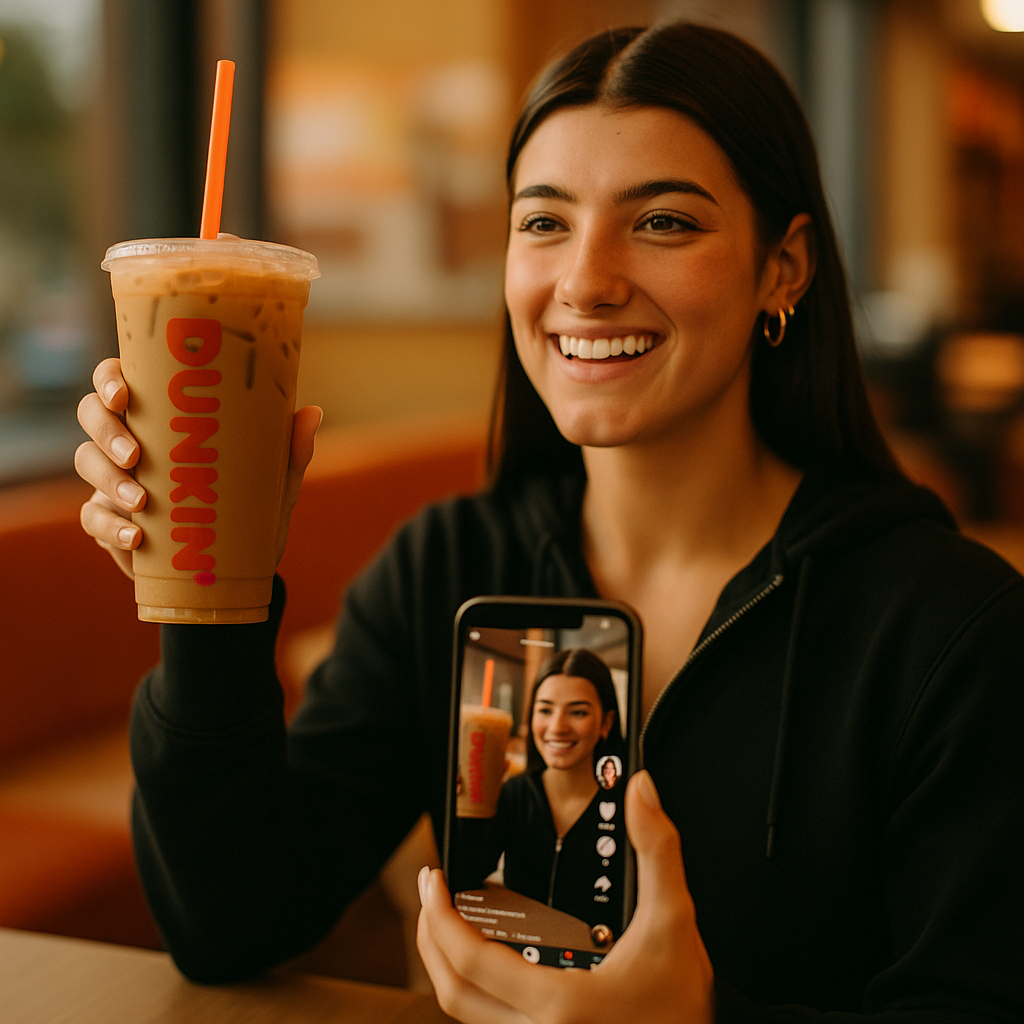
One drink. $9 million in sales estimates. A stock bump. That’s what happened when Dunkin’ put Charli D’Amelio’s name on a cold brew back in 2020. Most brands would’ve called it a win and moved on. Instead, Dunkin’ turned a single-drink stunt into a multi-year creator-commerce franchise that still shapes how the chain launches products. This case study breaks down why the partnership worked — and what it means for brands still treating influencer deals as one-off media buys.
The Launch That Broke the Playbook
In September 2020, Dunkin’ released “The Charli,” a cold brew with whole milk and three pumps of caramel swirl, named after the then-19-year-old TikTok phenomenon. The drink wasn’t just an endorsement. D’Amelio had been organically ordering Dunkin’ on camera for months, and the brand noticed the pattern before it built the campaign.
The results were immediate and, frankly, a little absurd for a menu tweak. Dunkin’ reported app downloads spiked 57% and sales of cold brew jumped 20% in the days following launch. TikTok engagement around the drink generated hundreds of millions of views. It was the kind of number that makes a CMO’s phone ring.
The Charli didn’t just move product — it proved that a creator with genuine brand affinity could outperform a celebrity endorsement deal at a fraction of the media spend.
But here’s the part most retrospectives skip: Dunkin’ didn’t treat this as a one-and-done activation. They treated it as a proof of concept for a longer commercial relationship, and that decision is the actual case study.
Why One Drink Turned Into a Franchise
Most influencer deals end after the content calendar runs out. Dunkin’ kept going, and the reasons are instructive for any brand weighing a similar bet.
- Authenticity was pre-existing, not manufactured. D’Amelio was already a Dunkin’ customer. The brand amplified real behavior instead of scripting affinity from scratch.
- The product tied to a measurable SKU. Unlike vague “brand ambassador” arrangements, The Charli had a UPC code, a price point, and trackable sales data. That made ROI conversations with finance simple.
- Dunkin’ built repeat mechanics. Follow-up drinks, holiday merch collabs, and Super Bowl commercials with D’Amelio’s family kept the relationship visible without becoming stale.
- The partnership expanded the creator’s role. D’Amelio’s family launched official Dunkin’ merch and made repeated appearances at Boston headquarters events, turning a paid placement into something closer to a co-branded identity.
This is the piece brands miss constantly: treating a viral moment as the ceiling instead of the floor. Dunkin’ used the initial spike as market research. They already knew the audience wanted more before they asked for a renewal.
The Franchise Model, Not Just a Campaign
By the time D’Amelio’s Dunkin’ relationship hit its multi-year mark, it had evolved into something closer to a licensing arrangement than a sponsored post. That distinction matters for how brands should structure creator deals going forward.
Consider the components that made it durable:
- Recurring product tie-ins. Dunkin’ didn’t rely on The Charli alone. Additional menu items, seasonal variations, and cross-promotions kept the creator relationship commercially active year-round instead of spiking once and fading.
- Merchandise extension. Branded apparel and accessories gave fans a way to participate beyond a $5 drink purchase, widening the revenue funnel.
- Cultural moment-jacking. Super Bowl ads featuring the D’Amelio family put the partnership in front of an audience far outside TikTok’s demographic, proving the creator relationship had crossover value.
- Data feedback loops. Each activation gave Dunkin’ fresh performance data — order volume, app engagement, social sentiment — that informed the next iteration rather than starting from zero.
That last point is the operational lesson brand marketers should steal. Every creator campaign should generate reusable data, not just impressions. If your influencer program can’t tell you anything about product-market fit after the fact, you’re leaving value on the table. It’s the same discipline behind how Stanley’s micro-creator waves built sustained demand for the Quencher rather than a single spike.
What This Means for Brand-Side Marketers
Not every brand has a creator with D’Amelio’s reach, and honestly, most shouldn’t try to replicate the scale. What’s replicable is the operating model.
Start by asking: is this creator already a customer? Dunkin’ didn’t discover D’Amelio through a media kit. They noticed her ordering behavior first. That’s a sourcing strategy any brand can run using social listening tools or affiliate tracking to find creators who already talk about the product unprompted. It’s the same logic behind Curology’s micro-influencer sourcing approach, which prioritized real usage over follower count.
Second, build the deal around a trackable commercial unit — a SKU, a discount code, a shoppable link — not just “content deliverables.” eMarketer has repeatedly flagged that brands struggle to prove influencer ROI precisely because campaigns lack this kind of attribution structure. Dunkin’ avoided that trap by anchoring the whole partnership to a purchasable product from day one.
If your creator partnership can’t survive a hard ROI conversation with finance, it’s a media buy dressed up as a relationship.
Third, plan the renewal before you launch. Dunkin’s marketing team reportedly had follow-up concepts ready within weeks of The Charli’s success, which is why the second and third activations felt like a continuation rather than a re-pitch. Compare that to brands that spend three months negotiating a “part two” after momentum has already died.
The Compliance Layer Brands Skip
A multi-year, high-visibility partnership like this one draws regulatory attention that a single post doesn’t. The FTC’s endorsement guidelines require clear, conspicuous disclosure any time there’s a material connection between a brand and a creator, and that obligation doesn’t fade just because the relationship has matured into something more like a co-brand.
Brands running long-term creator franchises need disclosure practices that scale across every touchpoint: TikTok captions, Super Bowl commercials, merch drops, in-app promotions. It’s not a one-time checkbox. Every new format needs its own disclosure review, especially as creators start appearing in owned channels like a brand’s app or email campaigns where audiences may not expect a paid relationship. This is the same governance challenge covered in regulatory gray zones around livestream commerce — the more integrated the creator becomes, the more disclosure complexity a brand inherits.
There’s also a contractual dimension most legal teams underweight early on. What happens if the creator’s public image shifts? Multi-year deals need morality clauses, renewal triggers tied to performance benchmarks, and clear IP terms for any co-branded merchandise. Dunkin’s arrangement reportedly evolved through renegotiated terms as the relationship grew, which suggests neither side locked into a rigid five-year contract upfront. That flexibility is worth building into your own agreements.
Measuring What Actually Matters
Vanity metrics like view count get the headlines, but Dunkin’s team was reportedly tracking harder numbers: app downloads, in-store redemption of promo codes, and same-week sales lift on the specific SKU. That’s the measurement framework brands should copy.
According to Statista, influencer marketing spend has continued climbing year over year as brands shift budget from traditional media, but the spend growth only makes sense if measurement keeps pace. A drink that sells for under $5 needs volume to justify a celebrity-tier creator fee, and Dunkin’ could only justify continued investment because they had the sales data to back the decision.
If you’re building a similar measurement stack, track:
- Unique promo code or link redemptions tied directly to the creator
- App or site traffic spikes in the 48-hour window post-launch
- Search volume lift for the branded product name
- Sentiment analysis on owned and earned social, not just impression counts
- Repeat purchase rate among customers acquired through the campaign
Tools like Sprout Social and HubSpot’s campaign attribution features can help stitch this together, but the harder part is organizational: someone on the brand side has to own the post-launch data review and actually act on it. That’s often the missing piece, not the tooling.
The Takeaway
Dunkin’ didn’t get lucky with Charli D’Amelio — they got disciplined. A viral moment became a franchise because the brand tracked hard sales data, built renewal plans before the first campaign even ended, and treated the creator as a long-term commercial partner rather than a one-time media placement.
If your influencer program can’t answer “what’s the SKU-level ROI and what’s the renewal plan,” you’re not running a partnership. You’re running a campaign that will end the moment the content calendar does.
Frequently Asked Questions
What made the Charli D’Amelio and Dunkin’ partnership different from a typical celebrity endorsement?
The relationship started organically, with D’Amelio already ordering Dunkin’ on camera before any deal existed. Dunkin’ amplified real behavior rather than manufacturing affinity, and tied the entire partnership to a trackable, purchasable product from launch.
How did Dunkin’ measure the success of The Charli drink launch?
Dunkin’ tracked app downloads, cold brew sales lift, and social engagement in the days immediately following launch. Reported figures included a 57% spike in app downloads and a 20% increase in cold brew sales, giving the brand hard data to justify further investment.
Can smaller brands replicate this creator-commerce model without a mega-influencer?
Yes. The replicable part isn’t the reach, it’s the operating model: find creators who are already genuine customers, anchor the deal to a trackable SKU or promo code, and plan renewal activations before the first campaign ends.
What compliance risks come with long-term creator partnerships like this one?
Multi-year, high-visibility partnerships require ongoing FTC disclosure compliance across every format the creator appears in, not just initial social posts. Brands also need contractual flexibility for renewal terms, morality clauses, and IP rights around any co-branded merchandise.
What metrics should brands track beyond views and engagement?
Prioritize unique promo code redemptions, SKU-level sales lift, app or site traffic spikes, branded search volume, and repeat purchase rates. These metrics tie creator activity directly to revenue, which is what sustains multi-year budget approval.
Top Influencer Marketing Agencies
The leading agencies shaping influencer marketing in 2026
Agencies ranked by campaign performance, client diversity, platform expertise, proven ROI, industry recognition, and client satisfaction. Assessed through verified case studies, reviews, and industry consultations.
Moburst

-
2

The Shelf
Boutique Beauty & Lifestyle Influencer AgencyA data-driven boutique agency specializing exclusively in beauty, wellness, and lifestyle influencer campaigns on Instagram and TikTok. Best for brands already focused on the beauty/personal care space that need curated, aesthetic-driven content.Clients: Pepsi, The Honest Company, Hims, Elf Cosmetics, Pure LeafVisit The Shelf → -
3

Audiencly
Niche Gaming & Esports Influencer AgencyA specialized agency focused exclusively on gaming and esports creators on YouTube, Twitch, and TikTok. Ideal if your campaign is 100% gaming-focused — from game launches to hardware and esports events.Clients: Epic Games, NordVPN, Ubisoft, Wargaming, Tencent GamesVisit Audiencly → -
4

Viral Nation
Global Influencer Marketing & Talent AgencyA dual talent management and marketing agency with proprietary brand safety tools and a global creator network spanning nano-influencers to celebrities across all major platforms.Clients: Meta, Activision Blizzard, Energizer, Aston Martin, WalmartVisit Viral Nation → -
5

The Influencer Marketing Factory
TikTok, Instagram & YouTube CampaignsA full-service agency with strong TikTok expertise, offering end-to-end campaign management from influencer discovery through performance reporting with a focus on platform-native content.Clients: Google, Snapchat, Universal Music, Bumble, YelpVisit TIMF → -
6

NeoReach
Enterprise Analytics & Influencer CampaignsAn enterprise-focused agency combining managed campaigns with a powerful self-service data platform for influencer search, audience analytics, and attribution modeling.Clients: Amazon, Airbnb, Netflix, Honda, The New York TimesVisit NeoReach → -
7

Ubiquitous
Creator-First Marketing PlatformA tech-driven platform combining self-service tools with managed campaign options, emphasizing speed and scalability for brands managing multiple influencer relationships.Clients: Lyft, Disney, Target, American Eagle, NetflixVisit Ubiquitous → -
8

Obviously
Scalable Enterprise Influencer CampaignsA tech-enabled agency built for high-volume campaigns, coordinating hundreds of creators simultaneously with end-to-end logistics, content rights management, and product seeding.Clients: Google, Ulta Beauty, Converse, AmazonVisit Obviously →