


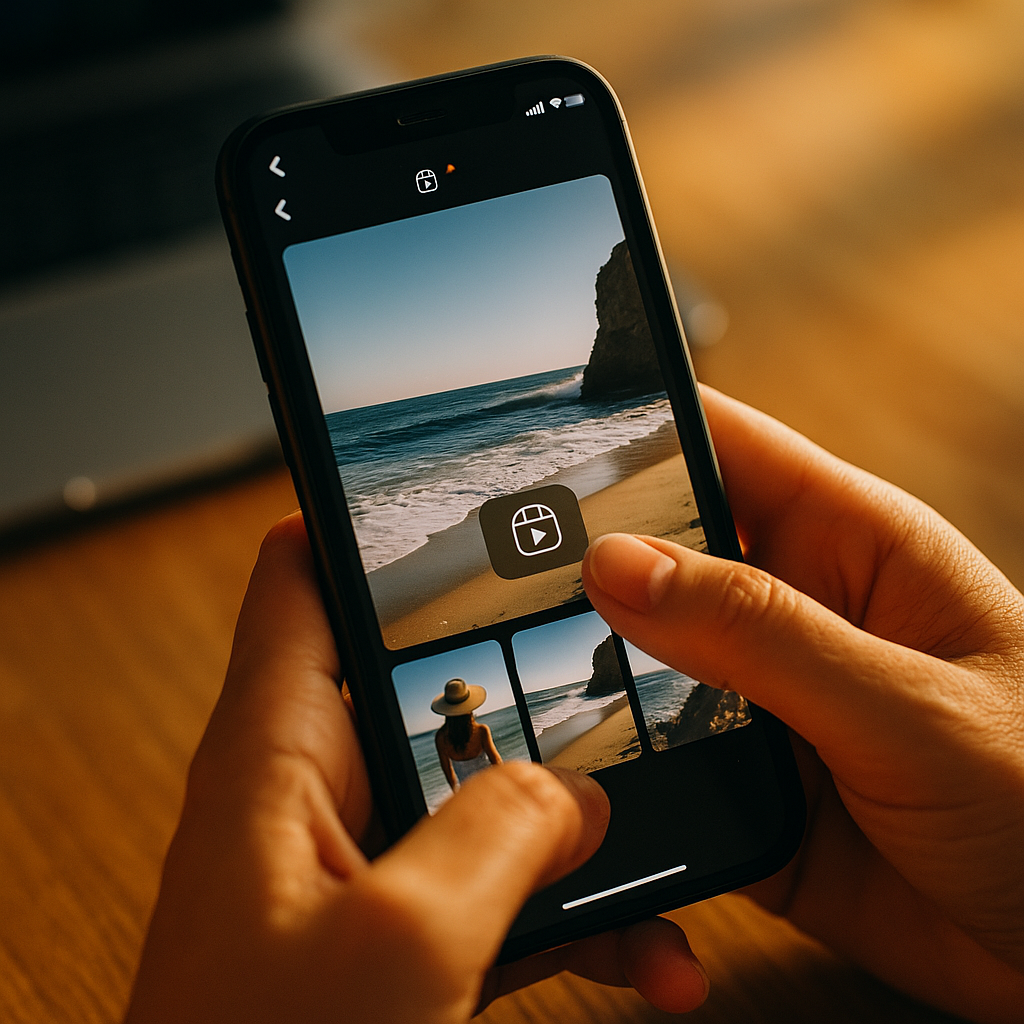
Instagram carousels get saved. Reels get distributed. If your team is still treating those as separate content strategies, you’re leaving reach on the table — Meta has said repeatedly that Reels get priority placement in recommendation surfaces, while carousels mostly serve people who already follow you. The Instagram carousel-to-reel conversion isn’t a nice-to-have anymore. It’s how lean teams stretch one idea into two distribution channels.
Why This Repurposing Gap Exists in the First Place
Most brand and creator teams build carousels because they’re cheap to produce. Canva template, some stock photography, a few bullet points, done. Reels require motion, pacing, hooks, captions timed to voiceover — more lift, more skill, more time. So teams default to carousels for education and Reels for “content that feels viral,” treating them as different content categories entirely.
That’s the mistake. The information architecture of a good educational carousel — problem, context, steps, payoff — is nearly identical to a good explainer Reel. You’re not creating new content strategy. You’re changing the delivery mechanism to match what the algorithm currently rewards.
Meta’s own creator guidance has consistently pushed Reels as the format with the widest non-follower reach, meaning your best-performing carousel is likely your most under-leveraged video asset.
What Actually Transfers From Carousel to Reel
Not every carousel deserves a second life as video. Before you greenlight a repurposing sprint, audit for three things:
- Save rate. Carousels with high saves-to-reach ratios signal “reference content” — the kind people want to revisit. That’s exactly what performs as a rewatchable Reel.
- Sequential logic. If the carousel only works because slide 3 depends on slide 2, it’ll translate cleanly to video pacing. Carousels that are just loosely related tips in a deck don’t convert well — they feel disjointed on screen.
- Evergreen relevance. Time-sensitive carousels (platform updates, trend commentary) age fast. You want source material that’ll still be useful in three months, because Reels have longer discovery tails than carousels.
Pull your top 10 carousels by saves over the last quarter. That’s your repurposing backlog. Don’t guess — check Insights.
The Framework: Slide-to-Scene Mapping
Here’s the actual mechanical process, and it’s simpler than most teams assume:
- Map each slide to a scene. A 7-slide carousel becomes a 7-beat Reel. Slide 1 (hook) becomes your first 1.5 seconds of video — arguably the most important real estate you’ll produce all week.
- Rewrite text for the ear, not the eye. Carousel copy is scannable and dense. Reel voiceover needs to sound like a person talking, with pauses and emphasis. If your slide says “73% of B2B buyers research on social before purchase,” your script says “Nearly three out of four B2B buyers are researching you on social before they ever talk to sales.”
- Add motion cues per beat. Text on screen should animate in sync with speech, not appear as a static block. Use CapCut, InShot, or Instagram’s native editor to keyframe text reveals.
- Compress your payoff. Carousels can end with a soft CTA slide. Reels need the payoff to land inside the first 80% of runtime, because completion rate is a stronger ranking signal than saves for video distribution.
- Reformat data slides as on-screen graphics, not talking-head narration. If a stat needs visual weight, keep it visual — just animate it instead of showing it as a static frame.
Hook Rewrite Is Non-Negotiable
Your carousel’s cover slide probably worked as a headline. It will not work as a video hook. Video hooks need a verbal or visual pattern interrupt within the first two seconds — a question, a bold claim, a visual surprise. “5 Mistakes Brands Make With UGC” reads fine as a slide. As a Reel opener, it needs punch: “Your UGC strategy is probably breaking FTC disclosure rules. Here’s mistake number one.”
This isn’t about being sensational. It’s about matching the cognitive speed of video versus static content. Someone can linger on a carousel cover for three seconds deciding whether to tap through. On video, they’ve already swiped past you if you don’t give them a reason to stay by second two.
Production Reality: What This Costs In Time
Teams often assume repurposing is a 15-minute job. It’s not, but it’s also not a full production cycle. Realistic benchmarks for a solo editor or small team:
- Script rewrite from existing carousel copy: 20-30 minutes
- Voiceover record (yourself or a creator via a platform like Fiverr or an in-house talent): 15 minutes
- Editing with text animation, B-roll or static visuals, captions: 45-90 minutes depending on complexity
- Caption optimization and publishing: 10 minutes
Call it 90-150 minutes per conversion. If that carousel already has proven save rates, that’s a strong time-to-ROI ratio compared to producing a Reel from scratch with no performance data to back the concept.
This is also where AI tooling is closing the gap fast. Text-to-speech tools like ElevenLabs, combined with auto-captioning in CapCut, mean the voiceover-to-caption workflow that used to take an hour can now take fifteen minutes. If your team hasn’t audited your editing stack in the last two quarters, this is a good moment to do it — the tooling landscape shifts quickly, and teams still hand-timing captions are burning hours they don’t need to.
Where the Algorithm Actually Rewards This
Instagram’s ranking systems weigh watch time, replays, shares, and — increasingly — whether a piece of content sends viewers to a creator’s profile. A well-converted educational Reel checks multiple boxes at once: it’s rewatchable (people replay to catch details), shareable (educational content gets sent in DMs more than lifestyle content), and profile-visit-inducing (viewers who found value want to see what else you’ve posted).
Compare that to the carousel version of the same content, which mostly reaches existing followers and rarely gets the same non-follower distribution. This mirrors what’s happened across other platforms — TikTok’s watch-time algorithm shift pushed brands toward similar retention-first thinking, and Instagram’s Reels ranking logic has converged toward the same principles.
According to Sprout Social’s ongoing platform benchmarking, Reels consistently outperform static formats on reach-per-follower ratios across brand accounts, even when engagement rate on the carousel was technically higher. Reach and engagement are not the same signal, and teams optimizing for the wrong one end up capping their own growth.
Measurement: What to Actually Track Post-Conversion
Don’t just compare Reel views to carousel reach — that’s an apples-to-oranges metric. Track instead:
- Completion rate on the Reel versus average for your account (this tells you if your pacing worked)
- Non-follower reach percentage compared to the original carousel’s non-follower reach
- Saves per 1,000 views, benchmarked against the original carousel’s save rate
- Profile visits attributed to the post, since this is a stronger down-funnel indicator than likes
If your Reel version underperforms the carousel on saves but dramatically outperforms on reach, that’s not a failure — that’s the format doing exactly what it’s supposed to do. Reach and depth-of-engagement often trade off, and that’s fine as long as your goal for that specific asset is top-of-funnel discovery.
Where Teams Get This Wrong
The most common failure mode isn’t bad editing — it’s treating the Reel as a lesser, rushed version of the “real” content. If your carousel took three hours to design and your Reel conversion takes fifteen minutes of screen-recording with no script, viewers notice. The algorithm notices too, indirectly, because low-effort Reels get low completion rates, and low completion rates suppress distribution.
The second failure mode: forgetting captions. A meaningful share of Instagram video is watched muted, especially in-feed on mobile. If your educational value lives entirely in voiceover with no on-screen text, you’ve just made your best content inaccessible to a huge chunk of your potential audience. Auto-captioning is table stakes now, not a bonus feature.
Third: publishing the Reel and carousel simultaneously. Give the carousel time to establish its save-rate signal first, then use that data to decide if it’s worth converting. Simultaneous publishing means you’re guessing instead of validating.
Building This Into an Ongoing Workflow
One-off conversions are fine for testing the format. But the real ROI shows up when this becomes a standing part of your content calendar — a weekly or biweekly review of top-performing carousels feeding directly into your Reel production queue. Treat your carousel library as a content mine, not a one-and-done publishing exercise.
This is the same operational logic brands are applying across other platform shifts right now — repackaging proven assets for the format the algorithm currently favors, rather than producing net-new content on a hunch. It’s less flashy than “going viral,” but it’s a far more defensible use of a limited production budget, and it’s the kind of workflow that survives the next algorithm update instead of getting rebuilt from scratch every time.
For teams managing this across multiple brand accounts or client rosters, build a simple scoring rubric — saves, sequential logic, evergreen value — into your monthly reporting cadence so repurposing candidates surface automatically instead of relying on someone remembering which carousel did well four months ago.
FAQs
How do I know which carousel to convert first?
Start with your highest save-rate carousels from the past 90 days. Save rate signals reference value, which tends to translate well into rewatchable video. Avoid converting carousels with low saves just because they had high likes — likes are a weaker predictor of Reel performance.
Does the original carousel need to stay published after I convert it to a Reel?
Yes. Keep both live. They serve different discovery paths — the carousel continues collecting saves from followers and profile visitors, while the Reel handles broader, non-follower discovery. Removing one doesn’t help the other.
How long should the converted Reel be?
Match runtime to content density, not a fixed rule. Most educational carousel conversions land well between 30 and 60 seconds. Anything shorter risks cutting the payoff; anything longer needs genuinely strong pacing to hold completion rate.
Do I need a human voiceover, or can I use AI narration?
AI voiceover tools have improved enough that many brand accounts use them successfully, especially for high-volume repurposing. Test both and compare completion rates — some audiences respond better to a recognizable human voice, particularly for trust-driven B2B or financial content.
What’s a realistic timeline to see if this repurposing strategy is working?
Give it a full production cycle of 8-10 conversions, roughly four to six weeks at a biweekly cadence, before judging results. Algorithmic distribution needs enough data points per post and enough posts overall to separate signal from noise.
Visible FAQ (HTML)
FAQs
How do I know which carousel to convert first?
Start with your highest save-rate carousels from the past 90 days. Save rate signals reference value, which tends to translate well into rewatchable video. Avoid converting carousels with low saves just because they had high likes — likes are a weaker predictor of Reel performance.
Does the original carousel need to stay published after I convert it to a Reel?
Yes. Keep both live. They serve different discovery paths — the carousel continues collecting saves from followers and profile visitors, while the Reel handles broader, non-follower discovery. Removing one doesn’t help the other.
How long should the converted Reel be?
Match runtime to content density, not a fixed rule. Most educational carousel conversions land well between 30 and 60 seconds. Anything shorter risks cutting the payoff; anything longer needs genuinely strong pacing to hold completion rate.
Do I need a human voiceover, or can I use AI narration?
AI voiceover tools have improved enough that many brand accounts use them successfully, especially for high-volume repurposing. Test both and compare completion rates — some audiences respond better to a recognizable human voice, particularly for trust-driven B2B or financial content.
What’s a realistic timeline to see if this repurposing strategy is working?
Give it a full production cycle of 8-10 conversions, roughly four to six weeks at a biweekly cadence, before judging results. Algorithmic distribution needs enough data points per post and enough posts overall to separate signal from noise.
Pull your top five carousels by save rate this week, run them through the slide-to-scene mapping framework above, and publish the first conversion within 48 hours — momentum matters more than perfection here. For more on how platform algorithm shifts are forcing brands to rethink content formats, see how TikTok’s Andromeda update is reshaping brief structures on that platform too.
Top Influencer Marketing Agencies
The leading agencies shaping influencer marketing in 2026
Agencies ranked by campaign performance, client diversity, platform expertise, proven ROI, industry recognition, and client satisfaction. Assessed through verified case studies, reviews, and industry consultations.
Moburst

-
2

The Shelf
Boutique Beauty & Lifestyle Influencer AgencyA data-driven boutique agency specializing exclusively in beauty, wellness, and lifestyle influencer campaigns on Instagram and TikTok. Best for brands already focused on the beauty/personal care space that need curated, aesthetic-driven content.Clients: Pepsi, The Honest Company, Hims, Elf Cosmetics, Pure LeafVisit The Shelf → -
3

Audiencly
Niche Gaming & Esports Influencer AgencyA specialized agency focused exclusively on gaming and esports creators on YouTube, Twitch, and TikTok. Ideal if your campaign is 100% gaming-focused — from game launches to hardware and esports events.Clients: Epic Games, NordVPN, Ubisoft, Wargaming, Tencent GamesVisit Audiencly → -
4

Viral Nation
Global Influencer Marketing & Talent AgencyA dual talent management and marketing agency with proprietary brand safety tools and a global creator network spanning nano-influencers to celebrities across all major platforms.Clients: Meta, Activision Blizzard, Energizer, Aston Martin, WalmartVisit Viral Nation → -
5

The Influencer Marketing Factory
TikTok, Instagram & YouTube CampaignsA full-service agency with strong TikTok expertise, offering end-to-end campaign management from influencer discovery through performance reporting with a focus on platform-native content.Clients: Google, Snapchat, Universal Music, Bumble, YelpVisit TIMF → -
6

NeoReach
Enterprise Analytics & Influencer CampaignsAn enterprise-focused agency combining managed campaigns with a powerful self-service data platform for influencer search, audience analytics, and attribution modeling.Clients: Amazon, Airbnb, Netflix, Honda, The New York TimesVisit NeoReach → -
7

Ubiquitous
Creator-First Marketing PlatformA tech-driven platform combining self-service tools with managed campaign options, emphasizing speed and scalability for brands managing multiple influencer relationships.Clients: Lyft, Disney, Target, American Eagle, NetflixVisit Ubiquitous → -
8

Obviously
Scalable Enterprise Influencer CampaignsA tech-enabled agency built for high-volume campaigns, coordinating hundreds of creators simultaneously with end-to-end logistics, content rights management, and product seeding.Clients: Google, Ulta Beauty, Converse, AmazonVisit Obviously →