


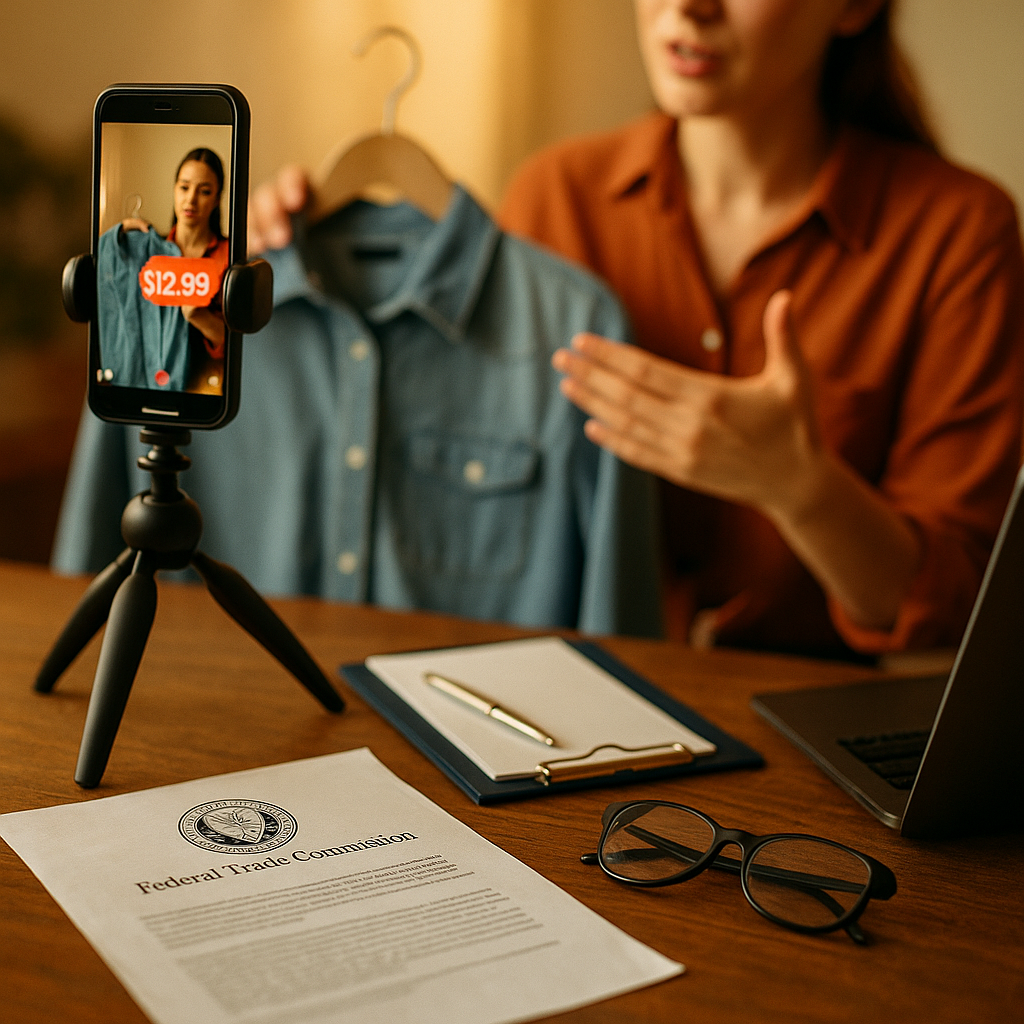
Livestream shopping generated more than $32 billion in US sales last year, and regulators noticed. The FTC has made undisclosed price claims and fake countdown timers a top enforcement priority. If your brand runs livestream commerce and can’t document every “limited time” claim, you’re one complaint away from a consent decree.
This isn’t a hypothetical risk anymore. The FTC’s 2023 Rule on Deceptive or Unfair Fees and its ongoing “dark patterns” enforcement sweep have both been cited in cases involving livestream shopping events. Brands running flash sales on TikTok Shop, Amazon Live, or Whatnot need a compliance playbook, not a hope-for-the-best attitude.
Why Livestream Pricing Claims Draw Extra Scrutiny
Livestream is different from a static product page. Prices flash, hosts talk fast, and viewers can’t screenshot terms before checkout closes. That format is exactly what makes it appealing to marketers and exactly what makes regulators suspicious.
The FTC’s Section 5 authority prohibits “unfair or deceptive acts or practices.” A price claim becomes deceptive when it misleads a reasonable consumer in a way that affects their purchasing decision. In livestream contexts, that typically shows up as three problems:
- Claiming a “was $80, now $40” discount when the item never sold at $80
- Displaying countdown timers that reset or don’t actually expire the deal
- Verbal urgency claims (“only 3 left!”) with no inventory data backing them up
None of these require intent to deceive. The FTC evaluates the net impression on an average viewer, not what the brand meant to communicate. That’s a much lower bar for enforcement than most marketing teams assume.
A discount claim without a verifiable reference price isn’t a marketing tactic — it’s a liability sitting on your balance sheet.
What Counts as a “Reference Price” Violation
The FTC has long required that “was” prices reflect a genuine, recent selling price, not an inflated number invented to make a markdown look bigger. This guidance predates livestream commerce but applies directly to it.
Here’s the practical test: if a product sold at $80 for a meaningful period (the FTC has historically looked at whether it was the prevailing price for a reasonably substantial period of time) and now sells at $40, that’s a legitimate claim. If the item was introduced at $80 for three days just to create a inflated anchor before the “real” livestream price of $40, that’s manufactured deception.
Brands running frequent livestream events sometimes lose track of actual price history across SKUs. Multiply that across dozens of creators and hundreds of SKUs, and you get a documentation nightmare. This is the same underlying failure mode covered in our retail readiness checklist for personalized pricing — the root issue is always incomplete pricing records, not bad intent.
Practical fix: maintain a centralized pricing ledger per SKU that logs every price change, the date it took effect, and the duration it was live. If your livestream host claims a discount, that ledger should be able to substantiate it within minutes, not days.
Countdown Timers: The Enforcement Flashpoint
Fake urgency is the single most litigated dark pattern in livestream and e-commerce broadly. The FTC’s enforcement actions on dark patterns have repeatedly flagged countdown clocks that reset after expiration, or that run independently of actual inventory or offer status.
If your livestream software shows “Sale ends in 04:59” and that clock resets for the next viewer who logs in, you have a textbook deceptive urgency claim. It doesn’t matter that the underlying platform vendor built the feature. Brands are responsible for how their offers are presented, regardless of whose countdown widget they’re using.
We’ve covered the mechanics of this in detail in our breakdown of livestream countdown timers and deceptive scarcity risk, and the escalation steps brands should take are laid out in our countdown escalation protocol. The short version: if a timer can’t be tied to a real, enforced deadline, pull it or fix it before your next stream.
“Only 3 Left” Claims Need Real Inventory Data
Verbal scarcity claims are harder to screenshot than a visual timer, which is part of why hosts default to them. “We’re almost out, guys” rolls off the tongue easily during a live show. But if that claim isn’t tied to real-time inventory numbers, it’s the same violation as a fake timer, just spoken instead of displayed.
Brands should require hosts to reference a live inventory dashboard, not their gut feeling or a script written before the stream started. Some livestream commerce platforms now support real-time stock counters that sync directly to host displays. If your platform doesn’t offer this, that’s a vendor selection problem worth solving before your next campaign cycle, not after a complaint lands.
Building a Compliance Layer Without Killing Conversion
Marketing teams often assume compliance and conversion are at odds. They’re not, at least not as much as people fear. Genuine scarcity converts fine. Consumers respond to real urgency; the psychological trigger doesn’t require deception to work.
Here’s a practical operating model for livestream teams:
- Pre-stream pricing audit. Every SKU featured in a livestream event should have its pricing history verified 24-48 hours before the show, not during it.
- Host script review. Any script referencing “was/now” pricing or urgency language gets a compliance sign-off before the stream airs. Improvised claims during live Q&A are the riskiest moment, so brief hosts explicitly on what they cannot say.
- Real inventory sync. Countdown timers and stock counters need to be tied to backend inventory systems, not static creative assets.
- Post-stream archive. Record every livestream in full and retain it for at least the FTC’s typical lookback window. If a complaint surfaces months later, you need the raw footage, not a summary.
- Creator contract language. Contracts with livestream hosts should include explicit compliance clauses obligating them to follow approved scripts on pricing and urgency claims. If a host improvises a discount claim, your brand is still on the hook, so the contract needs teeth.
This structure mirrors what we recommended in our analysis of script editing and material connection risk — the throughline across most FTC creator-economy enforcement is documentation gaps, not malicious brands.
Where This Intersects With Broader FTC Priorities
Livestream urgency claims don’t exist in isolation. They sit alongside a broader FTC push against dark patterns in checkout flows, subscription cancellations, and personalized pricing. If your brand has already built compliance infrastructure around the personalized pricing compliance checklist or the data-use disclosure template for surveillance pricing, extending that same rigor to livestream urgency claims is a relatively small lift.
The commonality across all these enforcement areas is the FTC’s “reasonable consumer” standard. Regulators aren’t asking whether your legal team understood the fine print. They’re asking whether an average shopper, watching a livestream in real time with no ability to pause and research, would be misled.
If your compliance review only happens after the stream airs, you’re auditing a liability that already shipped. The review has to happen before the “go live” button, not after.
Third-party research backs up why this matters for brand trust, not just legal exposure. Sprout Social’s consumer trust research consistently shows that perceived manipulation tactics erode brand loyalty faster than almost any other trust violation, including price increases themselves. Consumers forgive higher prices. They don’t forgive feeling tricked.
What Documentation Should Look Like
If regulators ever request records, here’s the minimum documentation set that protects a brand:
- Pricing history logs for every SKU featured in livestream events, with timestamps
- Approved host scripts with compliance sign-off dates
- Full video archives of every livestream event, indexed by date and platform
- Inventory system logs showing real-time stock levels during the stream
- Creator contracts with explicit pricing and urgency disclosure clauses
Brands that can produce this documentation within 48 hours of a regulatory inquiry are in a fundamentally different position than brands scrambling to reconstruct records after the fact. This is the same lesson from other recent enforcement waves we’ve tracked, including the compliance gaps exposed in Meta’s settlement checklist for brand legal teams.
Next Step
Audit your last three livestream events this week: pull the pricing history, the countdown timer logs, and the host scripts, and check whether any of them would survive a direct FTC inquiry. If you can’t produce that documentation in under an hour, that’s your actual risk score, not your legal team’s best guess.
FAQs
What makes a livestream price claim deceptive under FTC rules?
A price claim is deceptive if it misleads a reasonable consumer about the actual discount, availability, or urgency of an offer, regardless of intent. Common violations include fake “was” prices that were never the real selling price and countdown timers that don’t reflect an actual expiring deadline.
Do verbal urgency claims during a livestream carry the same risk as visual countdown timers?
Yes. The FTC evaluates the overall impression left on viewers, whether that impression comes from on-screen graphics or a host’s spoken claims. “Only a few left” statements need real inventory data behind them just like any displayed countdown clock.
Who is liable if a creator improvises a false urgency claim during a live stream?
Brands generally remain responsible for claims made during sponsored livestream events, even if a creator deviates from an approved script. This is why contracts need explicit compliance clauses and why scripts should be reviewed before the stream airs.
How long should brands retain livestream recordings for compliance purposes?
Most compliance teams retain full recordings for at least the FTC’s typical enforcement lookback window, generally several years, though brands facing prior complaints may want to retain records longer. Check with legal counsel on retention schedules specific to your risk profile.
Can real scarcity claims still be effective without triggering FTC scrutiny?
Yes. Genuine urgency, backed by real inventory counts and real time-limited offers, is not a violation. The risk only arises when scarcity is fabricated or when timers and stock counts don’t reflect actual conditions.
Top Influencer Marketing Agencies
The leading agencies shaping influencer marketing in 2026
Agencies ranked by campaign performance, client diversity, platform expertise, proven ROI, industry recognition, and client satisfaction. Assessed through verified case studies, reviews, and industry consultations.
Moburst

-
2

The Shelf
Boutique Beauty & Lifestyle Influencer AgencyA data-driven boutique agency specializing exclusively in beauty, wellness, and lifestyle influencer campaigns on Instagram and TikTok. Best for brands already focused on the beauty/personal care space that need curated, aesthetic-driven content.Clients: Pepsi, The Honest Company, Hims, Elf Cosmetics, Pure LeafVisit The Shelf → -
3

Audiencly
Niche Gaming & Esports Influencer AgencyA specialized agency focused exclusively on gaming and esports creators on YouTube, Twitch, and TikTok. Ideal if your campaign is 100% gaming-focused — from game launches to hardware and esports events.Clients: Epic Games, NordVPN, Ubisoft, Wargaming, Tencent GamesVisit Audiencly → -
4

Viral Nation
Global Influencer Marketing & Talent AgencyA dual talent management and marketing agency with proprietary brand safety tools and a global creator network spanning nano-influencers to celebrities across all major platforms.Clients: Meta, Activision Blizzard, Energizer, Aston Martin, WalmartVisit Viral Nation → -
5

The Influencer Marketing Factory
TikTok, Instagram & YouTube CampaignsA full-service agency with strong TikTok expertise, offering end-to-end campaign management from influencer discovery through performance reporting with a focus on platform-native content.Clients: Google, Snapchat, Universal Music, Bumble, YelpVisit TIMF → -
6

NeoReach
Enterprise Analytics & Influencer CampaignsAn enterprise-focused agency combining managed campaigns with a powerful self-service data platform for influencer search, audience analytics, and attribution modeling.Clients: Amazon, Airbnb, Netflix, Honda, The New York TimesVisit NeoReach → -
7

Ubiquitous
Creator-First Marketing PlatformA tech-driven platform combining self-service tools with managed campaign options, emphasizing speed and scalability for brands managing multiple influencer relationships.Clients: Lyft, Disney, Target, American Eagle, NetflixVisit Ubiquitous → -
8

Obviously
Scalable Enterprise Influencer CampaignsA tech-enabled agency built for high-volume campaigns, coordinating hundreds of creators simultaneously with end-to-end logistics, content rights management, and product seeding.Clients: Google, Ulta Beauty, Converse, AmazonVisit Obviously →