


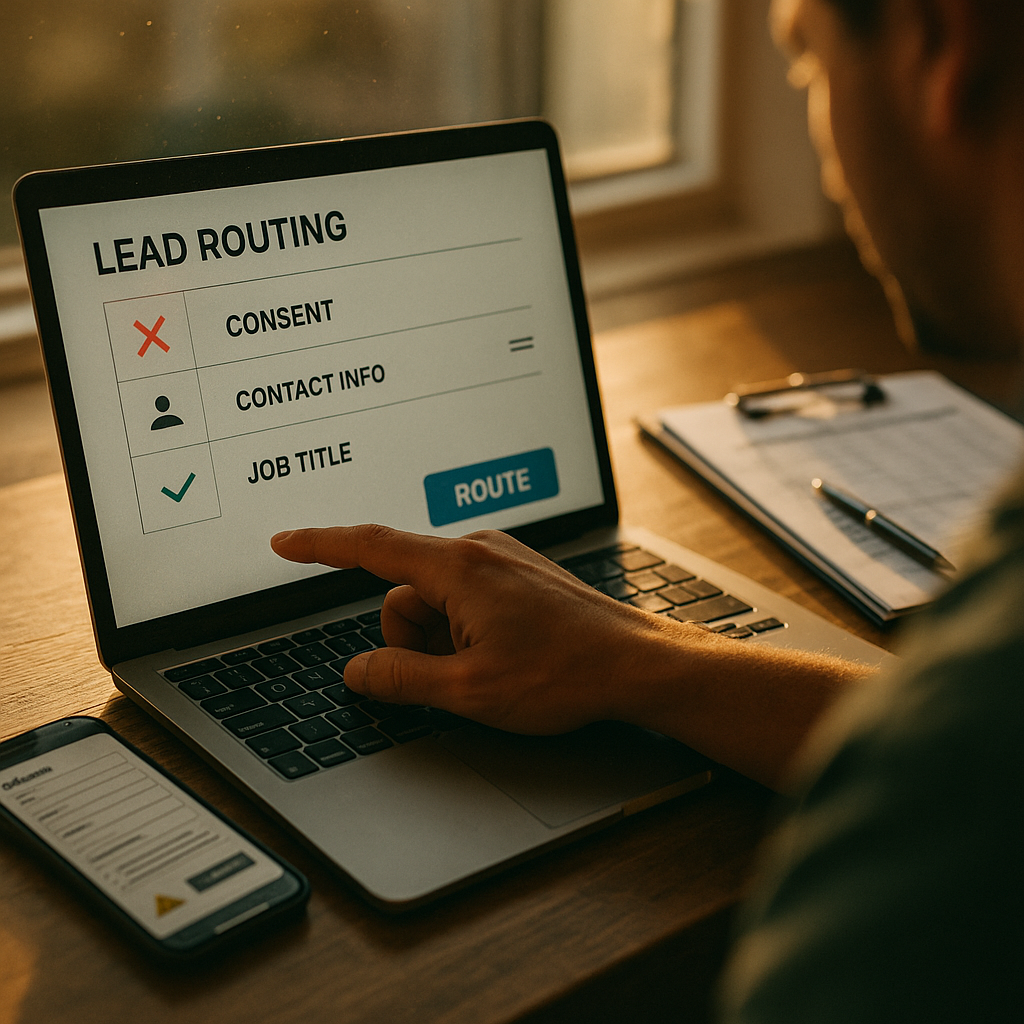
Roughly 40% of B2B leads sitting in your CRM right now would fail a basic consent audit. That’s not a scare number pulled from nowhere — it’s the rough average marketing ops teams report when they finally run a consent-and-data-quality layer against historical lead data. If your demand-gen platform isn’t checking consent status, field validity, and duplication risk before a lead ever touches your CRM, you’re not generating pipeline. You’re generating liability with a conversion rate attached.
Why “Just Route It to Sales” Stopped Working
For years, the demand-gen playbook was simple: capture a form fill, enrich it, push it to the CRM, let sales sort it out. That model is dead, or at least it should be. Between GDPR enforcement actions, California’s evolving privacy rules, and the sheer operational cost of bad data, routing unvetted leads straight into Salesforce or HubSpot is now a compliance and revenue problem rolled into one.
Sales teams have caught on too. Nothing kills rep morale faster than a queue full of duplicate records, fake work emails, and contacts who never actually opted in. Reps stop trusting MQLs. Marketing gets blamed for “bad leads.” Meanwhile the real issue was never lead quality in the abstract — it was the absence of a rules layer sitting between capture and CRM.
A lead that violates consent requirements isn’t a low-quality lead. It’s a liability disguised as pipeline.
What the Consent Layer Actually Checks
Think of the consent-and-data-quality layer as a bouncer standing at the CRM door. It doesn’t care how good the lead “feels.” It checks credentials against a fixed list before letting anyone through. Modern platforms — Marketo, HubSpot, Pardot successors, and newer entrants like Clay or Warmly — are increasingly building this as a native gate rather than a bolt-on afterthought.
- Explicit consent capture: Was there a clear, unbundled opt-in for marketing communications, distinct from terms-of-service acceptance?
- Legal basis documentation: Under GDPR, is the lawful basis (consent, legitimate interest, contract) recorded and timestamped?
- Source and channel tagging: Did this lead come from a paid form, a co-marketing partner, a scraped list, or an event badge scan? Each carries different consent obligations.
- Data freshness thresholds: Consent given eighteen months ago for a webinar may not cover today’s outbound sequence.
- Field-level validation: Real email domain, valid phone format, business email vs. free consumer domain flags.
- Duplicate and identity match: Is this actually a new lead, or the same contact re-entering through a different channel?
Miss any one of these and the lead either gets rejected, quarantined for review, or routed with a compliance flag that sales can see. That flag matters — it tells a rep whether they’re clear to call or should stick to email with an unsubscribe link front and center.
The Regulatory Backdrop Nobody Can Ignore
The FTC has become considerably more active around data broker practices and dark patterns in consent collection. Meanwhile the ICO in the UK continues to publish guidance tightening what counts as “freely given” consent under GDPR. State-level laws in the US (Virginia, Colorado, Connecticut) are converging on similar requirements: opt-in clarity, purpose limitation, and the right to know what data you’re holding.
None of this is theoretical for demand-gen teams. A single enforcement action or a viral LinkedIn post about a company “spamming” someone who never opted in can undo months of brand trust work. That’s a bigger cost than a soft lead count for the quarter.
Data Quality Is the Other Half of the Gate
Consent gets the headlines, but data quality is where most CRMs quietly rot. Duplicate records, mismatched company domains, and stale job titles create false attribution and inflate pipeline numbers that never materialize into revenue. This is the same problem explored in deduplication accuracy research — a claimed 78% dedup rate sounds impressive until you ask what happens to the other 22%, and whether those records are quietly poisoning your attribution models.
Identity resolution has become the unsung hero of this whole layer. Before a lead routes anywhere, the platform needs to answer a deceptively hard question: is this the same person or account we’ve already seen? Get that wrong and you either flood sales with duplicates or, worse, suppress a genuinely new opportunity because the matching logic was too aggressive. Frameworks for evaluating identity resolution vendors now go well beyond raw match-rate percentages, looking instead at false-positive rates and how vendors handle partial-match scenarios.
Where CDPs and CRMs Disagree
One underrated friction point: your CDP and your CRM often define “the same person” differently. A CDP might unify based on device and behavioral signals; a CRM cares about email and account hierarchy. When these two systems don’t share a consistent identity graph, the consent-and-quality rules layer has to reconcile them before routing — otherwise you get consent recorded on one record while a duplicate, un-consented record sails through untouched. Vendors like FirstHive have tried to close this gap with purpose-built matching logic, which is worth comparing against generic CDP approaches in this matching comparison.
Building the Rules Layer: A Practical Checklist
You don’t need a six-month engineering project to stand this up. Most modern MAPs and CDPs support rules-based routing natively, or through a middleware layer. Here’s the sequence that tends to work:
- Audit your current lead sources. List every form, integration, list import, and partner feed. Each needs its own consent mapping.
- Define your rejection and quarantine logic. Not every failed check should kill the lead — some should route to a manual review queue instead.
- Tag consent basis at the point of capture, not retroactively. Retrofitting consent metadata onto historical records is painful and often legally shaky.
- Set freshness expiration rules. Decide how long consent remains valid per channel and jurisdiction.
- Run deduplication before enrichment, not after. Enriching a duplicate just doubles your bad data with better metadata attached.
- Give sales visibility into the flags. A rejected or quarantined lead shouldn’t just vanish — reps and RevOps need a shared view of why.
Platforms increasingly ship this as configurable logic rather than custom code. If you’re evaluating vendors, ask directly: “Show me how a lead with expired consent gets handled end to end.” If the answer is vague, that’s your signal to keep shopping.
If your vendor can’t demonstrate what happens to a non-compliant lead in a live demo, assume the answer is: it goes to CRM anyway.
The CRM Pipeline Architecture Question
None of this matters if the pipe connecting your MAP to your CRM is architected for batch syncs and overnight jobs. Consent status can change in real time — someone unsubscribes, someone submits a data deletion request — and if your CRM-to-ad pipeline architecture only updates nightly, you risk running ad retargeting or email sequences against a contact who withdrew consent hours earlier. Real-time or near-real-time sync isn’t a nice-to-have anymore; it’s the difference between defensible compliance and a documented violation.
The same real-time principle applies to attribution. If leads route into CRM with inconsistent consent metadata, your attribution models inherit that noise. Teams working through attribution against messy CRM data consistently find that a large share of “unattributed” pipeline actually traces back to consent-flag gaps breaking the join between marketing touch and CRM record.
What This Means for Vendor Selection
When evaluating any new platform in this stack — a MAP, a CDP, an identity resolution tool — ask three questions before you sign anything:
- Does the platform enforce consent rules at ingestion, or only report on violations after the fact?
- Can quarantine and rejection logic be customized per region without custom development?
- How does the vendor handle the intersection of deduplication and consent — do merged records inherit the most restrictive consent status, or the most permissive one?
That last question trips up more vendors than you’d expect. The safe, legally defensible answer is always “most restrictive.” If a vendor’s default is “most permissive,” treat that as a red flag worth escalating to legal before procurement signs off. For a broader vetting framework, the approach outlined in CRM data monitoring vendor evaluation applies directly here.
The Cost of Getting This Wrong
Bad data doesn’t just cost you compliance risk. HubSpot’s own research on data hygiene has repeatedly flagged the compounding cost of dirty CRM records — wasted rep hours, skewed forecasting, and eroded trust between marketing and sales. eMarketer data on B2B lead quality trends consistently shows that the gap between MQL volume and sales-accepted leads is often a data quality problem wearing a “lead quality” costume.
Run the math on your own funnel. If 15% of routed leads are duplicates or consent-invalid, and your average rep spends even five minutes triaging each one, that’s a measurable tax on selling time — before you even factor in the regulatory exposure of contacting someone without valid consent.
Where This Is Headed
Expect the rules layer to keep absorbing more responsibility: real-time consent verification against source-of-truth registries, AI-assisted anomaly detection for suspicious lead patterns (bot fills, list-stuffing), and tighter integration with identity resolution so consent status travels with the unified profile rather than living on a single channel record. The platforms that treat this as a core architecture decision — not a compliance checkbox — will be the ones marketing ops trusts with real budget next cycle.
Next step: Pull last quarter’s routed leads and run them against just two checks — documented consent basis and duplicate match rate. Whatever percentage fails, that’s your current risk exposure, and it’s the number that should drive your next platform evaluation.
FAQs
What is a consent-and-data-quality rules layer in demand-gen platforms?
It’s a set of automated checks — covering consent basis, data validity, and duplicate detection — that a lead must pass before being routed from a marketing automation platform into the CRM. It acts as a gate rather than a post-hoc report.
Why can’t leads just be cleaned up after they reach the CRM?
By the time a lead is in the CRM, sales may have already acted on it — calling, emailing, or adding it to a sequence. If consent was invalid or the record was a duplicate, that action itself can create compliance exposure and wastes sales time. Gating before routing prevents the problem rather than remediating it.
How does consent expiration work in practice?
Consent isn’t permanent. Most compliant frameworks set freshness thresholds — for example, consent from a webinar registration older than 12–18 months may no longer justify active outreach. Platforms should flag or requalify aging consent rather than treating it as evergreen.
Does GDPR require this level of automation?
GDPR doesn’t mandate specific software, but it does require documented lawful basis, purpose limitation, and the ability to honor deletion and withdrawal requests promptly. Automating the rules layer is the practical way to meet those obligations at scale; manual review doesn’t hold up once lead volume grows.
What happens to leads that fail the rules layer?
Well-designed systems don’t just discard failed leads. They route them to a quarantine queue for manual review, flag them for sales visibility, or trigger a re-consent request depending on the failure type. The goal is transparency, not silent deletion or silent pass-through.
How does this connect to attribution accuracy?
Inconsistent consent metadata and unresolved duplicates break the join between marketing touchpoints and CRM records, which directly corrupts attribution modeling. Cleaning up the rules layer upstream tends to improve attribution accuracy downstream, since fewer records carry conflicting or fragmented identity data.
Top Influencer Marketing Agencies
The leading agencies shaping influencer marketing in 2026
Agencies ranked by campaign performance, client diversity, platform expertise, proven ROI, industry recognition, and client satisfaction. Assessed through verified case studies, reviews, and industry consultations.
Moburst

-
2

The Shelf
Boutique Beauty & Lifestyle Influencer AgencyA data-driven boutique agency specializing exclusively in beauty, wellness, and lifestyle influencer campaigns on Instagram and TikTok. Best for brands already focused on the beauty/personal care space that need curated, aesthetic-driven content.Clients: Pepsi, The Honest Company, Hims, Elf Cosmetics, Pure LeafVisit The Shelf → -
3

Audiencly
Niche Gaming & Esports Influencer AgencyA specialized agency focused exclusively on gaming and esports creators on YouTube, Twitch, and TikTok. Ideal if your campaign is 100% gaming-focused — from game launches to hardware and esports events.Clients: Epic Games, NordVPN, Ubisoft, Wargaming, Tencent GamesVisit Audiencly → -
4

Viral Nation
Global Influencer Marketing & Talent AgencyA dual talent management and marketing agency with proprietary brand safety tools and a global creator network spanning nano-influencers to celebrities across all major platforms.Clients: Meta, Activision Blizzard, Energizer, Aston Martin, WalmartVisit Viral Nation → -
5

The Influencer Marketing Factory
TikTok, Instagram & YouTube CampaignsA full-service agency with strong TikTok expertise, offering end-to-end campaign management from influencer discovery through performance reporting with a focus on platform-native content.Clients: Google, Snapchat, Universal Music, Bumble, YelpVisit TIMF → -
6

NeoReach
Enterprise Analytics & Influencer CampaignsAn enterprise-focused agency combining managed campaigns with a powerful self-service data platform for influencer search, audience analytics, and attribution modeling.Clients: Amazon, Airbnb, Netflix, Honda, The New York TimesVisit NeoReach → -
7

Ubiquitous
Creator-First Marketing PlatformA tech-driven platform combining self-service tools with managed campaign options, emphasizing speed and scalability for brands managing multiple influencer relationships.Clients: Lyft, Disney, Target, American Eagle, NetflixVisit Ubiquitous → -
8

Obviously
Scalable Enterprise Influencer CampaignsA tech-enabled agency built for high-volume campaigns, coordinating hundreds of creators simultaneously with end-to-end logistics, content rights management, and product seeding.Clients: Google, Ulta Beauty, Converse, AmazonVisit Obviously →