


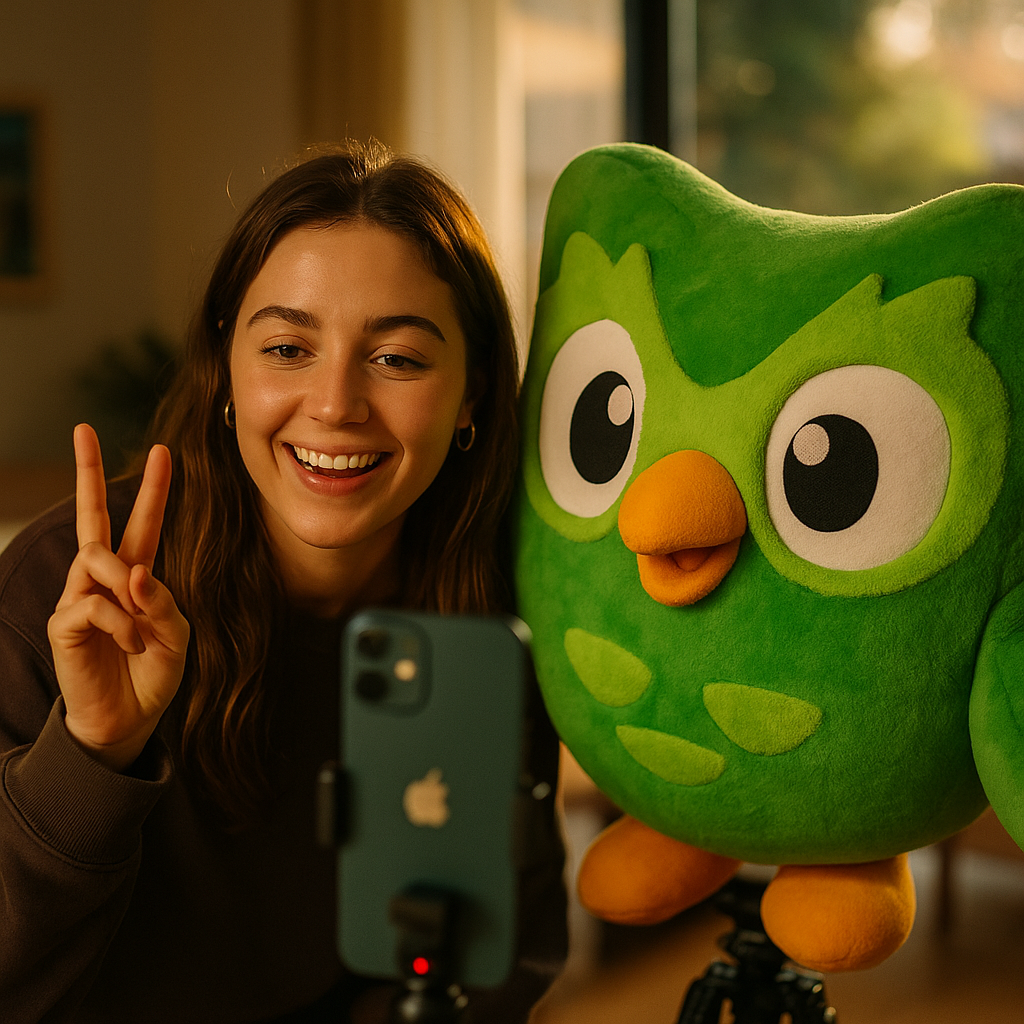
Duolingo has 15 million TikTok followers and, by most estimates, spends close to nothing on paid social to get there. No influencer retainers, no six-figure brand deals, no media buy propping up the numbers. Just a mascot in a bird costume and a rotating cast of micro-creators who show up because they want to, not because they’re invoiced. How does a language-learning app out-market brands with ten times its budget? The Duolingo TikTok presence is the answer, and it’s less about luck than a deliberately unglamorous system.
The Owl Did the Heavy Lifting, But Not Alone
Everyone remembers Duo the Owl chasing interns, crashing weddings, and threatening users who skip their lessons. That’s the part of the strategy that gets written up in marketing newsletters. But the mascot bit only works because Duolingo built an entire ecosystem around it instead of treating it as a one-off gimmick.
The owl gives the brand a recognizable character with zero licensing friction. Duolingo owns Duo outright, so there’s no negotiating usage rights, no creative approval bottleneck with an outside agency. That ownership is what lets the brand hand the mascot off to micro-creators and employees alike without legal review turning into a six-week slog.
Duolingo’s real innovation wasn’t the owl costume. It was building a content system where a mascot and unpaid micro-creators could co-exist and reinforce each other without a media budget holding it together.
Why Micro-Creators Instead of Macro Deals?
Duolingo could easily afford to book creators with millions of followers. It doesn’t, at least not as the backbone of its TikTok strategy. Instead, the brand leans on smaller creators, often people already making language-learning, comedy, or lifestyle content, and gives them room to riff on the Duo character or the brand’s absurdist tone without a rigid script.
This isn’t charity. It’s math. Micro-creators (generally defined as accounts in the 10,000 to 100,000 follower range) tend to post more frequently, engage more authentically with comments, and cost a fraction of what a macro deal runs. eMarketer research has repeatedly shown that engagement rates decline as follower count climbs, which means a swarm of smaller creators can out-perform a single celebrity post on cost-per-engagement.
- Lower cost per collaboration means more shots on goal.
- Authentic tone matches TikTok’s native, unpolished aesthetic.
- Faster turnaround since micro-creators aren’t juggling agency layers.
- Built-in trend fluency, since these accounts live on the platform daily.
Compare this to the approach detailed in Stanley’s micro-creator waves, where volume and repetition, not celebrity reach, built sustained demand. Duolingo is running a similar playbook, just applied to brand awareness instead of a single product drop.
No Paid Spend? Here’s What That Actually Means
“No paid spend” doesn’t mean zero cost. It means Duolingo isn’t running TikTok ad campaigns or paying for reach the way a traditional brand would through TikTok’s ad platform. The company still invests in a social team, a mascot costume budget (yes, that’s a real line item), and occasional gifting or light compensation for creators who collaborate on bits.
What it skips is the media buy. There’s no boosted post budget inflating view counts. The content either earns reach organically through TikTok’s recommendation algorithm, or it doesn’t get seen. That constraint forces discipline. Every video has to be genuinely entertaining enough to earn watch time, because there’s no ad spend to compensate for a weak hook.
This is a meaningfully different model from brands that treat TikTok watch time as something to be bought rather than earned. Duolingo’s team writes for the algorithm’s actual signals: completion rate, rewatches, shares, not impressions purchased upfront.
The Content Repurposing Engine Behind the Scenes
What’s less visible than the owl memes is the operational machinery that keeps this running for years without burning out the team. Duolingo doesn’t create from scratch for every platform. A single piece of content, say, a bit involving the owl reacting to a trending audio, gets reshaped for TikTok, Instagram Reels, and YouTube Shorts with minor edits rather than full reshoots.
Influencers Time covered this system in detail in a piece on Duolingo’s TikTok content repurposing system, which breaks down how the brand’s small internal team keeps output high without ballooning headcount. The short version: they build modular content that survives being cut, reformatted, and recontextualized across platforms, which is exactly the kind of operational efficiency most brand social teams are chasing and rarely achieve.
This matters for anyone trying to replicate the model. A mascot bit filmed once can fuel a week of derivative content: reaction clips, stitches, behind-the-scenes footage of the costume, employee commentary. That multiplier effect is what makes a small team look like it’s everywhere at once.
Sustaining It for Years Is the Hard Part
Plenty of brands have a viral month. Few sustain multi-year engagement without the novelty wearing thin. Duolingo has managed years of consistent attention, which is the actual case study here, not the initial owl virality from years back.
How? A few structural choices stand out:
- Consistent posting cadence. The brand treats TikTok like a daily habit, not a campaign with a start and end date.
- Trend participation over trend creation. Duolingo jumps on existing sounds and formats rather than betting everything on originating a trend.
- Character consistency with format flexibility. The owl’s personality (unhinged, thirsty, a little menacing) stays fixed even as the specific bits change constantly.
- Creator refresh cycles. New micro-creators rotate in regularly, which prevents the content well from running dry and keeps the brand connected to fresh audiences.
That last point deserves more attention than it usually gets. A static roster of the same five creators would eventually feel stale. Duolingo’s team appears to actively source new voices, similar to the seeding logic described in Stanley’s nano-creator seeding approach, where constant rotation prevents audience fatigue even when the core brand message doesn’t change.
What Brands Usually Get Wrong Trying to Copy This
Every brand wants “a Duolingo moment.” Almost none get the operational reality right first. The mistake is assuming this is a creative problem when it’s mostly a systems and governance problem.
Brands that try to copy the mascot-and-meme formula often fail because:
- Legal and compliance teams require approval chains too slow for trend-speed content.
- Leadership expects a media budget line item and gets nervous when told the strategy is “post a lot and see what works.”
- There’s no internal owner empowered to make fast creative calls without escalation.
- Brand guidelines are too rigid to allow a mascot or creators any real comedic latitude.
Duolingo’s social team reportedly has unusual creative latitude compared to peer companies, which is a governance choice, not a talent accident. That’s worth sitting with. If your compliance process requires three rounds of legal review before a TikTok posts, you’re not going to out-organic Duolingo no matter how funny your mascot is.
There’s also a disclosure angle brands can’t ignore. Even unpaid or lightly compensated creator collaborations can trigger FTC disclosure requirements if there’s a material connection, free product, or ongoing relationship. Brands scaling a micro-creator program modeled on Duolingo’s should build disclosure review into the workflow from day one rather than retrofitting it after a complaint, a lesson reinforced by Poppi’s experience rebuilding trust after its FTC settlement.
Does This Model Work Outside Consumer Apps?
A fair objection: Duolingo sells a product people already have an emotional relationship with (guilt, mostly, about skipped lessons), and a mascot with menace built in translates naturally to comedy. Not every brand has that raw material.
But the underlying mechanics translate more broadly than the owl bit itself. A recognizable character or symbol, owned outright and not licensed, gives any brand creative flexibility. Micro-creator rotation over macro-influencer retainers gives any brand a cost-efficient content engine. And a repurposing system that stretches one piece of content across formats gives any brand the operational leverage to sustain output without adding headcount, the same efficiency logic behind Newell Brands’ approach to unifying a fragmented media stack.
The category doesn’t have to be consumer apps. It has to be a brand willing to let go of tight message control in exchange for organic reach, which is a harder trade for a lot of legacy marketing organizations than picking the right mascot ever will be.
Next Step
If you’re evaluating whether a Duolingo-style approach fits your brand, start small: audit your approval workflow before you audit your creative concepts. A funny mascot idea dies fast inside a slow compliance process, and that bottleneck, not creative talent, is usually the real reason brands can’t replicate what Duolingo’s TikTok team does on a daily basis.
Frequently Asked Questions
Does Duolingo pay TikTok influencers to promote its app?
Duolingo primarily relies on organic collaborations with micro-creators rather than large paid influencer contracts. Some creators receive light compensation, product access, or creative collaboration opportunities, but the brand does not appear to run traditional paid influencer campaigns at scale, and it does not rely on TikTok ad spend to drive its reach.
What makes the Duolingo owl mascot effective on TikTok?
The owl works because Duolingo owns the character outright, giving the brand full creative control without licensing delays. Its consistent, exaggerated personality allows for flexible content formats while remaining instantly recognizable, which helps sustain audience interest across years rather than a single viral moment.
Can smaller brands replicate the Duolingo TikTok strategy without a big budget?
Yes, but the harder part isn’t budget, it’s internal process. Brands need fast creative approval workflows, a recognizable and flexible brand character or symbol, and a willingness to prioritize micro-creator volume over a small number of expensive influencer deals.
Why does Duolingo use micro-creators instead of celebrity influencers?
Micro-creators generally deliver higher engagement rates per dollar, post more frequently, and align more naturally with TikTok’s informal content style. Rotating a wider pool of smaller creators also helps Duolingo avoid audience fatigue compared to relying on a handful of large-name influencers repeatedly.
How does Duolingo sustain engagement without paid social spend?
The brand combines consistent daily posting, active trend participation, a flexible mascot character, and a content repurposing system that adapts single pieces of content across multiple platforms. This operational efficiency lets a small team maintain high output without needing a media budget to boost reach.
Top Influencer Marketing Agencies
The leading agencies shaping influencer marketing in 2026
Agencies ranked by campaign performance, client diversity, platform expertise, proven ROI, industry recognition, and client satisfaction. Assessed through verified case studies, reviews, and industry consultations.
Moburst

-
2

The Shelf
Boutique Beauty & Lifestyle Influencer AgencyA data-driven boutique agency specializing exclusively in beauty, wellness, and lifestyle influencer campaigns on Instagram and TikTok. Best for brands already focused on the beauty/personal care space that need curated, aesthetic-driven content.Clients: Pepsi, The Honest Company, Hims, Elf Cosmetics, Pure LeafVisit The Shelf → -
3

Audiencly
Niche Gaming & Esports Influencer AgencyA specialized agency focused exclusively on gaming and esports creators on YouTube, Twitch, and TikTok. Ideal if your campaign is 100% gaming-focused — from game launches to hardware and esports events.Clients: Epic Games, NordVPN, Ubisoft, Wargaming, Tencent GamesVisit Audiencly → -
4

Viral Nation
Global Influencer Marketing & Talent AgencyA dual talent management and marketing agency with proprietary brand safety tools and a global creator network spanning nano-influencers to celebrities across all major platforms.Clients: Meta, Activision Blizzard, Energizer, Aston Martin, WalmartVisit Viral Nation → -
5

The Influencer Marketing Factory
TikTok, Instagram & YouTube CampaignsA full-service agency with strong TikTok expertise, offering end-to-end campaign management from influencer discovery through performance reporting with a focus on platform-native content.Clients: Google, Snapchat, Universal Music, Bumble, YelpVisit TIMF → -
6

NeoReach
Enterprise Analytics & Influencer CampaignsAn enterprise-focused agency combining managed campaigns with a powerful self-service data platform for influencer search, audience analytics, and attribution modeling.Clients: Amazon, Airbnb, Netflix, Honda, The New York TimesVisit NeoReach → -
7

Ubiquitous
Creator-First Marketing PlatformA tech-driven platform combining self-service tools with managed campaign options, emphasizing speed and scalability for brands managing multiple influencer relationships.Clients: Lyft, Disney, Target, American Eagle, NetflixVisit Ubiquitous → -
8

Obviously
Scalable Enterprise Influencer CampaignsA tech-enabled agency built for high-volume campaigns, coordinating hundreds of creators simultaneously with end-to-end logistics, content rights management, and product seeding.Clients: Google, Ulta Beauty, Converse, AmazonVisit Obviously →