


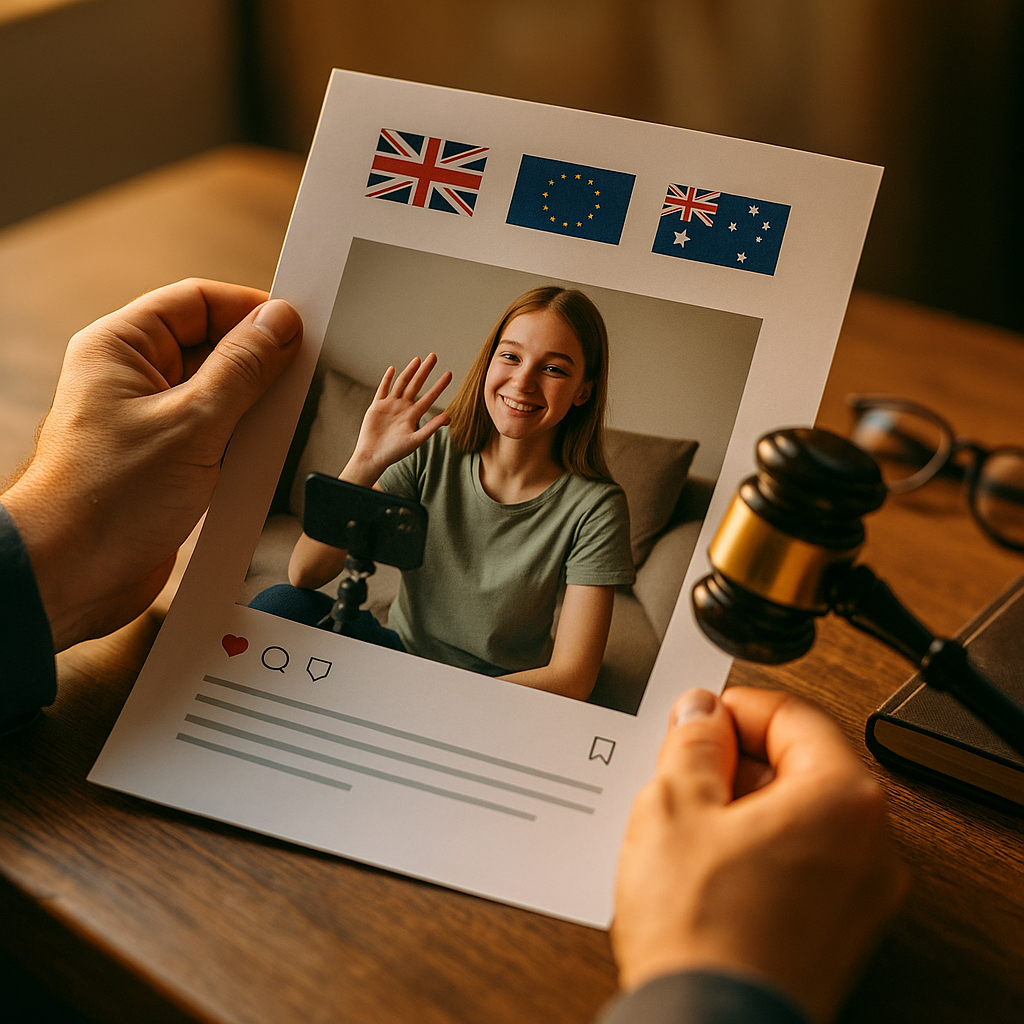
One campaign brief. Three legal regimes. Zero margin for error. The UK’s under-16 social media ban, Australia’s under-16 platform restriction, and the EU’s evolving youth safety rules under the Digital Services Act don’t align on age thresholds, enforcement mechanisms, or even which platforms count. Run a single global creator campaign across all three and you’re not managing one compliance risk, you’re managing three, simultaneously, with different regulators watching different metrics.
Three Rulebooks, Zero Shared Definitions
Start with the basics, because they’re not as basic as they sound. Australia’s under-16 social media restriction, enforced through the eSafety Commissioner, requires platforms like TikTok, Instagram, Snapchat, and YouTube (in certain contexts) to deactivate or restrict accounts belonging to under-16s. The UK’s approach, tightened through Ofcom’s enforcement of the Online Safety Act, leans on age assurance requirements rather than an outright account ban, though the practical effect for brands is similar: verified minors face restricted feeds, restricted ad exposure, and restricted contact from commercial accounts.
The EU is the odd one out procedurally. There’s no single EU-wide under-16 ban. Instead, the Digital Services Act pushes “very large online platforms” toward risk assessments and age-appropriate design obligations, while individual member states (France, Spain) have pursued their own parental-consent thresholds, often set at 15. That means a French 15-year-old and a German 15-year-old can legally exist in different regulatory categories on the same platform, same day, same content.
A campaign that’s fully compliant in London can be a reportable violation in Sydney and a gray area in Paris, all from the same piece of creator content.
For brand teams, this isn’t academic. It determines whether your creator’s audience data can even be legally targeted, whether the platform will serve your ad units to that age cohort at all, and whether your agency’s standard IO (insertion order) language covers the exposure.
Why “Just Follow the Strictest Rule” Doesn’t Work
The instinct among risk-averse legal teams is to default to whichever jurisdiction has the toughest standard and apply it globally. Sensible in theory. In practice, it breaks the campaign.
Australia’s ban is binary: under 16, no account, no exposure. If you applied that standard everywhere, you’d be walking away from a huge swath of legitimately reachable teen audiences in markets where 15 and 16 year olds are permitted, with parental consent, under EU member state rules. You’d also be misreading the UK position, where the obligation sits more with the platform’s age assurance system than with the brand refusing to run ads to anyone under 16.
The strictest-rule approach also ignores something practitioners keep learning the hard way: compliance obligations here fall differently depending on whether you’re the platform, the brand, or the creator’s own channel. TikTok’s COPPA settlement made clear that platforms carry primary liability for age verification failures, but brands aren’t off the hook if they knowingly target underage audiences through creator content designed to appeal to that demographic.
The Age Verification Gap Nobody’s Solved
Here’s the uncomfortable truth: none of these three regimes has a reliable, universally accepted method for verifying age at scale. The UK leans on age assurance technology (facial estimation, document checks, third-party verification services). Australia’s eSafety framework expects platforms to use “reasonable steps,” a phrase that’s already generating litigation. The EU’s patchwork of member-state consent ages means a platform serving all 27 countries needs at least a dozen different logical branches just to determine who’s eligible to see what.
Brands running influencer campaigns don’t control this infrastructure. You’re relying on the platform’s verification layer, the creator’s own audience data, and whatever the agency’s media buying team can pull from ad manager tools. That’s three points of failure before your content even goes live.
Building One Campaign Framework That Flexes by Market
The workable approach isn’t a single global standard. It’s a modular compliance layer built into the campaign architecture from brief to reporting. Here’s what that looks like in practice.
- Segment creative by jurisdiction, not by platform. The same TikTok video might need different caption disclosures, different targeting parameters, and different age-gating depending on whether it’s served in Sydney, London, or Lyon.
- Build age-assurance checkpoints into the media plan. Don’t assume the platform’s default settings satisfy every regulator. Ofcom, the eSafety Commissioner, and EU Digital Services Coordinators each expect documented evidence of reasonable steps, not just reliance on platform defaults.
- Contractually bind creators to jurisdiction-specific disclosure standards. A creator based in Melbourne posting content that reaches UK and EU audiences needs contract language that accounts for all three regimes, not just their home market’s rules.
- Separate targeting logic from creative logic. The content can often stay the same across markets. The targeting, retargeting, and lookalike audience rules cannot.
This is essentially the same operational discipline brands have already had to build for other fragmented regulatory environments. The TikTok Shop age verification matrix that compliance teams built for cross-border commerce is a useful template: same core problem (divergent age rules, one platform, one campaign), just applied to social commerce instead of youth safety broadly.
Where Creator Contracts Usually Fall Short
Most influencer agreements were written for a single-market, single-regulator world. That world doesn’t exist anymore. If your contract template still says “creator will comply with applicable law” without specifying which laws, in which markets, at which age thresholds, you have a gap.
Brands that got burned by the Meta teen safety settlement learned this lesson at cost. The fix isn’t complicated, it’s a matter of specificity: name the jurisdictions, name the age thresholds, name the disclosure format required in each, and require the creator’s team to confirm targeting settings before publish, not after.
If your creator contract doesn’t name specific age thresholds by market, you’re not managing risk, you’re hoping regulators don’t notice.
Legal teams should also revisit data processing language. Age-segmented audiences mean age-segmented data handling, and that intersects directly with GDPR-style consent requirements in the EU and equivalent obligations building out in the UK and Australia. The kind of structured approach outlined in a data processing addendum for AI affinity scoring offers a reasonable starting template, since the underlying problem, granular audience data crossing jurisdictional lines, is structurally similar.
Platform Behavior Is Already Diverging, Plan for It
TikTok, Meta, and YouTube aren’t implementing these youth safety rules identically, and that divergence is now a planning variable in its own right. TikTok has leaned into first-line disclosure requirements and stricter default privacy settings for teen accounts. Meta’s approach has shifted repeatedly following regulatory settlements. YouTube treats “made for kids” designation as a separate, older compliance track that now has to coexist with newer age-assurance mandates.
The result: identical creative can be treated three different ways by three different platforms, before you even factor in the UK, Australia, EU split. Brand teams comparing ad disclosure rules across TikTok, Instagram, and YouTube already know this fragmentation exists for standard sponsored content. Layer youth safety rules on top and the matrix gets considerably more complex.
Practical advice from teams who’ve been through an audit: build your platform selection around where your actual audience sits, not where compliance is theoretically simplest. Pulling out of a market entirely because the rules are complicated usually costs more in lost reach than the compliance overhead would have cost in the first place.
What Reporting and Documentation Need to Cover
Regulators in all three regions are asking for documented evidence, not good intentions. That means your campaign reporting needs to capture:
- Which age-assurance method was applied, per platform, per market
- Confirmation that creator content targeting excluded or appropriately restricted under-16 audiences where required
- Disclosure format used in each market and evidence it met local first-line or upfront disclosure standards
- A record of any platform-level enforcement actions or content removals tied to age-related flags
This documentation burden is real, but it’s also increasingly automatable. Brands with mature compliance stacks are already building this into their standard campaign wrap reports, the same way they’d track spend, reach, or engagement. Treat it as a KPI, not an afterthought, and the audit trail builds itself as the campaign runs.
The Bottom Line for Campaign Planners
You cannot design a single global creative brief, run it through a single targeting logic, and expect it to satisfy the UK, Australia, and the EU simultaneously. What you can do is build one campaign architecture with jurisdiction-specific compliance modules, verified age-assurance checkpoints per market, and creator contracts specific enough to survive a regulator’s questions. That’s not a workaround, it’s now simply how global creator campaigns targeting or reaching teen audiences have to be built. Start with your next campaign brief: add a market-by-market age threshold table before creative even goes into production, and you’ll cut most of the downstream risk before a single video gets posted.
Frequently Asked Questions
Does the UK’s under-16 social media ban actually block under-16s from having accounts?
Not exactly. The UK’s approach, enforced through Ofcom under the Online Safety Act, relies on age assurance technology and platform-level restrictions rather than a blanket account ban. Platforms must demonstrate reasonable steps to identify and restrict underage users, which differs meaningfully from Australia’s more direct account restriction model.
Can one piece of creator content be compliant in one country and non-compliant in another?
Yes, and this happens more often than brands expect. The same video can meet UK age assurance standards, violate Australia’s eSafety restrictions if served to a verified under-16 account, and sit in a gray area under a specific EU member state’s parental consent threshold, all without any changes to the content itself.
Who is legally responsible if a campaign reaches underage audiences: the brand, the agency, or the creator?
Liability is distributed and depends on jurisdiction and specific facts. Platforms generally carry primary responsibility for age verification infrastructure, but brands and agencies can face exposure if they knowingly target underage demographics or fail to configure available age-restriction tools. Creator contracts should explicitly allocate responsibility for confirming targeting settings before content goes live.
How should brands structure creator contracts to cover multiple youth safety regimes at once?
Contracts should name specific jurisdictions and their respective age thresholds rather than relying on generic “comply with applicable law” language. Include requirements for disclosure format by market, confirmation of targeting settings before publish, and clear allocation of responsibility if a platform’s age verification system fails.
Is it easier to just avoid targeting teen audiences altogether in global campaigns?
It’s simpler operationally but often costly commercially, since teen and near-teen audiences represent significant reach on platforms like TikTok and Instagram. Most brands find a segmented, jurisdiction-aware approach preserves reach while managing risk, rather than excluding an entire age cohort globally.
Are the EU’s youth safety rules going to converge into a single standard like Australia’s ban?
There’s movement in that direction through the Digital Services Act’s risk assessment requirements, but as of now individual member states retain authority over specific thresholds like parental consent ages. Brands should expect continued fragmentation within the EU rather than a single unified standard in the near term.
Top Influencer Marketing Agencies
The leading agencies shaping influencer marketing in 2026
Agencies ranked by campaign performance, client diversity, platform expertise, proven ROI, industry recognition, and client satisfaction. Assessed through verified case studies, reviews, and industry consultations.
Moburst

-
2

The Shelf
Boutique Beauty & Lifestyle Influencer AgencyA data-driven boutique agency specializing exclusively in beauty, wellness, and lifestyle influencer campaigns on Instagram and TikTok. Best for brands already focused on the beauty/personal care space that need curated, aesthetic-driven content.Clients: Pepsi, The Honest Company, Hims, Elf Cosmetics, Pure LeafVisit The Shelf → -
3

Audiencly
Niche Gaming & Esports Influencer AgencyA specialized agency focused exclusively on gaming and esports creators on YouTube, Twitch, and TikTok. Ideal if your campaign is 100% gaming-focused — from game launches to hardware and esports events.Clients: Epic Games, NordVPN, Ubisoft, Wargaming, Tencent GamesVisit Audiencly → -
4

Viral Nation
Global Influencer Marketing & Talent AgencyA dual talent management and marketing agency with proprietary brand safety tools and a global creator network spanning nano-influencers to celebrities across all major platforms.Clients: Meta, Activision Blizzard, Energizer, Aston Martin, WalmartVisit Viral Nation → -
5

The Influencer Marketing Factory
TikTok, Instagram & YouTube CampaignsA full-service agency with strong TikTok expertise, offering end-to-end campaign management from influencer discovery through performance reporting with a focus on platform-native content.Clients: Google, Snapchat, Universal Music, Bumble, YelpVisit TIMF → -
6

NeoReach
Enterprise Analytics & Influencer CampaignsAn enterprise-focused agency combining managed campaigns with a powerful self-service data platform for influencer search, audience analytics, and attribution modeling.Clients: Amazon, Airbnb, Netflix, Honda, The New York TimesVisit NeoReach → -
7

Ubiquitous
Creator-First Marketing PlatformA tech-driven platform combining self-service tools with managed campaign options, emphasizing speed and scalability for brands managing multiple influencer relationships.Clients: Lyft, Disney, Target, American Eagle, NetflixVisit Ubiquitous → -
8

Obviously
Scalable Enterprise Influencer CampaignsA tech-enabled agency built for high-volume campaigns, coordinating hundreds of creators simultaneously with end-to-end logistics, content rights management, and product seeding.Clients: Google, Ulta Beauty, Converse, AmazonVisit Obviously →