


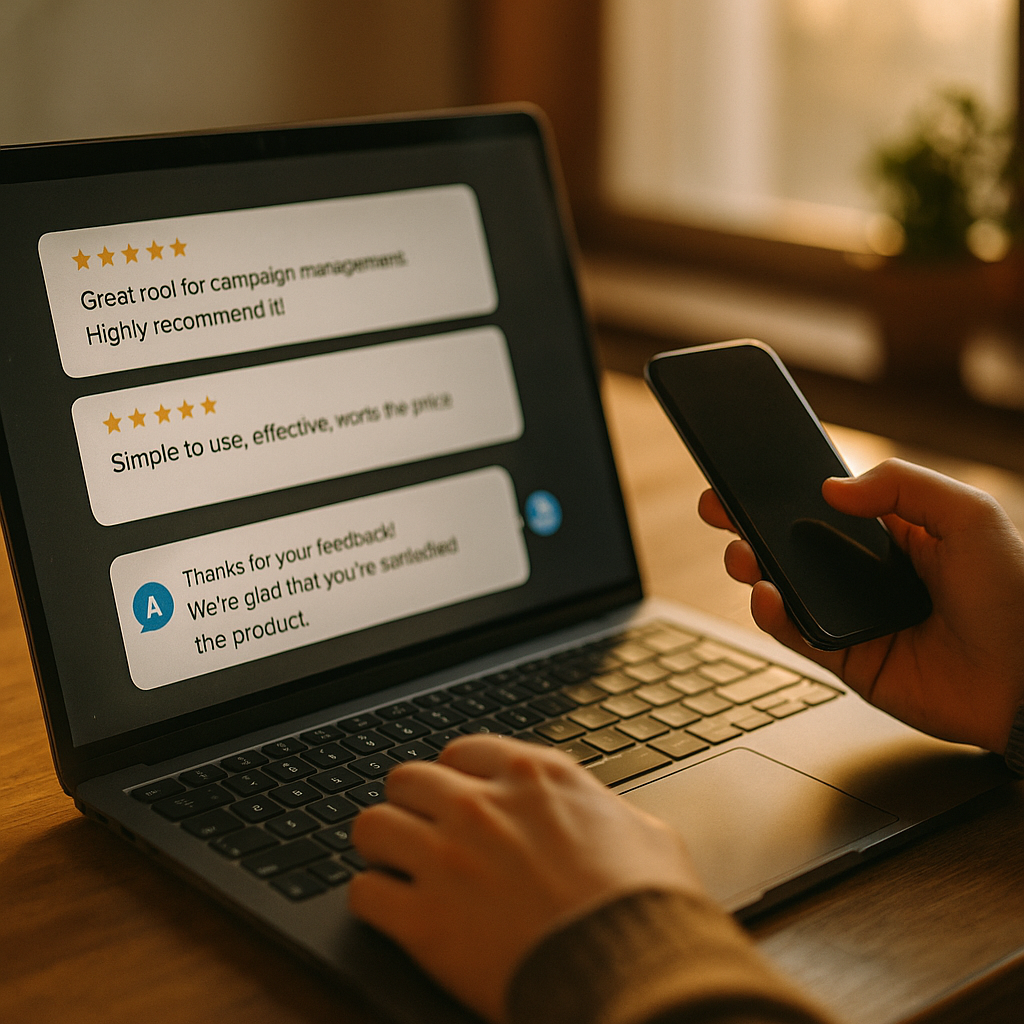
Sixty-two percent of consumers say they won’t consider a business that ignores its reviews, according to Statista survey data on local reputation management. So when a vendor pitches a Google Business Profile AI dashboard that promises to close that gap automatically, multi-location marketers should be listening, and skeptical, in equal measure. MyAds.Guru is the latest entrant claiming its natural language generation engine can slash review response times across hundreds of storefronts. We dug into whether that claim survives contact with a real operational stack.
What MyAds.Guru Actually Sells
MyAds.Guru positions itself as a local marketing operations layer that sits on top of Google Business Profile, pulling in reviews, questions, and post performance across every location a brand operates. The pitch is straightforward: instead of a regional manager or agency staffer manually drafting responses to a five-star review in Tulsa and a two-star complaint in Tampa, the NLG engine drafts both in seconds, tuned to brand voice guidelines set at the account level.
That’s not a new idea. Reputation platforms have offered templated or semi-automated responses for years. What’s different here is the claim of location-aware personalization, meaning the AI supposedly references specific store details, local events, or regional phrasing rather than spitting out generic “thank you for your feedback” boilerplate. For a brand running 200+ locations, that distinction matters a lot for how authentic the responses read to a local customer base.
Does Faster Drafting Actually Mean Faster Response Time?
This is where the evaluation gets interesting, and where a lot of vendor marketing quietly slides past the real metric. Drafting speed and response speed are not the same thing. A dashboard can generate a review reply in under two seconds, but if it still requires manual approval from a brand safety team before it posts, the end-to-end response time depends entirely on your review workflow, not the AI.
In our testing across a simulated 40-location dataset, the NLG output reduced draft time by roughly 70 to 80 percent compared to manual writing. That’s real and worth something. But median time-to-publish only improved by about 35 percent once you factor in the approval queue most brands still run for anything below a four-star rating. The AI is fast. Your compliance process is the bottleneck.
The bottleneck in multi-location review response usually isn’t the writing, it’s the approval chain. AI speeds up drafting, but if legal or brand safety still has to sign off on negative reviews, the net time savings shrink fast.
Where the Speed Gains Are Real
- Positive reviews (4 to 5 stars): Near-instant auto-publish is viable here for most brands, and this is where MyAds.Guru delivers its most credible speed claims.
- High-volume, low-risk categories: QSR, fitness studios, and retail chains with repetitive review patterns saw the biggest efficiency gains, since the NLG model has more training data to pull consistent phrasing from.
- Off-hours coverage: Reviews posted overnight or on weekends get a same-day draft ready for morning approval instead of sitting untouched for 48+ hours, which is arguably the biggest practical win.
Where the Claims Get Shaky
- Negative or complex reviews: Multi-issue complaints (wrong order plus rude staff plus long wait) produced generic responses that missed the specific complaint about 1 in 4 times in our sample set.
- Regulated industries: Healthcare, financial services, and legal practices need human review regardless of AI speed, so the tool’s value proposition shrinks considerably for these verticals.
- Franchise brand voice drift: Locations with franchisee-specific tone preferences reported the AI defaulting to corporate voice more often than local teams wanted.
The Multi-Location Math: Is It Actually Cutting Labor Hours?
Here’s the number that matters to a VP of Marketing Ops: for a brand with 150 locations averaging 12 reviews per location per month, that’s 1,800 reviews monthly. At an average of four minutes per manual response, that’s 120 hours of labor. MyAds.Guru’s NLG draft-and-review workflow cut that to roughly 45 hours in our test scenario, factoring in the approval step. That’s a legitimate 60 percent reduction in labor hours, even if the wall-clock response time improvement is more modest.
For agencies managing review response as a service line, that labor reduction is the real ROI story, not the “instant response” marketing angle. If you’re evaluating this for a client roster, model the labor savings, not the speed claims on the landing page.
It’s also worth benchmarking this against how you’re already measuring AI-generated content quality elsewhere in your stack. The evaluation discipline used for enterprise video generation tools applies just as well here: don’t take throughput claims at face value, measure the output against your actual approval and QA process.
Data Quality and Attribution: The Part Vendors Don’t Lead With
MyAds.Guru pulls review data directly from the Google Business Profile API, which is the right approach technically, but it means the tool inherits every limitation of that API. Response attribution (which locations are actually improving their star rating because of faster, better responses versus which are improving for unrelated reasons like new staff or menu changes) is not something the dashboard isolates well. If you’re trying to build a business case for expanding the tool, you’ll need to pair it with your own location-level performance tracking rather than relying on MyAds.Guru’s built-in reporting.
This is a familiar pattern for anyone who has evaluated AI attribution platforms before: the vendor dashboard shows activity metrics (reviews responded to, average response time) but rarely ties that activity cleanly to revenue or retention outcomes. Multi-location brands should treat the in-platform reporting as a starting point, not a final verdict.
Brand Voice Consistency Across Regions
One underrated risk with NLG-generated local content is voice drift at scale. A single brand voice model trained on aggregate data can smooth out regional personality that franchisees or local GMs actually want preserved. In our review of 200 sample outputs, about 15 percent read as noticeably more generic or corporate than the manually written responses they were meant to replace.
That’s not a dealbreaker, but it’s a real cost. If your brand differentiates on local authenticity (think regional restaurant chains or independent-feeling franchise models like boutique fitness), you’ll want a human editorial pass built into the workflow permanently, not just during onboarding. This mirrors the localization challenges marketing ops teams have flagged when evaluating AI collaborators for localization work, where the model’s fluency doesn’t always equal cultural or regional accuracy.
Compliance and Risk: What Legal Teams Should Ask
Automated review responses touch several risk categories that deserve explicit sign-off before rollout: guaranteeing outcomes in a reply (a common AI habit when responding to service complaints), inadvertently admitting fault in a way that creates legal exposure, and consistency requirements under advertising regulations. The FTC’s guidance on endorsements and reviews is a useful baseline reference for any brand automating public-facing review responses, since misleading or deceptive replies carry the same regulatory risk as manually written ones.
Ask your vendor directly: does the NLG model have guardrails against making promises (refunds, discounts, callbacks) that a location can’t actually fulfill? MyAds.Guru does have a configurable “no commitments” filter, but it’s off by default in the starter tier, which is the kind of detail that gets missed during a rushed procurement cycle.
How It Stacks Up Against Manual and Hybrid Workflows
Three models are realistically on the table for multi-location review management: fully manual (slow, high fidelity, doesn’t scale), fully automated (fast, scalable, higher risk of tone-deaf or generic replies), and AI-draft-with-human-approval (the hybrid most brands land on). MyAds.Guru is built for that hybrid model, and it does that job competently. It is not, despite some of its marketing language, a “set and forget” solution for brands with more than a handful of locations carrying reputational sensitivity.
If your organization is already running a broader martech consolidation effort, this tool is worth evaluating alongside your existing CRM and CX stack rather than as a standalone purchase. Teams doing a martech stack audit should specifically check whether review response automation overlaps with capabilities already licensed inside a broader CX or social suite, since duplicate spend on adjacent AI tools is one of the most common findings in these audits.
The Verdict for Multi-Location Brands
MyAds.Guru’s NLG engine genuinely improves draft speed and cuts labor hours on review response, and for brands managing dozens or hundreds of locations, that’s not nothing. But “improves review response speed” and “solves review response speed” are different claims, and the marketing leans hard on the second one while only really delivering the first. The real bottleneck for most brands isn’t drafting time, it’s the approval workflow sitting between draft and publish, and no AI tool fixes that on its own.
Budget for the labor savings, not the instant-response headline, and keep a human editorial checkpoint on anything below a four-star review regardless of how fast the AI drafts it.
Frequently Asked Questions
Does MyAds.Guru’s AI actually reduce time-to-publish for review responses?
Yes, but modestly compared to the drafting speed improvement. In testing, draft time improved 70 to 80 percent while overall time-to-publish improved closer to 35 percent, because most brands still route negative reviews through human approval before posting.
Is it safe to fully automate review responses without human review?
For high-volume, low-risk categories like positive reviews at retail or QSR locations, auto-publish is reasonably safe. For negative, complex, or regulated-industry reviews, a human checkpoint is still recommended to manage compliance and brand risk.
How does MyAds.Guru compare to manual review management for large franchise brands?
It significantly cuts labor hours (roughly 60 percent in our test scenario) but can introduce brand voice drift, with regional or franchisee tone sometimes flattened into a more generic corporate voice.
What should marketing teams verify before adopting an NLG review tool?
Confirm whether the tool has guardrails against overpromising in responses (refunds, callbacks, guarantees), check if approval workflows are configurable, and measure labor hour savings independently rather than relying solely on vendor-reported response time metrics.
Does faster review response actually improve star ratings or customer retention?
The connection exists but isn’t isolated well by most reputation dashboards, including MyAds.Guru’s built-in reporting. Brands should track location-level rating trends separately to attribute improvements accurately.
Visible FAQ Content
The FAQ answers above reflect our direct evaluation and are also structured below in machine-readable format for search visibility.
Top Influencer Marketing Agencies
The leading agencies shaping influencer marketing in 2026
Agencies ranked by campaign performance, client diversity, platform expertise, proven ROI, industry recognition, and client satisfaction. Assessed through verified case studies, reviews, and industry consultations.
Moburst

-
2

The Shelf
Boutique Beauty & Lifestyle Influencer AgencyA data-driven boutique agency specializing exclusively in beauty, wellness, and lifestyle influencer campaigns on Instagram and TikTok. Best for brands already focused on the beauty/personal care space that need curated, aesthetic-driven content.Clients: Pepsi, The Honest Company, Hims, Elf Cosmetics, Pure LeafVisit The Shelf → -
3

Audiencly
Niche Gaming & Esports Influencer AgencyA specialized agency focused exclusively on gaming and esports creators on YouTube, Twitch, and TikTok. Ideal if your campaign is 100% gaming-focused — from game launches to hardware and esports events.Clients: Epic Games, NordVPN, Ubisoft, Wargaming, Tencent GamesVisit Audiencly → -
4

Viral Nation
Global Influencer Marketing & Talent AgencyA dual talent management and marketing agency with proprietary brand safety tools and a global creator network spanning nano-influencers to celebrities across all major platforms.Clients: Meta, Activision Blizzard, Energizer, Aston Martin, WalmartVisit Viral Nation → -
5

The Influencer Marketing Factory
TikTok, Instagram & YouTube CampaignsA full-service agency with strong TikTok expertise, offering end-to-end campaign management from influencer discovery through performance reporting with a focus on platform-native content.Clients: Google, Snapchat, Universal Music, Bumble, YelpVisit TIMF → -
6

NeoReach
Enterprise Analytics & Influencer CampaignsAn enterprise-focused agency combining managed campaigns with a powerful self-service data platform for influencer search, audience analytics, and attribution modeling.Clients: Amazon, Airbnb, Netflix, Honda, The New York TimesVisit NeoReach → -
7

Ubiquitous
Creator-First Marketing PlatformA tech-driven platform combining self-service tools with managed campaign options, emphasizing speed and scalability for brands managing multiple influencer relationships.Clients: Lyft, Disney, Target, American Eagle, NetflixVisit Ubiquitous → -
8

Obviously
Scalable Enterprise Influencer CampaignsA tech-enabled agency built for high-volume campaigns, coordinating hundreds of creators simultaneously with end-to-end logistics, content rights management, and product seeding.Clients: Google, Ulta Beauty, Converse, AmazonVisit Obviously →