


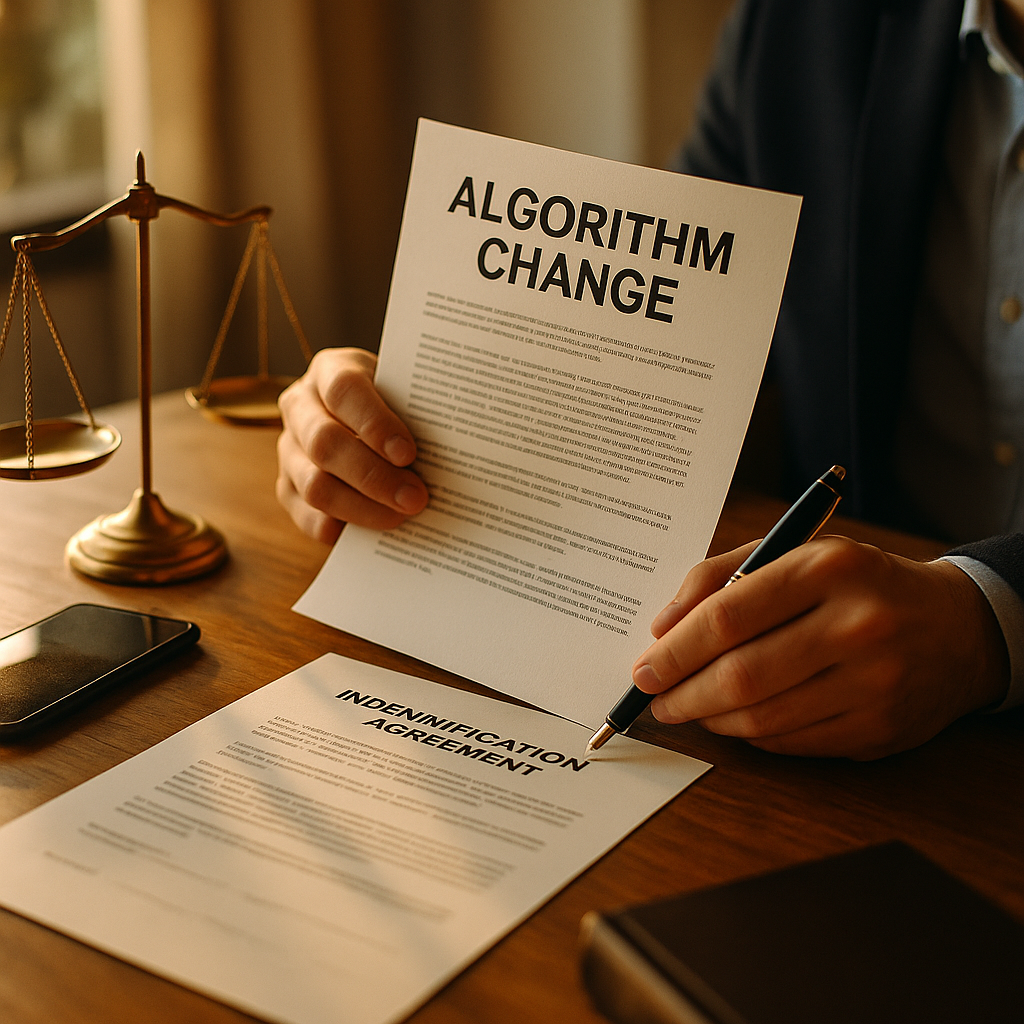
Instagram’s 2023 algorithm shift cut organic reach for some brand accounts by more than 40% in a single quarter, according to data cited by Sprout Social. No warning. No appeal process. Just a dead feed and a campaign forecast that no longer means anything. If your influencer contracts don’t include a platform-algorithm-change indemnification clause, you’re absorbing that risk alone, every single time a platform tweaks its ranking model.
Why Brands Can No Longer Treat Algorithm Risk as an Act of God
For years, marketing teams treated algorithm shifts like weather: unpredictable, uncontrollable, nobody’s fault. That framing was convenient for agencies and creators because it meant nobody had to own the fallout when a sponsored post underperformed. It’s also outdated.
Platforms now change ranking logic multiple times a year, sometimes without public announcement. TikTok, Meta, and YouTube all run continuous experimentation on their recommendation engines, and brands find out about shifts only after their engagement dashboards flatline. When that happens mid-campaign, the financial exposure lands squarely on whoever wrote the loosest contract.
An indemnification clause tied to algorithm changes isn’t about predicting the unpredictable. It’s about deciding, in advance, who pays when the unpredictable happens.
This is no longer a niche legal concern. It’s a budget-protection mechanism, and it belongs in every influencer agreement, every agency retainer, and every platform-dependent media plan.
What a Platform-Algorithm-Change Indemnification Clause Actually Does
Let’s be precise about scope. This clause does not guarantee performance. It does not promise a certain number of impressions or a fixed engagement rate. What it does is allocate financial responsibility when a documented, platform-initiated change materially reduces the organic distribution a campaign was built around.
In plain terms, it answers three questions:
- Who absorbs the cost when reach collapses through no fault of the creator or brand?
- What counts as evidence that a change actually occurred?
- What remedy is owed, whether that’s a make-good post, a partial refund, or a renegotiated deliverable schedule?
Without this clause, the default legal position is usually “tough luck.” Most standard influencer agreements are silent on platform-side risk entirely, which means courts and arbitrators fall back on general contract principles that rarely favor the brand footing the bill.
Defining “Material Algorithm Change” Without Writing a Blank Check
Here’s where most first drafts fail. Brands either write the definition so tight that it never triggers, or so loose that every minor engagement dip becomes a dispute. Neither serves anyone.
A workable definition needs a measurable threshold, a defined time window, and a documented source. Something like: a decline of 30% or more in average organic reach for comparable content, measured over a rolling 14-day period against the creator’s trailing 90-day baseline, attributable to a publicly acknowledged or independently verified platform ranking change.
That last clause matters enormously. You need an evidentiary anchor. Options include:
- Official platform announcements (Meta’s newsroom, TikTok’s creator updates, YouTube’s Creator Insider communications)
- Third-party analytics reporting a broad-based reach decline across a sample of unrelated accounts, not just your creator’s
- Platform support documentation acknowledging a known issue or intentional ranking update
Without a source requirement, you invite bad-faith claims every time a creator’s numbers dip for unrelated reasons, like posting off-schedule or losing relevance in their niche. With one, you filter for genuine platform-side events.
The Core Clause Language: A Working Framework
Legal teams should adapt this to jurisdiction and deal size, but the skeleton looks like this:
- Trigger definition: A precise, measurable threshold for what constitutes a qualifying algorithm change, as described above.
- Notice obligation: The party that discovers the change (usually the creator or agency, since they see the analytics first) must notify the brand within a set window, typically 3 to 5 business days.
- Verification period: Both parties get a defined window, often 10 business days, to confirm the change against agreed data sources before any remedy is owed.
- Remedy menu: Specify options rather than a single fixed outcome. Common remedies include a make-good deliverable, a pro-rated refund tied to the shortfall percentage, an extended campaign window, or a shift to paid amplification at the platform’s cost or a shared cost split.
- Cap and carve-outs: Set a maximum liability ceiling, and explicitly exclude reach declines caused by content policy violations, brand safety strikes, or creator account suspensions unrelated to the algorithm event.
That carve-out section is not optional. Without it, a creator who gets shadowbanned for a community guidelines violation could try to claim algorithm-change protection. You need language that separates platform-caused declines from creator-caused ones.
Notice Periods and Remedies: Where the Real Negotiation Happens
Everyone agrees in principle that algorithm risk should be shared fairly. The fighting starts over specifics: how fast must someone flag the issue, and what exactly do they owe once it’s confirmed?
Shorter notice windows favor brands because they catch problems before a campaign fully unwinds. Agencies push back because monitoring reach dips across dozens of creator accounts in real time is operationally expensive. A reasonable middle ground is a tiered notice structure: informal flagging within 48 hours of detection, formal written notice with supporting data within 5 business days.
On remedies, avoid locking yourself into a single option. A rigid “full refund” clause sounds protective but often gets negotiated out entirely because it’s too punitive for agencies to accept. A tiered remedy scale, where a 20 to 30% reach decline triggers a make-good post and anything above 50% triggers a partial refund, tends to survive negotiation and actually gets used when needed.
A clause that’s too aggressive to sign is worthless. The best indemnification language is the kind both sides can live with when the algorithm actually does something unpredictable.
Common Drafting Mistakes That Gut the Clause’s Value
A few patterns show up repeatedly in contracts that look protective on paper but fail in practice:
- No baseline data requirement. If the creator never establishes a documented reach baseline before the campaign starts, there’s nothing to measure a decline against. Require baseline screenshots or analytics exports at contract signing.
- Vague “significant decline” language with no percentage threshold, which guarantees a dispute over what “significant” means.
- Missing platform specificity. A clause written generically for “social media” doesn’t account for the fact that Instagram, TikTok, and YouTube have different reporting metrics, different definitions of reach, and different disclosure practices around algorithm changes.
- No sunset provision. Algorithm-change protection should apply during the active campaign window, not indefinitely. Cap the protection period to avoid open-ended liability.
These gaps are why brands sometimes have an indemnification clause on paper and still lose the argument when it matters. This connects directly to broader indemnification issues brands face with algorithmic tools, which we’ve covered in the context of AI creator matching platforms, where similar ambiguity around “material change” definitions creates the same enforcement problems.
Bring Agencies and Legal Into the Same Draft Early
The worst version of this clause is one legal writes in isolation without input from the media team that actually manages platform relationships day to day. Legal knows how to write enforceable trigger language. Media strategists know what a “normal” reach fluctuation actually looks like on TikTok versus Instagram Reels versus YouTube Shorts. You need both perspectives in the room, or you end up with a clause that’s legally sound but operationally useless.
It’s also worth benchmarking your disclosure and platform-risk language against how other compliance issues are being handled across the industry right now. For instance, the way brands are restructuring creator contracts around Meta’s teen safety settlement shows a similar pattern: platform-driven policy shifts forcing brands to rewrite indemnification and liability language reactively instead of proactively. Algorithm-change protection deserves the same forward-looking treatment before the next major ranking shift, not after.
Data governance around these clauses matters too. If your remedy calculations depend on third-party analytics or platform reporting, make sure your data processing terms actually support pulling and sharing that evidence without violating platform terms of service or creator privacy agreements.
Finally, don’t treat this as a one-time contract update. Platform ranking systems evolve constantly, and your indemnification language should get revisited on the same cadence as your broader vendor risk reviews, similar to how brands now approach platform vendor due diligence after major infrastructure or policy shifts.
How to Roll This Out Without Blowing Up Existing Relationships
You don’t need to renegotiate every active contract overnight. Start with new agreements and high-spend renewals. For existing relationships, propose the clause as an amendment framed around mutual protection, since a well-drafted version protects creators too when a platform tanks their reach through no fault of their own.
Track algorithm-related disputes internally even before you formalize this language. If you can show your legal and procurement teams three documented instances where reach collapsed mid-campaign with no contractual remedy, the business case for standardized clause language writes itself. For broader context on how platform policy volatility is reshaping brand contracts across categories, eMarketer’s ongoing coverage of platform algorithm changes and FTC guidance on advertising disclosures are both useful reference points to bring into internal conversations with legal.
Next step: pull your three most recent underperforming campaigns, check whether reach declines correlated with a documented platform change, and use that data to draft a threshold-based indemnification clause for your next contract cycle rather than waiting for the next algorithm shift to catch you exposed.
FAQs
What is a platform-algorithm-change indemnification clause?
It’s a contract provision that assigns financial responsibility when a documented, platform-initiated ranking change causes a measurable drop in organic reach for sponsored content, separate from performance guarantees or general force majeure language.
How do you prove an algorithm change actually happened?
Reliable evidence includes official platform announcements, third-party analytics showing broad-based reach declines across unrelated accounts, or platform support documentation acknowledging a ranking update. Contracts should specify acceptable evidence sources upfront to avoid disputes later.
Should this clause apply to paid or organic content only?
It should apply specifically to organic reach commitments. Paid media has its own performance guarantees and platform-side service level agreements, so mixing the two creates confusion about which remedy structure applies.
What percentage decline should trigger the clause?
There’s no universal standard, but many brands use a 25 to 30% decline in average organic reach, measured against a documented baseline, as the minimum trigger threshold, with steeper remedies attached to declines above 50%.
Can creators use this clause to avoid accountability for poor content performance?
Not if it’s drafted correctly. Include carve-outs excluding declines caused by content policy violations, account suspensions, or off-brand posting behavior, so the clause only applies to genuine platform-side ranking changes.
Does this clause need to be platform-specific?
Yes. Instagram, TikTok, and YouTube report reach and engagement differently, and their public disclosure practices around algorithm changes vary significantly, so generic “social media” language weakens enforceability.
Top Influencer Marketing Agencies
The leading agencies shaping influencer marketing in 2026
Agencies ranked by campaign performance, client diversity, platform expertise, proven ROI, industry recognition, and client satisfaction. Assessed through verified case studies, reviews, and industry consultations.
Moburst

-
2

The Shelf
Boutique Beauty & Lifestyle Influencer AgencyA data-driven boutique agency specializing exclusively in beauty, wellness, and lifestyle influencer campaigns on Instagram and TikTok. Best for brands already focused on the beauty/personal care space that need curated, aesthetic-driven content.Clients: Pepsi, The Honest Company, Hims, Elf Cosmetics, Pure LeafVisit The Shelf → -
3

Audiencly
Niche Gaming & Esports Influencer AgencyA specialized agency focused exclusively on gaming and esports creators on YouTube, Twitch, and TikTok. Ideal if your campaign is 100% gaming-focused — from game launches to hardware and esports events.Clients: Epic Games, NordVPN, Ubisoft, Wargaming, Tencent GamesVisit Audiencly → -
4

Viral Nation
Global Influencer Marketing & Talent AgencyA dual talent management and marketing agency with proprietary brand safety tools and a global creator network spanning nano-influencers to celebrities across all major platforms.Clients: Meta, Activision Blizzard, Energizer, Aston Martin, WalmartVisit Viral Nation → -
5

The Influencer Marketing Factory
TikTok, Instagram & YouTube CampaignsA full-service agency with strong TikTok expertise, offering end-to-end campaign management from influencer discovery through performance reporting with a focus on platform-native content.Clients: Google, Snapchat, Universal Music, Bumble, YelpVisit TIMF → -
6

NeoReach
Enterprise Analytics & Influencer CampaignsAn enterprise-focused agency combining managed campaigns with a powerful self-service data platform for influencer search, audience analytics, and attribution modeling.Clients: Amazon, Airbnb, Netflix, Honda, The New York TimesVisit NeoReach → -
7

Ubiquitous
Creator-First Marketing PlatformA tech-driven platform combining self-service tools with managed campaign options, emphasizing speed and scalability for brands managing multiple influencer relationships.Clients: Lyft, Disney, Target, American Eagle, NetflixVisit Ubiquitous → -
8

Obviously
Scalable Enterprise Influencer CampaignsA tech-enabled agency built for high-volume campaigns, coordinating hundreds of creators simultaneously with end-to-end logistics, content rights management, and product seeding.Clients: Google, Ulta Beauty, Converse, AmazonVisit Obviously →