


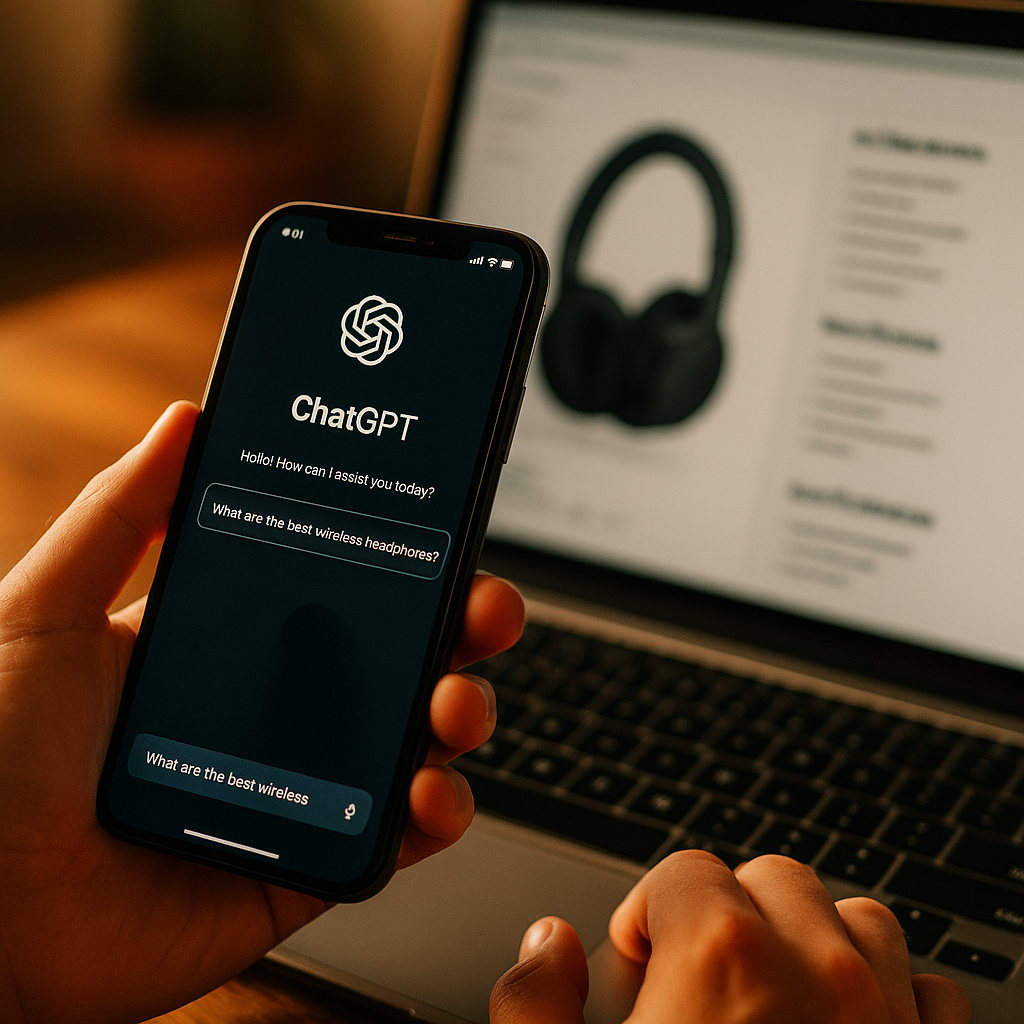
Half of all consumers now begin product research inside an AI search tool, not a traditional search engine. That single stat should stop every CMO mid-scroll. If your brand’s visibility strategy still treats AI search as a side experiment rather than the new front door to discovery, you are already behind, and the gap is widening every quarter.
The Numbers Behind the Shift
This isn’t a fringe behavior anymore. Tools like ChatGPT, Google’s AI Overviews, Perplexity, and Claude have moved from novelty to default for a meaningful share of shoppers researching everything from skincare routines to enterprise software. Industry surveys from eMarketer and Statista have tracked steady quarter-over-quarter growth in AI-assisted product research, with younger demographics leading adoption but older cohorts closing the gap fast.
Why does this matter more than another platform trend? Because search behavior is sticky. Once a consumer trusts an AI tool to summarize reviews, compare specs, and recommend a shortlist, they rarely go back to clicking through ten blue links to do the same work manually. The habit forms quickly, and it does not reverse.
When half your addressable audience starts their buying journey inside a chat interface instead of a search results page, your entire SEO and content strategy needs a parallel track built for machine comprehension, not just human scanning.
Why Are Consumers Abandoning the Old Search Habit?
Traditional search asks the consumer to do the synthesis work. Type a query, open five tabs, cross-reference reviews, ignore the ads, and eventually piece together an answer. AI search collapses that into a single conversational exchange. Ask “what’s the best budget mechanical keyboard for a small apartment” and get a synthesized answer with reasoning attached, not just a ranked list of pages hoping to be clicked.
That convenience is the whole story. Consumers are lazy in the best possible way: they want less friction, not more control. A generation raised on voice assistants and chat interfaces sees no reason to manually filter search results when a model can do it faster and explain its reasoning.
- Fewer steps between question and decision
- Answers that synthesize multiple sources instead of listing them
- A conversational format that allows follow-up questions without starting over
- Growing trust that AI recommendations are “good enough” for low-to-mid stakes purchases
None of this means traditional search engines are dying tomorrow. But the share of research queries that never touch a classic SERP is climbing, and brands optimizing purely for keyword rankings are fighting yesterday’s war.
What This Means for Brand Discoverability
Here’s the uncomfortable part: AI search tools don’t work like Google. They don’t reward a page for stuffing keywords or building backlinks in the way legacy SEO trained marketers to think. Large language models pull from training data, retrieval systems, and increasingly from real-time web crawling, but the criteria for what gets surfaced and cited is different. Clarity, structured data, third-party validation, and consistent brand mentions across the web matter more than raw domain authority.
This is the same dynamic reshaping how brands think about creator content. Just as organic seeding strategies have outperformed paid amplification in media mix models, brand mentions that occur naturally across trusted creator content, review sites, and forums appear to carry more weight with AI models than brand-owned marketing copy. If an AI tool is deciding what to recommend, it’s pulling signal from places consumers already trust: Reddit threads, YouTube reviews, and creator comparisons, not just your product page.
Brands that have historically underinvested in earned media and third-party validation are going to feel this shift hardest. You cannot buy your way into an AI Overview citation the way you could buy a paid search placement.
The New Funnel: From Keywords to Conversational Queries
Marketers spent two decades optimizing for how people type into search bars. Short, fragmented, keyword-heavy queries. AI search flips that script entirely. Consumers now phrase requests the way they’d talk to a knowledgeable friend: “I need running shoes for flat feet under $120 that won’t fall apart after a few months.” That’s a completely different content target than optimizing a page for “best running shoes flat feet.”
This changes what “ranking” even means. Instead of chasing position one on a results page, brands need to think about whether their product, review data, and comparison content get cited, quoted, or referenced when an AI model answers a long-tail conversational question. That requires content built around genuine use cases and honest comparisons, not keyword density.
It also rewards speed. Brands that can respond to emerging search patterns and shifting consumer language faster than competitors gain outsized visibility before the space gets crowded. That’s the same principle driving speed-to-relevance strategies in creator marketing: the first credible voice to answer a new question tends to get cited repeatedly after that.
Where the Risk Lives
There’s a compliance angle here too, and it’s easy to miss. When AI tools summarize product claims, they can misattribute, oversimplify, or hallucinate details from your own marketing copy. If your product page makes a borderline claim about efficacy or safety, an AI summary might strip the nuance and present it as fact. That’s a real brand and legal exposure, and it deserves the same scrutiny marketing and legal teams already apply to influencer disclosures under FTC guidance.
Response speed matters here too. Slow, generic answers from your own AI-powered customer touchpoints erode trust just as fast as absence does. Our earlier coverage on slow chatbot response times found that latency alone is enough to tank conversion on AI-assisted commerce interactions, and the same principle applies to how quickly your brand’s information updates across the web.
How Brands Can Adapt Without Overhauling Everything
You don’t need to blow up your existing SEO program. You need to build a parallel discipline aimed at machine-readable clarity and earned trust signals. A few practical moves:
- Structure content for extraction. Use clear headers, direct answers near the top, and schema markup so AI crawlers can parse intent quickly. Google’s own guidance on structured data is a solid starting point.
- Invest in third-party validation. Reviews, comparison articles, and creator content that mentions your product organically carry more weight with AI models than owned content ever will.
- Audit for hallucination risk. Regularly query major AI tools about your own brand and products to see what they’re saying. Correct inaccuracies before they compound.
- Track citation share, not just rank. Tools that monitor AI search visibility are still maturing, but platforms like HubSpot and Sprout Social are already building reporting features around this. Start measuring now, even manually, so you have a baseline.
- Feed the creator ecosystem. AI models weight authentic, high-engagement content heavily. That’s another reason the shift toward evergreen creator infrastructure over one-off campaign bursts matters: content that stays live and gets referenced repeatedly compounds its influence on AI outputs over time.
None of this is a silver bullet. But brands that treat AI search visibility as a distinct workstream, staffed and budgeted separately from legacy SEO, are the ones who’ll still be discoverable when this becomes table stakes instead of a differentiator.
The brands winning AI search visibility right now aren’t the ones with the biggest ad budgets. They’re the ones with the most consistent, credible presence across the third-party content ecosystem that AI models actually trust.
There’s also a resourcing question underneath all of this. Building AI-visible content, monitoring citation accuracy, and coordinating with creators for organic mentions requires cross-functional work that most marketing orgs haven’t staffed for yet. That’s part of a broader pattern our team has tracked as the creator economy forces agency restructuring, and it’s worth asking whether your current team has anyone explicitly responsible for AI search presence at all.
Start Here, Not There
Pick one high-intent product category, query it across three major AI tools this week, and see exactly what gets cited, what gets ignored, and what gets flat-out wrong about your brand. That fifteen-minute audit will tell you more about your AI search readiness than any deck full of projections.
Frequently Asked Questions
What counts as “AI search” versus traditional search?
AI search refers to tools like ChatGPT, Google AI Overviews, Perplexity, and similar conversational interfaces that synthesize an answer from multiple sources rather than returning a ranked list of links for the user to click through manually.
Does traditional SEO still matter if consumers are shifting to AI search?
Yes. Traditional SEO fundamentals like site structure, page speed, and authoritative backlinks still influence whether AI crawlers can access and trust your content, but ranking position alone no longer guarantees visibility inside an AI-generated answer.
How do brands measure visibility inside AI search results?
Measurement is still maturing. Marketers currently rely on manual query audits across major AI tools, emerging citation-tracking features from martech platforms, and monitoring referral traffic patterns that suggest a user arrived after an AI-assisted research session.
Can paid advertising influence AI search recommendations?
Not directly in most cases. Unlike paid search placements, most AI search tools generate recommendations from training data and retrieval systems that prioritize organic, third-party validated content over sponsored placements.
What’s the biggest risk of AI search misrepresenting a brand?
The biggest risk is AI tools oversimplifying or hallucinating product claims, which can create compliance exposure similar to unsubstantiated advertising claims, especially around health, safety, or efficacy statements.
Top Influencer Marketing Agencies
The leading agencies shaping influencer marketing in 2026
Agencies ranked by campaign performance, client diversity, platform expertise, proven ROI, industry recognition, and client satisfaction. Assessed through verified case studies, reviews, and industry consultations.
Moburst

-
2

The Shelf
Boutique Beauty & Lifestyle Influencer AgencyA data-driven boutique agency specializing exclusively in beauty, wellness, and lifestyle influencer campaigns on Instagram and TikTok. Best for brands already focused on the beauty/personal care space that need curated, aesthetic-driven content.Clients: Pepsi, The Honest Company, Hims, Elf Cosmetics, Pure LeafVisit The Shelf → -
3

Audiencly
Niche Gaming & Esports Influencer AgencyA specialized agency focused exclusively on gaming and esports creators on YouTube, Twitch, and TikTok. Ideal if your campaign is 100% gaming-focused — from game launches to hardware and esports events.Clients: Epic Games, NordVPN, Ubisoft, Wargaming, Tencent GamesVisit Audiencly → -
4

Viral Nation
Global Influencer Marketing & Talent AgencyA dual talent management and marketing agency with proprietary brand safety tools and a global creator network spanning nano-influencers to celebrities across all major platforms.Clients: Meta, Activision Blizzard, Energizer, Aston Martin, WalmartVisit Viral Nation → -
5

The Influencer Marketing Factory
TikTok, Instagram & YouTube CampaignsA full-service agency with strong TikTok expertise, offering end-to-end campaign management from influencer discovery through performance reporting with a focus on platform-native content.Clients: Google, Snapchat, Universal Music, Bumble, YelpVisit TIMF → -
6

NeoReach
Enterprise Analytics & Influencer CampaignsAn enterprise-focused agency combining managed campaigns with a powerful self-service data platform for influencer search, audience analytics, and attribution modeling.Clients: Amazon, Airbnb, Netflix, Honda, The New York TimesVisit NeoReach → -
7

Ubiquitous
Creator-First Marketing PlatformA tech-driven platform combining self-service tools with managed campaign options, emphasizing speed and scalability for brands managing multiple influencer relationships.Clients: Lyft, Disney, Target, American Eagle, NetflixVisit Ubiquitous → -
8

Obviously
Scalable Enterprise Influencer CampaignsA tech-enabled agency built for high-volume campaigns, coordinating hundreds of creators simultaneously with end-to-end logistics, content rights management, and product seeding.Clients: Google, Ulta Beauty, Converse, AmazonVisit Obviously →