


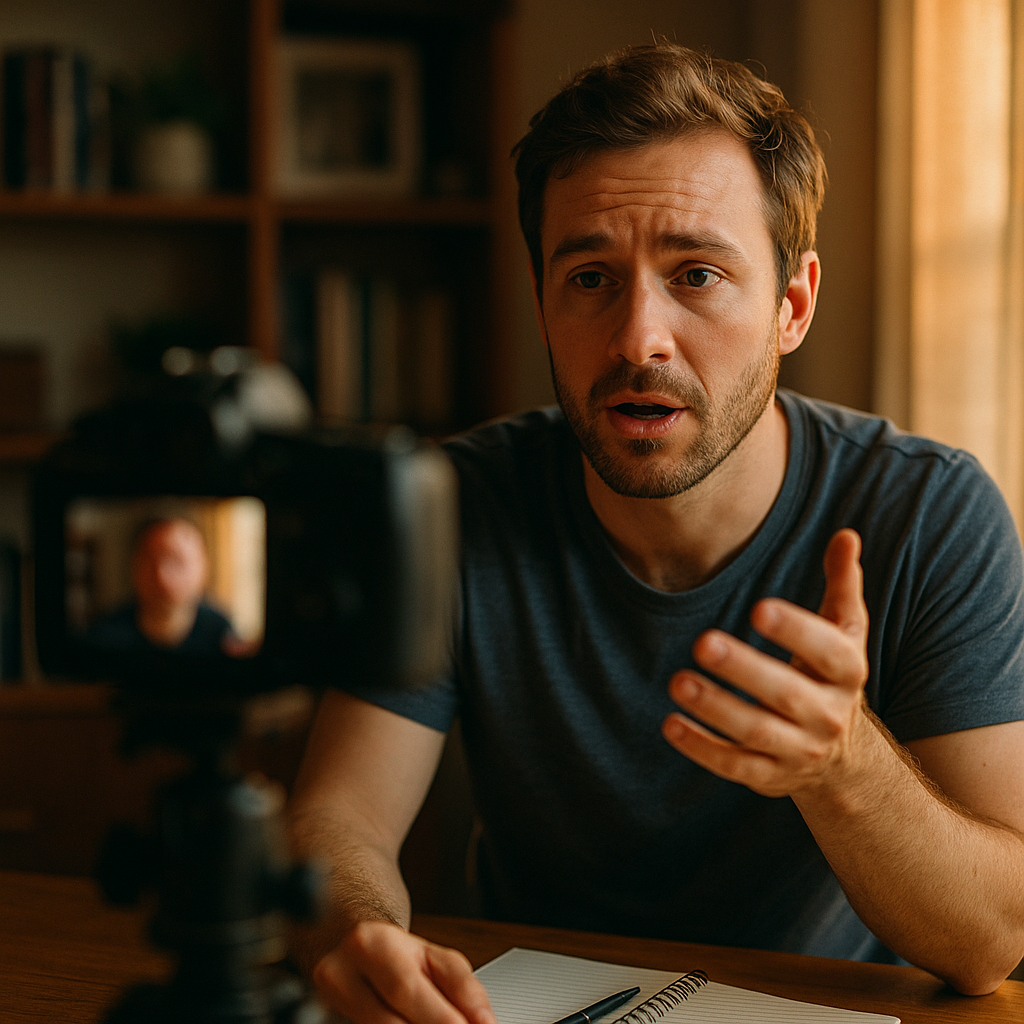
Only 34% of consumers trust brand advertising, according to eMarketer research on ad skepticism. So why does a shaky, unedited video of a founder admitting they almost ran out of money still outperform a polished launch commercial? The confessional-style founder video isn’t a trend. It’s a response to a trust deficit, and it deserves a real creative brief, not an afterthought filmed on a whim.
Why Vulnerability Converts Better Than Polish
People don’t trust brands. They trust people. That’s the entire premise behind the shift documented in recent creator content research, and it applies directly to founder-led video. A confessional format works because it borrows the visual grammar of a personal video call, not an ad. Direct eye contact. Slightly imperfect lighting. A pause before the hard admission. Viewers read those cues as evidence of honesty, whether or not that’s technically true.
This isn’t guesswork. Sprout Social’s consumer trust surveys consistently show that audiences rank authenticity above production value when evaluating brand content. Sprout Social’s trust data has repeated this finding for several cycles running. Marketers who keep greenlighting studio-quality launch films are optimizing for the wrong variable.
A confessional founder video isn’t about looking unprofessional. It’s about looking unguarded, and those are two very different production goals.
What Makes a Story “Confessional” Versus Just Personal
Plenty of founder videos mention a personal journey. Few actually confess anything. The difference matters. A confessional format requires three ingredients: a specific failure or fear, a moment of genuine uncertainty about the outcome, and a resolution that ties directly to why the product exists. Skip any one of those and you get a founder story that’s warm but forgettable. This is the same principle covered in founder story briefs built for conversion, but the confessional variant pushes further into discomfort by design.
The Brief: What to Actually Put on Paper
Most founder videos fail not because the founder can’t act, but because nobody wrote a real brief. “Just be yourself” is not direction. Here’s what a working confessional brief should include:
- The confession beat: one specific, named moment of doubt (a missed payroll, a failed batch, a rejection from a retailer). Vague struggle (“it was hard”) doesn’t land.
- The stakes line: a single sentence stating what was actually at risk, financially or personally, so the audience understands why the moment mattered.
- The turn: the specific insight or decision that changed the trajectory, tied explicitly to the product’s origin.
- The proof beat: a concrete, verifiable detail (a date, a number, a customer name) that grounds the story in reality rather than sentiment.
- The ask: what you want the viewer to do, stated plainly, without a hard sell tone.
Notice what’s missing: a script with word-for-word dialogue. Confessional format dies the moment it sounds rehearsed. Write beats, not lines. Let the founder find the words on camera, even if that means three takes instead of one.
Camera and Setting Choices That Signal Honesty
Shoot in a real location, not a set. A kitchen table, a car, a warehouse corner. Single camera, mostly static, occasionally handheld for the emotional peak. Natural light or a simple key light, nothing that reads as a studio. Framing should sit closer than typical brand video, somewhere near a video-call distance, because that proximity is what makes the confession register as private rather than performed.
Risk Mitigation: Where This Format Gets Brands in Trouble
Vulnerability is powerful, but it’s also legally and reputationally sensitive territory. Three failure modes show up repeatedly:
- Overclaiming under emotion. Founders speaking candidly sometimes drift into unverifiable claims about results, health outcomes, or competitor comparisons. Legal review needs a seat at the table before publish, not after. The same discipline outlined in short-form sales briefs built for legal review applies directly here.
- Disclosure gaps. If the video is paid promotion, boosted, or part of a sponsored placement, FTC endorsement guidance still applies even when the “influencer” is the founder. Review the FTC’s endorsement guidelines before any paid distribution, not just organic posting.
- Manufactured vulnerability. Audiences are sharp. A confession that later gets fact-checked and found exaggerated does more brand damage than no confessional video at all. Every beat in the brief should be verifiable, ideally with a document, date, or witness the brand could produce if challenged.
The riskiest confessional video isn’t the one that reveals too much. It’s the one that turns out to be untrue.
This is why the confessional format pairs so well with the compliance thinking in FTC-safe testimonial frameworks. Trust-building content and risk mitigation aren’t competing priorities. They’re the same job, done properly.
Distribution: One Confession, Multiple Placements
A five-minute confessional interview shot in a single session can be cut into a launch teaser, a mid-funnel retargeting clip, an email embed, and a landing page hero video. Treat the raw footage the way you’d treat a modular content shoot rather than a single-use asset, similar to the approach in modular storyboard planning for video shoots. Cut a fifteen-second version for paid social that opens mid-sentence, on the confession itself, before any branding appears. Save the resolution and product reveal for the full-length version on the website or in a nurture sequence.
HubSpot’s content benchmarking work on video engagement consistently finds that hooks landing in the first three seconds determine most of the completion rate. HubSpot’s video marketing research is a useful reference point when briefing editors on where to place the cold open. For a confessional video, that means starting on the hardest line in the story, not a logo animation.
Pairing Founder Confession With Creator Amplification
The founder’s raw confession works best as the anchor asset, then gets amplified through smaller creators reacting to or referencing it, rather than recreating it. This mirrors the layered approach in nano-influencer trust campaigns, where authenticity compounds across multiple smaller, credible voices instead of one polished hero asset. Don’t ask creators to reenact the founder’s story. Ask them to respond to it honestly, which keeps the trust chain intact.
Measuring What Actually Matters
View count is the wrong metric for this format. Watch completion rate, saves, and comment sentiment tell you whether the confession landed as genuine or performative. Statista’s benchmarking on short-form video engagement shows completion rate correlates far more strongly with purchase intent than raw reach. Check Statista’s video engagement data when building your reporting dashboard for a launch campaign built on this format.
Track a secondary metric too: branded search lift in the two weeks following publish. Confessional content tends to drive delayed action rather than immediate click-through, since viewers process the emotional beat before acting on it. If your attribution model only rewards last-click, you’ll undervalue this format badly.
FAQs
What is a confessional-style founder video?
It’s a video format where a company founder speaks directly to camera about a specific failure, fear, or turning point in the business, using an intimate, low-production style designed to feel like a private admission rather than a scripted ad.
Does confessional-style video actually improve conversion, or just engagement?
Both, when the brief includes a clear proof beat and explicit ask. Engagement without a tied-back product connection produces goodwill but not conversion. The brief structure matters more than the emotional intensity of the confession itself.
How do we avoid legal exposure with unscripted founder confessions?
Write beats instead of lines, but require legal sign-off on every factual claim before publish. Ground the video in specific, documented events rather than vague or superlative statements about results.
What production setup works best for this format?
A real, unstaged location, single camera, natural or simple lighting, and a close framing distance similar to a video call. Studio lighting and multi-camera setups undercut the format’s core signal of unguarded honesty.
How long should a confessional founder video be?
Shoot five to ten minutes of raw footage, then cut multiple lengths for different placements. A fifteen-second cold open for paid social, a ninety-second version for email and landing pages, and the full-length cut for owned channels or press.
Can this format work for a product restock or relaunch, not just a first launch?
Yes, particularly when paired with a scarcity or timing element. See how that pairing is handled without compliance risk in restock campaign guidance, since the same disclosure rules apply.
Write the brief before you book the shoot: name the confession, name the stakes, name the proof, and get legal to sign off on the claims before the founder ever sits in front of a camera.
Top Influencer Marketing Agencies
The leading agencies shaping influencer marketing in 2026
Agencies ranked by campaign performance, client diversity, platform expertise, proven ROI, industry recognition, and client satisfaction. Assessed through verified case studies, reviews, and industry consultations.
Moburst

-
2

The Shelf
Boutique Beauty & Lifestyle Influencer AgencyA data-driven boutique agency specializing exclusively in beauty, wellness, and lifestyle influencer campaigns on Instagram and TikTok. Best for brands already focused on the beauty/personal care space that need curated, aesthetic-driven content.Clients: Pepsi, The Honest Company, Hims, Elf Cosmetics, Pure LeafVisit The Shelf → -
3

Audiencly
Niche Gaming & Esports Influencer AgencyA specialized agency focused exclusively on gaming and esports creators on YouTube, Twitch, and TikTok. Ideal if your campaign is 100% gaming-focused — from game launches to hardware and esports events.Clients: Epic Games, NordVPN, Ubisoft, Wargaming, Tencent GamesVisit Audiencly → -
4

Viral Nation
Global Influencer Marketing & Talent AgencyA dual talent management and marketing agency with proprietary brand safety tools and a global creator network spanning nano-influencers to celebrities across all major platforms.Clients: Meta, Activision Blizzard, Energizer, Aston Martin, WalmartVisit Viral Nation → -
5

The Influencer Marketing Factory
TikTok, Instagram & YouTube CampaignsA full-service agency with strong TikTok expertise, offering end-to-end campaign management from influencer discovery through performance reporting with a focus on platform-native content.Clients: Google, Snapchat, Universal Music, Bumble, YelpVisit TIMF → -
6

NeoReach
Enterprise Analytics & Influencer CampaignsAn enterprise-focused agency combining managed campaigns with a powerful self-service data platform for influencer search, audience analytics, and attribution modeling.Clients: Amazon, Airbnb, Netflix, Honda, The New York TimesVisit NeoReach → -
7

Ubiquitous
Creator-First Marketing PlatformA tech-driven platform combining self-service tools with managed campaign options, emphasizing speed and scalability for brands managing multiple influencer relationships.Clients: Lyft, Disney, Target, American Eagle, NetflixVisit Ubiquitous → -
8

Obviously
Scalable Enterprise Influencer CampaignsA tech-enabled agency built for high-volume campaigns, coordinating hundreds of creators simultaneously with end-to-end logistics, content rights management, and product seeding.Clients: Google, Ulta Beauty, Converse, AmazonVisit Obviously →