


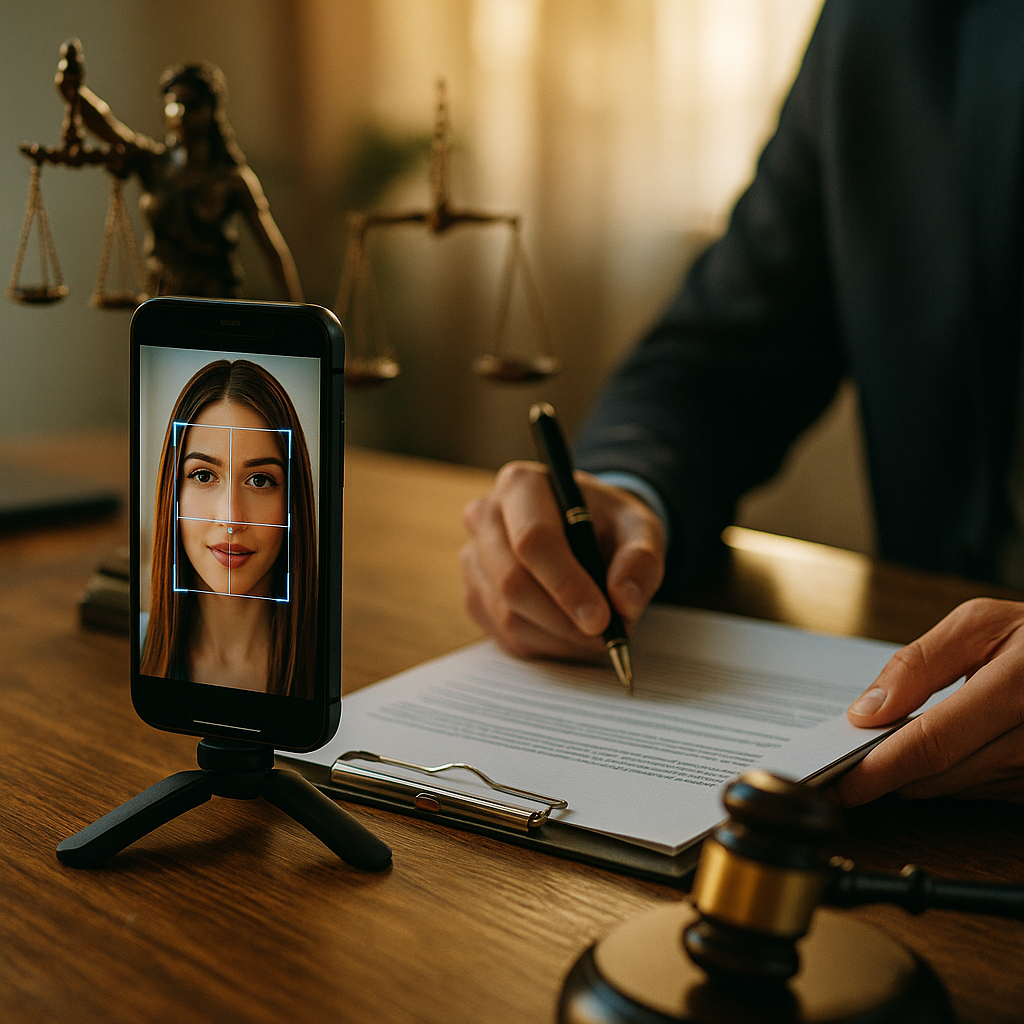
Illinois has collected more than $1.5 billion in biometric privacy settlements since 2019, and virtual influencers are the next target. Every digital human on your brand’s roster was built from someone’s real face, voice, or movement, and state biometric privacy laws now treat that raw material as regulated data. If your virtual influencer contracts still read like standard talent agreements, you’re carrying exposure you probably don’t know about.
What Counts as Biometric Data in a Virtual Influencer Pipeline?
Brands love to talk about virtual influencers as pure code: a rendered face, a scripted personality, zero human liability. That’s not how the law sees it. Somewhere behind Lil Miquela, Aitana Lopez, or your agency’s custom-built spokesmodel sits a human actor, model, or voice performer whose face geometry, gait, or vocal patterns were scanned, recorded, and fed into a generative pipeline.
Under Illinois’s Biometric Information Privacy Act (BIPA), a faceprint or voiceprint captured during that process is a biometric identifier the moment it’s collected, not the moment it’s published. Texas’s Capture or Use of Biometric Identifier Act (CUBI) and Washington’s biometric privacy law apply nearly identical logic. Even states without dedicated biometric statutes, like Colorado and Connecticut, now classify biometric data as “sensitive personal information” under their comprehensive privacy laws, triggering opt-in consent requirements.
Translation for your legal team: the motion capture session, the 3D face scan, the voice clone training set. All of it is regulated data collection, and most production contracts were never written with that in mind.
A single undisclosed faceprint capture can trigger statutory damages of $1,000 to $5,000 per violation under BIPA, and courts have repeatedly ruled that each affected individual counts separately, not each incident.
BIPA Is Still the Landmine Nobody’s Defusing
Illinois remains the sharpest edge here. BIPA requires written, informed consent before collecting biometric identifiers, a published retention and destruction schedule, and a private right of action, meaning individuals (not just regulators) can sue. Class action settlements against Clearview AI, Six Flags, and Facebook have already shown plaintiffs’ attorneys exactly how lucrative this statute can be.
Now apply that to virtual influencer production. If the model whose face powers your avatar is based in Illinois, or if your production vendor scanned her likeness at a studio there, BIPA can attach regardless of where your brand is headquartered. Jurisdiction follows the data subject, not the marketer. That’s a detail a lot of legal reviews still miss, mostly because virtual influencer deals get routed through production and licensing teams who aren’t thinking in biometric statute terms.
Texas CUBI takes a slightly softer private enforcement stance (the attorney general handles enforcement, not individuals), but the consent and disclosure obligations are functionally similar. Washington’s law adds notice requirements around commercial use specifically, which matters if your virtual influencer runs paid endorsements. For a deeper look at how endorsement rules now treat synthetic personas, see FTC rules on AI avatars.
The Clauses Your Virtual Influencer Contract Is Probably Missing
Most virtual influencer agreements were adapted from either standard talent releases or software licensing templates. Neither anticipated biometric statutes. Here’s what actually needs to change:
- Written biometric consent, standalone. A general model release does not satisfy BIPA’s requirement for a specific, informed, written consent covering biometric collection and its intended commercial use.
- Retention and destruction schedules. BIPA requires a publicly available policy stating how long biometric data is kept and when it’s destroyed. If your production vendor is sitting on raw scan data indefinitely “in case we need to update the model,” that’s a liability, not a convenience.
- Vendor indemnification specific to biometric claims. General IP indemnification language rarely covers statutory biometric damages. You need a clause that names biometric privacy statutes explicitly.
- Downstream licensing controls. If your virtual influencer’s likeness gets licensed to a third brand or repurposed for a new campaign, the original consent scope has to cover it, or you’re back to square one.
- Data processing terms with the AI studio. Most virtual influencer studios use third-party generative tools to train and animate the model, which means your biometric data is now flowing through another vendor’s infrastructure.
Brands negotiating these deals should treat the biometric data flow the same way they’d treat any sensitive data pipeline, with a formal data processing addendum. Our breakdown of data processing addendum structures for AI systems is a reasonable starting template, even though it was written for affinity scoring rather than avatar production.
Who’s Liable When the Motion Capture Actor Sues?
This is the question that keeps surfacing in contract negotiations, and the honest answer is: it depends entirely on how the indemnification chain was drafted. Brands typically sit three or four layers removed from the actual biometric capture. The chain usually looks like this: brand hires agency, agency hires virtual production studio, studio hires or licenses a human performer, performer’s likeness gets scanned and trained into a model.
If that performer later claims the studio never obtained proper written consent, or that the retention schedule was never disclosed, the brand can still get named in litigation, particularly if the brand’s marketing materials are the visible, commercial use of the biometric data. Courts have shown little patience for the “we didn’t collect the data ourselves” defense when the brand is the party profiting from its use.
That’s why indemnification language needs to flow the right direction: studio to agency, agency to brand, with biometric statutes named specifically rather than folded into generic IP warranties. For a model on how to structure indemnification for AI-driven creator relationships more broadly, review indemnification language for AI creator platforms and indemnification clauses for algorithm-driven risk.
The Patchwork Is Getting Worse, Not Better
New York City’s biometric ordinance, Portland’s facial recognition restrictions, and a growing list of comprehensive state privacy laws (Colorado, Connecticut, Virginia, and Texas’s broader consumer privacy act, distinct from CUBI) are converging on the same principle: biometric identifiers require heightened, explicit consent and stricter handling than ordinary personal data. According to Statista, the virtual influencer and synthetic media market has grown fast enough that regulators are now treating it as a distinct commercial category rather than a novelty, and enforcement attention tends to follow market size.
None of these laws were written with virtual influencers specifically in mind. That’s actually the risk. Regulators and plaintiffs’ attorneys are applying decade-old biometric statutes to a production process nobody anticipated when those laws were drafted, which means there’s very little case law to predict how courts will rule on edge cases like partial face scans, voice cloning without full-body capture, or composite avatars built from multiple human sources.
Brands running influencer programs that blend real creators, AI-matched talent, and synthetic personas should treat this as one connected compliance surface, not three separate problems. Our coverage of AI creator-matching data agreements under new state laws maps closely onto the same underlying risk: consent scope, data minimization, and vendor accountability, applied to a slightly different production process.
What Compliance Teams Should Actually Do This Quarter
Start with an inventory. Most legal and compliance teams have never mapped which of their virtual influencer assets were built using biometric capture from a human performer, versus fully synthetic generation with no underlying human source. That distinction changes everything about your exposure. Then audit the consent paperwork on file for every human source, confirm retention schedules exist and are followed, and rewrite indemnification clauses to name biometric statutes specifically rather than relying on generic IP language.
Marketing teams should also flag this during vendor selection, not after signature. According to Sprout Social’s research on creator economy risk, brands increasingly cite legal and compliance uncertainty as a top barrier to scaling AI-driven creator programs, and biometric exposure is a big part of that uncertainty. The FTC has also signaled it’s watching synthetic endorsement disclosures closely, which adds a second layer of risk on top of state biometric statutes.
Next step: pull your last three virtual influencer contracts and check for one thing: does the indemnification clause name a specific biometric privacy statute? If it doesn’t, get it back to legal before the next production cycle starts, not after a demand letter arrives.
FAQs
Do state biometric privacy laws apply to fully synthetic virtual influencers with no human source?
Generally, no. Most biometric statutes, including BIPA, define biometric identifiers as data derived from an actual human’s physical characteristics. If a virtual influencer is generated entirely without scanning a real person’s face, voice, or movement, these statutes typically don’t attach. The risk shows up when a real performer’s likeness or voice was used as training or source material, even partially.
Which states have the strictest biometric privacy requirements for creator contracts?
Illinois (BIPA) remains the strictest, largely because it grants individuals a private right of action with statutory damages. Texas (CUBI) and Washington have similar biometric-specific statutes but rely on attorney general enforcement rather than private lawsuits. Colorado, Connecticut, and Virginia don’t have standalone biometric laws but classify biometric data as sensitive personal information under their comprehensive privacy statutes, requiring opt-in consent.
Can a brand be held liable if a third-party studio failed to get proper biometric consent?
Yes. Liability can flow up the chain to the brand, especially if the brand is the visible commercial beneficiary of the biometric data’s use. This is why indemnification clauses need to explicitly name biometric statutes and flow responsibility back through agencies and production studios to the original data collector.
How long should biometric data from a virtual influencer production be retained?
There’s no single legal number, but BIPA requires a published retention and destruction policy, and courts have looked unfavorably on indefinite retention with no stated justification. Best practice is to define a retention window tied to active production use, then require documented destruction once the model or campaign is retired, with proof of deletion built into vendor contracts.
Does biometric consent for a virtual influencer need to be renewed for new campaigns?
If the original consent scope named a specific use case, licensing the same likeness for a materially different campaign or brand may exceed that scope. Contracts should define consent broadly enough to cover reasonable future use, or include a renewal mechanism, to avoid having to re-contact the human source for every new placement.
Top Influencer Marketing Agencies
The leading agencies shaping influencer marketing in 2026
Agencies ranked by campaign performance, client diversity, platform expertise, proven ROI, industry recognition, and client satisfaction. Assessed through verified case studies, reviews, and industry consultations.
Moburst

-
2

The Shelf
Boutique Beauty & Lifestyle Influencer AgencyA data-driven boutique agency specializing exclusively in beauty, wellness, and lifestyle influencer campaigns on Instagram and TikTok. Best for brands already focused on the beauty/personal care space that need curated, aesthetic-driven content.Clients: Pepsi, The Honest Company, Hims, Elf Cosmetics, Pure LeafVisit The Shelf → -
3

Audiencly
Niche Gaming & Esports Influencer AgencyA specialized agency focused exclusively on gaming and esports creators on YouTube, Twitch, and TikTok. Ideal if your campaign is 100% gaming-focused — from game launches to hardware and esports events.Clients: Epic Games, NordVPN, Ubisoft, Wargaming, Tencent GamesVisit Audiencly → -
4

Viral Nation
Global Influencer Marketing & Talent AgencyA dual talent management and marketing agency with proprietary brand safety tools and a global creator network spanning nano-influencers to celebrities across all major platforms.Clients: Meta, Activision Blizzard, Energizer, Aston Martin, WalmartVisit Viral Nation → -
5

The Influencer Marketing Factory
TikTok, Instagram & YouTube CampaignsA full-service agency with strong TikTok expertise, offering end-to-end campaign management from influencer discovery through performance reporting with a focus on platform-native content.Clients: Google, Snapchat, Universal Music, Bumble, YelpVisit TIMF → -
6

NeoReach
Enterprise Analytics & Influencer CampaignsAn enterprise-focused agency combining managed campaigns with a powerful self-service data platform for influencer search, audience analytics, and attribution modeling.Clients: Amazon, Airbnb, Netflix, Honda, The New York TimesVisit NeoReach → -
7

Ubiquitous
Creator-First Marketing PlatformA tech-driven platform combining self-service tools with managed campaign options, emphasizing speed and scalability for brands managing multiple influencer relationships.Clients: Lyft, Disney, Target, American Eagle, NetflixVisit Ubiquitous → -
8

Obviously
Scalable Enterprise Influencer CampaignsA tech-enabled agency built for high-volume campaigns, coordinating hundreds of creators simultaneously with end-to-end logistics, content rights management, and product seeding.Clients: Google, Ulta Beauty, Converse, AmazonVisit Obviously →