


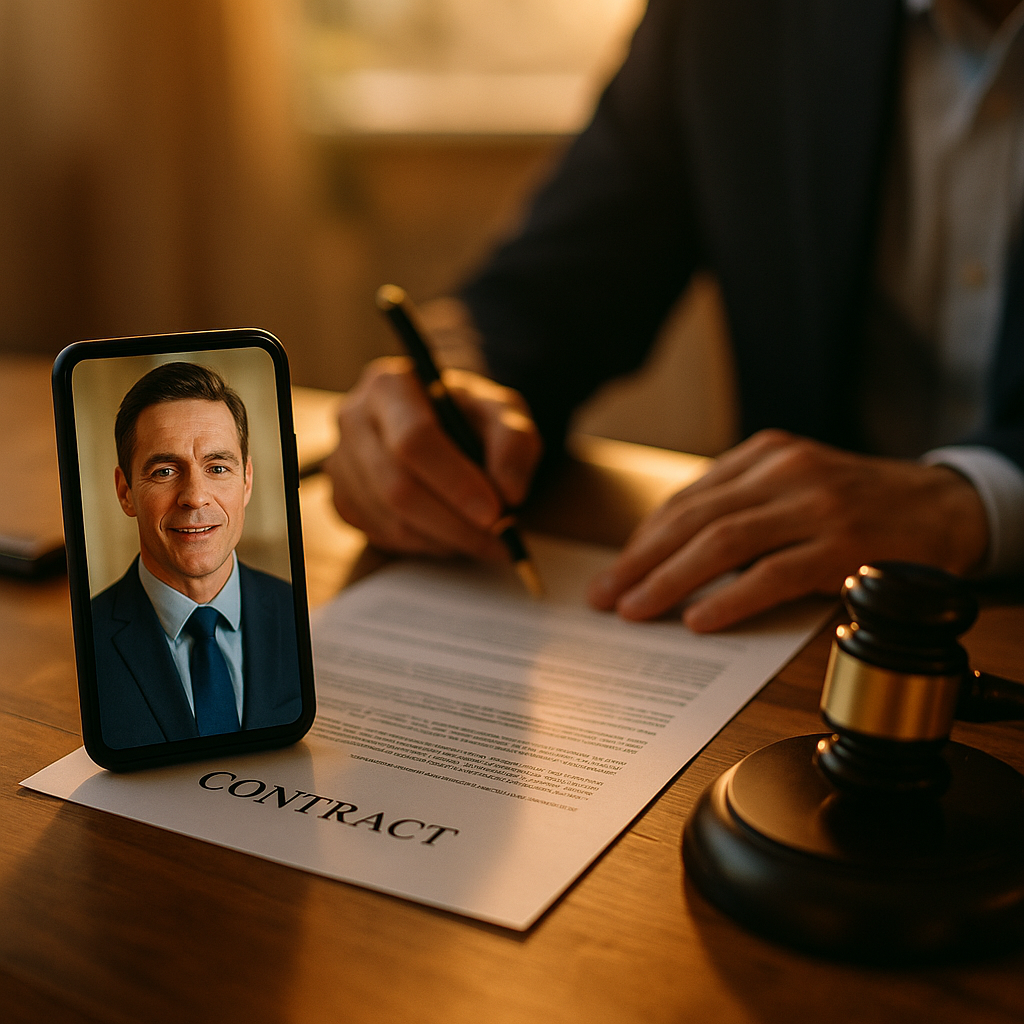
A single unauthorized deepfake ad running for 48 hours can reach millions of viewers before takedown notices even get filed. Deepfake endorsement risk isn’t a hypothetical anymore, it’s a line item your legal team should have flagged last quarter. If your creator and celebrity contracts still treat “likeness” as a static photo or a video shoot, you’re negotiating for a threat that no longer exists.
What Counts as an Unauthorized AI Clone?
Let’s define the problem before we fix it. An unauthorized AI clone is any synthetic reproduction of a person’s voice, face, gestures, or speech patterns used commercially without a specific, current license covering that exact use. That distinction matters. A spokesperson who signed a 2023 deal for a TV commercial did not sign away rights to a voice-cloned chatbot script in 2026.
Scammers have gotten good at this. Financial services brands in particular have seen their executives and paid endorsers cloned into fake crypto pitches and “insider trading tip” videos. But the more uncomfortable version of this risk is internal: agencies and marketing teams reusing an influencer’s likeness for AI-generated variations of a campaign, assuming the original contract covers it. It usually doesn’t.
The riskiest deepfakes aren’t the ones from anonymous scammers. They’re the ones your own team generates internally, assuming a signed release from three years ago still applies.
The Contract Gap Most Brands Don’t Know They Have
Most influencer and celebrity endorsement agreements were written before generative AI could convincingly clone a voice from eleven seconds of audio. That’s not an exaggeration, it’s roughly the benchmark cited by voice-cloning researchers for tools like ElevenLabs-style synthesis. Your existing contract library was built for a world where reproducing someone’s likeness required a camera crew, not a laptop.
Here’s the gap in plain terms: standard likeness clauses grant usage rights for “the Content” or “materials produced under this Agreement.” They rarely address synthetic derivatives, AI training use, or third-party clones that were never authorized in the first place. When a deepfake surfaces wearing your brand’s colors, your legal team is left arguing trademark and right-of-publicity law case by case, which is slow, expensive, and inconsistent across jurisdictions.
This is exactly the kind of exposure covered in our AI marketing risk checklist, and it’s worth running your current contract templates against it before your next campaign cycle.
Five Clauses Every Endorsement Contract Needs Now
You don’t need to reinvent contract law. You need five specific additions, most of which your outside counsel can draft in an afternoon once you know what to ask for.
- Synthetic likeness definition: Explicitly define “likeness” to include AI-generated, voice-cloned, deepfake, or synthetic reproductions, not just photography and video captured during the engagement.
- Affirmative consent for AI use, scoped and time-limited: Require separate, opt-in consent for any AI training, generative reuse, or synthetic media application, with an expiration date that forces renegotiation rather than perpetual rights.
- Monitoring and takedown obligation: Assign responsibility (brand, agency, or platform) for actively monitoring for unauthorized clones and specify response timelines, ideally under 24 hours for confirmed matches.
- Indemnification for platform failure: If a third-party platform’s content moderation fails to catch an obvious deepfake ad using your creator’s face, who eats the cost? Spell it out before launch, not after a viral scandal.
- Right to audit AI-generated derivative assets: Give the brand or talent the contractual right to review any AI-modified version of approved content before it goes live, closing the loophole where “we just upscaled it with AI” becomes an excuse for unauthorized alteration.
None of these clauses are exotic. They’re the same discipline we recommend in creator ad approval audits, just extended to cover synthetic media specifically.
Who’s Liable When a Clone Slips Through?
This is the question that keeps general counsel up at night. Liability tends to split three ways: the platform that hosted the deepfake ad, the bad actor who created it, and the brand whose products it promoted. In practice, the bad actor is usually unreachable or judgment-proof. That leaves platforms and brands pointing fingers at each other, and consumers rarely care who’s technically at fault when they’ve been scammed by a fake celebrity endorsement of your product.
Regulators are paying attention too. The FTC has signaled that brands benefiting from deceptive AI-generated endorsements, even unauthorized ones, can face scrutiny if they were slow to act on credible reports. “We didn’t make it” is a weaker defense than most marketing teams assume.
Regulators increasingly ask not “did you create the deepfake” but “how fast did you respond once you knew.” Speed of takedown is becoming its own compliance metric.
This is where indemnification language for the platforms you use to source and match creators becomes non-negotiable. If you’re running AI-assisted creator matching or generative ad tools, review the indemnification language for AI matching platforms before you scale spend through them.
Building Detection Into the Deal, Not Just the Document
A contract clause is only as good as your ability to enforce it, and enforcement requires detection. Brands with real endorsement portfolios (think beauty, finance, fitness, anything with recognizable spokespeople) are increasingly contracting with detection vendors like Reality Defender, Sensity, and DeepMedia to run continuous scans across social platforms and ad networks. Some are folding these detection services directly into their talent contracts as a shared cost with the platforms and agencies involved.
Budget for this. According to Statista, spend on synthetic media detection and brand safety tooling has climbed steadily as deepfake incidents have multiplied across financial services, beauty, and wellness categories, the sectors most frequently impersonated in scam ads. If your annual influencer program budget doesn’t include a line for detection tooling, that’s a gap worth raising at the next planning meeting.
Detection also intersects with biometric privacy law in ways many marketers haven’t fully mapped. If your monitoring vendor is scanning faces and voices to detect clones, you may be triggering biometric data obligations of your own. Our breakdown of biometric privacy contract fixes is a useful companion read here, especially if you’re running virtual influencer programs alongside human talent.
Insurance Won’t Save You, But It Helps
Contract clauses reduce risk. Insurance absorbs what’s left. A growing number of talent agencies and brand legal teams are pushing for endorsement-specific coverage that names deepfake misuse and unauthorized synthetic likeness as a covered peril, not an exclusion buried in boilerplate. This is a relatively new ask for underwriters, so don’t assume your existing media liability policy covers it automatically.
Ask your broker directly whether synthetic media impersonation is named or excluded. If it’s silent, treat that as a no. Our guide to insurance for creator partnerships walks through the coverage categories worth pushing for as your influencer program scales past a handful of talent relationships.
According to Sprout Social’s ongoing research into brand trust, consumer confidence in influencer content drops sharply after a single high-profile deepfake scandal touches an adjacent brand, not just the impersonated one. Trust damage spreads sideways. That’s the real cost driver behind getting this contract language right before you need it.
What to Do This Quarter
Pull your top ten active endorsement contracts by spend. Check for a synthetic likeness definition. If it’s missing, that’s your priority fix, not next year’s project. Pair the contract update with a detection vendor conversation and a five-minute call to your insurance broker, and you’ve closed the three biggest gaps that let deepfake endorsement risk turn into an actual incident.
Frequently Asked Questions
What is deepfake endorsement risk?
Deepfake endorsement risk refers to the financial, legal, and reputational exposure a brand faces when a person’s face, voice, or likeness is used in an AI-generated endorsement without proper authorization, whether created by outside scammers or by internal teams exceeding the scope of an existing contract.
Do standard influencer contracts already cover AI clones?
Usually not. Most contracts written before recent AI advances define likeness rights around photography and video captured during the engagement, not synthetic or AI-generated derivatives. Brands need explicit clauses covering synthetic media use.
Who is legally responsible when a deepfake ad uses a real endorser’s likeness without consent?
Liability typically splits between the platform hosting the content, the party who created the deepfake, and the brand that benefits from it commercially. Regulators including the FTC have signaled that slow response to known deepfakes can itself create exposure for brands, independent of who created the content.
What contract clauses best protect against unauthorized AI clones?
The strongest protections include a synthetic likeness definition, time-limited affirmative consent for AI use, a monitoring and takedown obligation, indemnification for platform moderation failures, and a right to audit any AI-modified derivative assets before publication.
Does insurance cover deepfake endorsement incidents?
Not automatically. Many media liability and talent policies are silent on synthetic media impersonation, which effectively excludes it. Brands should confirm with their broker whether deepfake misuse is a named covered peril rather than assuming standard coverage applies.
How quickly should a brand respond to a discovered deepfake?
Fast. Regulators and platforms increasingly evaluate brand response time as part of compliance scrutiny, with a target of under 24 hours from confirmed detection to takedown request being a reasonable internal benchmark for most contracts.
Top Influencer Marketing Agencies
The leading agencies shaping influencer marketing in 2026
Agencies ranked by campaign performance, client diversity, platform expertise, proven ROI, industry recognition, and client satisfaction. Assessed through verified case studies, reviews, and industry consultations.
Moburst

-
2

The Shelf
Boutique Beauty & Lifestyle Influencer AgencyA data-driven boutique agency specializing exclusively in beauty, wellness, and lifestyle influencer campaigns on Instagram and TikTok. Best for brands already focused on the beauty/personal care space that need curated, aesthetic-driven content.Clients: Pepsi, The Honest Company, Hims, Elf Cosmetics, Pure LeafVisit The Shelf → -
3

Audiencly
Niche Gaming & Esports Influencer AgencyA specialized agency focused exclusively on gaming and esports creators on YouTube, Twitch, and TikTok. Ideal if your campaign is 100% gaming-focused — from game launches to hardware and esports events.Clients: Epic Games, NordVPN, Ubisoft, Wargaming, Tencent GamesVisit Audiencly → -
4

Viral Nation
Global Influencer Marketing & Talent AgencyA dual talent management and marketing agency with proprietary brand safety tools and a global creator network spanning nano-influencers to celebrities across all major platforms.Clients: Meta, Activision Blizzard, Energizer, Aston Martin, WalmartVisit Viral Nation → -
5

The Influencer Marketing Factory
TikTok, Instagram & YouTube CampaignsA full-service agency with strong TikTok expertise, offering end-to-end campaign management from influencer discovery through performance reporting with a focus on platform-native content.Clients: Google, Snapchat, Universal Music, Bumble, YelpVisit TIMF → -
6

NeoReach
Enterprise Analytics & Influencer CampaignsAn enterprise-focused agency combining managed campaigns with a powerful self-service data platform for influencer search, audience analytics, and attribution modeling.Clients: Amazon, Airbnb, Netflix, Honda, The New York TimesVisit NeoReach → -
7

Ubiquitous
Creator-First Marketing PlatformA tech-driven platform combining self-service tools with managed campaign options, emphasizing speed and scalability for brands managing multiple influencer relationships.Clients: Lyft, Disney, Target, American Eagle, NetflixVisit Ubiquitous → -
8

Obviously
Scalable Enterprise Influencer CampaignsA tech-enabled agency built for high-volume campaigns, coordinating hundreds of creators simultaneously with end-to-end logistics, content rights management, and product seeding.Clients: Google, Ulta Beauty, Converse, AmazonVisit Obviously →