


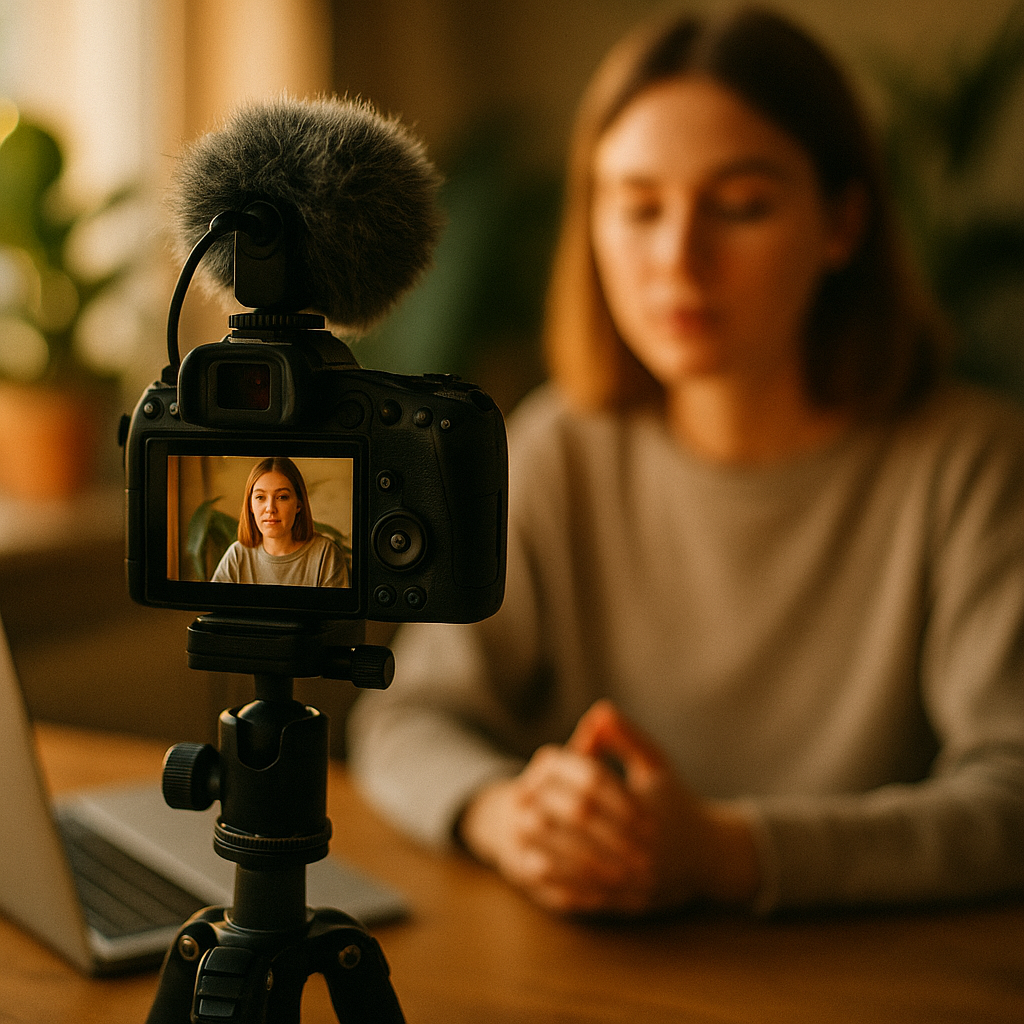
Scroll through TikTok or Instagram Reels right now and you will hit a wall of quiet: no trending audio, no breathless voiceover, sometimes no captions at all. Just ambient sound, a slow pan, and a product doing the talking. The silent vlog trend has racked up billions of views across lifestyle and retail content, and it is forcing brand teams to answer an uncomfortable question: what does your voice sound like when there is no voice at all?
What Counts as a Silent Vlog, Exactly?
Silent vlogs strip out narration and often music, leaning instead on diegetic sound: keys jangling, coffee pouring, footsteps on hardwood. Think of the “quiet luxury” morning routine clips or the no-talking store walkthroughs that dominate home, beauty, and fashion niches. Creators let the room tone, the product texture, and the pacing carry the story. It is the opposite of the hyped-up, caption-stacked format that ruled short video for years.
The aesthetic borrows from ASMR and slow cinema, but it is not just an audio choice. It is a pacing choice, an editing choice, and increasingly, a brand strategy choice. We have already covered adjacent formats like silent store walkthroughs, which apply the same muted logic to retail environments specifically.
Why Are Audiences Suddenly Craving Quiet?
Feed fatigue is real. Sprout Social and other platform researchers have repeatedly flagged declining trust in overly polished, loud brand content. Consumers, especially younger ones, associate volume and hype with sales pressure. Silence reads as confidence. It signals “we don’t need to shout, the product speaks for itself,” which is a powerful psychological reframe for brands tired of fighting algorithm-driven noise.
Silence is not the absence of a message. It is a message that says the product doesn’t need convincing, and that restraint is now doing more persuasive work than any hook line.
The Brand Voice Problem Nobody Planned For
Brand voice guidelines were built for words: tone, vocabulary, sentence rhythm. Nobody wrote a style guide for silence. Yet that is exactly what marketing teams need now. If your brand voice is “playful and energetic” in copy, does it fall apart when a creator posts a wordless 40-second clip with nothing but ambient café noise?
The answer is that brand voice has to expand beyond language into pacing, framing, and sound design choices. A muted aesthetic still communicates brand personality through:
- Editing rhythm (quick cuts versus long, unhurried takes)
- Choice of ambient sound (busy street versus quiet studio)
- Visual color grading and lighting mood
- What is left in frame versus what gets cropped out
- The absence or presence of on-screen text
This is where a lot of brand safety teams get nervous. Without a script or voiceover, how do you control messaging? The honest answer: you don’t control it the same way. You brief for intent and trust the creator’s instinct, similar to the approach outlined in briefing for intentionally imperfect content, where letting go of scripted precision actually increases perceived authenticity.
ROI: Does Quiet Content Actually Convert?
Here is the part performance marketers actually care about. Early data from agencies running silent-format tests shows engagement rates holding steady or improving compared to voiceover-heavy content, particularly in the 25-44 demographic that has grown wary of “hey guys” openers. Watch time tends to increase because there is no jarring cut when a hook ends; the pacing invites longer, more meditative viewing.
Conversion lift is harder to isolate, but retail and beauty brands running silent walkthroughs alongside trust-first unboxing content report comparable click-through to product pages, sometimes with lower cost per view because these formats are cheaper to produce. No script, no talent read-through, no re-shoots for flubbed lines. That is a real operational efficiency gain for brands managing tight content budgets.
Silent content often costs less to produce than scripted formats, while matching or beating watch time benchmarks, which makes it one of the rare trends that improves both brand perception and unit economics simultaneously.
Where Silent Vlogs Fit in Your Content Mix
Nobody is suggesting you go fully silent across every channel. That would be a category error. Silent vlogs work best as a texture within a broader content ladder, not a replacement for your entire strategy. Consider how they slot alongside other formats:
- Top of funnel discovery: Silent aesthetic content performs well here because it feels native and unforced, unlike ad-coded hooks.
- Mid-funnel consideration: Pair muted product walkthroughs with more explanatory formats like comparison and versus videos that do need voice to make the case.
- Bottom funnel conversion: Silence alone rarely closes a sale. Layer in shoppable interactive video elements so the quiet aesthetic still has a clear path to checkout.
Think of silence as one register in a larger vocal range, not a monolingual strategy.
Compliance and Disclosure: The Part Legal Will Ask About
Silent format or not, disclosure rules from the FTC still apply. A muted aesthetic does not exempt sponsored content from clear and conspicuous disclosure. Brands in the UK also need to keep an eye on ICO guidance around data and advertising transparency, particularly if silent content is paired with any tracking or retargeting pixels embedded in shoppable formats.
The tricky bit is visual placement. Without a voiceover to say “this video is sponsored,” disclosure has to live on screen, and it needs to be legible against whatever quiet, minimal aesthetic the creator is running. Compliance teams should treat this the same way they would comment-bait formats without crossing compliance lines: build disclosure into the creative brief from day one rather than bolting it on after edit.
Briefing Creators for Muted Content Without Killing the Vibe
Over-briefing is the fastest way to ruin a silent vlog. If you hand a creator a shot list with 14 mandatory beats and three brand mentions, you get something that looks like an ad with the sound turned off, not an authentic quiet moment. Instead:
- Brief for mood and pacing, not dialogue or talking points.
- Specify 2-3 product touchpoints that must appear in frame, and let the creator decide how.
- Give sound design guardrails (no trending audio if brand safety is a concern) but avoid dictating every ambient noise.
- Allow longer runtimes. Silent content often needs 45-90 seconds to breathe; forcing it into a 15-second cut kills the effect.
This mirrors the looser, trust-based briefing style already working well for retail therapy vlogs, where the creator’s natural pacing is the selling point, not an obstacle to manage.
Measuring a Format That Has No Words to Track
Traditional sentiment analysis tools rely heavily on transcripts and captions. Silent content breaks that model. Marketers need to lean more on watch-time curves, replay rate, and save/share ratios rather than keyword-based sentiment scoring. Platforms like Sprout Social and native analytics dashboards on Meta and TikTok Ads Manager still capture these engagement signals even without spoken content, so reporting frameworks need a slight recalibration, not a rebuild.
If your team already reports on eMarketer benchmark data for short-form video, add watch-completion rate as a headline metric for silent formats specifically. It is the single best proxy for whether the quiet actually held attention or just faded into background noise.
A Quick Gut Check Before You Brief Your First Silent Campaign
Ask three questions internally. Does our product have enough visual or tactile interest to carry a wordless narrative? Can our disclosure requirements fit cleanly on screen without ruining the aesthetic? And is our brand voice flexible enough to translate into pacing and framing, not just vocabulary? If you answer yes to all three, you have a real opportunity, not just a trend to chase.
Start small: brief one creator for a 60-second silent product walkthrough, measure watch-completion against your usual voiceover content, and let the data decide whether quiet earns a permanent slot in your content calendar.
Frequently Asked Questions
What is the silent vlog trend in influencer marketing?
It refers to short-form video content that drops narration and often music in favor of ambient sound, slow pacing, and visual storytelling. Brands are adopting it in product walkthroughs, unboxings, and lifestyle content to feel less like traditional advertising.
Does silent content still need FTC disclosure?
Yes. Sponsorship disclosure rules apply regardless of whether a video includes narration. Disclosure must be clear and conspicuous on screen since there is no voiceover to state it verbally.
How do you measure success for a format with no dialogue?
Rely on watch-completion rate, replay rate, and save or share ratios instead of keyword-based sentiment tools, since those depend on transcripts that silent content often lacks.
Is silent content cheaper to produce than scripted formats?
Generally yes. Without a script, talent read-throughs, or voiceover recording, production timelines shrink and reshoots for line flubs disappear, lowering cost per piece of content.
Should every brand try a silent vlog format?
Not necessarily. Products with strong visual or tactile qualities translate well. Complex services or highly technical products may need spoken explanation to convert, so silent formats work best as one part of a broader content mix.
Top Influencer Marketing Agencies
The leading agencies shaping influencer marketing in 2026
Agencies ranked by campaign performance, client diversity, platform expertise, proven ROI, industry recognition, and client satisfaction. Assessed through verified case studies, reviews, and industry consultations.
Moburst

-
2

The Shelf
Boutique Beauty & Lifestyle Influencer AgencyA data-driven boutique agency specializing exclusively in beauty, wellness, and lifestyle influencer campaigns on Instagram and TikTok. Best for brands already focused on the beauty/personal care space that need curated, aesthetic-driven content.Clients: Pepsi, The Honest Company, Hims, Elf Cosmetics, Pure LeafVisit The Shelf → -
3

Audiencly
Niche Gaming & Esports Influencer AgencyA specialized agency focused exclusively on gaming and esports creators on YouTube, Twitch, and TikTok. Ideal if your campaign is 100% gaming-focused — from game launches to hardware and esports events.Clients: Epic Games, NordVPN, Ubisoft, Wargaming, Tencent GamesVisit Audiencly → -
4

Viral Nation
Global Influencer Marketing & Talent AgencyA dual talent management and marketing agency with proprietary brand safety tools and a global creator network spanning nano-influencers to celebrities across all major platforms.Clients: Meta, Activision Blizzard, Energizer, Aston Martin, WalmartVisit Viral Nation → -
5

The Influencer Marketing Factory
TikTok, Instagram & YouTube CampaignsA full-service agency with strong TikTok expertise, offering end-to-end campaign management from influencer discovery through performance reporting with a focus on platform-native content.Clients: Google, Snapchat, Universal Music, Bumble, YelpVisit TIMF → -
6

NeoReach
Enterprise Analytics & Influencer CampaignsAn enterprise-focused agency combining managed campaigns with a powerful self-service data platform for influencer search, audience analytics, and attribution modeling.Clients: Amazon, Airbnb, Netflix, Honda, The New York TimesVisit NeoReach → -
7

Ubiquitous
Creator-First Marketing PlatformA tech-driven platform combining self-service tools with managed campaign options, emphasizing speed and scalability for brands managing multiple influencer relationships.Clients: Lyft, Disney, Target, American Eagle, NetflixVisit Ubiquitous → -
8

Obviously
Scalable Enterprise Influencer CampaignsA tech-enabled agency built for high-volume campaigns, coordinating hundreds of creators simultaneously with end-to-end logistics, content rights management, and product seeding.Clients: Google, Ulta Beauty, Converse, AmazonVisit Obviously →