


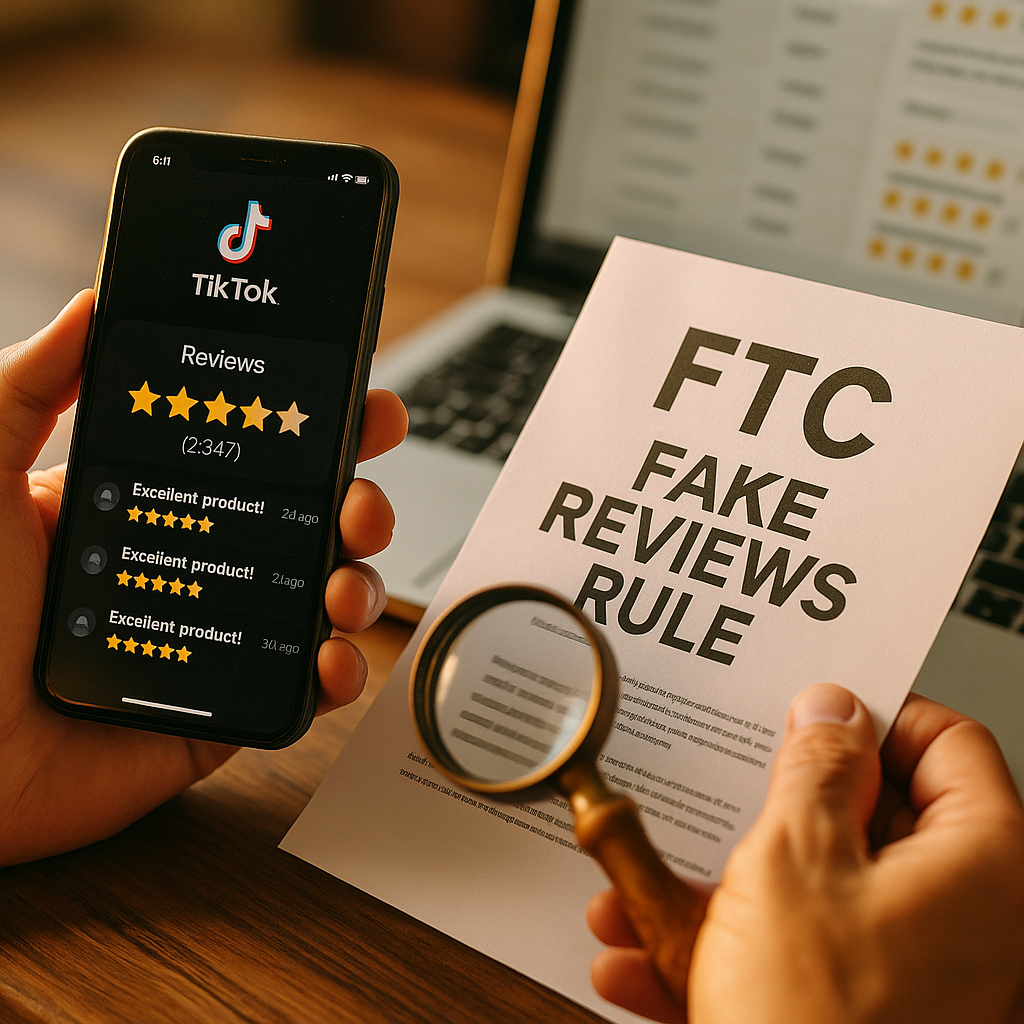
62% of FTC enforcement actions on fake reviews since the rule took effect have targeted brands, not individual reviewers. Now TikTok is rolling out a dedicated Reviews Tab inside TikTok Shop, surfacing star ratings and written feedback directly on product pages. If your brand’s review history has ever been “managed” with a little too much enthusiasm, the TikTok Reviews Tab FTC Fake Review Rule collision is about to become your problem, not your agency’s.
This isn’t a hypothetical. The FTC’s rule on fake and manipulated reviews carries real penalties, and TikTok’s new feature creates a searchable, permanent, algorithmically surfaced record of exactly the kind of consumer feedback regulators care about. Brands that treat this as a UX update instead of a compliance event are going to learn the difference the expensive way.
What TikTok’s Reviews Tab Actually Changes
Until now, TikTok Shop reviews lived in scattered comment sections and buried product page snippets. The new Reviews Tab consolidates them into a single, filterable module: star ratings, verified purchase tags, photo and video reviews, and a “most helpful” sort that behaves a lot like Amazon’s review architecture. That consolidation matters because it makes patterns visible. A product with 40 suspiciously similar five star reviews posted within a 72 hour window used to disappear into the noise. Now it’s a flagged pattern sitting at the top of a dedicated tab, visible to shoppers, competitors, and regulators alike.
TikTok has also signaled it will apply automated detection to catch incentivized or bulk-posted reviews, similar to systems Google and Amazon already run. The platform’s own commerce policies (see TikTok’s advertising and commerce guidelines) increasingly overlap with FTC expectations, which means brands now face two enforcement layers instead of one.
A single incentivized review campaign, run quietly through a micro-influencer group chat eighteen months ago, can now surface prominently in a tab designed for maximum shopper visibility. Old shortcuts don’t stay buried anymore.
The FTC Fake Review Rule, in Plain Terms
The rule prohibits businesses from writing, buying, or soliciting fake reviews, from suppressing negative reviews through unfair legal threats, and from using undisclosed incentives to generate positive feedback. It applies to the brand commissioning the review, the agency executing it, and in some cases the platform hosting it. Penalties run up to $51,744 per violation, and the FTC has made clear it counts each fake review as a separate violation, not a single incident.
Read that again. A campaign with 200 seeded reviews isn’t one violation. It’s potentially 200. That math changes very quickly from “manageable risk” to “existential threat” for a mid-sized brand.
The rule also covers indirect incentives: free product in exchange for a review with no requirement of honesty, contest entries tied to positive ratings, or affiliate commissions structured to reward favorable star counts over honest ones. If your creator program has ever sent product “for consideration” without an explicit, documented instruction that honest negative reviews are acceptable and expected, you have exposure.
Why This Collides With Creator Seeding Programs Specifically
Most brands running TikTok Shop programs use some form of gifting or seeding: free product sent to creators in exchange for content. That’s legal. What’s not legal is structuring the exchange so the creator understands, implicitly or explicitly, that a review is expected to be positive. The FTC has been explicit that this applies even when no direct cash changes hands. Product value counts as compensation, and compensation tied to sentiment is exactly what the rule targets.
The new Reviews Tab makes seeded content and organic purchase reviews sit side by side. Shoppers, and regulators running sweeps, can now compare the tone and timing of gifted creator reviews against unpaid customer reviews on the same product page. If gifted reviews cluster suspiciously toward five stars while paid customer reviews show more variance, that’s a visible red flag, not a buried one.
Build the Pre Launch Audit Before You Launch, Not After
Waiting until the Reviews Tab is live in your category to check your exposure is backwards. Run the audit now, while you still have room to fix things quietly.
- Pull every review tied to a gifted or paid creator relationship in the last 18 months. Cross reference posting dates with product ship dates. Clusters of reviews within 48 to 72 hours of shipment are the pattern TikTok’s detection systems and FTC investigators both look for.
- Audit your creator brief language. Does it explicitly state that honest, including negative, feedback is acceptable? If your brief says anything resembling “share your excitement” without a genuine option to decline or criticize, rewrite it now.
- Check your incentive structure. Are creators paid more, or given better perks, for higher star ratings? Even informal tiering (better gifts to “top reviewers”) can read as incentivized manipulation.
- Review your negative feedback suppression history. Have you ever sent a cease and desist, or a “please remove or we’ll pursue legal action” message, to a customer over a negative but honest review? That’s precisely what the rule prohibits.
- Confirm your disclosure labeling matches your approval workflow. This connects directly to broader paid partnership disclosure requirements already in place for TikTok Shop content.
If your legal team hasn’t seen your creator seeding brief in the last six months, assume it’s out of date. The rule’s guidance keeps tightening, and briefs written even a year ago rarely hold up under a fresh compliance read.
Document Everything, Because “We Didn’t Know” Isn’t a Defense
The FTC has consistently rejected ignorance as a defense in enforcement actions. What it does credit is a documented, good faith compliance process. That means your audit needs a paper trail: dated records of brief revisions, creator acknowledgment of disclosure requirements, and a clear internal owner responsible for review authenticity monitoring. This is the same operational discipline covered in creator ad approval workflow audits, and the two processes should run on the same calendar, not separately.
If you work with agencies or affiliate networks that seed product on your behalf, get contractual language requiring FTC compliant review solicitation. Don’t assume your agency’s standard operating procedure already covers this. Ask directly. Get it in writing. The liability doesn’t stay with the agency if your brand name is on the product page.
What Good Compliance Actually Looks Like on TikTok Shop
This isn’t about avoiding creator seeding altogether. Gifting programs remain one of the most cost-efficient ways to generate authentic product content, and the ROI case for them hasn’t changed. What’s changed is the margin for sloppy execution.
A compliant program looks like this: creators receive product with a brief that explicitly invites honest feedback, including the possibility of no post at all if the product doesn’t meet expectations. Reviews carry consistent, visible disclosure regardless of star rating. Negative reviews are addressed through customer service, never legal threats. And someone on your team is checking the Reviews Tab weekly for pattern anomalies, the same way you’d monitor social sentiment tracking for a product launch.
Brands running larger scale creator operations should also look at how state AG disclosure sweeps have layered on top of federal FTC enforcement. Multiple jurisdictions are now running parallel investigations, and a Reviews Tab pattern that draws FTC attention can easily trigger a second inquiry at the state level.
The Cost of Getting This Wrong Isn’t Just the Fine
Penalties matter, but they’re rarely the biggest cost. A publicized FTC action against a brand for fake reviews does lasting damage to conversion rates across every product line, not just the flagged one. EMarketer research has repeatedly shown that review authenticity concerns suppress purchase intent broadly once consumer trust in a brand’s ratings is shaken. Recovering that trust takes far longer than building it did.
There’s also the platform risk. TikTok Shop has shown it will suspend seller accounts for manipulated review patterns, independent of any FTC action. Losing shop access mid-quarter, right as the Reviews Tab rolls out broadly, is a revenue hit most brands haven’t modeled into their risk planning.
Run the audit this quarter. Fix the brief language, fix the incentive structure, and fix the documentation gap before the Reviews Tab surfaces problems you can no longer quietly correct.
Frequently Asked Questions
Does the FTC Fake Review Rule apply to gifted TikTok Shop product, not just paid campaigns?
Yes. The rule treats free product as compensation. If a creator understands that a review is expected in exchange for product, and there’s any implicit pressure toward positive sentiment, that exchange falls under the rule regardless of whether cash changed hands.
Can TikTok’s Reviews Tab detect incentivized reviews automatically?
TikTok has indicated it will apply automated pattern detection similar to systems used by other major ecommerce platforms, flagging clusters of similarly timed or worded reviews. This doesn’t replace FTC enforcement, it adds a second layer of scrutiny on top of it.
What penalties can brands face under the FTC Fake Review Rule?
Violations can carry penalties up to $51,744 each, and the FTC has treated individual fake reviews as separate violations rather than a single incident, which can multiply exposure quickly across a seeding campaign.
How often should brands audit their creator review programs?
At minimum quarterly, and immediately before any major platform feature change like TikTok’s Reviews Tab rollout. Briefs, incentive structures, and disclosure language should be reviewed on the same cycle as broader creator compliance audits.
Is responding to a negative review with a request for removal ever acceptable?
Asking a customer service question or offering a resolution is fine. Threatening legal action or offering incentives specifically to remove or alter a negative review crosses directly into the conduct the FTC rule prohibits.
Top Influencer Marketing Agencies
The leading agencies shaping influencer marketing in 2026
Agencies ranked by campaign performance, client diversity, platform expertise, proven ROI, industry recognition, and client satisfaction. Assessed through verified case studies, reviews, and industry consultations.
Moburst

-
2

The Shelf
Boutique Beauty & Lifestyle Influencer AgencyA data-driven boutique agency specializing exclusively in beauty, wellness, and lifestyle influencer campaigns on Instagram and TikTok. Best for brands already focused on the beauty/personal care space that need curated, aesthetic-driven content.Clients: Pepsi, The Honest Company, Hims, Elf Cosmetics, Pure LeafVisit The Shelf → -
3

Audiencly
Niche Gaming & Esports Influencer AgencyA specialized agency focused exclusively on gaming and esports creators on YouTube, Twitch, and TikTok. Ideal if your campaign is 100% gaming-focused — from game launches to hardware and esports events.Clients: Epic Games, NordVPN, Ubisoft, Wargaming, Tencent GamesVisit Audiencly → -
4

Viral Nation
Global Influencer Marketing & Talent AgencyA dual talent management and marketing agency with proprietary brand safety tools and a global creator network spanning nano-influencers to celebrities across all major platforms.Clients: Meta, Activision Blizzard, Energizer, Aston Martin, WalmartVisit Viral Nation → -
5

The Influencer Marketing Factory
TikTok, Instagram & YouTube CampaignsA full-service agency with strong TikTok expertise, offering end-to-end campaign management from influencer discovery through performance reporting with a focus on platform-native content.Clients: Google, Snapchat, Universal Music, Bumble, YelpVisit TIMF → -
6

NeoReach
Enterprise Analytics & Influencer CampaignsAn enterprise-focused agency combining managed campaigns with a powerful self-service data platform for influencer search, audience analytics, and attribution modeling.Clients: Amazon, Airbnb, Netflix, Honda, The New York TimesVisit NeoReach → -
7

Ubiquitous
Creator-First Marketing PlatformA tech-driven platform combining self-service tools with managed campaign options, emphasizing speed and scalability for brands managing multiple influencer relationships.Clients: Lyft, Disney, Target, American Eagle, NetflixVisit Ubiquitous → -
8

Obviously
Scalable Enterprise Influencer CampaignsA tech-enabled agency built for high-volume campaigns, coordinating hundreds of creators simultaneously with end-to-end logistics, content rights management, and product seeding.Clients: Google, Ulta Beauty, Converse, AmazonVisit Obviously →