


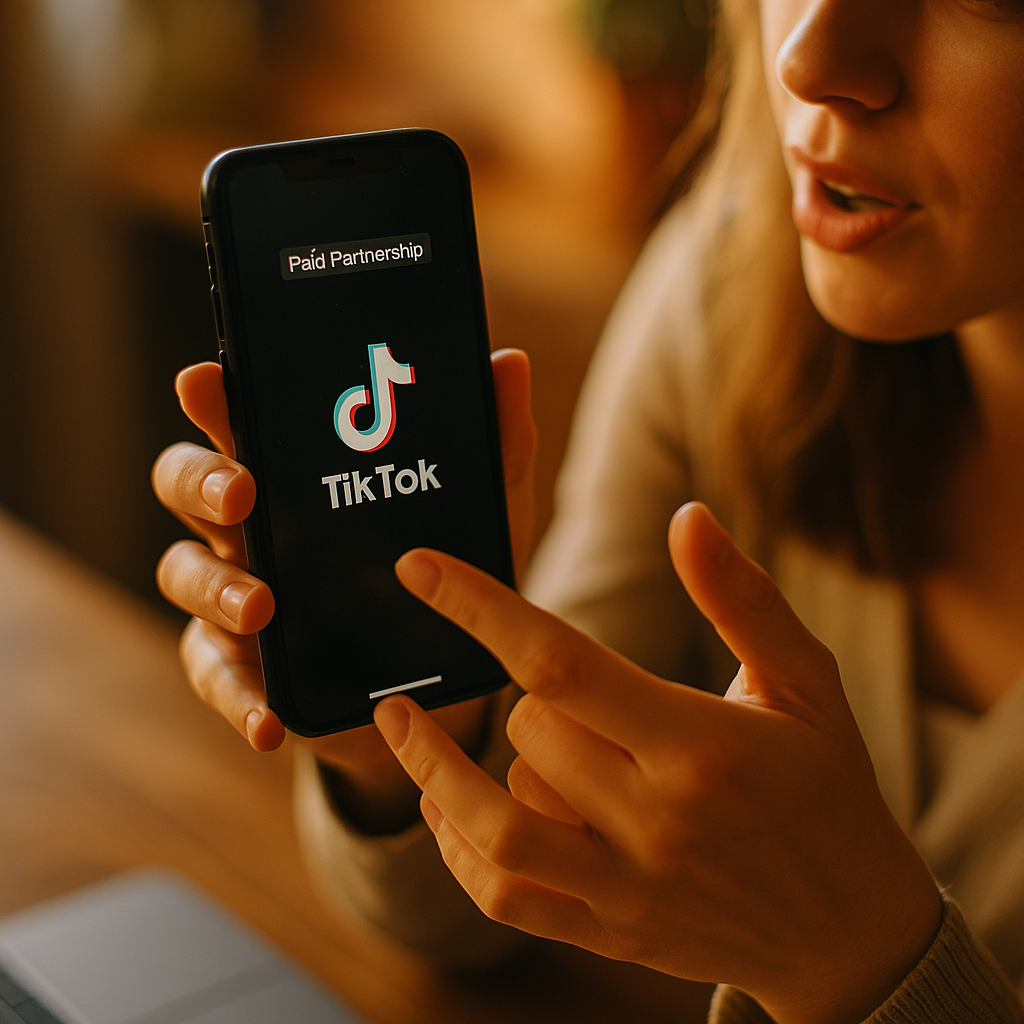
Here’s an uncomfortable question for anyone running influencer budgets right now: does saying “thanks to [Brand] for sponsoring this” actually satisfy disclosure rules, or is it just theater that tanks your reach? TikTok’s built in paid partnership label exists precisely because verbal callouts are inconsistent, easy to skip, and hard to audit at scale. Yet plenty of creators and brands still lean on spoken disclosure because they believe it protects distribution. The data says otherwise.
The Label Isn’t Just a Compliance Checkbox
TikTok’s Branded Content Toggle does two things simultaneously: it tags the video for the platform’s ad systems and it renders a visible “Paid partnership with [Brand]” tag on the video itself. That second part matters more than most marketers realize. It’s metadata, not decoration. When a creator flips that toggle, TikTok’s recommendation system classifies the content differently, routes it through commercial content review, and in some cases makes it eligible for Spark Ads amplification that a purely organic post can’t access.
Verbal disclosure does none of that. Saying “this is sponsored” fifteen seconds into a video tells the human viewer something, sure, but it tells TikTok’s algorithm nothing. The system doesn’t parse spoken audio for FTC compliance phrases and adjust distribution weighting accordingly. It reads signals: hashtags, captions, the toggle, watch-through patterns. A verbal mention is a wrapper. The toggle is the label on the can.
A video with the paid partnership label toggled on can still be boosted through Spark Ads and whitelisting tools, while an undisclosed or verbally-only disclosed post risks removal, shadow suppression, or an outright compliance strike that limits future reach for that creator account.
Why Creators Still Default to Verbal Disclosure
Ask any creator manager why talent avoids the toggle and you’ll hear the same answer: fear of the “sponsored content tax.” There’s a widespread belief, not entirely unfounded, that TikTok’s algorithm suppresses reach on anything tagged as branded content compared to organic posts. Creators would rather mumble a disclosure line and keep the toggle off, hoping the video performs like any other post.
That fear isn’t irrational. Branded content historically underperforms organic posts on watch time and completion rate, mostly because audiences scroll past anything that smells like an ad. But conflating that performance gap with algorithmic punishment is a mistake. The suppression, where it exists, comes from viewer behavior, not a hidden penalty baked into the toggle itself. Brands that understand this distinction structure briefs differently. They ask for creative that earns watch time on its own merit, then layer disclosure on top rather than treating disclosure as the thing killing performance.
The Real Risk Isn’t Reach. It’s Enforcement.
Verbal-only disclosure creates a paper trail problem. If the FTC or a state attorney general ever audits a campaign, “the creator said it out loud” is a weak defense compared to a platform-verified, timestamped label attached to the post metadata. The FTC’s endorsement guidance is explicit that disclosures must be clear, conspicuous, and hard to miss, not buried in a fast-talking intro that half the audience skips by tapping through.
For brands, this is a risk mitigation issue dressed up as a creative debate. Legal teams don’t care how a video performs if it triggers an investigation. Compliance teams want documentation. The paid partnership label gives you that documentation automatically. Verbal disclosure gives you a transcript you might have to pull manually, if the video is even still up.
What Actually Happens to Reach When You Toggle the Label
Internal campaign data from agencies running high-volume TikTok Shop programs consistently shows a narrower performance gap than creators assume. Properly tagged branded content, when paired with strong creative and boosted through TikTok’s Spark Ads product, frequently outperforms untagged organic posts on conversion metrics even if raw view counts run slightly lower. Views without purchase intent aren’t the KPI brands should be optimizing for anyway. This is the same logic playing out across the platform’s other measurement shifts, including the recalibrated instant-view metric that’s forcing teams to rebuild KPI frameworks around intent, not vanity reach.
There’s also a distribution mechanic worth understanding: whitelisted or dark-posted content run through tools like TikTok’s Symphony agent requires the branded content toggle to function correctly. You cannot dark post a creator’s content through a brand ad account without the underlying video being properly tagged. Brands trying to skip the toggle and rely on verbal disclosure alone are locking themselves out of the exact amplification tools that make influencer spend scalable.
A Quick Reality Check on “Suppression”
- Toggled branded content is eligible for paid amplification. Verbal-only disclosure typically is not.
- Toggled content satisfies platform terms of service. Verbal-only disclosure leaves compliance exposure open.
- Toggled content generates a permanent, auditable record. Verbal disclosure disappears if the video is edited or deleted.
- Toggled content plays nicely with whitelisting and Spark Ads. Verbal-only content usually cannot be boosted through those channels at all.
None of that means creative suffers. It means the toggle is infrastructure, not a penalty box.
Building a Disclosure Policy That Protects Both Reach and Legal Exposure
Most brands don’t have a documented disclosure policy for TikTok creators. They have a line item in a contract that says “must comply with FTC guidelines,” which is legally necessary but operationally useless. Creators need specifics: toggle on, hashtag placement, caption language, and whether verbal mention is required in addition to the tag (it often should be, for belt-and-suspenders compliance, especially with younger audiences who skip captions).
Here’s a workable framework for briefs:
- Require the paid partnership toggle on every sponsored post, no exceptions, documented in the contract with a screenshot requirement before payment releases.
- Add a verbal or on-screen text disclosure as a secondary layer, since the FTC has flagged platform tags as insufficient on their own in some enforcement actions.
- Build disclosure verification into your content approval workflow, the same way you’d check for brand safety or trademark usage.
- Track performance separately for tagged versus untagged historical content to build your own internal benchmark instead of trusting creator anecdotes about “the algorithm hates sponsored posts.”
This isn’t dramatically different from disclosure discipline brands are having to build across other platforms. The Instagram Edits app rollout forced similar brief rewrites when native editing tools changed how sponsored content gets tagged and distributed. Every new creative tool platforms ship tends to quietly shift where disclosure requirements sit in the workflow, and brands that don’t update briefs in lockstep end up exposed.
Where This Intersects With Regulatory Risk
Regulators outside the US are watching too. The UK’s Information Commissioner’s Office and the Competition and Markets Authority have both pushed for clearer, platform-verified disclosure rather than relying on creator judgment call. Global brands running influencer programs across multiple markets can’t standardize on “creator says it out loud” as a compliance strategy because the bar for “clear and conspicuous” varies by jurisdiction. A toggled label, paired with consistent caption language, travels better across markets than a verbal ad-lib that changes take to take.
There’s also a brand safety angle agencies underweight. Platforms are increasingly using AI-assisted content review to catch compliance issues, and AI-driven compliance tooling is becoming standard across the industry for exactly this reason. Automated systems can detect a missing metadata tag instantly. They cannot reliably parse whether a mumbled verbal disclosure eleven seconds into a video meets legal thresholds. If your compliance strategy depends on a human reviewer catching every verbal disclosure across hundreds of creator videos a month, you’re building a process that doesn’t scale and won’t survive an audit.
Format Choices Are Compounding the Problem
Newer formats add complexity. Dual-camera content, for instance, often blends reaction footage with product demonstration in ways that make a single verbal disclosure easy to miss if it only appears in one camera feed. Brands briefing creators on these formats need to be explicit about where and how disclosure appears, because “somewhere in the video” isn’t a standard that holds up to scrutiny from either TikTok’s trust and safety team or a regulator.
According to research summarized by Sprout Social, disclosure transparency also correlates with higher audience trust scores over time, which is the reach argument brands actually care about. Short-term view counts matter less than whether an audience keeps engaging with a creator’s sponsored content month after month. Undisclosed or poorly disclosed sponsorships erode that trust faster than a visible, consistent label ever will.
The takeaway for anyone managing budgets right now: stop treating the paid partnership toggle as a reach tax and start treating it as the only disclosure method that’s actually auditable, boostable, and defensible. Update your creator briefs this quarter to require the toggle plus a verbal or on-screen disclosure as a backup, and build a simple screenshot verification step into your payment workflow before the next campaign launches.
Frequently Asked Questions
Does the TikTok paid partnership label actually reduce reach?
Not inherently. The performance gap most creators cite comes from audience scroll behavior on obvious ads, not an algorithmic penalty tied to the toggle itself. Properly tagged content remains eligible for Spark Ads boosting, which untagged or verbally-disclosed-only content typically cannot access.
Is verbal disclosure enough to satisfy FTC requirements on TikTok?
Generally no. The FTC requires disclosures to be clear and conspicuous, and a fast, easy-to-miss verbal mention often fails that standard on its own. Pairing the platform’s paid partnership tag with on-screen text or a clear verbal statement is the safer approach.
Can brands boost creator content without the paid partnership toggle enabled?
No. Tools like Spark Ads and whitelisting through TikTok’s ad platform require the underlying video to have the branded content toggle enabled. Skipping the toggle locks brands out of paid amplification entirely.
What happens if a creator forgets to enable the label?
The video may be removed, the creator’s account can receive a compliance strike, and the content becomes ineligible for boosted distribution until it’s corrected. Brands should build toggle verification into content approval before publishing.
How should brands handle disclosure across multiple countries?
Standardize on the platform’s built-in label as the baseline requirement, then layer in market-specific verbal or caption language to meet local regulator expectations, since standards for “clear and conspicuous” disclosure vary by jurisdiction.
Top Influencer Marketing Agencies
The leading agencies shaping influencer marketing in 2026
Agencies ranked by campaign performance, client diversity, platform expertise, proven ROI, industry recognition, and client satisfaction. Assessed through verified case studies, reviews, and industry consultations.
Moburst

-
2

The Shelf
Boutique Beauty & Lifestyle Influencer AgencyA data-driven boutique agency specializing exclusively in beauty, wellness, and lifestyle influencer campaigns on Instagram and TikTok. Best for brands already focused on the beauty/personal care space that need curated, aesthetic-driven content.Clients: Pepsi, The Honest Company, Hims, Elf Cosmetics, Pure LeafVisit The Shelf → -
3

Audiencly
Niche Gaming & Esports Influencer AgencyA specialized agency focused exclusively on gaming and esports creators on YouTube, Twitch, and TikTok. Ideal if your campaign is 100% gaming-focused — from game launches to hardware and esports events.Clients: Epic Games, NordVPN, Ubisoft, Wargaming, Tencent GamesVisit Audiencly → -
4

Viral Nation
Global Influencer Marketing & Talent AgencyA dual talent management and marketing agency with proprietary brand safety tools and a global creator network spanning nano-influencers to celebrities across all major platforms.Clients: Meta, Activision Blizzard, Energizer, Aston Martin, WalmartVisit Viral Nation → -
5

The Influencer Marketing Factory
TikTok, Instagram & YouTube CampaignsA full-service agency with strong TikTok expertise, offering end-to-end campaign management from influencer discovery through performance reporting with a focus on platform-native content.Clients: Google, Snapchat, Universal Music, Bumble, YelpVisit TIMF → -
6

NeoReach
Enterprise Analytics & Influencer CampaignsAn enterprise-focused agency combining managed campaigns with a powerful self-service data platform for influencer search, audience analytics, and attribution modeling.Clients: Amazon, Airbnb, Netflix, Honda, The New York TimesVisit NeoReach → -
7

Ubiquitous
Creator-First Marketing PlatformA tech-driven platform combining self-service tools with managed campaign options, emphasizing speed and scalability for brands managing multiple influencer relationships.Clients: Lyft, Disney, Target, American Eagle, NetflixVisit Ubiquitous → -
8

Obviously
Scalable Enterprise Influencer CampaignsA tech-enabled agency built for high-volume campaigns, coordinating hundreds of creators simultaneously with end-to-end logistics, content rights management, and product seeding.Clients: Google, Ulta Beauty, Converse, AmazonVisit Obviously →