


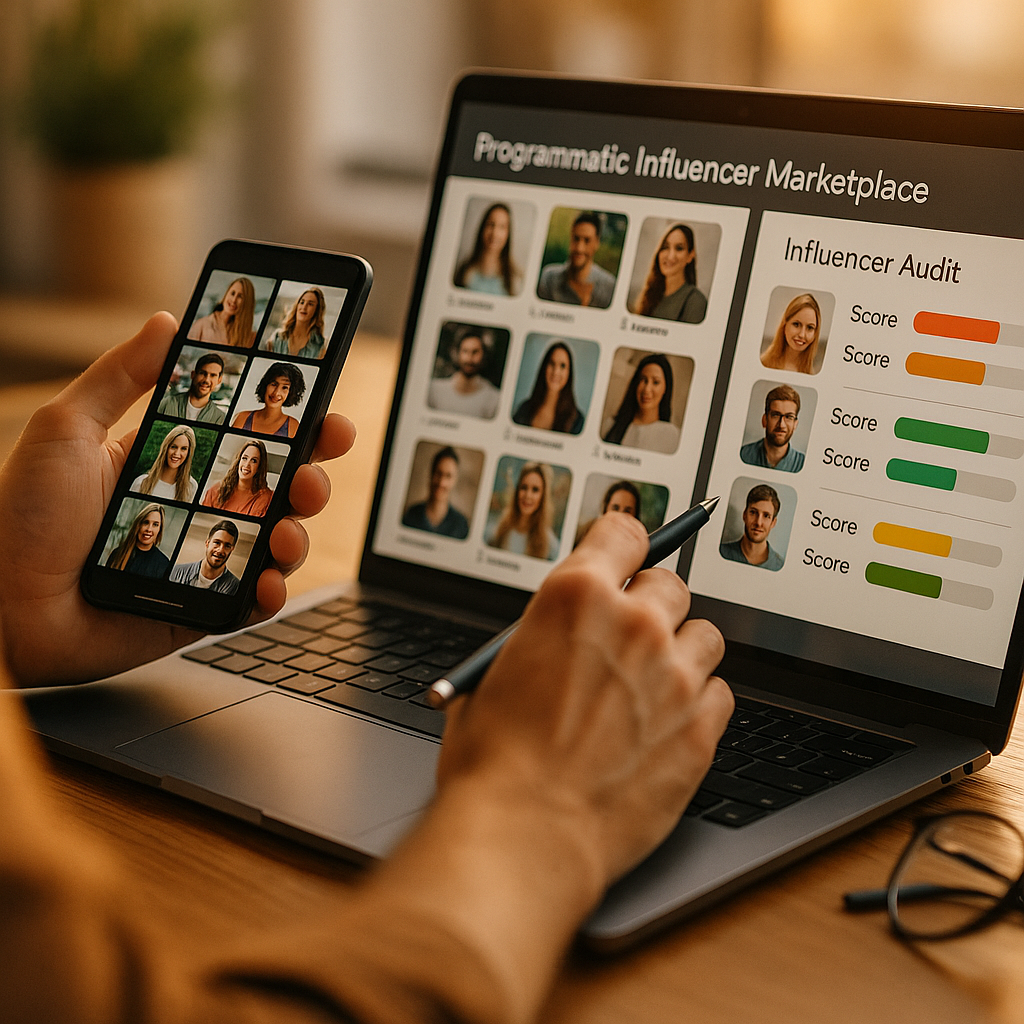
Ninety seconds. That’s roughly how long some programmatic influencer marketplaces take to generate a “recommended creator list” for a new campaign brief. Sounds efficient, right? Except the algorithm behind that list is often scoring creators on engagement metrics that are three months stale, audience data that was never verified, and brand-fit signals pulled from a handful of hashtags. A programmatic influencer marketplace can absolutely compress sourcing time from weeks to hours. Whether it compresses risk at the same rate is a different question entirely.
What Is a Programmatic Influencer Marketplace, Exactly?
Strip away the marketing language and a programmatic influencer marketplace is a matching engine. Brands input a brief (budget, category, audience targets, content format), and the platform’s algorithm ranks a pool of creators against that brief automatically, without a human strategist manually pulling profiles. Think of it as programmatic ad buying applied to creator selection: bid, match, activate.
Platforms like CreatorIQ, Aspire, and Grin have all pushed further into automated matching over the past two years, layering in AI scoring models on top of what used to be searchable databases. TikTok’s own Creator Marketplace does something similar natively, ranking creators by predicted performance for a given advertiser vertical. The pitch is consistent across vendors: fewer manual searches, faster shortlist generation, and theoretically better fit because the machine sees patterns humans miss.
The operational upside is real. Teams running high-volume seeding or affiliate programs, the kind covered in our breakdown of TikTok Shop creator recruitment software, simply cannot manually vet thousands of applicants. Automation isn’t optional at that scale. It’s the only path to launch.
Inside the Black Box: How Matching Algorithms Score Creators
Most marketplaces won’t publish their exact scoring weights (that’s the intellectual property they’re selling), but the inputs are fairly consistent across vendors. Here’s what typically feeds the model:
- Engagement rate benchmarks, normalized against category and follower tier so a 50k-follower fitness creator isn’t unfairly compared to a 2M-follower celebrity.
- Audience demographic overlap, matching declared or inferred follower age, gender, location, and interest data against the brand’s target profile.
- Content semantic relevance, using natural language processing and computer vision to tag what a creator actually posts about, not just what bio keywords they’ve chosen.
- Historical brand collaboration data, weighting creators who’ve worked in adjacent categories and delivered measurable lift.
- Fraud and authenticity signals, flagging suspicious follower growth curves, bot-like engagement patterns, or bought audiences.
The more sophisticated platforms have moved away from keyword and hashtag matching entirely, using embedding models that understand context. That shift is worth understanding on its own, and we covered it in detail in our piece on semantic matching for creator discovery. A creator who never uses the word “sustainable” but consistently posts about thrifting, zero-waste swaps, and secondhand fashion should score high for an eco-conscious apparel brand. Tag-based search misses that creator. Vector search catches it.
An algorithm can only score what it can measure, and most marketplaces still can’t measure whether a creator’s audience actually converts, only whether it engages.
Composite Scores Hide More Than They Reveal
Here’s the operational trap: most marketplaces roll all these signals into a single composite score, often displayed as a number out of 100 or a star rating. That single number feels decisive. It invites trust. But a creator scoring 87 for “brand fit” might be scoring high on audience demographics while scoring terribly on authenticity, with the platform simply averaging those factors instead of surfacing the risk separately. If you’re buying based on the top-line score alone, you’re buying blind to the components that actually matter for compliance and ROI.
The Data Problem Nobody Talks About
Algorithms are only as good as the data feeding them, and creator data is notoriously messy. Follower counts get inflated. Engagement pods manipulate comment sections. Platform APIs (particularly Instagram’s and TikTok’s) throttle what third-party tools can even access, meaning some “real-time” scores are built on data that’s already a week old by the time a campaign launches.
This is the same latency issue plaguing broader martech stacks, and we’ve written extensively about how signal delay quietly kills campaign performance in this breakdown of dark data and campaign timing. When a matching algorithm scores a creator using engagement data from thirty days ago, it’s making a prediction about audience behavior that may no longer be accurate. Creator audiences shift fast. A single viral video, a controversy, a platform algorithm change: any of these can reshape a creator’s actual reach within days, and most marketplace scoring engines don’t refresh fast enough to catch it.
According to eMarketer research on influencer marketing spend, brands continue increasing budget allocation toward creator partnerships year over year, which means more dollars are riding on matching decisions that may be built on outdated inputs. That’s not a reason to abandon programmatic tools. It’s a reason to treat the score as a starting point, not a verdict.
Where Algorithms Get It Wrong
Automated matching is genuinely good at pattern recognition across large datasets. It’s genuinely bad at judgment calls that require context a machine simply doesn’t have.
- Brand safety nuance. An algorithm can flag obviously problematic content (hate speech, explicit material), but it struggles with subtler risks like a creator whose humor style doesn’t match a conservative brand voice, even if nothing they’ve posted violates any policy.
- Micro and nano creator undervaluation. Scoring models trained on engagement volume tend to favor creators with larger followings, even when smaller, hyper-niche creators drive better conversion for specific verticals. Volume bias is a known limitation across most vendor models.
- Category drift. A creator who built an audience around parenting content and later pivots to home renovation may still show a high “parenting brand fit” score simply because the historical data hasn’t caught up to the content shift.
- Rights and usage complexity. Matching algorithms score creative fit, not contractual fit. They rarely account for whether a creator’s content can legally be whitelisted or repurposed, an issue we unpacked in our rights risk scorecard piece.
None of this means the tools are broken. It means the score is an input to a decision, not the decision itself. Treating a 92% match score as gospel is how brands end up in avoidable compliance messes, the kind the Federal Trade Commission has increasingly scrutinized around disclosure and authenticity in sponsored content.
Building an Audit Process Before You Trust the Score
If you’re running or evaluating a programmatic influencer marketplace, build a lightweight audit layer around the algorithm rather than replacing it entirely. A few practices that actually hold up operationally:
- Request scoring transparency. Ask vendors what specific factors feed the composite score and how heavily each is weighted. If a vendor can’t answer this in a sales call, that’s diagnostic information on its own.
- Cross-check top matches manually. For any creator above a spend threshold you define, have a human strategist review the last 10 to 15 posts before activation. This takes fifteen minutes and catches most category drift and tone mismatches.
- Verify identity resolution accuracy. Many marketplaces stitch creator data across platforms using probabilistic matching, and match rate quality varies enormously by vendor. Contracts should specify guaranteed match rates, similar to what we recommend in our piece on identity resolution contract terms.
- Layer in CRM and first-party data where possible. Marketplace scores improve dramatically when matched against your own customer data rather than platform-reported demographics alone, a point we explore further in this look at CRM identity resolution for creator programs.
- Track post-campaign accuracy. Did the “high match” creators actually outperform lower-scored ones? Feed that data back into your vendor selection criteria at renewal time.
Platforms like Sprout Social and other social analytics tools can serve as a secondary verification layer, giving you an independent read on engagement authenticity that isn’t tied to the marketplace’s own scoring incentives. It’s worth remembering the vendor scoring your creators also profits from you activating quickly, which isn’t necessarily aligned with your interest in activating correctly.
Cost, Speed, and the Trade-off You’re Actually Making
Every brand evaluating a programmatic marketplace is really weighing the same trade-off: speed versus certainty. Manual sourcing, done well, produces higher-confidence matches but doesn’t scale past a few dozen creators without adding headcount. Programmatic matching scales infinitely but introduces the risks outlined above. Most mature influencer programs land on a hybrid model: algorithmic matching for top-of-funnel shortlisting, human review for final activation decisions, especially above a defined spend threshold per creator. That hybrid approach is showing up increasingly in how brands structure affiliate and whitelisting stacks too, a trend detailed in this piece on the layers brands skip in whitelisting programs.
Data from HubSpot on marketing automation adoption suggests a consistent pattern across martech categories: tools that promise full automation get adopted fastest, then get partially rolled back once teams discover the accuracy gaps. Influencer matching is following the same curve. Expect more vendors to add “confidence intervals” or human-in-the-loop review layers to their scoring in the near term, not less.
Where Programmatic Matching Goes From Here
The next generation of these platforms is already shifting toward outcome-based scoring rather than engagement-based scoring, meaning the model weights actual conversion and sales lift data from past campaigns more heavily than likes and comments. That’s a meaningful improvement, assuming brands are willing to share the closed-loop sales data needed to train it. Platforms that can reconcile creator payouts against actual attribution data, the kind discussed in our review of attribution platforms tied to creator finance, are positioned to build meaningfully more accurate scoring models over time. The marketplaces that can’t close that loop will keep scoring popularity, not performance.
Use the algorithm to build your shortlist, not your final roster. Assign a human strategist to review the top 10 to 20% of matches before any contract goes out, and demand scoring transparency from any vendor charging a premium for “AI-powered matching.”
FAQs
What is a programmatic influencer marketplace?
It’s a software platform that automatically matches brands with creators using algorithmic scoring based on engagement, audience demographics, content relevance, and brand safety signals, replacing or supplementing manual creator sourcing.
How accurate are creator matching scores?
Accuracy varies significantly by vendor and depends heavily on data freshness, audience verification methods, and whether the algorithm weights engagement volume over actual conversion history. Most scores are directionally useful but shouldn’t be treated as definitive without human review.
Can programmatic marketplaces detect fake followers or engagement fraud?
Most established platforms include fraud detection signals like unnatural follower growth curves and bot-pattern engagement, but detection quality varies widely, and sophisticated fraud can still slip through automated screening.
Should brands rely entirely on algorithmic matching for creator selection?
No. Best practice is a hybrid model where algorithms generate shortlists at scale and human strategists review top candidates before final activation, particularly for higher-budget partnerships or sensitive brand categories.
Why do micro and nano creators sometimes score lower than they should?
Many scoring models weight raw engagement volume, which structurally favors larger accounts even when smaller, niche creators deliver stronger conversion rates for specific audience segments.
What should brands ask vendors before adopting a programmatic marketplace?
Ask how the composite score is calculated, how frequently underlying data refreshes, what fraud detection methods are used, and whether the platform can provide match rate guarantees for identity resolution across platforms.
Top Influencer Marketing Agencies
The leading agencies shaping influencer marketing in 2026
Agencies ranked by campaign performance, client diversity, platform expertise, proven ROI, industry recognition, and client satisfaction. Assessed through verified case studies, reviews, and industry consultations.
Moburst

-
2

The Shelf
Boutique Beauty & Lifestyle Influencer AgencyA data-driven boutique agency specializing exclusively in beauty, wellness, and lifestyle influencer campaigns on Instagram and TikTok. Best for brands already focused on the beauty/personal care space that need curated, aesthetic-driven content.Clients: Pepsi, The Honest Company, Hims, Elf Cosmetics, Pure LeafVisit The Shelf → -
3

Audiencly
Niche Gaming & Esports Influencer AgencyA specialized agency focused exclusively on gaming and esports creators on YouTube, Twitch, and TikTok. Ideal if your campaign is 100% gaming-focused — from game launches to hardware and esports events.Clients: Epic Games, NordVPN, Ubisoft, Wargaming, Tencent GamesVisit Audiencly → -
4

Viral Nation
Global Influencer Marketing & Talent AgencyA dual talent management and marketing agency with proprietary brand safety tools and a global creator network spanning nano-influencers to celebrities across all major platforms.Clients: Meta, Activision Blizzard, Energizer, Aston Martin, WalmartVisit Viral Nation → -
5

The Influencer Marketing Factory
TikTok, Instagram & YouTube CampaignsA full-service agency with strong TikTok expertise, offering end-to-end campaign management from influencer discovery through performance reporting with a focus on platform-native content.Clients: Google, Snapchat, Universal Music, Bumble, YelpVisit TIMF → -
6

NeoReach
Enterprise Analytics & Influencer CampaignsAn enterprise-focused agency combining managed campaigns with a powerful self-service data platform for influencer search, audience analytics, and attribution modeling.Clients: Amazon, Airbnb, Netflix, Honda, The New York TimesVisit NeoReach → -
7

Ubiquitous
Creator-First Marketing PlatformA tech-driven platform combining self-service tools with managed campaign options, emphasizing speed and scalability for brands managing multiple influencer relationships.Clients: Lyft, Disney, Target, American Eagle, NetflixVisit Ubiquitous → -
8

Obviously
Scalable Enterprise Influencer CampaignsA tech-enabled agency built for high-volume campaigns, coordinating hundreds of creators simultaneously with end-to-end logistics, content rights management, and product seeding.Clients: Google, Ulta Beauty, Converse, AmazonVisit Obviously →