


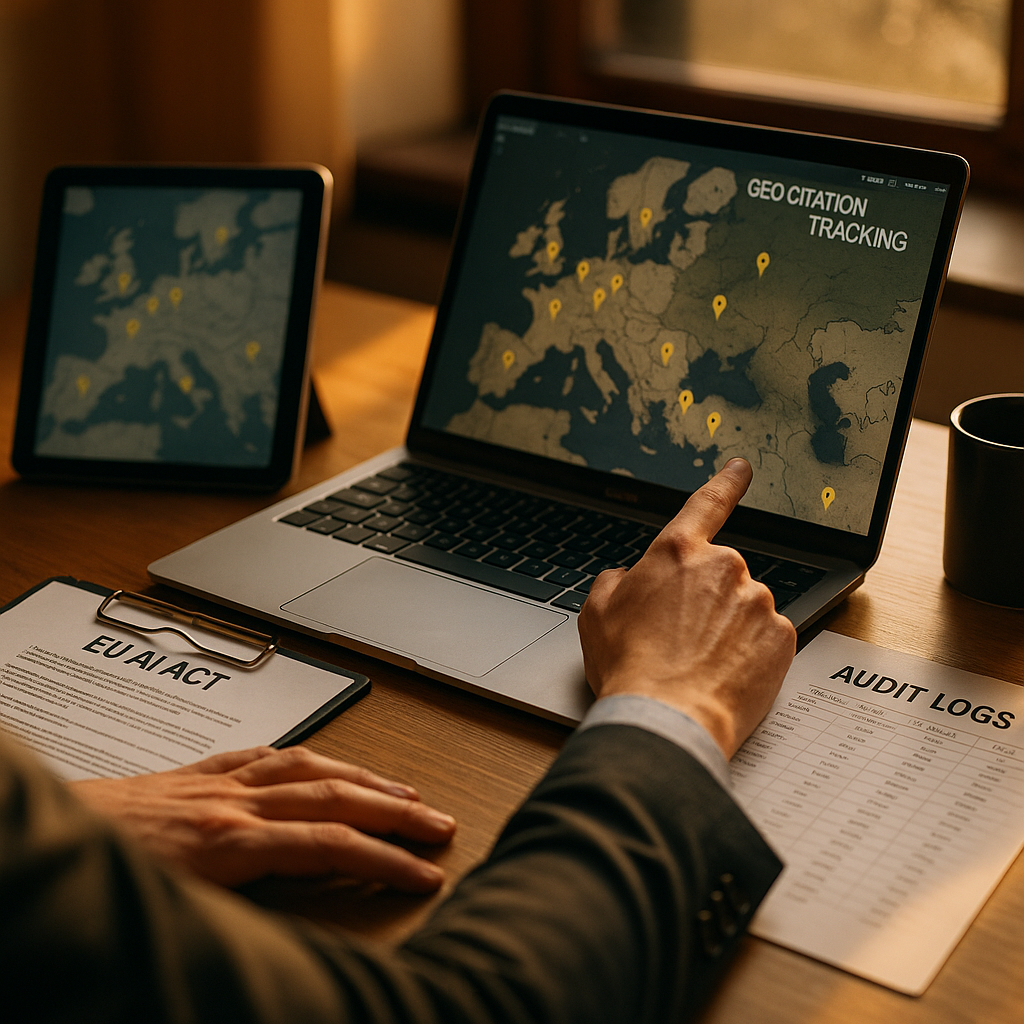
Only a handful of GEO citation tracking tools can currently produce an audit-ready log of how an AI model sourced and attributed brand content. That gap is about to become expensive. With EU AI Act enforcement timelines tightening and transparency obligations extending to generative systems that summarize or cite branded content, marketing teams relying on AI-driven visibility are discovering their tracking stack was built for optimization, not compliance.
The Enforcement Clock Changes What “Good Enough” Means
For the past two years, GEO (generative engine optimization) tools have sold themselves on a simple pitch: tell us when ChatGPT, Perplexity, or Google’s AI Overviews mention your brand. That was enough when the stakes were bragging rights in a board deck. It is not enough now.
The EU AI Act’s transparency and documentation requirements push obligations onto anyone deploying or relying on high-impact AI systems for consumer-facing decisions, and regulators have signaled that marketing and advertising use cases are squarely in scope. Brands that use AI-generated citations to justify influencer payouts, content licensing claims, or public visibility statements now need a defensible paper trail, not just a dashboard screenshot.
A visibility score without a verifiable source log is a liability waiting for a compliance audit, not a marketing asset.
This is the pivot point vendors are scrambling to address, and it is why the conversation has shifted from “which tool shows the most citations” to “which tool can prove where those citations came from.”
Why Citation Verification Is Suddenly a Legal Question
Citation tracking used to be a marketing metric. Now it doubles as evidence. If a brand claims in regulatory filings, partner contracts, or investor materials that its content is “frequently cited by AI search engines,” that claim needs to survive scrutiny. Regulators reviewing AI transparency compliance under the UK ICO’s guidance on automated decision-making, and their EU counterparts, are increasingly asking for source documentation, not vendor summaries.
The practical problem: most GEO tools scrape or sample AI outputs periodically, then extrapolate. Sampling is fine for trend spotting. It is not fine when a compliance officer asks for the exact prompt, timestamp, and model version that generated a specific citation. Our GEO analytics dashboards comparison flagged this exact issue months before enforcement became a live topic: verification, not volume, separates serious tools from noise generators.
Comparing the Field: Who Actually Logs What?
Here is where the tool landscape splits into three tiers.
- Profound has built out granular query-level logging, including prompt variants and model responses, which gives compliance teams something closer to an audit trail than a marketing report. It is not cheap, and onboarding takes real effort, but the data lineage is defensible.
- Rankscale takes a different approach, weighting citation frequency against topical authority scores. Useful for strategy, less useful if you need raw, timestamped evidence for a regulator. Our Profound vs Rankscale comparison found their scoring methodologies diverge enough that using both in parallel, rather than picking one, is often the safer play.
- Semrush’s AI toolkit leans on its existing SEO infrastructure, bolting citation tracking onto a familiar interface. Convenient for teams already inside Semrush, but the audit depth trails purpose-built GEO platforms. We broke this trade-off down in detail in our Profound vs Semrush breakdown.
- Smaller entrants like Otterly.ai and Scrunch AI offer lighter-weight monitoring at lower price points, which works for early-stage tracking but rarely satisfies enterprise documentation demands.
None of these tools were originally engineered with EU regulatory language in mind. That is showing. Vendors are now racing to retrofit compliance features onto platforms designed for growth marketing, and the retrofits are uneven.
The Documentation Gap Nobody Budgeted For
Ask any procurement lead who evaluated a GEO tool last year: did the RFP include a question about log retention periods? Almost certainly not. Most GEO buying decisions were made on citation volume, competitive benchmarking, and dashboard usability. Compliance readiness barely made the shortlist.
That oversight is now a budget problem. Retrofitting a tracking stack to meet audit standards mid-contract usually means either paying for an enterprise tier upgrade or switching vendors entirely, both of which come with implementation lag nobody wants during an active enforcement window. Our GEO vendor contracts guide now treats data retention and export rights as non-negotiable clauses, not nice-to-haves, and that shift happened specifically because of cases like this.
If your GEO vendor can’t export a raw, timestamped citation log on demand, you don’t have a compliance tool. You have a marketing dashboard with legal exposure attached.
Vendor Claims vs. Verifiable Logs
There is a persistent gap between what GEO vendors advertise and what their systems can actually prove. Marketing decks talk about “AI visibility scores” and “share of citation.” Compliance teams want prompt histories, model version tracking, and source attribution chains that hold up under third-party review.
Some of this mirrors what happened in the referral analytics space. Publishers spent years fighting the “direct traffic” black box before tools started properly attributing AI referral sources, a shift our Parse.ly AI referral tracking piece covered in depth. GEO citation tracking is going through the same maturation curve, just under regulatory pressure instead of curiosity.
Practically, this means brand teams should stop asking vendors “do you track citations” and start asking “can you produce a chain-of-custody record for a citation from six months ago.” Most current tools cannot. That answer alone should reshape your shortlist.
Building a Compliance-Ready GEO Stack Without Starting Over
You don’t need to rip out your entire GEO stack to get compliant. But you do need to stress-test it against a few hard questions before enforcement deadlines land:
- Does the tool store raw model outputs, or only aggregated scores?
- Can you export logs in a format a legal team can actually review, not just a CSV of numbers?
- How long is data retained, and is retention adjustable to match regulatory requirements?
- Does the vendor disclose which AI models and versions were queried, given that model updates can shift citation behavior overnight?
- Is there a documented process for disputing or correcting inaccurate citations?
These questions align closely with the criteria laid out in our GEO vendor evaluation framework, which was written before the EU AI Act enforcement timeline sharpened but holds up remarkably well now. That’s not a coincidence. Rigorous vendor evaluation and regulatory readiness usually point at the same weaknesses: shallow logging, vague retention policies, and dashboards optimized for optics over evidence.
It also helps to look at how adjacent categories handled similar transparency pressure. Watermarking requirements pushed a wave of MarTech vendors to rebuild disclosure workflows almost overnight, a scramble we tracked in our EU AI Act watermarking coverage. GEO citation tools are roughly six to nine months behind that curve, which means brands evaluating vendors today have leverage to demand better documentation before signing.
Market data backs the urgency. eMarketer has tracked accelerating ad spend shifting toward AI-driven discovery channels, and Statista surveys show a growing share of consumers using AI assistants for product research before ever hitting a brand’s website. That growth is exactly why regulators are paying attention now. The bigger the channel, the more scrutiny it draws, and citation tracking sits right at the center of that channel’s accountability question.
What This Means for Budget Owners
If you’re the person signing off on GEO tooling spend, treat compliance readiness as a line item, not an afterthought. Ask your legal or privacy team to sit in on the next vendor demo. Push for a trial period specifically to test log export and retention, not just citation volume. And if a vendor can’t answer the chain-of-custody question clearly, that’s your answer regardless of how polished the dashboard looks.
This is also a good moment to revisit broader AI governance tooling. Platforms built for content oversight, like those covered in our AI content governance platforms roundup, often integrate more smoothly with compliance workflows than standalone GEO trackers, since they were designed with audit trails from day one.
HubSpot’s marketing operations research has repeatedly shown that tools bought in a rush, under competitive pressure, tend to get replaced within eighteen months. Don’t let citation tracking become another example. The vendors that survive this enforcement cycle will be the ones that treated documentation as a feature, not a patch.
FAQs
Frequently Asked Questions
What is GEO citation tracking?
GEO citation tracking refers to tools that monitor how generative AI engines like ChatGPT, Perplexity, and Google’s AI Overviews mention, summarize, or attribute brand content in their responses. It helps marketing teams measure visibility in AI-driven search and discovery.
Why does the EU AI Act affect GEO citation tracking tools?
The EU AI Act imposes transparency and documentation obligations on high-impact AI systems, and regulators have indicated that AI-driven marketing claims and automated content attribution fall within scope. Brands using citation data for compliance, contracts, or public claims need verifiable logs, not just summary dashboards.
Which GEO citation tracking tools currently support audit-ready logs?
Profound offers the most granular query-level logging among widely used platforms. Rankscale and Semrush provide useful visibility scoring but currently offer less detailed raw log export. Smaller tools like Otterly.ai and Scrunch AI are generally better suited to early-stage monitoring than formal compliance documentation.
What should marketers ask GEO vendors before signing a contract?
Ask whether the tool stores raw model outputs, how long data is retained, whether logs can be exported in a legally usable format, which AI model versions were queried, and what process exists for disputing inaccurate citations.
Do smaller brands need to worry about EU AI Act enforcement for GEO tools?
Any brand marketing into the EU, regardless of size, should review its AI visibility claims and tooling. Enforcement priority typically starts with higher-impact use cases, but documentation gaps discovered later are harder and more expensive to fix retroactively.
The next 90 days are the window to fix this before enforcement makes it urgent: pull your current GEO vendor’s log export sample, hand it to legal, and see if it survives a straight-faced audit review.
Top Influencer Marketing Agencies
The leading agencies shaping influencer marketing in 2026
Agencies ranked by campaign performance, client diversity, platform expertise, proven ROI, industry recognition, and client satisfaction. Assessed through verified case studies, reviews, and industry consultations.
Moburst

-
2

The Shelf
Boutique Beauty & Lifestyle Influencer AgencyA data-driven boutique agency specializing exclusively in beauty, wellness, and lifestyle influencer campaigns on Instagram and TikTok. Best for brands already focused on the beauty/personal care space that need curated, aesthetic-driven content.Clients: Pepsi, The Honest Company, Hims, Elf Cosmetics, Pure LeafVisit The Shelf → -
3

Audiencly
Niche Gaming & Esports Influencer AgencyA specialized agency focused exclusively on gaming and esports creators on YouTube, Twitch, and TikTok. Ideal if your campaign is 100% gaming-focused — from game launches to hardware and esports events.Clients: Epic Games, NordVPN, Ubisoft, Wargaming, Tencent GamesVisit Audiencly → -
4

Viral Nation
Global Influencer Marketing & Talent AgencyA dual talent management and marketing agency with proprietary brand safety tools and a global creator network spanning nano-influencers to celebrities across all major platforms.Clients: Meta, Activision Blizzard, Energizer, Aston Martin, WalmartVisit Viral Nation → -
5

The Influencer Marketing Factory
TikTok, Instagram & YouTube CampaignsA full-service agency with strong TikTok expertise, offering end-to-end campaign management from influencer discovery through performance reporting with a focus on platform-native content.Clients: Google, Snapchat, Universal Music, Bumble, YelpVisit TIMF → -
6

NeoReach
Enterprise Analytics & Influencer CampaignsAn enterprise-focused agency combining managed campaigns with a powerful self-service data platform for influencer search, audience analytics, and attribution modeling.Clients: Amazon, Airbnb, Netflix, Honda, The New York TimesVisit NeoReach → -
7

Ubiquitous
Creator-First Marketing PlatformA tech-driven platform combining self-service tools with managed campaign options, emphasizing speed and scalability for brands managing multiple influencer relationships.Clients: Lyft, Disney, Target, American Eagle, NetflixVisit Ubiquitous → -
8

Obviously
Scalable Enterprise Influencer CampaignsA tech-enabled agency built for high-volume campaigns, coordinating hundreds of creators simultaneously with end-to-end logistics, content rights management, and product seeding.Clients: Google, Ulta Beauty, Converse, AmazonVisit Obviously →