


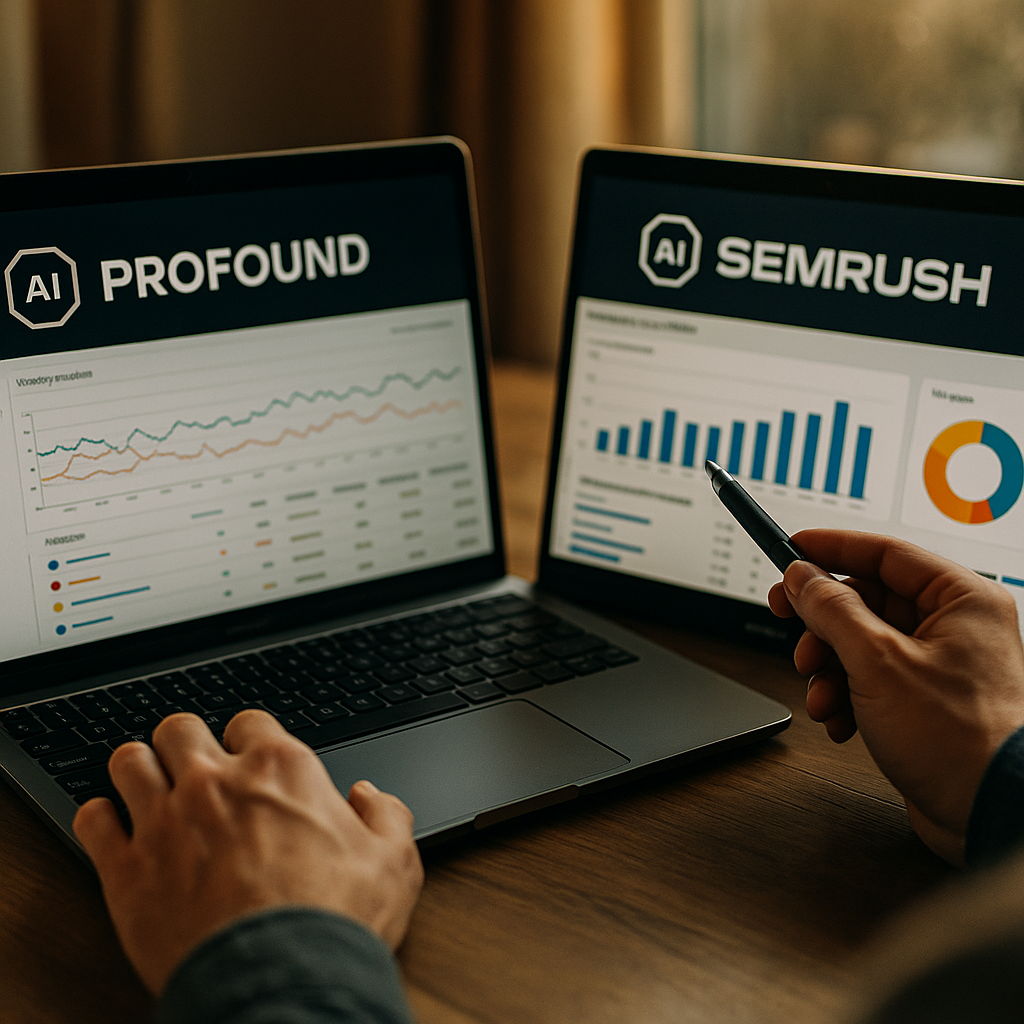
Only 9% of brand marketers say they can confidently prove which AI chatbot mentions actually drove revenue, according to recent eMarketer survey data. Yet budget for AI visibility trackers is exploding anyway. If you’re evaluating an AI visibility tracker right now, you’re not alone, and you’re probably confused about which platform actually measures what it claims to measure.
Profound built its name as the enterprise default. Semrush just muscled into the category with the marketing team’s existing subscription. And a wave of smaller GEO (generative engine optimization) tools are promising sharper data at a fraction of the price. None of them agree on methodology. That’s the part nobody tells you before the invoice arrives.
The Problem With “Visibility” as a Metric
Ask three vendors to define “AI visibility” and you’ll get three different answers. Some count raw mention frequency across ChatGPT, Gemini, and Perplexity. Others weight mentions by sentiment, position in the response, or whether a citation link accompanied the brand name. A few blend in traditional share-of-voice math borrowed from PR monitoring, which was never designed for probabilistic language model outputs in the first place.
This isn’t a minor technical quibble. It’s the reason two dashboards looking at the same brand, in the same week, can produce visibility scores that differ by 20 or 30 points. We’ve covered this exact discrepancy in detail when comparing GEO visibility scores across platforms, and the underlying issue hasn’t gone away. Different sampling frequencies, different prompt libraries, different model versions queried on different days. Add it up and you get noise dressed up as insight.
If your AI visibility dashboard can’t tell you which prompts triggered a brand mention and why, you’re buying a scoreboard, not a strategy.
Practitioners need to stop asking “what’s my score” and start asking “what’s the methodology behind my score.” That single shift changes vendor conversations entirely.
Profound: The Enterprise Standard, at Enterprise Prices
Profound remains the reference point for large brand teams, and for good reason. It monitors a wide spread of AI surfaces, tracks citation-level detail, and ties visibility trends to specific content changes on a client’s site. Enterprise buyers like Profound because it plays well with existing SEO and content operations teams, and because its reporting language maps cleanly to boardroom conversations about share of AI answer traffic.
The tradeoff is cost and complexity. Profound’s pricing sits well above what mid-market teams typically allocate for a single measurement tool, and onboarding requires real setup time from a marketing ops function that already has too much on its plate. If you’ve got the budget and a dedicated analyst, it’s a strong pick. If you’re a lean team trying to prove GEO value before asking for more headcount, it can feel like overkill.
We’ve stress-tested Profound against smaller challengers before, and the pattern holds: Profound wins on breadth and enterprise polish, but loses ground on price-to-insight ratio for teams under a certain size. Our earlier breakdown of Bluefish, Evertune, and Profound found meaningfully different citation counts for identical brand queries, which should give any buyer pause before treating a single score as gospel.
Semrush Enters the Chat, and Why That Matters
Semrush’s entry into AI visibility tracking changes the buying calculus more than most vendors want to admit. It’s not the most sophisticated tool in the category, but it’s bundled into a platform that thousands of marketing teams already pay for and already know how to use. That distribution advantage is enormous.
For teams that already lean on Semrush for traditional SEO, adding AI visibility tracking is a checkbox, not a procurement project. That matters because procurement friction, not feature gaps, is often the real reason smaller teams delay adopting GEO measurement. Semrush’s AI visibility module surfaces brand mentions across major chatbots and links them loosely to existing keyword and content data, which gives teams a workable starting point even if the granularity trails purpose-built tools like Profound or Rankscale.
The honest read: Semrush is good enough for teams that need directional signal and don’t have a dedicated GEO budget line yet. It’s not the tool you want if you’re trying to defend a seven-figure content investment to a CFO who wants precision.
What Is the New GEO Tool Stack, Anyway?
“GEO tool stack” has become shorthand for the layered approach smart teams now take instead of betting on a single vendor. It typically looks like this:
- A primary tracker (Profound, Semrush, or a comparable enterprise or mid-market tool) for headline visibility metrics.
- A secondary or challenger tool used specifically to sanity-check the primary vendor’s numbers.
- A content readability layer that audits whether your actual site content is structured for AI crawlers to parse and cite in the first place.
- An attribution bridge that connects AI-referred traffic to downstream conversion data, since most native AI visibility tools stop at “mentioned” and don’t get to “converted.”
This stacked approach exists because no single vendor currently covers all four layers well. We broke down five providers using five genuinely different metrics in our comparison of AI search optimization providers, and the takeaway was blunt: buy for the layer you’re weakest in, not for the flashiest dashboard.
There’s also a growing recognition that visibility scores mean nothing if your underlying content can’t be parsed by the models generating those answers. That’s a technical readability problem more than a tracking problem, and it’s costing teams real hours to fix. One recent audit found marketing teams losing an average of 16.6 hours per month chasing AI readability gaps that a tracker alone will never surface.
How Do You Pick the Right Tracker for Your Budget?
Start with the question your leadership actually cares about. If the ask is “are we visible in AI search at all,” a lighter tool like Semrush’s module or a lower-cost challenger will answer that fine. If the ask is “how does AI visibility compare to organic search revenue,” you need something closer to Profound with an attribution layer bolted on.
Budget tiers roughly break down like this in practice:
- Under $1,000/month: Bundled tools inside existing SEO platforms (Semrush, similar suites). Directional data only.
- $1,000 to $5,000/month: Mid-market GEO specialists offering better prompt coverage and citation detail.
- $5,000+/month: Enterprise platforms like Profound, typically paired with a dedicated analyst and custom reporting.
Whatever tier you land in, don’t sign anything before reading the contract closely. Vendor terms in this category are still immature, and clauses around data retention, model version disclosure, and reporting frequency vary wildly. We put together a checklist covering exactly what to check in GEO vendor contracts before you sign anything, and it’s worth a read before your next renewal cycle regardless of which tool you’re evaluating.
Compliance and Attribution Risks Nobody Talks About
Here’s the part that gets glossed over in vendor pitch decks: AI visibility trackers are measuring outputs from third-party models you don’t control and can’t audit directly. Model providers change training data, adjust guardrails, and update response formatting without notice. A visibility dip in your dashboard next month might reflect a model update, not a content problem on your end.
That volatility creates real reporting risk if your team presents visibility scores to leadership as if they were stable, controllable KPIs. They’re not, at least not yet. Treat every score as a snapshot influenced by factors outside your control, and build reporting language that reflects that honestly. The FTC and other regulators are paying increasing attention to how brands represent AI-driven marketing claims, so overstating certainty in an internal deck is a bad habit that can bleed into external claims too. Review the FTC’s guidance on marketing claims if your team is publishing any external-facing AI visibility numbers.
Attribution is the other unsolved piece. Most AI visibility tools tell you a brand got mentioned. Almost none of them reliably connect that mention to a purchase, a form fill, or a lead. Until that gap closes, treat AI visibility as a leading indicator worth watching, not a bottom-line metric worth betting your budget defense on. For teams that need to bridge the AI mention to real conversion data, pairing your visibility tracker with attribution infrastructure that reconciles across channels is becoming standard practice, similar to how Sprout Social and other platforms have pushed cross-channel reporting into the mainstream over the past few years.
Where This Category Is Headed
Expect consolidation. The current landscape of a dozen-plus GEO trackers with inconsistent methodology won’t survive procurement scrutiny once finance teams start asking for standardized reporting. Expect Semrush, HubSpot, and similar all-in-one platforms to keep absorbing basic AI visibility features into existing tiers, pushing pure-play GEO vendors to either specialize deeply (citation-level detail, model-specific tracking) or get acquired. Reference material from HubSpot and Statista on marketing technology adoption trends both point toward the same bundling pattern that played out in social media analytics a decade ago.
Brands that get ahead of this won’t be the ones with the fanciest dashboard. They’ll be the ones who understood the methodology early, built a layered stack instead of trusting one score, and kept their reporting language honest about what these tools can and can’t prove.
If you’re choosing your first AI visibility tracker this quarter, start with a two-week trial against a fixed list of 20 brand prompts, run the same list through your top two vendor candidates, and compare not just the scores but the citation-level detail behind them. The tool that shows its work wins, every time.
Frequently Asked Questions
What is an AI visibility tracker?
An AI visibility tracker is a software tool that monitors how often, and in what context, a brand is mentioned or cited in responses from AI chatbots and generative search engines like ChatGPT, Gemini, and Perplexity.
Is Profound better than Semrush for AI visibility tracking?
Profound generally offers deeper citation-level detail and broader AI surface coverage, making it stronger for enterprise reporting needs. Semrush is more accessible for teams already using its SEO platform and works well for directional tracking on a tighter budget.
Why do different AI visibility tools show different scores for the same brand?
Vendors use different prompt libraries, sampling frequencies, model versions, and weighting formulas, so identical brands can produce inconsistent scores across platforms even when measured in the same time period.
Can AI visibility scores be tied directly to revenue?
Not reliably yet. Most tools measure mention frequency and sentiment but stop short of connecting a mention to a specific conversion, so visibility should be treated as a leading indicator rather than a bottom-line metric.
What should marketing teams check before signing a GEO vendor contract?
Review data retention terms, model version disclosure practices, reporting frequency guarantees, and how the vendor handles methodology changes over time, since these details vary significantly across providers in this category.
Top Influencer Marketing Agencies
The leading agencies shaping influencer marketing in 2026
Agencies ranked by campaign performance, client diversity, platform expertise, proven ROI, industry recognition, and client satisfaction. Assessed through verified case studies, reviews, and industry consultations.
Moburst

-
2

The Shelf
Boutique Beauty & Lifestyle Influencer AgencyA data-driven boutique agency specializing exclusively in beauty, wellness, and lifestyle influencer campaigns on Instagram and TikTok. Best for brands already focused on the beauty/personal care space that need curated, aesthetic-driven content.Clients: Pepsi, The Honest Company, Hims, Elf Cosmetics, Pure LeafVisit The Shelf → -
3

Audiencly
Niche Gaming & Esports Influencer AgencyA specialized agency focused exclusively on gaming and esports creators on YouTube, Twitch, and TikTok. Ideal if your campaign is 100% gaming-focused — from game launches to hardware and esports events.Clients: Epic Games, NordVPN, Ubisoft, Wargaming, Tencent GamesVisit Audiencly → -
4

Viral Nation
Global Influencer Marketing & Talent AgencyA dual talent management and marketing agency with proprietary brand safety tools and a global creator network spanning nano-influencers to celebrities across all major platforms.Clients: Meta, Activision Blizzard, Energizer, Aston Martin, WalmartVisit Viral Nation → -
5

The Influencer Marketing Factory
TikTok, Instagram & YouTube CampaignsA full-service agency with strong TikTok expertise, offering end-to-end campaign management from influencer discovery through performance reporting with a focus on platform-native content.Clients: Google, Snapchat, Universal Music, Bumble, YelpVisit TIMF → -
6

NeoReach
Enterprise Analytics & Influencer CampaignsAn enterprise-focused agency combining managed campaigns with a powerful self-service data platform for influencer search, audience analytics, and attribution modeling.Clients: Amazon, Airbnb, Netflix, Honda, The New York TimesVisit NeoReach → -
7

Ubiquitous
Creator-First Marketing PlatformA tech-driven platform combining self-service tools with managed campaign options, emphasizing speed and scalability for brands managing multiple influencer relationships.Clients: Lyft, Disney, Target, American Eagle, NetflixVisit Ubiquitous → -
8

Obviously
Scalable Enterprise Influencer CampaignsA tech-enabled agency built for high-volume campaigns, coordinating hundreds of creators simultaneously with end-to-end logistics, content rights management, and product seeding.Clients: Google, Ulta Beauty, Converse, AmazonVisit Obviously →