


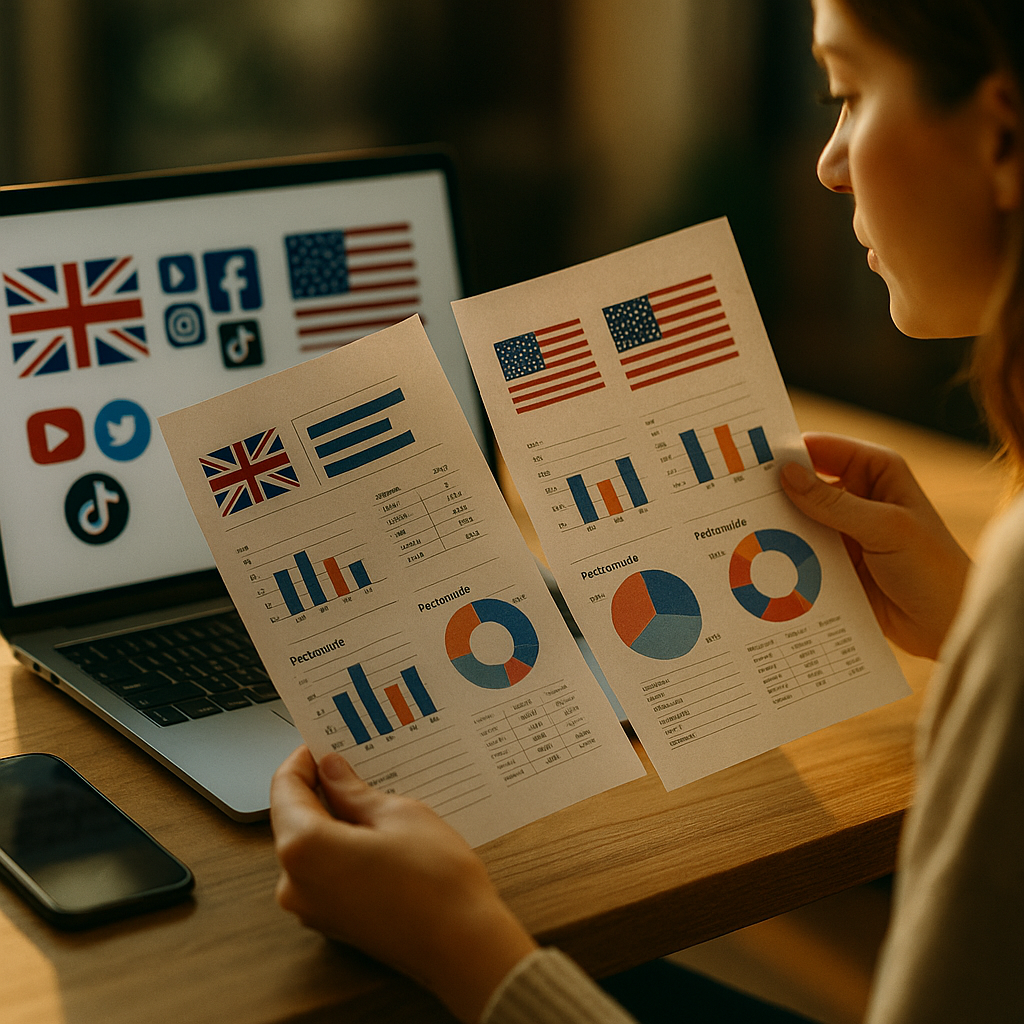
Here’s an uncomfortable number for any brand running a transatlantic creator strategy: UK influencer rates average 20 to 30 percent lower than US equivalents for comparable follower counts, yet UK disclosure enforcement is markedly stricter. Most global marketing teams treat influencer program benchmarks as a single global standard. That’s a mistake costing them money, compliance exposure, or both.
Two Markets, Two Very Different Rulebooks
Start with the regulatory baseline, because it shapes everything downstream. The UK’s Advertising Standards Authority and the Information Commissioner’s Office have pushed for years toward blunt, visible disclosure: #ad at the front of a caption, not buried after six hashtags. The ASA has also named and shamed brands publicly for non-compliant creator content, which is a reputational lever the US doesn’t really use in the same way.
In the US, the Federal Trade Commission enforces disclosure too, but enforcement has historically leaned on settlements and guidance updates rather than public shaming campaigns. The practical effect: US creator programs often treat disclosure as a legal checkbox, while UK programs build it into creative briefs from day one.
Brands running both markets under one disclosure policy usually default to the stricter standard without realizing it, then wonder why their US creators grumble about “UK style” compliance friction.
The fix isn’t picking a winner. It’s documenting both standards clearly in your creator output SLAs so nobody’s guessing mid-campaign. If your contracts don’t already specify disclosure language by market, that’s a gap worth closing before your next brief goes out, and it pairs well with the kind of structure covered in creator output SLAs.
Pricing Gaps: Why the Same Creator Costs Less in Manchester Than Miami
Currency conversion explains part of the UK/US rate gap, but not all of it. The bigger driver is market size and competitive density. The US creator economy has more brands chasing the same mid-tier talent pool, which pushes rates up through straightforward demand pressure. The UK market, smaller and more concentrated around London-based agencies, has less bidding competition for comparable audience sizes.
What should brands steal from this? US marketers negotiating UK campaigns often overpay because they import US rate cards wholesale. That’s leaving budget on the table. Conversely, UK marketers entering the US market frequently lowball offers based on home-market pricing and get ghosted by agents who know what the market actually bears.
- Steal from the UK: tighter rate negotiation discipline and smaller retainer increments tied to deliverable count rather than flat monthly fees.
- Steal from the US: more granular format cost multipliers, since US agencies have refined pricing by content type (short form, long form, livestream) more aggressively than most UK shops.
If you’re building a rate card that works across both markets, the format cost multipliers approach gives you a defensible structure that adjusts by content type instead of guessing region by region. It also helps when finance asks why a 60 second Reel and a 10 minute YouTube review cost differently, which they inevitably will.
Platform Mix Isn’t the Same Game
TikTok’s reach in the UK is proportionally larger relative to total population than in the US, where Instagram and YouTube still dominate B2C influencer budgets for mid-market brands. Meanwhile, LinkedIn creator activity (thought leadership, employee advocacy, B2B influence) skews more heavily toward US adoption, partly because American corporate culture rewards personal brand building in ways UK corporate norms still find slightly uncomfortable.
This matters for budget allocation. A brand running identical platform splits across both markets is almost certainly misallocating spend somewhere. UK teams should lean harder into TikTok-first creative testing before porting winning formats to Instagram. US teams get more mileage treating LinkedIn as a legitimate creator channel rather than an afterthought, something covered in depth in employee advocacy governance frameworks that most UK HR and legal teams haven’t yet formalized.
For platform benchmark data, eMarketer’s regional breakdowns and Sprout Social’s annual index both track usage shifts worth checking quarterly, since platform dominance in either market can flip faster than annual planning cycles account for.
Agency Structures: Who’s Actually Running the Program?
US brands lean more heavily toward in-house creator teams or hybrid pods, especially at enterprise scale, partly because talent costs for in-house ops specialists are more justifiable against larger overall media budgets. UK brands, working with tighter overall marketing spend relative to US counterparts, outsource more to specialist agencies and rely on agency-held creator rosters rather than building owned databases.
Neither approach is objectively better. But brands expanding across both markets should map their structure decision against volume, not habit. The in house vs agency vs hybrid framework is a useful gut check here: if your UK arm runs 15 campaigns a year and your US arm runs 150, they probably shouldn’t use the same operating model just because it’s tidier on an org chart.
This also affects how fast you can scale creator discovery. US teams investing in AI-driven sourcing tools are moving faster on nano and micro creator recruitment, a trend explored in AI agent matching approaches. UK agencies have been slower to adopt these tools, partly due to smaller addressable creator pools making manual curation still fairly efficient.
What Finance Actually Cares About
Here’s where it gets interesting for anyone reporting up the chain. US marketing orgs tend to demand harder attribution, often insisting on proxy metrics tied to paid media benchmarks even for awareness-stage influencer work. UK finance teams have historically accepted softer brand lift metrics more readily, though that’s tightening fast as budgets get scrutinized harder across the board.
Global brands should steal the US instinct for rigor here. Building proxy metrics for awareness campaigns that finance actually trusts protects your budget during the next cost review, regardless of which market you’re reporting from. It’s a lot easier to defend a creator line item with a clear measurement framework than with “brand sentiment felt positive.”
The brands winning budget renewals aren’t the ones with the biggest creator rosters. They’re the ones who can show a finance director exactly how creator spend maps to pipeline, regardless of currency.
On the flip side, UK teams are often ahead on one thing: blended budget thinking. Smaller overall spend forces tighter cross-channel coordination earlier. The blended budget allocation model, tracking one CAC ledger across paid, organic, influencer, and affiliate, is more common in lean UK marketing orgs out of necessity, and it’s worth importing to larger US teams who still run influencer as a budget silo.
Compliance Isn’t Optional, and It’s Getting Harder
Both markets are tightening enforcement, not loosening it. The ASA’s monitoring has expanded into livestream shopping and affiliate links, areas that were previously grey zones. The FTC has signaled increased scrutiny of AI-generated endorsements and synthetic influencer content, an area global brands can’t afford to treat casually given how fast AI-generated creator content is scaling.
Brands running AI-assisted content pipelines across both markets should build governance before launch, not after a regulator asks questions. The AI marketing agent governance checklist is a reasonable starting point for teams that haven’t yet mapped disclosure requirements against AI-generated content specifically, which is a gap in most compliance frameworks right now, UK and US alike.
The Takeaway
Don’t run one global playbook and call it efficient. Audit your current UK and US programs against each other this quarter: pull rate cards, disclosure language, platform spend splits, and attribution models side by side, then steal whichever half is actually working better and kill the half that isn’t.
Frequently Asked Questions
Are UK influencer rates really lower than US rates for similar audience sizes?
Generally yes, by roughly 20 to 30 percent for comparable follower counts and engagement rates, driven mainly by market size and lower bidding competition among UK brands for mid-tier talent.
Which market has stricter influencer disclosure enforcement?
The UK’s Advertising Standards Authority has been more publicly aggressive about naming non-compliant brands and creators, while US FTC enforcement tends to rely more on guidance and settlements.
Should a global brand use one influencer policy for both markets?
No. A single policy usually forces one market into unnecessary friction. It’s better to document disclosure, pricing, and platform standards separately for each market within one shared governance framework.
Why does platform mix differ so much between UK and US creator programs?
TikTok carries proportionally more reach in the UK relative to population, while Instagram, YouTube, and LinkedIn hold stronger ground in US creator budgets, particularly for B2B and employee advocacy content.
Do US brands measure influencer ROI differently than UK brands?
US marketing orgs tend to demand harder attribution and proxy metrics even for awareness campaigns, while UK finance teams have historically accepted softer brand lift data, though that gap is narrowing.
Top Influencer Marketing Agencies
The leading agencies shaping influencer marketing in 2026
Agencies ranked by campaign performance, client diversity, platform expertise, proven ROI, industry recognition, and client satisfaction. Assessed through verified case studies, reviews, and industry consultations.
Moburst

-
2

The Shelf
Boutique Beauty & Lifestyle Influencer AgencyA data-driven boutique agency specializing exclusively in beauty, wellness, and lifestyle influencer campaigns on Instagram and TikTok. Best for brands already focused on the beauty/personal care space that need curated, aesthetic-driven content.Clients: Pepsi, The Honest Company, Hims, Elf Cosmetics, Pure LeafVisit The Shelf → -
3

Audiencly
Niche Gaming & Esports Influencer AgencyA specialized agency focused exclusively on gaming and esports creators on YouTube, Twitch, and TikTok. Ideal if your campaign is 100% gaming-focused — from game launches to hardware and esports events.Clients: Epic Games, NordVPN, Ubisoft, Wargaming, Tencent GamesVisit Audiencly → -
4

Viral Nation
Global Influencer Marketing & Talent AgencyA dual talent management and marketing agency with proprietary brand safety tools and a global creator network spanning nano-influencers to celebrities across all major platforms.Clients: Meta, Activision Blizzard, Energizer, Aston Martin, WalmartVisit Viral Nation → -
5

The Influencer Marketing Factory
TikTok, Instagram & YouTube CampaignsA full-service agency with strong TikTok expertise, offering end-to-end campaign management from influencer discovery through performance reporting with a focus on platform-native content.Clients: Google, Snapchat, Universal Music, Bumble, YelpVisit TIMF → -
6

NeoReach
Enterprise Analytics & Influencer CampaignsAn enterprise-focused agency combining managed campaigns with a powerful self-service data platform for influencer search, audience analytics, and attribution modeling.Clients: Amazon, Airbnb, Netflix, Honda, The New York TimesVisit NeoReach → -
7

Ubiquitous
Creator-First Marketing PlatformA tech-driven platform combining self-service tools with managed campaign options, emphasizing speed and scalability for brands managing multiple influencer relationships.Clients: Lyft, Disney, Target, American Eagle, NetflixVisit Ubiquitous → -
8

Obviously
Scalable Enterprise Influencer CampaignsA tech-enabled agency built for high-volume campaigns, coordinating hundreds of creators simultaneously with end-to-end logistics, content rights management, and product seeding.Clients: Google, Ulta Beauty, Converse, AmazonVisit Obviously →