


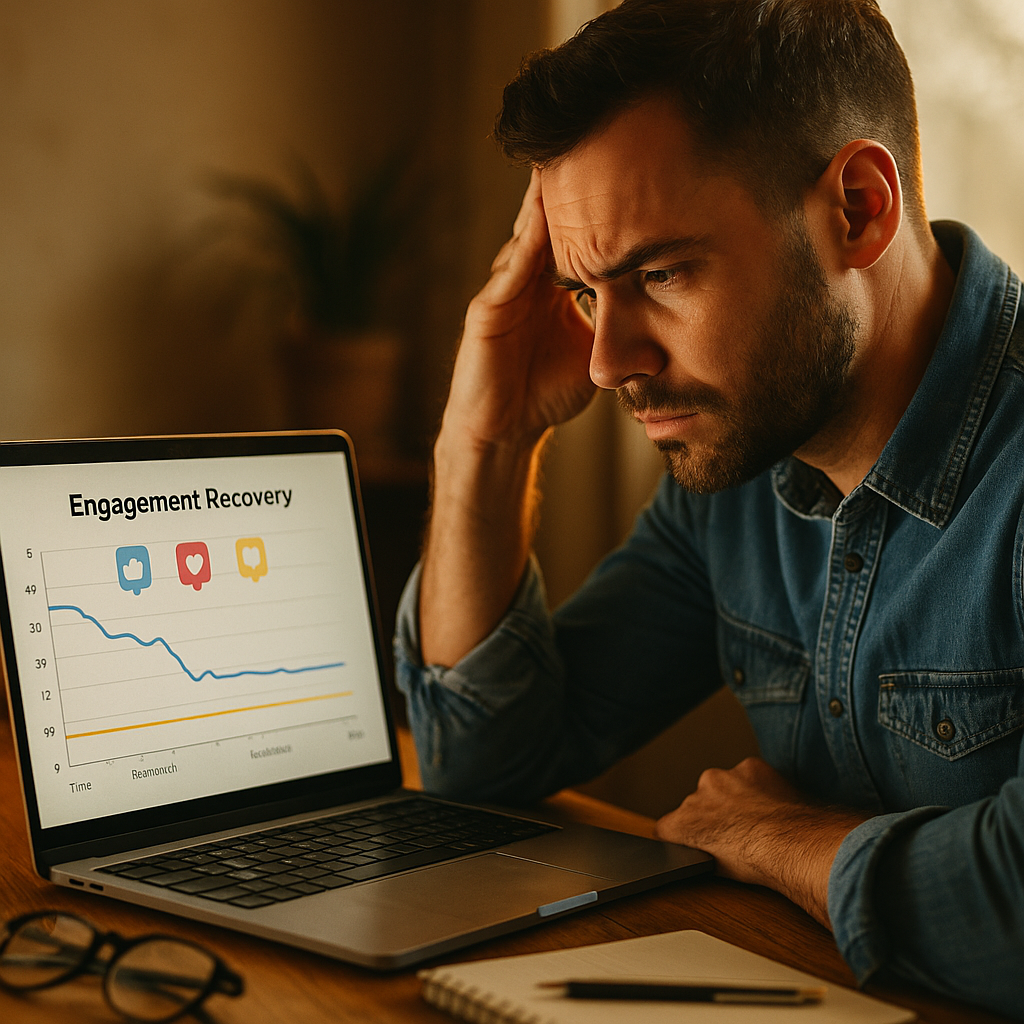
A campaign that misses its engagement target by 15% isn’t dead. One that misses by 40% three weeks running probably is. The problem: most brands never define that line, so every underperforming campaign gets the same panicked response. Engagement recovery benchmarks fix that by giving marketers a pre-agreed threshold for what “recoverable” actually looks like, before the dashboard goes red.
Why Most Teams Wing It When Engagement Drops
Here’s the uncomfortable truth: most influencer programs have launch benchmarks but no recovery benchmarks. Marketing teams set a target engagement rate, watch a campaign fall short, and then debate in real time whether to pull spend, swap creators, or just wait it out. That debate eats days. Sometimes weeks. And every day spent arguing is a day of ad spend and creator fees generating substandard returns.
Recovery benchmarking solves a different problem than diagnosis. If you haven’t yet figured out why a campaign is underperforming, start with a proper root-cause pass, like the one outlined in low engagement diagnosis frameworks. Recovery benchmarking picks up after that: once you know the cause, how do you know if your fix is working, and how long do you give it before cutting losses?
A recovery benchmark isn’t a hope. It’s a pre-committed decision rule that tells you, by a specific date, whether to double down, pivot, or kill the campaign.
What a Recovery Benchmark Actually Measures
A launch benchmark answers “what good looks like.” A recovery benchmark answers “what good enough, fast enough, looks like after an intervention.” These are not the same number. Recovery benchmarks typically track three things over a defined window, usually 7 to 14 days post-intervention:
- Velocity of recovery: the rate of week-over-week improvement in engagement rate, saves, shares, or comments, not the absolute number.
- Floor threshold: the minimum engagement rate below which the campaign is considered non-viable regardless of trend.
- Ceiling target: the level at which the campaign is declared “recovered” and returns to standard monitoring cadence.
Without these three data points, “we’re watching it closely” is just a polite way of saying nobody owns the decision.
Setting the Floor: When Is a Campaign Actually Unrecoverable?
Most brands set their floor threshold too low, because nobody wants to be the person who kills a campaign that might have turned around. That instinct is expensive. Data from Sprout Social’s industry benchmarking research consistently shows that campaigns underperforming their category average by more than 50% in the first 72 hours rarely close that gap without a structural change, not a tweak.
A workable floor rule: if engagement rate sits below 50% of your category benchmark for three consecutive posting cycles after an intervention, the campaign moves to a kill-or-restructure decision, not another “let’s give it another week.” This single rule, written down and agreed before launch, removes more internal debate than any dashboard ever will.
Compare that floor against your original rate card expectations. If you’re working across UK and US creator markets, your floor will differ by platform mix and market norms, which is exactly why UK vs US influencer benchmarks should inform your baseline before you set recovery thresholds, not after.
The Ceiling: Defining “Recovered” Instead of “Better”
“Better” is a trap. A campaign that improves engagement by 20% but is still 60% below target hasn’t recovered, it’s just less broken. Your ceiling target should be expressed as a percentage of the original launch benchmark, typically 85 to 95%, not as an improvement over the underperforming baseline.
Set the ceiling too low and you’ll declare victory prematurely, redirect attention elsewhere, and watch the metric slide right back down once nobody’s monitoring it. Set it too high and you’ll keep intervening on a campaign that’s already delivered acceptable, if not spectacular, results.
Building the Recovery Window: How Much Time Is Fair?
This is where most recovery plans fall apart. Teams either give a campaign too little time to respond to a fix (judging a creator swap after 48 hours is pointless, the algorithm hasn’t even redistributed the content yet) or too much time (letting a dying campaign limp along for six weeks because “we already invested in it”).
A sensible window structure, based on typical platform content lifecycle:
- Days 1 to 3 post-intervention: no judgment calls. This is algorithmic settling time on most platforms.
- Days 4 to 10: trend monitoring. Compare velocity against your recovery curve, not absolute numbers.
- Day 11 to 14: decision point. Ceiling hit, continue. Floor breached, kill or restructure. Sitting in between, extend once, with a hard stop.
Notice there’s no “extend indefinitely” option. That’s deliberate. Open-ended recovery windows are how underperforming campaigns quietly become permanent budget drains.
Tying Recovery Benchmarks to Funnel Stage
Not every campaign is chasing the same metric, so not every recovery benchmark should look the same. An awareness campaign that’s underperforming on engagement rate but overperforming on reach might not need “recovery” at all, it needs a different proxy metric. This is a common misread: teams panic over engagement dips on top-funnel content when they should be tracking completion rate or share velocity instead.
If your underperforming campaign sits at the awareness end of the funnel, cross-reference against proxy metrics finance actually trusts before setting a recovery target that might be chasing the wrong number entirely. Conversion and consideration stage campaigns need a tighter, harder recovery benchmark since they’re closer to revenue attribution. For a full breakdown of what good looks like at each stage, the funnel-stage ROI benchmarking guide is worth pulling up alongside your recovery plan.
Recovering the wrong metric is worse than not recovering at all. It burns budget and creates false confidence in a campaign structure that still doesn’t work.
Who Owns the Recovery Decision?
This sounds like a process question, but it’s really a governance question. If the person who greenlit the original creator and budget is also the person deciding whether to extend the recovery window, you’ve got a built-in bias toward “give it more time.” Recovery benchmark ownership should sit with whoever owns reporting lines for the broader program, which is exactly the structural issue covered in reporting lines that set budget. Separating the “champion” from the “judge” is one of the simplest governance fixes that most mid-size programs skip entirely.
For programs running creator output through formal agreements, your recovery benchmark should also tie back into the creator output SLAs you’ve negotiated. If a creator’s content underperforms because they missed a posting window or delivered off-brief content, that’s a contract issue, not a strategy issue, and your recovery benchmark shouldn’t have to do the heavy lifting there.
What Interventions Actually Move the Needle
Setting the benchmark is half the job. The other half is having a real menu of interventions to test against it, rather than just “boost the post” and hope. Based on what’s actually worked across recent creator campaigns:
- Format substitution: swapping a static post for a short-form video, since format carries real weight in algorithmic distribution. See format cost multipliers for how pricing shifts with format changes.
- Repurposing existing assets: instead of commissioning new content (which resets your recovery clock), pull from a content repurposing calendar to test a different cut of the same shoot.
- Creator tier adjustment: moving budget from one underperforming macro creator to a cluster of nano or micro creators, a shift detailed in blended tier retainer structures.
- Paid amplification layer: a modest boost behind organic content to test whether the creative itself is sound but reach is the bottleneck.
Test one variable at a time against your recovery window. Changing the creator, the format, and the targeting simultaneously means you’ll never know which lever actually worked, and you’ll repeat the same mistake next quarter.
Documenting Recovery Outcomes for the Next Campaign
Every recovery benchmark decision, win or kill, should feed into your next planning cycle. Programs that treat each underperforming campaign as an isolated incident never build institutional memory about what recovery interventions actually work for their audience and category. That’s a wasted learning opportunity, and it’s exactly the kind of gap that shows up in annual strategic reviews when nobody can explain why the same mistake happened twice.
If your program runs on quarterly or monthly cycles, build a lightweight recovery log into your budget cadence reviews: what was the floor, what was the ceiling, what intervention was tried, what happened. Six months of this data is worth more than any external benchmark report, because it’s calibrated to your actual audience and platform mix.
External data still has a place. eMarketer’s creator economy forecasts and Statista’s social media engagement data are useful for sanity-checking whether your category benchmark itself has shifted, since a recovery target calibrated against last year’s engagement norms might be chasing a number that no longer exists.
A Quick Sanity Check Before You Set Your Own Benchmarks
Before finalizing recovery thresholds, ask three questions internally:
- Is our floor threshold based on category data, or on what felt comfortable last time?
- Does our recovery window account for platform-specific content lifecycle, or is it an arbitrary two weeks?
- Who has final authority to kill a campaign, and are they separate from whoever approved it?
If you can’t answer all three without a meeting, your recovery benchmarks aren’t actually benchmarks yet. They’re guesses with a deadline attached.
Next Step
Pick your next underperforming campaign and write down a floor, a ceiling, and a 14-day window before you touch a single creative asset. That one document will save more budget than any new platform or tool you add this quarter.
FAQs
What is an engagement recovery benchmark?
It’s a pre-agreed threshold that defines how much engagement improvement a campaign needs within a set time window to be considered “recovered” after underperforming, rather than relying on subjective judgment calls.
How long should a recovery window last?
Most campaigns need 11 to 14 days post-intervention to show a reliable trend, with the first 3 days excluded as algorithmic settling time. Shorter windows risk premature judgment; longer windows risk wasted spend.
What’s the difference between a launch benchmark and a recovery benchmark?
A launch benchmark defines expected performance before a campaign goes live. A recovery benchmark defines the minimum acceptable trajectory after an intervention has been applied to an underperforming campaign.
Should every campaign use the same recovery floor?
No. Recovery floors should vary by funnel stage, platform, and creator tier, since awareness campaigns and conversion campaigns respond to different metrics and have different acceptable variance ranges.
Who should own the decision to kill an underperforming campaign?
Ideally someone separate from whoever approved the original creator and budget, to avoid bias toward extending a campaign that isn’t working.
Top Influencer Marketing Agencies
The leading agencies shaping influencer marketing in 2026
Agencies ranked by campaign performance, client diversity, platform expertise, proven ROI, industry recognition, and client satisfaction. Assessed through verified case studies, reviews, and industry consultations.
Moburst

-
2

The Shelf
Boutique Beauty & Lifestyle Influencer AgencyA data-driven boutique agency specializing exclusively in beauty, wellness, and lifestyle influencer campaigns on Instagram and TikTok. Best for brands already focused on the beauty/personal care space that need curated, aesthetic-driven content.Clients: Pepsi, The Honest Company, Hims, Elf Cosmetics, Pure LeafVisit The Shelf → -
3

Audiencly
Niche Gaming & Esports Influencer AgencyA specialized agency focused exclusively on gaming and esports creators on YouTube, Twitch, and TikTok. Ideal if your campaign is 100% gaming-focused — from game launches to hardware and esports events.Clients: Epic Games, NordVPN, Ubisoft, Wargaming, Tencent GamesVisit Audiencly → -
4

Viral Nation
Global Influencer Marketing & Talent AgencyA dual talent management and marketing agency with proprietary brand safety tools and a global creator network spanning nano-influencers to celebrities across all major platforms.Clients: Meta, Activision Blizzard, Energizer, Aston Martin, WalmartVisit Viral Nation → -
5

The Influencer Marketing Factory
TikTok, Instagram & YouTube CampaignsA full-service agency with strong TikTok expertise, offering end-to-end campaign management from influencer discovery through performance reporting with a focus on platform-native content.Clients: Google, Snapchat, Universal Music, Bumble, YelpVisit TIMF → -
6

NeoReach
Enterprise Analytics & Influencer CampaignsAn enterprise-focused agency combining managed campaigns with a powerful self-service data platform for influencer search, audience analytics, and attribution modeling.Clients: Amazon, Airbnb, Netflix, Honda, The New York TimesVisit NeoReach → -
7

Ubiquitous
Creator-First Marketing PlatformA tech-driven platform combining self-service tools with managed campaign options, emphasizing speed and scalability for brands managing multiple influencer relationships.Clients: Lyft, Disney, Target, American Eagle, NetflixVisit Ubiquitous → -
8

Obviously
Scalable Enterprise Influencer CampaignsA tech-enabled agency built for high-volume campaigns, coordinating hundreds of creators simultaneously with end-to-end logistics, content rights management, and product seeding.Clients: Google, Ulta Beauty, Converse, AmazonVisit Obviously →