


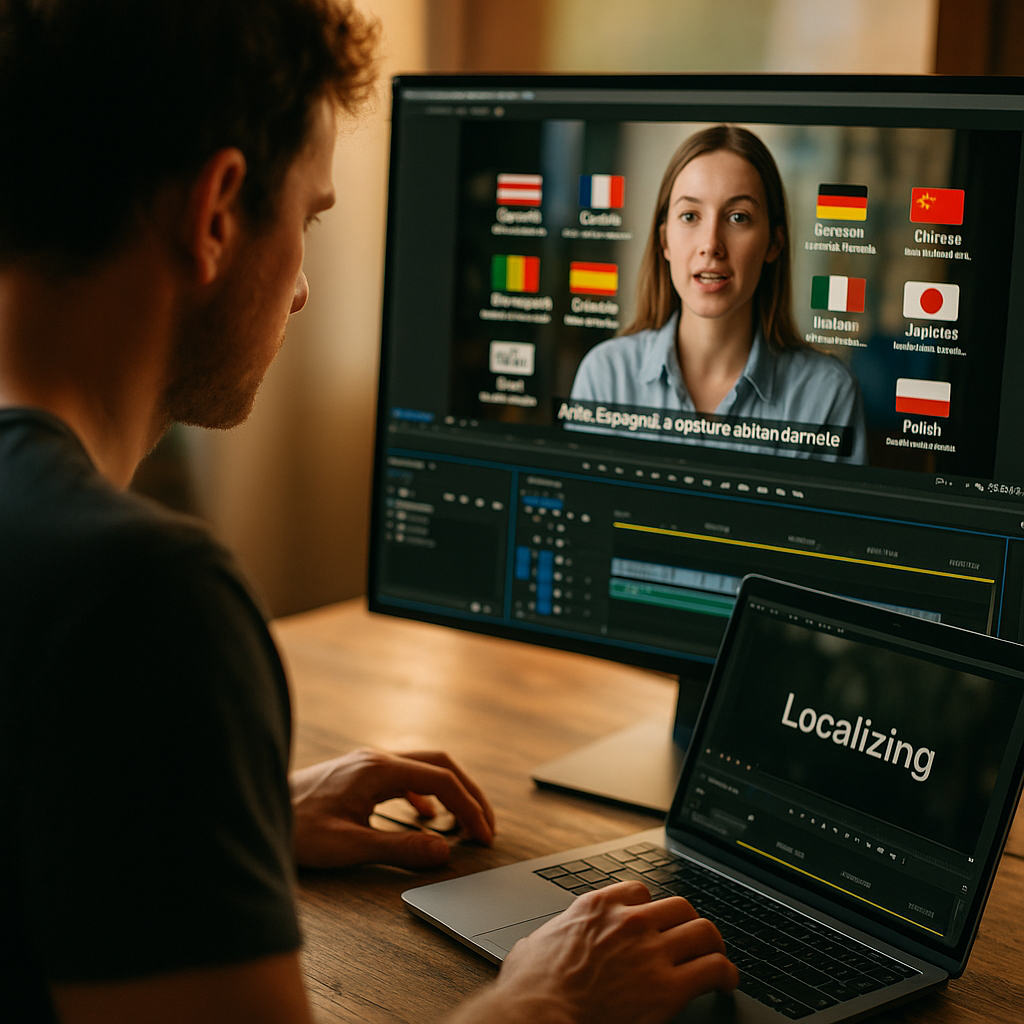
One creator video. Twelve languages. Zero reshoots. That’s the pitch behind AI video localization, and it’s no longer a demo reel promise, it’s a production reality that’s rewriting how global brands brief influencer campaigns. A single UGC ad shot in English can now land in Tokyo, São Paulo, and Berlin with matched lip movement and native-sounding voiceover before the original creator has even finished posting their own version.
Why Speed Suddenly Matters More Than Polish
Global campaigns used to run on a staggered rollout. You’d launch in the US, wait six weeks for translated assets, then push to secondary markets once the budget cycle allowed it. That lag cost brands cultural relevance. By the time a dubbed version hit a regional market, the trend it referenced was dead.
AI video localization collapses that timeline. Tools built on voice cloning and generative lip-sync can now take a single creator asset and produce a dozen market-ready cuts in the time it takes to approve a media plan. eMarketer has flagged localized creative as a top lever for international ad performance, and the reason is simple: audiences convert faster when the person on screen sounds like they belong to their market, not like a dubbed import from a different one.
A campaign that used to take six weeks to localize across five markets can now go live in twelve languages within a single production sprint, often before the paid media buy is even finalized.
How the Technology Actually Works
Strip away the marketing language and the workflow is fairly mechanical. It’s just very good mechanics.
- Voice cloning: the platform ingests the original creator’s voice and generates a synthetic version speaking the target language, preserving tone, pacing, and emotional inflection.
- Lip-sync remapping: generative video models adjust mouth movements frame by frame so the dubbed audio matches on screen, closing the “obviously dubbed” gap that used to make localized ads feel cheap.
- Cultural adaptation layers: some platforms flag idioms, humor, or references that won’t land and suggest localized substitutes rather than literal translations.
- QC and human review: the better vendors route every output through a native-speaking reviewer before it ships, catching tone mismatches or awkward phrasing the model missed.
That last step matters more than the tech vendors like to admit. Automated dubbing without human review still produces the occasional phrase that’s technically correct and culturally tone deaf. Brands running this at scale are pairing AI output with the same kind of human trust layer we’ve covered in hybrid AI and human production workflows, where the machine does the heavy lifting and a person signs off on the final cut.
The Budget Case: Why CFOs Are Suddenly Interested
Traditional multi-market video production means re-briefing creators in each region, paying separate production fees, and managing a dozen parallel approval chains. That’s expensive and slow, and it’s the main reason so many “global” influencer campaigns actually only ran in three or four countries.
AI localization changes the unit economics. Instead of paying for twelve separate shoots, brands pay for one strong creative asset and a localization pass. Early adopters report production cost reductions in the range of 60 to 80 percent for multi-market rollouts, according to workflow benchmarks tracked by Sprout Social and echoed in vendor case studies across the space. That math is why performance marketing leads who used to treat localization as a “nice to have” line item are now building it into the base campaign budget.
There’s a secondary win here too: testing velocity. When a single hook can be localized into twelve markets overnight, brands can run true multivariate testing on messaging across regions in the same flight window, instead of testing sequentially over months. That’s a research advantage as much as a cost one.
Where This Gets Risky
Speed without governance is how brands end up explaining themselves to regulators. A few things to lock down before you flip the switch on twelve-language launches:
- Disclosure consistency. If the original creator video carries a paid partnership disclosure, every localized version needs the equivalent disclosure in that market’s language and format, not a rough translation buried in a caption. The FTC has been explicit that disclosure obligations travel with the ad, not just the original language version.
- Creator consent scope. Voice cloning a creator’s likeness into eleven other languages is a different usage right than the one they signed for a single-market post. Contracts need to explicitly cover synthetic voice use, or you’re exposed the moment a creator (or their lawyer) notices their voice speaking Portuguese without a conversation ever happening.
- Regional compliance nuance. The EU, UK, and several APAC markets have different rules on AI-generated content labeling. What passes in the US market can trigger a compliance flag elsewhere. The ICO guidance on automated content is a reasonable starting reference point for UK-facing campaigns.
- Cultural QC, not just linguistic QC. A technically accurate translation can still misfire on humor, gesture, or product context. This is where the human review layer earns its keep.
None of this is a reason to avoid the technology. It’s a reason to build the approval chain before the first campaign, not after the first complaint.
Building the Workflow: What Actually Ships
The brands getting this right treat localization as a production stage, not an afterthought bolted onto a finished campaign. A few operational patterns worth stealing:
- Brief creators knowing localization is coming. That changes how you shoot: fewer visual puns tied to English wordplay, cleaner audio for cloning accuracy, and product shots that don’t rely on on-screen text that needs redesigning per market.
- Batch the review cycle. Route all twelve language versions through native reviewers in a single pass rather than staggering approvals, which is where most of the “overnight” speed gets lost to process, not tech.
- Keep a style guide per market. Tone that works in a founder-style direct address in one region can read as too casual in another. The same discipline that goes into founder-style talking head coaching applies here, just multiplied across markets.
- Track performance per language, not just per campaign. A hook that converts in German might flatline in Japanese for reasons that have nothing to do with translation quality and everything to do with pacing or humor norms.
This is also where faceless and voice-forward formats have an edge. Campaigns built around faceless creator channels or AI narrated storytelling localize more cleanly than heavily face-forward content, since there’s less lip-sync work required and fewer opportunities for the uncanny valley effect to creep in. If your content strategy already leans on documentary-style vertical formats, you’re likely closer to localization-ready than a brand running exclusively talking-head selfie content.
What This Means for the Next Twelve Months
Localization used to be a gate. Now it’s a lever. The brands that treat it as a strategic capability, built into the creative brief from day one, are the ones running true global-first campaigns instead of US campaigns with subtitles bolted on. Platforms including TikTok Ads Manager and Meta Business Suite are already building creative tooling around multi-language asset management, which suggests the platforms expect this to become standard practice rather than a novelty.
The practitioners who get ahead of this won’t be the ones with the flashiest AI dubbing demo. They’ll be the ones who solved consent, disclosure, and QC before scaling to twelve markets, because that’s the part that actually determines whether the campaign survives contact with a regulator or an unhappy creator.
Frequently Asked Questions
What is AI video localization?
AI video localization is the process of using voice cloning, generative lip-sync, and automated translation to adapt a single creator video into multiple languages and markets without reshooting the original content.
How fast can a campaign actually go live in multiple languages?
With a streamlined production and review workflow, brands are launching campaigns across ten to twelve languages within a single production sprint, often 24 to 72 hours depending on the review process, rather than the multi-week timelines traditional dubbing required.
Does AI localization replace human translators and voice actors?
Not entirely. Most reliable workflows still route AI-generated output through native-speaking human reviewers to catch cultural or tonal mismatches the model misses, so it’s a labor multiplier rather than a full replacement.
Do localized creator videos still need paid partnership disclosures?
Yes. Every localized version of a sponsored video needs the equivalent disclosure in that market’s language and platform format. Translating the video without translating the disclosure creates real regulatory exposure.
Do creators need to give separate consent for voice cloning into other languages?
They should. Contracts negotiated for single-market usage typically don’t cover synthetic voice replication into other languages, so brands need explicit consent language covering AI localization before deploying a creator’s cloned voice.
Which content formats localize most easily?
Faceless, voiceover-driven, and documentary-style formats generally localize more cleanly than heavy talking-head content, since they require less lip-sync manipulation and carry a lower risk of visual mismatch between audio and mouth movement.
Next step: before you greenlight a twelve-language launch, get consent language, disclosure templates, and native review checkpoints written into the production plan, not the post-launch cleanup plan.
Top Influencer Marketing Agencies
The leading agencies shaping influencer marketing in 2026
Agencies ranked by campaign performance, client diversity, platform expertise, proven ROI, industry recognition, and client satisfaction. Assessed through verified case studies, reviews, and industry consultations.
Moburst

-
2

The Shelf
Boutique Beauty & Lifestyle Influencer AgencyA data-driven boutique agency specializing exclusively in beauty, wellness, and lifestyle influencer campaigns on Instagram and TikTok. Best for brands already focused on the beauty/personal care space that need curated, aesthetic-driven content.Clients: Pepsi, The Honest Company, Hims, Elf Cosmetics, Pure LeafVisit The Shelf → -
3

Audiencly
Niche Gaming & Esports Influencer AgencyA specialized agency focused exclusively on gaming and esports creators on YouTube, Twitch, and TikTok. Ideal if your campaign is 100% gaming-focused — from game launches to hardware and esports events.Clients: Epic Games, NordVPN, Ubisoft, Wargaming, Tencent GamesVisit Audiencly → -
4

Viral Nation
Global Influencer Marketing & Talent AgencyA dual talent management and marketing agency with proprietary brand safety tools and a global creator network spanning nano-influencers to celebrities across all major platforms.Clients: Meta, Activision Blizzard, Energizer, Aston Martin, WalmartVisit Viral Nation → -
5

The Influencer Marketing Factory
TikTok, Instagram & YouTube CampaignsA full-service agency with strong TikTok expertise, offering end-to-end campaign management from influencer discovery through performance reporting with a focus on platform-native content.Clients: Google, Snapchat, Universal Music, Bumble, YelpVisit TIMF → -
6

NeoReach
Enterprise Analytics & Influencer CampaignsAn enterprise-focused agency combining managed campaigns with a powerful self-service data platform for influencer search, audience analytics, and attribution modeling.Clients: Amazon, Airbnb, Netflix, Honda, The New York TimesVisit NeoReach → -
7

Ubiquitous
Creator-First Marketing PlatformA tech-driven platform combining self-service tools with managed campaign options, emphasizing speed and scalability for brands managing multiple influencer relationships.Clients: Lyft, Disney, Target, American Eagle, NetflixVisit Ubiquitous → -
8

Obviously
Scalable Enterprise Influencer CampaignsA tech-enabled agency built for high-volume campaigns, coordinating hundreds of creators simultaneously with end-to-end logistics, content rights management, and product seeding.Clients: Google, Ulta Beauty, Converse, AmazonVisit Obviously →