


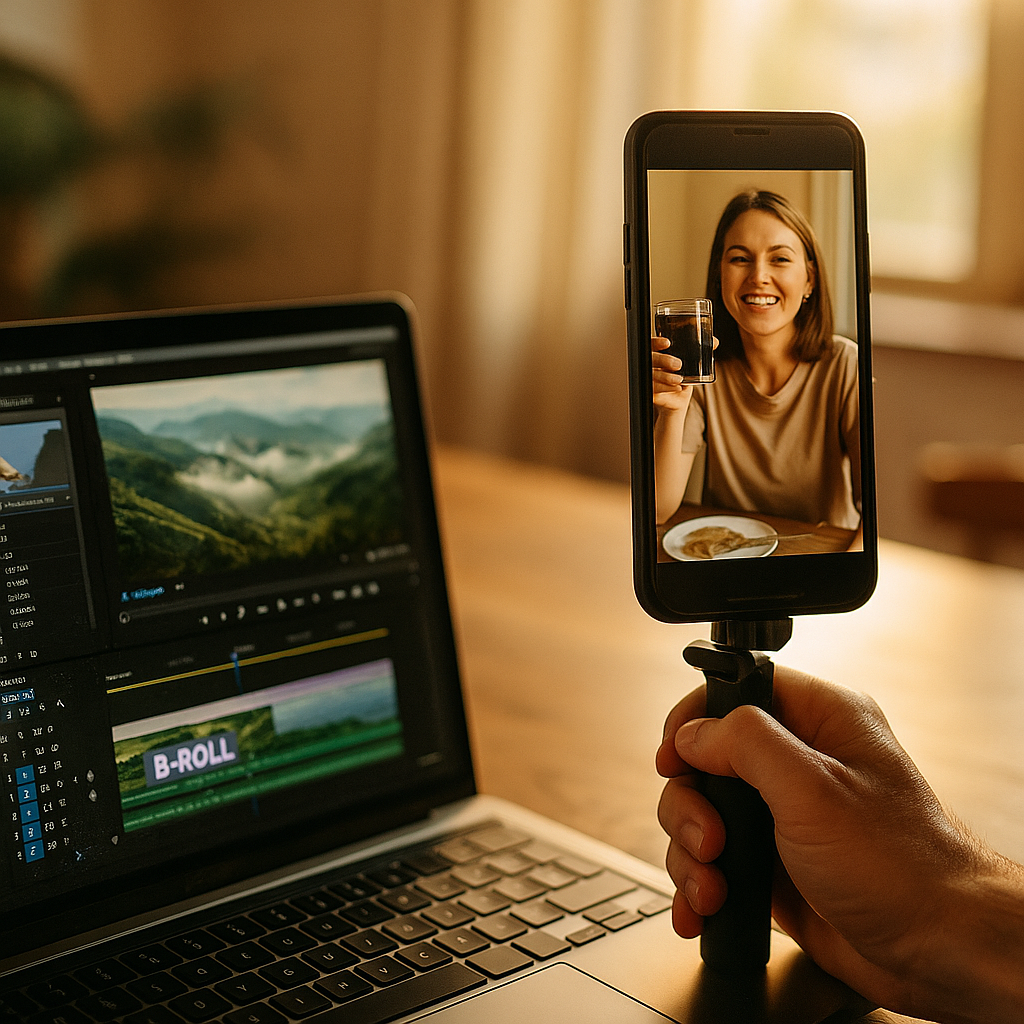
Sixty percent of marketers say video production costs are their biggest barrier to scaling content output, according to HubSpot research on marketing trends. So what happens when you let AI generate the backgrounds while humans keep the faces? A hybrid production format is quietly becoming the default for brands trying to ship more content without ballooning budgets, and it’s called AI b-roll paired with human UGC.
What Hybrid Production Actually Means
Strip away the buzzwords and the concept is simple. A creator films themselves talking, reacting, or demoing a product, exactly the way they always have. Then, instead of sending a videographer to shoot supporting footage (product close-ups, lifestyle scenes, location shots), a brand generates that b-roll with AI tools like Runway, Luma, or Google’s Veo.
The creator’s voice, face, and opinion stay human. The connective tissue around it gets synthetic. Nobody’s pretending the influencer is AI generated. Nobody’s faking a testimonial. It’s a division of labor: humans handle trust, AI handles texture.
This isn’t the same conversation as AI narrated storytelling, where a synthetic voice replaces the human one entirely. Here, the human is still the star. AI just fills in the gaps that used to require a second shoot day.
Why Brands Are Testing This Now
Three forces converged at once. Production budgets got squeezed as brands chased more content across more platforms. AI video tools got good enough to pass a casual scroll test. And creators, frankly, got tired of shooting twenty versions of the same product shot for every brand deal.
The math is straightforward. A single UGC creator can produce a talking-head video in an afternoon. Getting matching b-roll used to mean either a second shoot, stock footage that looks generic, or skipping it altogether and losing production value. AI b-roll closes that gap for a fraction of the cost.
Brands running hybrid AI b-roll and human UGC pilots report cutting per-asset production costs by 30 to 50 percent compared to fully shot campaigns, while keeping the same creator on talent.
This mirrors what we’ve already seen with AI generated b-roll cutting reshoot costs in standalone brand content. The natural next step was layering it under UGC, where the trust signal matters even more.
The Workflow: Where AI Ends and Humans Begin
A typical hybrid brief looks something like this. The creator shoots their core talking segment first, unscripted or lightly scripted, in their own space with their own lighting. That footage anchors the video and never touches a generative tool.
Post-production is where AI enters. Editors drop in AI-generated cutaways: a product rotating on a clean surface, an abstract texture shot, a “lifestyle” scene that would have cost a location fee. These cutaways run three to five seconds each, just enough to add visual rhythm without asking viewers to stare at synthetic footage for long.
- Talking segment: 100 percent human, unedited voice and face
- Product cutaways: AI generated, reviewed against brand style guide
- Transitions and texture shots: AI generated, kept under five seconds each
- Captions and CTA overlays: human written, human approved
The rule most production teams settle on: if it has a face or a voice making a claim, it’s human. If it’s ambient, textural, or purely visual filler, AI can take it. That line matters for both creative quality and legal exposure, which we’ll get to.
Does This Actually Hold Up on Camera?
Skeptics are right to ask. AI video still has tells, warped hands, uncanny lighting shifts, objects that morph slightly between frames. Those flaws are less forgivable in a hero shot and much more forgivable in a two-second cutaway that’s gone before the eye can scrutinize it.
That’s the actual insight brands are landing on: AI b-roll works because viewers aren’t studying it. It’s supporting material, not the main event. The same logic that made silent product demos effective applies here. Attention is scarce and selective, so the parts of a video doing the least emotional work can tolerate the most artificial construction.
Where it fails is when brands get greedy and push AI into the emotional core of the video. An AI generated “customer” reacting to a product, for instance, torches the entire trust premise UGC is built on. The format only works because the human part stays untouched.
Where It Breaks: Risk and Compliance
Legal and brand safety teams should be paying attention here, not because the format is inherently risky, but because disclosure expectations haven’t caught up to production reality. The FTC’s endorsement guidance already requires clear disclosure when content is materially deceptive or when AI-generated elements could mislead consumers about a product’s actual appearance or performance.
If your AI b-roll shows a product feature, texture, or function that doesn’t match reality, that’s not a stylistic choice. That’s a compliance problem. A skincare brand generating an AI shot of “glowing skin” that oversells actual results is walking into the same territory as any other deceptive advertising claim.
Smart teams are building disclosure into the workflow itself rather than treating it as an afterthought. That means:
- Labeling AI-assisted segments in the video description or on-screen when regulators in the relevant market require it
- Keeping AI b-roll strictly non-claim-making (no product performance implied)
- Running a compliance pass separate from the creative approval pass
- Documenting which tool generated which asset, in case of audit
This is the same discipline covered in brand safety style guides built for looser, less polished content formats. Hybrid production needs its own version of that guardrail document, and most agencies don’t have one yet.
Is This Just Cheaper UGC?
Not exactly, and this is worth separating from the cost conversation. Cheaper UGC usually means paying creators less or negotiating bulk rates. Hybrid AI b-roll production keeps creator pay steady but reduces the agency and production overhead sitting around that creator relationship.
Think of it less as a discount and more as a reallocation. The budget that used to go toward a second shoot day, a location scout, or stock footage licensing now goes toward better creative direction, faster turnaround, or simply more creators in rotation. eMarketer’s creator economy forecasts consistently point to volume as the next competitive lever, brands that can produce more variations faster tend to outperform on paid social, where creative fatigue sets in within days.
It also opens the door for formats that were previously too expensive to justify, like micro-documentary series that need multiple location-feeling scenes but can’t support a real location budget.
Getting Started: A Practical Framework
Brands piloting this shouldn’t start with a flagship campaign. Start small, with a single creator relationship and a low-stakes product line, and treat the first few assets as a workflow test rather than a media buy.
- Pick the right creator first. This works best with creators who already have strong production discipline and consistent lighting, since AI cutaways need to match tone, not just content.
- Set a hard cap on AI-generated screen time. Most teams land around 20 to 30 percent of total runtime. Beyond that, viewers start noticing.
- Build a two-stage approval process. Creative approves for look and feel, legal or compliance approves for claims and disclosure separately.
- Track engagement against fully human control videos. If the hybrid version underperforms on watch time or comments, that’s a signal the AI segments are pulling focus rather than supporting it.
Platforms are also starting to build native tools for this. TikTok’s ad platform and Meta’s advertising tools have both rolled out generative asset features that plug directly into creator content, which suggests the platforms themselves see hybrid production as a durable format rather than a passing workaround.
Next Step
Run one hybrid pilot with a single trusted creator, cap AI b-roll at under a third of total runtime, and compare it head to head against a fully human control video before committing budget beyond that test.
FAQs
What is AI b-roll in the context of UGC content?
AI b-roll refers to supporting footage, like product shots, textures, or ambient scenes, generated by AI video tools rather than filmed on location. It’s used alongside human-shot UGC talking segments to add visual variety without a second production shoot.
Is hybrid AI and UGC production legal for brand campaigns?
Yes, as long as brands follow existing disclosure and advertising guidelines. Problems arise when AI-generated footage implies product claims that aren’t accurate, which falls under the same rules the FTC applies to any deceptive advertising practice.
Do creators need to disclose when b-roll is AI generated?
Disclosure requirements depend on the market and whether the AI content could mislead viewers about the product. Best practice is to disclose AI-assisted segments even when not strictly required, since transparency protects both the creator and the brand.
How much cheaper is hybrid production compared to full video shoots?
Early adopters report cutting per-asset production costs by roughly 30 to 50 percent, mainly by eliminating second shoot days, location fees, and stock footage licensing while keeping the creator’s fee unchanged.
What percentage of a video should be AI generated in this format?
Most brands testing this cap AI-generated footage at 20 to 30 percent of total runtime, reserving the rest for the human creator’s talking segment, reactions, and any claims made on camera.
Top Influencer Marketing Agencies
The leading agencies shaping influencer marketing in 2026
Agencies ranked by campaign performance, client diversity, platform expertise, proven ROI, industry recognition, and client satisfaction. Assessed through verified case studies, reviews, and industry consultations.
Moburst

-
2

The Shelf
Boutique Beauty & Lifestyle Influencer AgencyA data-driven boutique agency specializing exclusively in beauty, wellness, and lifestyle influencer campaigns on Instagram and TikTok. Best for brands already focused on the beauty/personal care space that need curated, aesthetic-driven content.Clients: Pepsi, The Honest Company, Hims, Elf Cosmetics, Pure LeafVisit The Shelf → -
3

Audiencly
Niche Gaming & Esports Influencer AgencyA specialized agency focused exclusively on gaming and esports creators on YouTube, Twitch, and TikTok. Ideal if your campaign is 100% gaming-focused — from game launches to hardware and esports events.Clients: Epic Games, NordVPN, Ubisoft, Wargaming, Tencent GamesVisit Audiencly → -
4

Viral Nation
Global Influencer Marketing & Talent AgencyA dual talent management and marketing agency with proprietary brand safety tools and a global creator network spanning nano-influencers to celebrities across all major platforms.Clients: Meta, Activision Blizzard, Energizer, Aston Martin, WalmartVisit Viral Nation → -
5

The Influencer Marketing Factory
TikTok, Instagram & YouTube CampaignsA full-service agency with strong TikTok expertise, offering end-to-end campaign management from influencer discovery through performance reporting with a focus on platform-native content.Clients: Google, Snapchat, Universal Music, Bumble, YelpVisit TIMF → -
6

NeoReach
Enterprise Analytics & Influencer CampaignsAn enterprise-focused agency combining managed campaigns with a powerful self-service data platform for influencer search, audience analytics, and attribution modeling.Clients: Amazon, Airbnb, Netflix, Honda, The New York TimesVisit NeoReach → -
7

Ubiquitous
Creator-First Marketing PlatformA tech-driven platform combining self-service tools with managed campaign options, emphasizing speed and scalability for brands managing multiple influencer relationships.Clients: Lyft, Disney, Target, American Eagle, NetflixVisit Ubiquitous → -
8

Obviously
Scalable Enterprise Influencer CampaignsA tech-enabled agency built for high-volume campaigns, coordinating hundreds of creators simultaneously with end-to-end logistics, content rights management, and product seeding.Clients: Google, Ulta Beauty, Converse, AmazonVisit Obviously →