


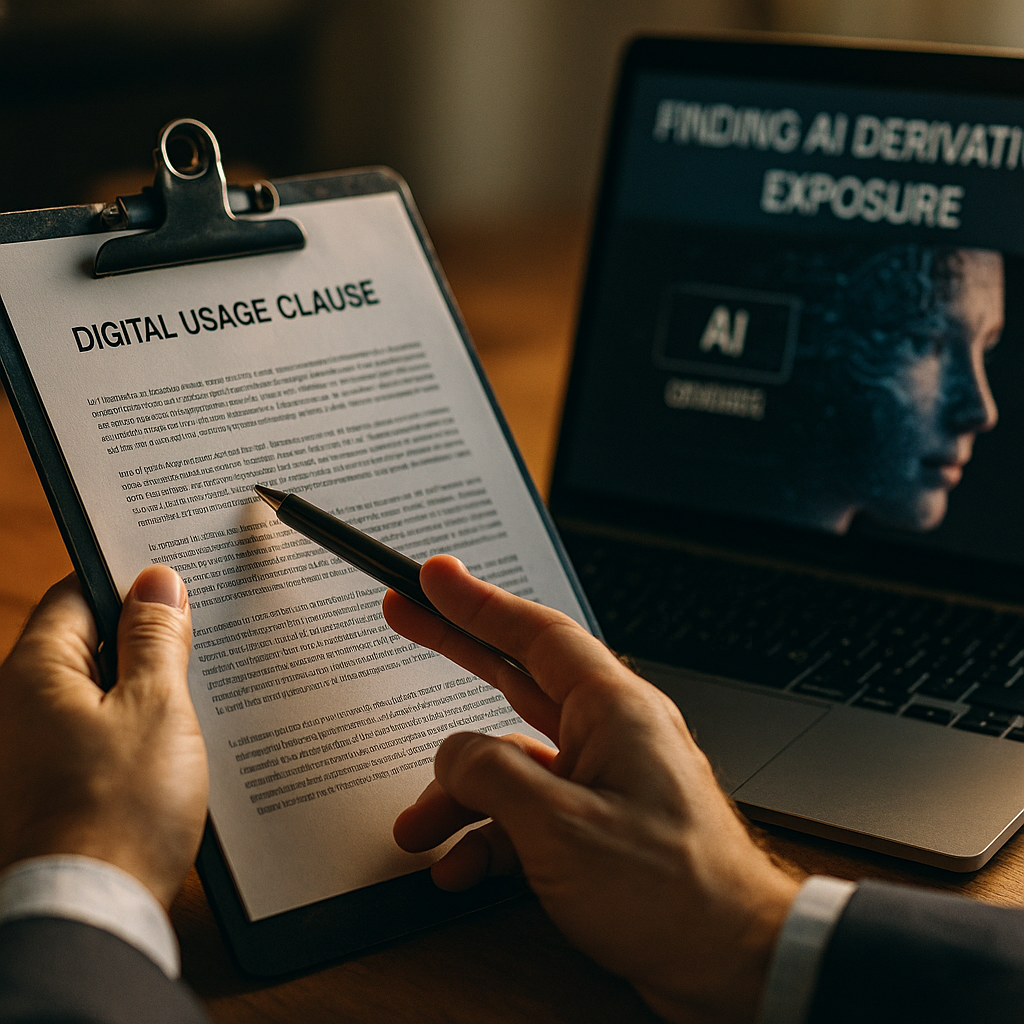
Seventy percent of marketers now use generative AI tools somewhere in their content workflow, according to HubSpot survey data. Yet most creator contracts still license “digital usage” in language written before anyone imagined feeding a creator’s face into a diffusion model. A digital usage clause audit is no longer a nice-to-have legal chore. It is the only way to find out whether your brand has quietly acquired rights to train, remix, or clone a creator’s likeness, or whether you are exposed the moment someone does.
The Gap Nobody Priced Into the Deal
Here’s the uncomfortable truth: most “usage rights” language in creator agreements was drafted for a world of static reposts and paid boosting. It says things like “brand may use the content across owned and paid digital channels for twelve months.” That sentence made sense in 2019. It makes almost no sense now.
What happens when a brand’s internal AI tool ingests that content to generate ten new variations for a dynamic ad campaign? Is that still “use”? Is it a derivative work? Does the original license even contemplate machine transformation, or just human repurposing? Most contracts are silent, and silence is exactly where disputes are born.
A usage clause that never mentions AI training, derivative generation, or synthetic likeness is not neutral. It’s a liability waiting for a trigger event.
We’ve already covered how ambiguous digital usage clauses fuel AI derivative claims, and the pattern keeps repeating: brands assume broad usage rights cover AI repurposing, creators assume they don’t, and nobody finds out who’s right until a legal notice lands on someone’s desk.
What a Digital Usage Clause Audit Actually Looks For
An audit isn’t just a read-through. It’s a structured review that maps every active and archived creator contract against a checklist of AI-specific exposure points. At minimum, that means checking for:
- Explicit language (or its absence) covering AI training, fine-tuning, and dataset inclusion.
- Whether “derivative works” is defined broadly enough to include AI-generated variations, voice clones, or synthetic likeness.
- Term limits: does usage expire, and does that expiration apply to AI outputs already generated before the cutoff?
- Geographic and platform scope, since a clause written for Instagram and YouTube rarely anticipates a repurposing pipeline feeding a generative ad tool.
- Compensation triggers tied to expanded usage, so creators aren’t unknowingly donating training data for free.
Legal teams running these audits typically find that fewer than half of active contracts have any AI-specific carve-out at all. That’s not a hypothetical risk. It’s a documented gap sitting in your contract management system right now.
Why “Perpetual, Worldwide, All Media” Isn’t the Shield You Think It Is
Plenty of legacy contracts include sweeping language like “perpetual, worldwide, all media now known or hereafter devised.” Brand counsel loves that phrase because it sounds airtight. But courts and creators alike are starting to push back on whether “hereafter devised” media genuinely anticipated generative AI as a category, or whether it’s being stretched to cover something the original signer never agreed to.
This matters because right of publicity law varies wildly by jurisdiction, and creators are increasingly willing to test that boundary in court or through public pressure. Our breakdown of AI likeness publicity law shows just how uneven state-level protections are, and that unevenness is exactly what makes a blanket clause risky rather than reassuring.
The Compliance Angle: FTC, Disclosure, and the Paper Trail
Regulators aren’t waiting for the industry to sort this out on its own. The FTC has signaled increasing interest in synthetic endorsements and AI-generated content that blurs the line between real and manufactured creator voice. If your brand generates an AI derivative from a creator’s original UGC and pushes it into a paid campaign without a fresh disclosure or without confirming the underlying license covers synthetic use, you’re stacking two risks at once: an IP dispute with the creator and an FTC disclosure gap with regulators.
This is why usage clause audits increasingly get run alongside disclosure audits. Our guide to the IAB AI disclosure framework is a useful companion piece here, since disclosure obligations and usage rights are two sides of the same compliance coin. You can have a technically valid license and still violate disclosure rules, or vice versa. Neither problem cancels the other out.
Voice cloning adds another layer entirely. If your AI pipeline generates a synthetic voiceover using a creator’s vocal likeness, the usage clause needs to say so explicitly, and the disclosure needs to keep pace. We’ve mapped this exposure in detail in our piece on AI voice clone endorsements, and the enforcement risk there is not theoretical.
Running the Audit: A Practical Workflow
Legal and brand teams don’t need to reinvent contract law to close this gap. They need a repeatable process. Here’s a workable structure:
- Inventory every active contract touching content that could plausibly feed an AI pipeline, whether that’s an internal generative tool, a third-party creative vendor, or an agency’s automated production system.
- Flag silent contracts where AI, derivative works, and synthetic likeness are simply not mentioned. Silence should be treated as a red flag, not a green light.
- Classify by risk tier based on how the content is actually being used today. A creator whose UGC feeds an automated ad-variant generator carries far more exposure than one whose content sits untouched in an archive.
- Re-paper high-risk agreements with explicit AI usage language, updated compensation terms, and clear derivative work definitions before renewal, not after a complaint.
- Log consent provenance so you can prove, not just assert, what rights were granted and when.
That last point connects directly to a broader industry problem. Consent tracking has become its own discipline, and our coverage of identity resolution vendors closing the consent provenance gap is worth reading if your team is still tracking usage rights in spreadsheets rather than a system built for auditability.
Automated Pipelines Make This Worse, Not Better
If your brand runs any kind of automated UGC repurposing pipeline (and increasingly, most do), the usage clause gap compounds fast. A single ambiguous contract clause, multiplied across thousands of pieces of automatically processed content, turns a small legal question into a portfolio-wide exposure. We’ve written previously about the insurance liability brands ignore in automated UGC pipelines, and digital usage clause gaps are one of the biggest hidden drivers of that liability. Insurers are starting to ask underwriting questions about AI usage rights specifically, which means a clean audit trail isn’t just a legal nicety, it’s becoming a coverage requirement.
Automation doesn’t create new legal risk. It multiplies existing contract ambiguity at machine speed.
What Creators Are Starting to Demand
Creators aren’t sitting passively while brands sort this out. Talent agencies are increasingly negotiating explicit AI carve-outs, separate compensation tiers for training data usage, and sunset clauses that require renegotiation before any AI derivative work is produced. Some are pushing for approval rights over specific generative outputs, not just blanket usage categories.
Brands that get ahead of this by proactively updating contract language tend to fare better in negotiations than those forced into it after a dispute. It’s a familiar pattern in influencer marketing: the same dynamic played out with non-disparagement clauses and with revenue share terms in our piece on revenue share creator deals. Whenever a new usage category emerges, early movers negotiate from strength. Late movers negotiate from a legal complaint.
According to eMarketer forecasts on creator economy spend, brands are increasing AI-assisted content production budgets faster than they’re updating the contracts governing that content. That gap between production speed and contract speed is the exact vulnerability an audit is designed to close.
Building the Audit Into Your Renewal Cycle
The most efficient brands don’t treat this as a one-time cleanup project. They fold digital usage clause review into every contract renewal, every campaign kickoff, and every new agency relationship. That means:
- Standardizing AI-specific usage language across all new templates, so future contracts don’t inherit the same ambiguity.
- Requiring agencies and MCNs to disclose their own AI tooling before campaigns launch, so you know exactly where derivative risk enters the pipeline.
- Setting calendar triggers for contract review tied to renewal dates, not waiting for a dispute to force the conversation.
- Training brand marketers, not just legal teams, to recognize when a campaign idea (say, an AI-generated “creator voice” ad variant) requires a fresh usage check before it goes into production.
None of this requires exotic legal maneuvering. It requires discipline, a checklist, and a willingness to treat contract language as a living document rather than boilerplate you copy and paste every quarter.
Frequently Asked Questions
FAQs
What is a digital usage clause audit?
It’s a structured review of creator contracts to determine whether existing usage rights language covers AI-generated derivatives, training data use, and synthetic likeness, or whether it leaves brands exposed to disputes over unauthorized AI repurposing.
Why do older creator contracts fail to cover AI derivatives?
Most were drafted before generative AI tools became part of standard marketing workflows. Terms like “digital usage” or “all media now known or hereafter devised” were written with reposting and paid boosting in mind, not machine-generated transformation of a creator’s likeness.
What’s the difference between usage rights and derivative work rights?
Usage rights typically govern how existing content can be distributed or displayed. Derivative work rights govern whether that content can be altered, remixed, or used to generate new content, which is exactly what happens when AI tools train on or transform creator assets.
How often should brands audit their creator contracts for AI exposure?
At minimum, tie the audit to every contract renewal cycle. High-volume programs using automated content pipelines should review usage language quarterly, since new tooling can outpace existing contract language within a single campaign cycle.
Does FTC disclosure guidance cover AI-generated derivatives?
The FTC has signaled growing scrutiny of synthetic endorsements and AI-altered creator content, but enforcement is still catching up to the technology. Brands should treat disclosure obligations as a separate but related requirement to usage rights, not a substitute for them.
What should brands do if they find gaps during an audit?
Prioritize re-papering high-risk contracts first, especially those tied to automated production pipelines. Add explicit AI usage, training, and derivative work language to templates going forward, and log consent provenance so rights can be proven, not just assumed.
Pull your top twenty creator contracts by spend, run them against the AI-derivative checklist above, and re-paper anything silent on training or synthetic use before your next renewal cycle. That single afternoon of work closes more risk than any insurance rider you’ll buy this year.
Top Influencer Marketing Agencies
The leading agencies shaping influencer marketing in 2026
Agencies ranked by campaign performance, client diversity, platform expertise, proven ROI, industry recognition, and client satisfaction. Assessed through verified case studies, reviews, and industry consultations.
Moburst

-
2

The Shelf
Boutique Beauty & Lifestyle Influencer AgencyA data-driven boutique agency specializing exclusively in beauty, wellness, and lifestyle influencer campaigns on Instagram and TikTok. Best for brands already focused on the beauty/personal care space that need curated, aesthetic-driven content.Clients: Pepsi, The Honest Company, Hims, Elf Cosmetics, Pure LeafVisit The Shelf → -
3

Audiencly
Niche Gaming & Esports Influencer AgencyA specialized agency focused exclusively on gaming and esports creators on YouTube, Twitch, and TikTok. Ideal if your campaign is 100% gaming-focused — from game launches to hardware and esports events.Clients: Epic Games, NordVPN, Ubisoft, Wargaming, Tencent GamesVisit Audiencly → -
4

Viral Nation
Global Influencer Marketing & Talent AgencyA dual talent management and marketing agency with proprietary brand safety tools and a global creator network spanning nano-influencers to celebrities across all major platforms.Clients: Meta, Activision Blizzard, Energizer, Aston Martin, WalmartVisit Viral Nation → -
5

The Influencer Marketing Factory
TikTok, Instagram & YouTube CampaignsA full-service agency with strong TikTok expertise, offering end-to-end campaign management from influencer discovery through performance reporting with a focus on platform-native content.Clients: Google, Snapchat, Universal Music, Bumble, YelpVisit TIMF → -
6

NeoReach
Enterprise Analytics & Influencer CampaignsAn enterprise-focused agency combining managed campaigns with a powerful self-service data platform for influencer search, audience analytics, and attribution modeling.Clients: Amazon, Airbnb, Netflix, Honda, The New York TimesVisit NeoReach → -
7

Ubiquitous
Creator-First Marketing PlatformA tech-driven platform combining self-service tools with managed campaign options, emphasizing speed and scalability for brands managing multiple influencer relationships.Clients: Lyft, Disney, Target, American Eagle, NetflixVisit Ubiquitous → -
8

Obviously
Scalable Enterprise Influencer CampaignsA tech-enabled agency built for high-volume campaigns, coordinating hundreds of creators simultaneously with end-to-end logistics, content rights management, and product seeding.Clients: Google, Ulta Beauty, Converse, AmazonVisit Obviously →