


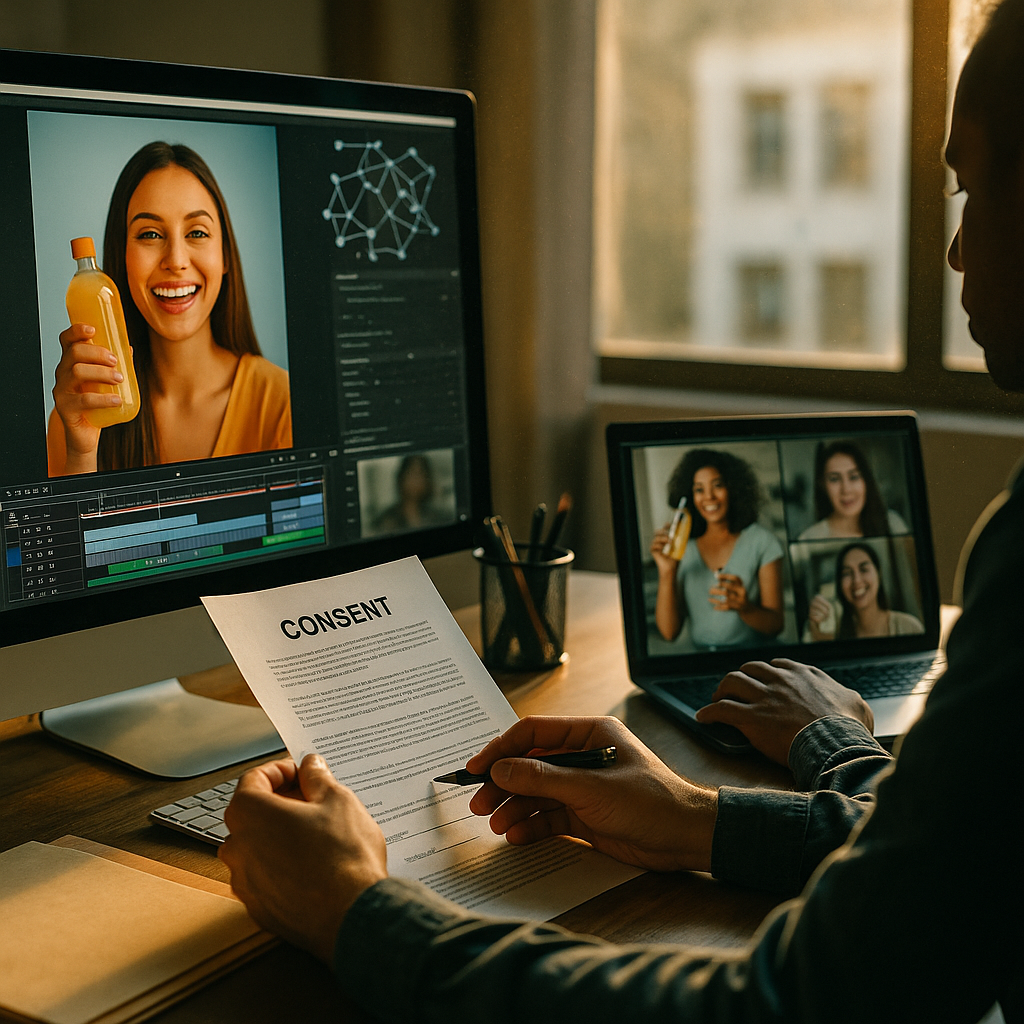
One unlicensed face in an AI-generated ad can cost a brand more than the entire campaign budget. That’s not hyperbole. Right of publicity claims tied to AI-repurposed user generated content are climbing fast, and most brand legal teams still treat UGC consent as a marketing afterthought rather than a contract requirement. If your team is feeding customer photos, reviews, or short-form clips into generative tools to build ad creative at scale, you’re sitting on exposure that traditional UGC licensing never anticipated.
Why This Risk Didn’t Exist Two Years Ago
Right of publicity law isn’t new. It’s been around for decades, protecting a person’s name, image, likeness, and voice from unauthorized commercial use. What’s new is the mechanism. A brand used to run a customer’s testimonial video as-is, under a UGC release that said something like “you grant us the right to use your submitted content in our marketing.” Simple. Bounded. Everyone understood what “use” meant.
Now the same content gets pulled into an AI pipeline. A customer’s face becomes a synthetic avatar. Their voice gets cloned and re-scripted to say things they never said. Their likeness gets remixed into a dozen ad variants for different audience segments, sometimes with AI-generated backgrounds or bodies attached to their real face. That original UGC release never contemplated any of this, because the technology to do it didn’t exist when the release was signed.
A consent form written for static reposting does not automatically cover synthetic transformation. Courts increasingly treat AI-altered likeness as a distinct use, not a derivative of the original grant.
This is the gap plaintiffs’ attorneys are learning to exploit. And regulators are watching too. State-level publicity statutes, particularly in California, Tennessee, and New York, have been updated or interpreted to explicitly cover digital replicas and AI-generated likeness. For a broader look at how state law is catching brands off guard, see our coverage of state publicity law risk.
The Scale Problem Makes This Worse, Not Better
Here’s the uncomfortable math. When a brand manually repurposed UGC, a human reviewed each piece before it went live. That human judgment, however imperfect, acted as a natural risk filter. Someone would notice if a submission looked underage, or if the original consent language seemed thin, or if the person in the photo seemed identifiable in a way the brand hadn’t cleared.
AI-generated ad pipelines remove that checkpoint. Marketing teams are now running hundreds or thousands of customer photos and clips through generative tools to produce localized, personalized, or A/B-tested ad variants automatically. Nobody is individually reviewing whether each source asset had a right of publicity release broad enough to cover synthetic transformation, voice cloning, or likeness extraction. The volume that makes AI attractive is exactly what makes the legal exposure compound.
According to eMarketer, AI-assisted ad creative production has grown sharply as brands push to cut content costs, and UGC remains one of the cheapest, most trusted inputs for that pipeline. Trust in the format is exactly why misuse of the underlying consent is so damaging when it surfaces publicly.
What “Right of Publicity” Actually Covers in an AI Context
Right of publicity protects four things: name, image, likeness, and (increasingly) voice. When a brand takes a customer’s UGC submission and runs it through an AI tool that does any of the following, the original UGC consent almost certainly doesn’t cover it:
- Generating a synthetic voice clone from the customer’s audio to produce new dialogue they never recorded
- Extracting a person’s face or body from the original footage and placing it in a new AI-generated scene or context
- Using the likeness to train or fine-tune a generative model that produces “similar looking” avatars for other ads
- Creating hyper-personalized ad variants that imply endorsement of products the customer never reviewed
- Distributing the transformed content in new geographies or media where the original consent scope was silent
Each of these is a distinct commercial use, and courts are increasingly unwilling to read broad AI transformation rights into a consent form that was written before AI tools existed. We’ve covered the contract mechanics of this problem in detail in ambiguous digital usage clauses, and the pattern is consistent: silence in a contract gets interpreted against the party that drafted it, which is usually the brand.
Real Consequences, Not Hypothetical Ones
Right of publicity litigation has already hit major platforms and brands over AI voice and likeness use, and the settlements and injunctions have been expensive enough to get general counsel’s attention. State attorneys general have also signaled interest in enforcement, particularly where AI-generated content misleads consumers about who is actually endorsing a product. The FTC has separately made clear that misrepresenting endorsements, synthetic or otherwise, falls under its existing authority to police deceptive advertising, a point worth reviewing on the FTC’s official guidance.
Beyond litigation cost, there’s reputational damage. A customer discovering their face or voice was AI-manipulated into an ad they never approved is a brand safety event, not just a legal one. It shows up in press coverage, social backlash, and creator community distrust that makes future UGC campaigns harder to source. Influencer and creator networks talk. If word spreads that a brand quietly fed customer content into AI pipelines without clear consent, sourcing organic UGC gets measurably harder.
How Brands Are Auditing Consent Before It Becomes a Claim
The fix isn’t complicated, but it does require discipline that most marketing teams haven’t built into their workflow yet. Smart brands are running a three-part audit before any UGC enters an AI ad pipeline.
First, map the original consent scope. Pull the actual release language for every UGC asset slated for AI repurposing. Does it mention derivative works? Does it mention AI, synthetic media, or digital manipulation at all? If the release predates broad AI ad adoption, assume it doesn’t cover transformation use, regardless of how broadly “marketing purposes” is worded.
Second, classify the transformation type. Not all AI use is equally risky. Cropping and resizing a UGC photo is low risk. Extracting a person’s likeness to generate a new synthetic scene, or cloning their voice, is high risk and almost certainly requires a new, specific consent instrument. Our piece on digital usage clause audits walks through a practical framework for this classification step.
Third, get supplemental consent for anything ambiguous. This doesn’t have to be a legal ordeal. A short, plain-language addendum specifically authorizing AI transformation, likeness extraction, and voice synthesis, sent to the original UGC contributor, closes most of the gap. Brands that build this into their onboarding flow for UGC campaigns avoid the retroactive scramble entirely.
If your consent audit takes longer than your AI production cycle, you’ve already lost the risk management race. Build the check into the intake form, not the legal review after launch.
Where Identity Verification Tools Fit
A growing category of vendors now specializes in tracking consent provenance across the full lifecycle of a piece of content, from original submission through every downstream AI transformation. These tools essentially create an audit trail: who submitted the content, what they agreed to, and whether that agreement covers the specific AI use case a brand wants to deploy. For teams managing UGC at real scale, this kind of system is becoming as standard as a DAM (digital asset management) platform. We’ve reviewed how these platforms are closing gaps in identity resolution vendor coverage, and it’s worth evaluating one if your team runs AI-assisted UGC campaigns on a recurring basis.
It’s also worth revisiting whitelisting and paid amplification agreements tied to UGC, since those often have their own expiration windows that don’t automatically extend to AI-generated derivatives. Our whitelisting expiration audit guide covers how to catch these gaps before a renewal cycle quietly lapses mid-campaign.
What Should Actually Be in the Contract
For any UGC campaign that might feed an AI pipeline down the line, whether now or in future budget cycles, the release language should explicitly address:
- Whether the brand may use AI to transform, extend, remix, or generate new content from the submitted material
- Whether voice cloning or synthetic likeness generation is permitted, and if so, in what context
- Geographic and media scope for any AI-generated derivative, not just the original submission
- A defined term or expiration for AI-use rights, so consent doesn’t become indefinite by default
- A clear revocation mechanism the contributor can invoke if they later object to AI use
Brands that skip this step and rely on generic “all marketing purposes” language are betting that no contributor ever notices or objects. Given how visible AI-generated ads have become, and how quickly creators and consumers now spot synthetic media, that’s a bet getting harder to win. For a deeper dive into fixing the underlying contract language, see AI derivative reuse clauses, which lays out language brands can adopt directly.
There’s also a parallel thread worth tracking here: brands that repurpose creator-submitted content, not just customer UGC, into AI ads face a nearly identical exposure, covered in our piece on UGC right of publicity claims. The consent gap is structurally the same whether the source is a paying customer or a contracted creator.
Insurance Won’t Save You Here Either
Many brands assume general marketing liability or media insurance covers this kind of claim. It often doesn’t, particularly when the underlying issue is a consent scope failure rather than a straightforward infringement. Insurers are increasingly carving out AI-specific exclusions from standard policies, precisely because the risk profile is still being priced. Our analysis of automated UGC pipeline insurance gaps breaks down why relying on existing coverage for AI-repurposed content is a mistake most risk teams don’t catch until a claim is already filed.
Marketing operations platforms like HubSpot and social management tools like Sprout Social are starting to build consent flagging into their content workflows, but as of now, none of them fully solve the legal classification problem. That still requires a human process, backed by contract language that anticipates AI use before the content ever enters production.
Frequently Asked Questions
Does a standard UGC release cover AI-generated ad use?
In most cases, no. A standard release written before AI ad tools became common typically doesn’t address likeness extraction, voice cloning, or synthetic transformation. Courts have been reluctant to read those rights into older, broadly worded consent language.
What counts as a right of publicity violation in an AI ad?
Any commercial use of a person’s name, image, likeness, or voice without proper authorization can qualify, including AI-generated derivatives that recreate or transform someone’s identifiable features, even if the final output looks different from the original submission.
Can brands fix consent gaps retroactively?
Yes, through a supplemental consent addendum sent to the original contributor specifically authorizing AI transformation and use. It’s not a perfect fix if content has already been distributed, but it significantly reduces forward-looking exposure.
Does the FTC regulate AI-generated UGC ads?
The FTC’s endorsement guidelines apply regardless of whether content is AI-generated or organic. Misrepresenting who is endorsing a product, including through synthetic likeness or voice, falls under existing deceptive advertising rules.
How do brands audit existing UGC libraries for this risk?
Start by classifying assets by consent scope, transformation type, and distribution channel. Assets with vague or outdated release language, or those slated for high-risk AI transformations like voice cloning, should be flagged for supplemental consent before use.
Next step: before your team greenlights another AI-generated ad built from customer content, run every source asset through a three-point check: original consent scope, transformation type, and whether supplemental authorization is needed. That fifteen-minute audit is cheaper than the claim it prevents.
FAQs
Does a standard UGC release cover AI-generated ad use?
In most cases, no. A standard release written before AI ad tools became common typically doesn’t address likeness extraction, voice cloning, or synthetic transformation. Courts have been reluctant to read those rights into older, broadly worded consent language.
What counts as a right of publicity violation in an AI ad?
Any commercial use of a person’s name, image, likeness, or voice without proper authorization can qualify, including AI-generated derivatives that recreate or transform someone’s identifiable features, even if the final output looks different from the original submission.
Can brands fix consent gaps retroactively?
Yes, through a supplemental consent addendum sent to the original contributor specifically authorizing AI transformation and use. It’s not a perfect fix if content has already been distributed, but it significantly reduces forward-looking exposure.
Does the FTC regulate AI-generated UGC ads?
The FTC’s endorsement guidelines apply regardless of whether content is AI-generated or organic. Misrepresenting who is endorsing a product, including through synthetic likeness or voice, falls under existing deceptive advertising rules.
How do brands audit existing UGC libraries for this risk?
Start by classifying assets by consent scope, transformation type, and distribution channel. Assets with vague or outdated release language, or those slated for high-risk AI transformations like voice cloning, should be flagged for supplemental consent before use.
Top Influencer Marketing Agencies
The leading agencies shaping influencer marketing in 2026
Agencies ranked by campaign performance, client diversity, platform expertise, proven ROI, industry recognition, and client satisfaction. Assessed through verified case studies, reviews, and industry consultations.
Moburst

-
2

The Shelf
Boutique Beauty & Lifestyle Influencer AgencyA data-driven boutique agency specializing exclusively in beauty, wellness, and lifestyle influencer campaigns on Instagram and TikTok. Best for brands already focused on the beauty/personal care space that need curated, aesthetic-driven content.Clients: Pepsi, The Honest Company, Hims, Elf Cosmetics, Pure LeafVisit The Shelf → -
3

Audiencly
Niche Gaming & Esports Influencer AgencyA specialized agency focused exclusively on gaming and esports creators on YouTube, Twitch, and TikTok. Ideal if your campaign is 100% gaming-focused — from game launches to hardware and esports events.Clients: Epic Games, NordVPN, Ubisoft, Wargaming, Tencent GamesVisit Audiencly → -
4

Viral Nation
Global Influencer Marketing & Talent AgencyA dual talent management and marketing agency with proprietary brand safety tools and a global creator network spanning nano-influencers to celebrities across all major platforms.Clients: Meta, Activision Blizzard, Energizer, Aston Martin, WalmartVisit Viral Nation → -
5

The Influencer Marketing Factory
TikTok, Instagram & YouTube CampaignsA full-service agency with strong TikTok expertise, offering end-to-end campaign management from influencer discovery through performance reporting with a focus on platform-native content.Clients: Google, Snapchat, Universal Music, Bumble, YelpVisit TIMF → -
6

NeoReach
Enterprise Analytics & Influencer CampaignsAn enterprise-focused agency combining managed campaigns with a powerful self-service data platform for influencer search, audience analytics, and attribution modeling.Clients: Amazon, Airbnb, Netflix, Honda, The New York TimesVisit NeoReach → -
7

Ubiquitous
Creator-First Marketing PlatformA tech-driven platform combining self-service tools with managed campaign options, emphasizing speed and scalability for brands managing multiple influencer relationships.Clients: Lyft, Disney, Target, American Eagle, NetflixVisit Ubiquitous → -
8

Obviously
Scalable Enterprise Influencer CampaignsA tech-enabled agency built for high-volume campaigns, coordinating hundreds of creators simultaneously with end-to-end logistics, content rights management, and product seeding.Clients: Google, Ulta Beauty, Converse, AmazonVisit Obviously →