


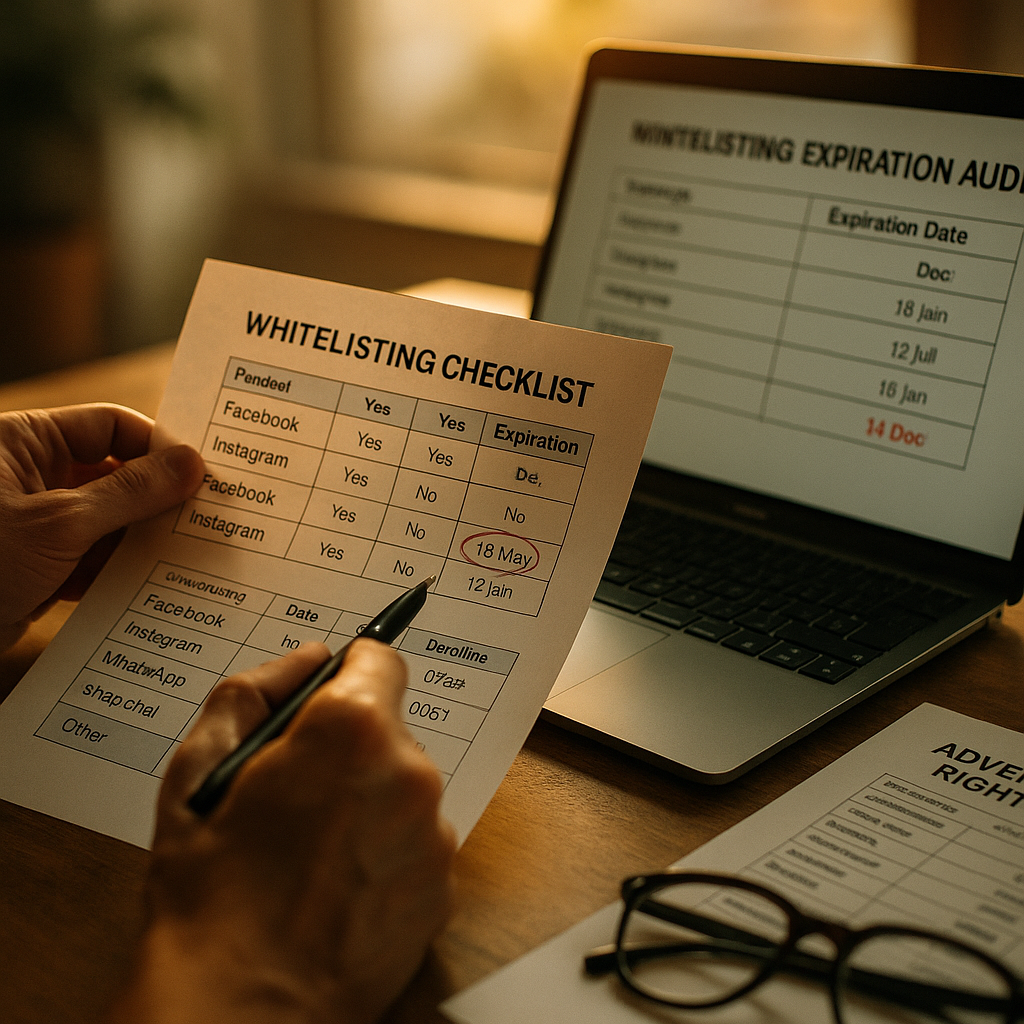
Roughly 30% of brands running paid social amplification through creator whitelisting have no formal process for tracking when usage rights expire. That means active ad budgets are running behind content the brand may no longer have the legal right to promote. A whitelisting expiration audit isn’t paperwork theater. It’s the difference between a clean renewal cycle and a six figure legal exposure you didn’t know existed.
Whitelisting, sometimes called creator partnership ads or branded content ads depending on the platform, lets brands run paid media directly through a creator’s handle. It’s effective. It’s also a compliance minefield that most marketing teams treat as a media buying task instead of a contract management task. That gap is where the risk lives.
Why Expiration Dates Get Ignored Until It’s Too Late
Here’s the pattern almost every performance marketing team falls into: a whitelisting agreement gets signed, the ad account access gets granted, the campaign performs well, and everyone moves on to the next launch. Nobody calendars the expiration date. Six months later, the same creative is still spending because it’s converting, and nobody thought to check whether the underlying rights lapsed.
This happens because whitelisting sits in an awkward organizational no man’s land. Legal negotiates the contract. Influencer marketing manages the relationship. Paid media runs the spend. Each team assumes someone else owns the renewal tracking. Nobody does.
An expired whitelisting agreement doesn’t stop the ads from running. It just stops them from being legal. Platforms don’t check usage rights before serving impressions, so the exposure compounds silently every day spend continues.
The financial incentive makes it worse. If a whitelisted asset is your top performer, the last thing a media buyer wants to hear is “pause it, the rights expired.” Renewal audits exist precisely to catch that tension before it becomes a legal claim instead of a scheduling inconvenience.
What a Whitelisting Expiration Audit Actually Covers
A proper audit isn’t a quick glance at the contract’s end date. It’s a structured review across four dimensions: usage rights, platform access, disclosure compliance, and financial terms. Skip any one of these and you’ve left a gap.
- Usage rights window. Confirm the exact date range the contract grants for paid amplification, and whether it covers the specific ad account, geography, and platform where spend is currently live.
- Ad account access status. Verify the creator hasn’t revoked Business Manager or TikTok Spark Ads permissions, and that access hasn’t lapsed due to an expired authorization on the platform side, separate from the contract’s legal terms.
- Disclosure tagging. Confirm paid partnership labels are still applied and haven’t been stripped during creative refreshes or A/B test variants.
- Renewal or termination clause. Check whether the agreement auto-renews, requires affirmative renegotiation, or has a defined cure period if a lapse occurs.
Most brands only check the first item, if they check anything at all. The other three are where the real exposure hides. A creator can technically still be under contract for usage rights while their platform-side ad account authorization has quietly expired, which means Meta or TikTok could flag or pull the ad without warning mid-flight.
The Renewal Calendar Problem
Ask your influencer marketing lead this: can they produce, right now, a list of every whitelisting agreement expiring in the next 90 days? Most can’t. That’s not a knock on them, it’s a symptom of how these programs scale faster than the operational infrastructure supporting them.
Brands running programs across dozens or hundreds of creators need a centralized renewal calendar, not a folder of PDFs in a shared drive. This is the same discipline required in digital usage clause audits, where the goal is proactively surfacing rights gaps before a campaign launch rather than discovering them after a legal notice arrives.
A practical fix: build the audit into the ad spend renewal cycle itself, not a separate compliance calendar that gets deprioritized. If your team already reviews budget allocation quarterly, tie the whitelisting expiration check to that same meeting. It forces accountability because the people approving spend are the same people confirming the rights to spend on.
FTC Disclosure Risk Doesn’t Expire With the Contract
Here’s a wrinkle a lot of brands miss: even after a whitelisting agreement ends and the ads stop running, the disclosure obligation on any content that remains organically live doesn’t disappear. The FTC’s endorsement guidelines require clear and conspicuous disclosure for as long as the material benefit relationship is relevant to a reasonable consumer, which courts and regulators have interpreted broadly.
That means an expired paid partnership tag on organic content, left up after the ad spend stops, can still trigger enforcement scrutiny. This is closely related to the disclosure gap issues covered in revenue share disclosure requirements, where the compensation relationship, not the ad flight dates, determines the disclosure window.
Your audit checklist should explicitly separate “when does the ad spend authorization expire” from “when does the disclosure obligation expire,” because these are legally distinct questions with different answers.
Building the Checklist: What to Verify Before You Renew
Before signing off on renewed ad spend against any whitelisted asset, run through this sequence. It takes fifteen minutes per creator relationship and it’s the cheapest insurance policy in your marketing operations stack.
- Pull the original contract and confirm the current date falls within the granted usage window, not the campaign launch date.
- Check platform-side ad account access directly, don’t rely on the contract date alone since platform authorizations can lapse independently.
- Confirm paid partnership disclosure tags are active on every live ad variant, including any creative refreshes made since the original approval.
- Review whether the agreement includes geographic or platform restrictions that current spend might be violating (a common issue when campaigns expand from TikTok to Instagram Reels without updating the contract scope).
- Verify payment terms tied to the renewal, including whether usage fees increase for extended terms or additional platforms.
- Document the audit outcome with a timestamp, so you have a paper trail if a dispute arises later.
Treat every whitelisting renewal like a new contract negotiation, not a rubber stamp. Rates change, platform terms change, and creator leverage changes. A rights check that skips renegotiation opportunities is only half doing the job.
This connects directly to the broader issue of ambiguous contract language creating downstream exposure, something explored in depth in ambiguous usage clause risks. Vague renewal language is just as dangerous as no renewal language at all.
Where AI Tools Complicate the Audit
If your whitelisted assets have been repurposed with AI editing tools, whether for aspect ratio changes, dubbing, or generative background swaps, the original usage grant may not cover the derivative version now running as an ad. This is a fast-growing gap area. Brands assume a minor AI-assisted edit falls under the original grant. It often doesn’t, particularly if the contract predates the AI tooling now standard in most creative workflows.
The reasoning behind this is laid out well in AI derivative reuse clauses, and it’s worth cross-checking every whitelisted asset that’s gone through a post-production AI pass since the original signing.
Identity verification adds another layer. If your identity resolution or ad targeting stack pulls creator likeness data into lookalike modeling, confirm that consent chain hasn’t broken somewhere between the original agreement and the current targeting setup, a risk area detailed in consent provenance tracking.
For teams managing this at scale, platform-native tools like Meta Business Suite partnership ads hub and TikTok’s Spark Ads authorization center both show live authorization status, which should be your first stop before assuming a contract date tells the whole story. Data from eMarketer continues to show whitelisted creator content outperforming standard brand ads on engagement, which is exactly why the financial pull to keep spend running past expiration is so strong, and why the audit discipline matters more as budgets scale.
Who Should Own This Process?
Ownership ambiguity is the root cause of most expiration failures. The cleanest structure assigns a single owner, typically influencer marketing operations or a dedicated creator compliance role, who is responsible for maintaining the renewal calendar and signing off before paid media touches any whitelisted asset. Legal reviews contract language upfront. Paid media executes within approved windows. But the audit checkpoint itself needs one accountable person, not a shared responsibility that nobody actually holds.
For larger organizations managing employee creators alongside external partnerships, the accountability structure gets more complex, a topic addressed in employee creator ownership clauses, where HR and legal alignment becomes essential rather than optional.
Smaller teams without dedicated compliance headcount can still solve this with a shared spreadsheet or lightweight project management tool, as long as someone owns updating it and someone else is required to check it before spend renews. The tool matters less than the discipline.
FAQs
Frequently Asked Questions
What is a whitelisting expiration audit?
It’s a structured review of creator whitelisting agreements before ad spend renewal, checking usage rights windows, platform ad account access, disclosure compliance, and contract terms to confirm the brand still has legal authorization to run paid media through the creator’s account.
How often should brands audit whitelisting agreements?
At minimum, before every renewal cycle or budget reallocation decision. High-volume programs running dozens of creator partnerships should build the audit into quarterly budget reviews so it happens automatically rather than reactively.
What happens if ad spend continues after usage rights expire?
The brand risks a right of publicity claim, a breach of contract dispute, or FTC scrutiny over disclosure lapses. Platforms don’t automatically stop ads when contract rights expire, so the exposure accumulates until someone manually catches it.
Does an expired whitelisting contract also end disclosure obligations?
Not necessarily. Disclosure requirements under FTC guidelines depend on the material connection between brand and creator, which can outlast the specific ad spend authorization window, especially on organic content that remains live.
Who should be responsible for tracking whitelisting expiration dates?
A single accountable owner, typically within influencer marketing operations or creator compliance, should maintain the renewal calendar. Legal, paid media, and creative teams all touch the process, but ownership needs to sit with one role to avoid gaps.
Can AI-edited creator content still be run under the original whitelisting agreement?
Not automatically. If the asset has been altered with AI tools, dubbing, or generative edits, the original usage grant may not cover the derivative version, and brands should verify contract language explicitly addresses AI-modified content.
Build the audit into your renewal calendar this quarter, assign one owner, and require sign-off before any whitelisted spend gets reauthorized. That single habit closes more compliance exposure than any contract clause you could add after the fact.
Frequently Asked Questions
What is a whitelisting expiration audit?
It’s a structured review of creator whitelisting agreements before ad spend renewal, checking usage rights windows, platform ad account access, disclosure compliance, and contract terms to confirm the brand still has legal authorization to run paid media through the creator’s account.
How often should brands audit whitelisting agreements?
At minimum, before every renewal cycle or budget reallocation decision. High-volume programs running dozens of creator partnerships should build the audit into quarterly budget reviews so it happens automatically rather than reactively.
What happens if ad spend continues after usage rights expire?
The brand risks a right of publicity claim, a breach of contract dispute, or FTC scrutiny over disclosure lapses. Platforms don’t automatically stop ads when contract rights expire, so the exposure accumulates until someone manually catches it.
Does an expired whitelisting contract also end disclosure obligations?
Not necessarily. Disclosure requirements under FTC guidelines depend on the material connection between brand and creator, which can outlast the specific ad spend authorization window, especially on organic content that remains live.
Who should be responsible for tracking whitelisting expiration dates?
A single accountable owner, typically within influencer marketing operations or creator compliance, should maintain the renewal calendar. Legal, paid media, and creative teams all touch the process, but ownership needs to sit with one role to avoid gaps.
Can AI-edited creator content still be run under the original whitelisting agreement?
Not automatically. If the asset has been altered with AI tools, dubbing, or generative edits, the original usage grant may not cover the derivative version, and brands should verify contract language explicitly addresses AI-modified content.
Top Influencer Marketing Agencies
The leading agencies shaping influencer marketing in 2026
Agencies ranked by campaign performance, client diversity, platform expertise, proven ROI, industry recognition, and client satisfaction. Assessed through verified case studies, reviews, and industry consultations.
Moburst

-
2

The Shelf
Boutique Beauty & Lifestyle Influencer AgencyA data-driven boutique agency specializing exclusively in beauty, wellness, and lifestyle influencer campaigns on Instagram and TikTok. Best for brands already focused on the beauty/personal care space that need curated, aesthetic-driven content.Clients: Pepsi, The Honest Company, Hims, Elf Cosmetics, Pure LeafVisit The Shelf → -
3

Audiencly
Niche Gaming & Esports Influencer AgencyA specialized agency focused exclusively on gaming and esports creators on YouTube, Twitch, and TikTok. Ideal if your campaign is 100% gaming-focused — from game launches to hardware and esports events.Clients: Epic Games, NordVPN, Ubisoft, Wargaming, Tencent GamesVisit Audiencly → -
4

Viral Nation
Global Influencer Marketing & Talent AgencyA dual talent management and marketing agency with proprietary brand safety tools and a global creator network spanning nano-influencers to celebrities across all major platforms.Clients: Meta, Activision Blizzard, Energizer, Aston Martin, WalmartVisit Viral Nation → -
5

The Influencer Marketing Factory
TikTok, Instagram & YouTube CampaignsA full-service agency with strong TikTok expertise, offering end-to-end campaign management from influencer discovery through performance reporting with a focus on platform-native content.Clients: Google, Snapchat, Universal Music, Bumble, YelpVisit TIMF → -
6

NeoReach
Enterprise Analytics & Influencer CampaignsAn enterprise-focused agency combining managed campaigns with a powerful self-service data platform for influencer search, audience analytics, and attribution modeling.Clients: Amazon, Airbnb, Netflix, Honda, The New York TimesVisit NeoReach → -
7

Ubiquitous
Creator-First Marketing PlatformA tech-driven platform combining self-service tools with managed campaign options, emphasizing speed and scalability for brands managing multiple influencer relationships.Clients: Lyft, Disney, Target, American Eagle, NetflixVisit Ubiquitous → -
8

Obviously
Scalable Enterprise Influencer CampaignsA tech-enabled agency built for high-volume campaigns, coordinating hundreds of creators simultaneously with end-to-end logistics, content rights management, and product seeding.Clients: Google, Ulta Beauty, Converse, AmazonVisit Obviously →