


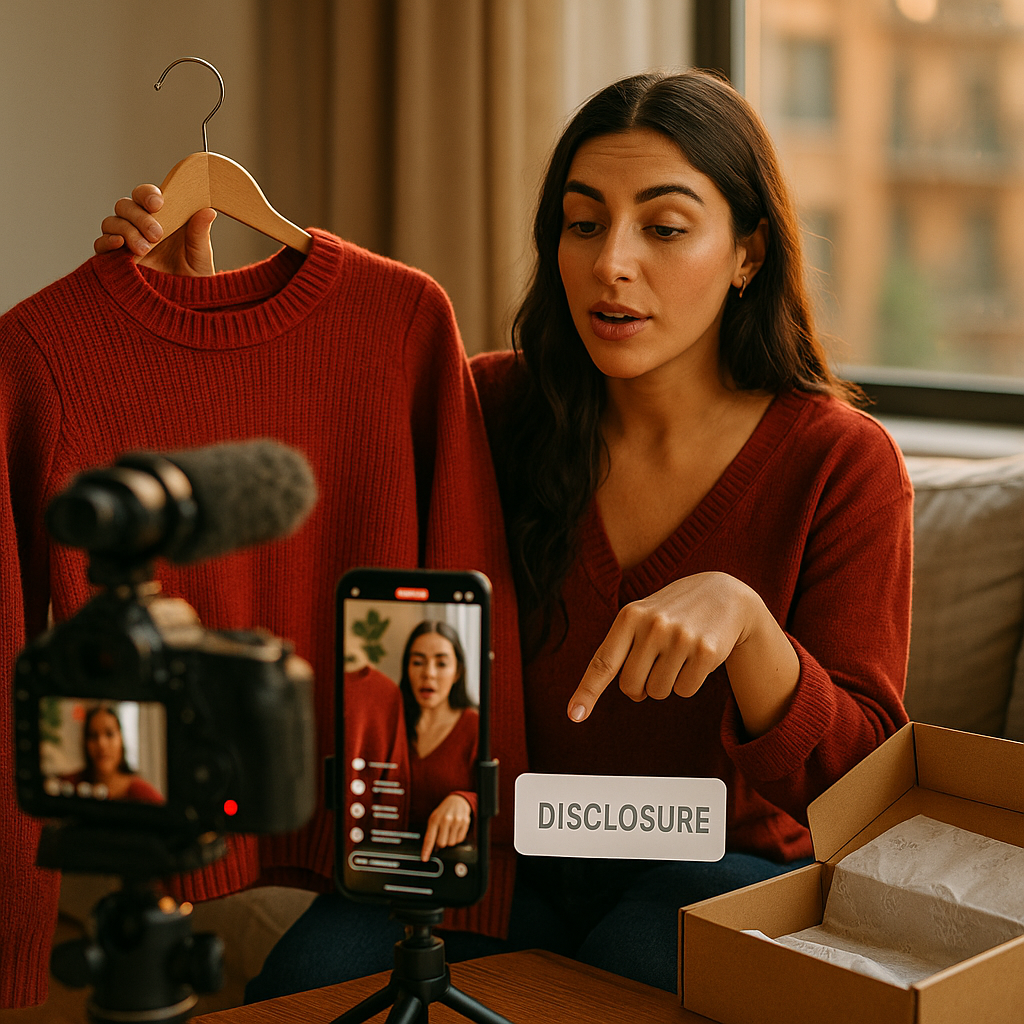
A shopper watching a live stream makes a purchase decision in under eight seconds, according to platform data from TikTok Shop. That leaves almost no room for a buried disclosure to do its job. Yet most brands are still applying static-post disclosure habits to a format that moves in real time, and the FTC material connection rules for live stream shopping have not gotten any more forgiving about it.
Live commerce is not a variation on influencer marketing. It is its own animal, with its own timing problems, its own screen real estate constraints, and its own enforcement exposure. If your compliance playbook hasn’t been rewritten for it, you are running risk you probably haven’t priced in.
Why Live Shopping Breaks the Old Disclosure Playbook
Traditional disclosure guidance assumes a static asset: a post, a caption, a video description. Viewers can pause, scroll back, or re-read. Live stream shopping offers none of that. A host might mention a product twenty times over ninety minutes, cutting between banter, demos, and price drops. If the disclosure appears once, at the start, and a viewer joins seven minutes in, they never see it.
The FTC’s Endorsement Guides don’t carve out an exception for real-time formats. The standard is the same: a material connection must be clear and conspicuous, and it must be disclosed in a way viewers can’t miss, regardless of when they tune in. That’s a much higher operational bar for live content than for a feed post, and most brand compliance teams haven’t caught up.
A single opening disclaimer no longer satisfies the FTC’s clear and conspicuous standard when viewers join a stream mid-broadcast, which is the majority of live shopping audiences on most platforms.
What “Clear and Conspicuous” Actually Means for Live Formats
The FTC has never published a live-shopping-specific rulebook, but its enforcement pattern and guidance updates point to a few consistent expectations that brands should treat as functional requirements, not suggestions.
- Repetition, not a one-time mention. Disclosures should recur at intervals throughout the stream, not just at open and close.
- Persistent on-screen text. A verbal “this is sponsored” is not enough if viewers are watching with sound off, which is common on mobile.
- Proximity to the claim. If a host is pushing a specific product’s benefits, the disclosure needs to be near that moment, not generic and detached from the pitch.
- Platform-native tools used correctly. Built-in “Promotional Content” or “Paid Partnership” labels help, but they are not a substitute for the host’s own disclosure if the platform tag can be toggled off or missed by viewers.
Notice the theme: passive, single-instance disclosure is dead for this format. The FTC’s expectation is closer to a running caption than a disclaimer slide.
Placement Guide: Where Disclosures Actually Need to Live
Here’s the practical breakdown brands and agencies should be building into live commerce SOPs right now.
On-Screen, Persistent Overlay
A small, legible “Ad” or “Sponsored” tag should stay visible for the duration of any segment where paid product is being featured. Not a flash graphic. Not text that fades after five seconds. Persistent means persistent. Several live commerce platforms now support this natively, but brands still need to confirm the overlay meets minimum size and contrast thresholds, because a disclosure too small to read fails the conspicuousness test just as badly as no disclosure at all.
Verbal Disclosure, Repeated on a Cadence
Hosts should verbally state the material connection at the start of the stream, again whenever a new sponsored product is introduced, and periodically throughout longer segments, roughly every ten to fifteen minutes is a reasonable working cadence for streams over half an hour. This matters most for streams that run long, where audience turnover means a large share of viewers never heard the opening disclosure.
Platform Tags as a Floor, Not a Ceiling
Use TikTok Shop’s, Instagram’s, or Amazon Live’s built-in disclosure labels every time they’re available. But treat them as the minimum requirement, not the whole solution. Regulators have made clear that platform-level tagging doesn’t shift the underlying obligation off the brand or the creator. This is the same logic driving scrutiny of automated tagging elsewhere in the industry, and it’s worth reading how automated disclosure labels have shifted responsibility back onto brands rather than away from them.
Chat and Comment Pinning
On platforms with live chat, pin a disclosure message at the top of the comment feed for the stream’s duration. It’s a low-lift addition that reinforces the visual and verbal disclosures without cluttering the screen further.
The Multi-Host, Multi-Product Problem
Live shopping events increasingly feature rotating hosts, guest appearances, and dozens of SKUs in a single broadcast. That structure multiplies disclosure obligations fast. If host A discloses their relationship with Brand X but host B, joining twenty minutes later, is promoting Brand Y without a fresh disclosure, the brand still carries exposure. Multi-brand livestream events, the kind run by agencies bundling several sponsors into one broadcast, need a disclosure script for every host-brand pairing, not a single blanket disclaimer at the top of the show.
This is where a lot of brands get caught flat. They assume the event producer or platform is handling compliance holistically. In practice, the material connection obligation sits with each brand for its own segment, and agencies coordinating these events should be building disclosure checkpoints into the run-of-show document, not leaving it to host improvisation.
Where AI-Generated Hosts Complicate Things Further
Synthetic and AI-assisted hosts are creeping into live commerce, particularly for overnight or off-hours shopping streams where a brand wants continuous coverage without staffing a human host around the clock. These formats raise the same disclosure questions as any sponsored content, plus an added layer: viewers may not immediately register that the “host” isn’t a real person, and material connection disclosures need to be even more explicit as a result. Brands running or considering AI-hosted shopping streams should study how the FTC has approached synthetic avatar disclosure rules, since the same clear-and-conspicuous logic applies, arguably with a higher bar given the added ambiguity about who or what is speaking.
Building This Into Contracts and Pre-Production
Disclosure placement isn’t just a production detail, it’s a contract term. Creator and host agreements for live shopping events should specify:
- The exact verbal disclosure language to be used, and the cadence for repeating it.
- Who is responsible for enabling platform-native disclosure tags before the stream goes live.
- Screen real estate requirements for on-screen overlays, including minimum duration and size.
- What happens if a host forgets or skips a disclosure segment, including any pause-and-correct protocol.
Brands that already run a pre-launch creator ad review checklist for static content should extend that same discipline to live formats, just adapted for real-time execution instead of asset approval. The review has to happen before the stream starts, since there’s no post-publish edit option once the broadcast is live.
Live commerce removes the brand’s ability to fix a disclosure after the fact. Everything has to be right before the stream goes live, because there is no edit button on a broadcast.
What Enforcement Risk Actually Looks Like Here
The FTC’s enforcement priorities have consistently targeted patterns, not one-off mistakes, but live commerce generates a lot of raw footage that regulators or watchdog groups can review after the fact. Recorded replays of “live” streams often stay up on platforms for weeks, meaning a disclosure failure isn’t a fleeting risk, it’s an archived one. Brands should treat every live shopping VOD as a permanent record subject to the same scrutiny as an evergreen post, and audit accordingly.
This connects to a broader compliance trend across the industry: enforcement bodies increasingly expect brands to have documented processes, not just good intentions. That’s the same logic behind updated guidance on creator claims and FTC deception risk and the growing expectation that brands can show their compliance homework, not just their outcomes.
A Quick Operational Checklist
- Persistent on-screen “Ad” or “Sponsored” overlay for the full duration of sponsored segments.
- Verbal disclosure repeated at a set cadence, not just at stream open.
- Platform-native disclosure tags enabled and verified before going live.
- Pinned chat disclosure where the platform supports comment pinning.
- Written disclosure scripts baked into host contracts for every brand-host pairing.
- Post-stream VOD review to confirm disclosures appear correctly in the archived replay.
None of this is expensive to implement. It’s mostly a matter of building the habit into pre-production, the same way brands already build in product-tagging QA or link tracking. The cost of skipping it, on the other hand, is an open-ended enforcement question that nobody wants to be the test case for.
Frequently Asked Questions
FAQs
Does a single disclosure at the start of a live shopping stream satisfy FTC requirements?
No. The FTC’s clear and conspicuous standard expects viewers joining at any point in the stream to see or hear a disclosure, so a single opening mention typically isn’t sufficient for longer broadcasts with rolling audiences.
Are platform-native disclosure labels like “Promotional Content” tags enough on their own?
Platform tags help but generally aren’t treated as a complete substitute for a host’s own verbal and on-screen disclosure, since the underlying material connection obligation rests with the brand and creator, not just the platform’s labeling system.
How often should a host repeat a disclosure during a live shopping event?
There’s no fixed legal number, but a reasonable practice is to disclose at the start, whenever a new sponsored product is introduced, and roughly every ten to fifteen minutes during longer segments to account for viewer turnover.
Who is liable if a co-host in a multi-brand livestream fails to disclose their sponsorship?
Liability generally follows the brand-creator relationship for each segment, meaning a brand can still be exposed even if a different host on the same broadcast handled their own disclosure correctly.
Do AI-hosted or synthetic avatar shopping streams need different disclosure treatment?
Yes. Because viewers may not immediately recognize a host as synthetic, disclosures typically need to be more explicit to meet the same clear and conspicuous standard applied to human hosts.
Does an archived replay of a live shopping stream carry the same disclosure risk as the live broadcast?
Yes. If a replay stays available on the platform, it’s generally treated as an ongoing piece of content subject to the same disclosure scrutiny as the original live event.
Live shopping isn’t slowing down, and neither is regulatory attention on it. Update your host contracts and run-of-show templates now, before your next scheduled event, not after an enforcement letter forces the issue.
Top Influencer Marketing Agencies
The leading agencies shaping influencer marketing in 2026
Agencies ranked by campaign performance, client diversity, platform expertise, proven ROI, industry recognition, and client satisfaction. Assessed through verified case studies, reviews, and industry consultations.
Moburst

-
2

The Shelf
Boutique Beauty & Lifestyle Influencer AgencyA data-driven boutique agency specializing exclusively in beauty, wellness, and lifestyle influencer campaigns on Instagram and TikTok. Best for brands already focused on the beauty/personal care space that need curated, aesthetic-driven content.Clients: Pepsi, The Honest Company, Hims, Elf Cosmetics, Pure LeafVisit The Shelf → -
3

Audiencly
Niche Gaming & Esports Influencer AgencyA specialized agency focused exclusively on gaming and esports creators on YouTube, Twitch, and TikTok. Ideal if your campaign is 100% gaming-focused — from game launches to hardware and esports events.Clients: Epic Games, NordVPN, Ubisoft, Wargaming, Tencent GamesVisit Audiencly → -
4

Viral Nation
Global Influencer Marketing & Talent AgencyA dual talent management and marketing agency with proprietary brand safety tools and a global creator network spanning nano-influencers to celebrities across all major platforms.Clients: Meta, Activision Blizzard, Energizer, Aston Martin, WalmartVisit Viral Nation → -
5

The Influencer Marketing Factory
TikTok, Instagram & YouTube CampaignsA full-service agency with strong TikTok expertise, offering end-to-end campaign management from influencer discovery through performance reporting with a focus on platform-native content.Clients: Google, Snapchat, Universal Music, Bumble, YelpVisit TIMF → -
6

NeoReach
Enterprise Analytics & Influencer CampaignsAn enterprise-focused agency combining managed campaigns with a powerful self-service data platform for influencer search, audience analytics, and attribution modeling.Clients: Amazon, Airbnb, Netflix, Honda, The New York TimesVisit NeoReach → -
7

Ubiquitous
Creator-First Marketing PlatformA tech-driven platform combining self-service tools with managed campaign options, emphasizing speed and scalability for brands managing multiple influencer relationships.Clients: Lyft, Disney, Target, American Eagle, NetflixVisit Ubiquitous → -
8

Obviously
Scalable Enterprise Influencer CampaignsA tech-enabled agency built for high-volume campaigns, coordinating hundreds of creators simultaneously with end-to-end logistics, content rights management, and product seeding.Clients: Google, Ulta Beauty, Converse, AmazonVisit Obviously →