


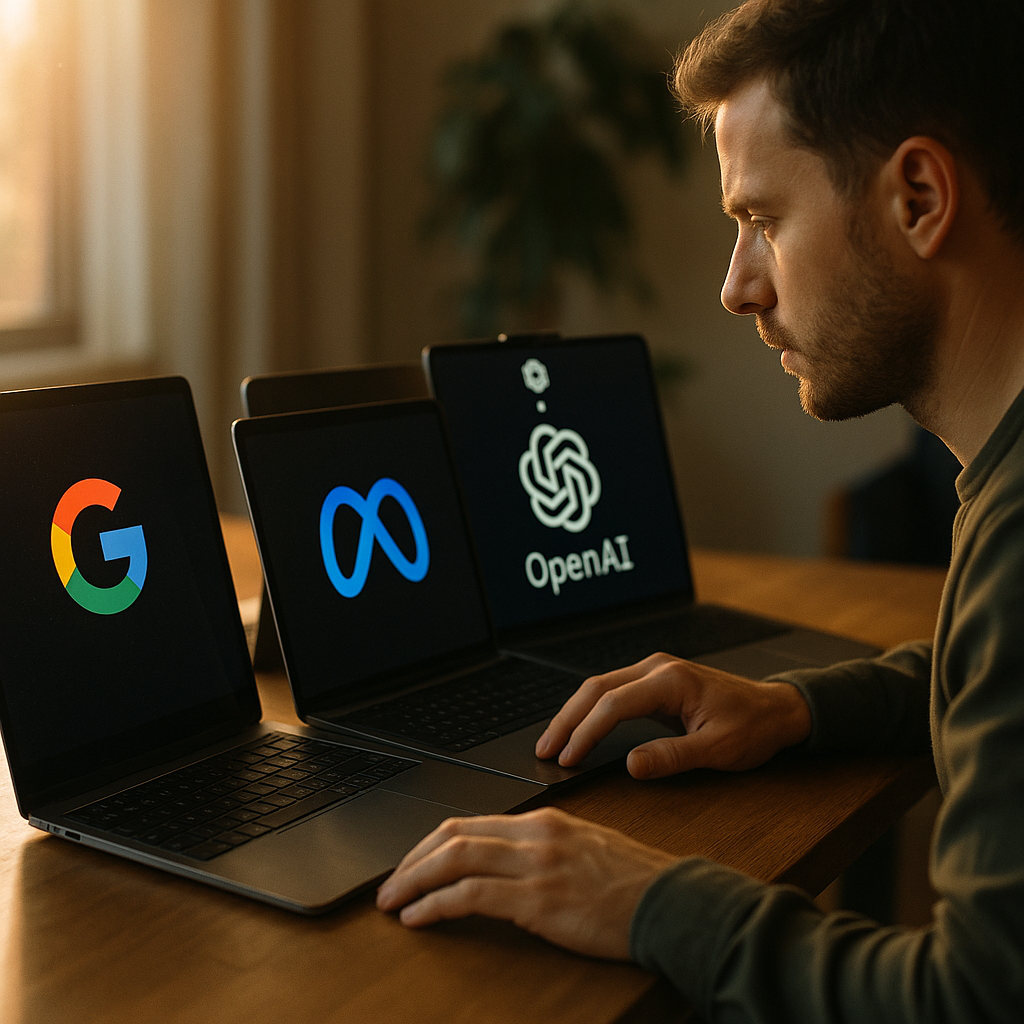
73% of enterprise marketers now run at least three AI-driven ad or content tools simultaneously, yet fewer than one in five can explain how those tools actually talk to each other. That gap is the entire story of the multi-agent marketing stack right now. Brands are stacking Google’s Performance Max agents, Meta’s Advantage+ automation, and OpenAI’s function-calling pipelines on top of each other, hoping the overlap resolves itself. It rarely does.
What Is a Multi-Agent Marketing Stack, Really?
Forget the vendor slide decks for a second. A multi-agent marketing stack is a set of autonomous or semi-autonomous AI systems, each optimizing a slice of the funnel, that need to share signal without stepping on each other’s decisions. Google’s agents bid on search and shopping intent. Meta’s agents optimize creative and placement across feeds and reels. OpenAI-based agents (built through the API, custom GPTs, or third-party orchestration layers) handle everything from creator brief generation to customer service triage to on-site product recommendations.
Individually, each of these systems performs well. The problem shows up at the seams. Google’s agent doesn’t know what Meta’s agent just did with the same audience segment an hour ago. Neither knows that an OpenAI-powered chatbot just promised a customer a discount code that isn’t in either platform’s promotion logic. Multiply that across a $2M quarterly budget and you get duplicate spend, conflicting messages, and attribution reports that contradict each other in the same board meeting.
The real cost of unorchestrated AI stacks isn’t wasted spend, it’s the erosion of trust when three “sources of truth” give three different answers to the same performance question.
Why This Is Suddenly Urgent
Three forces converged to make orchestration a board-level issue rather than an ops nice-to-have.
- Agentic bidding went mainstream. Agentic ad platforms now bid autonomously, which means budget shifts happen faster than a human can review them, often between platforms in the same session.
- Attribution broke. As zero-click search breaks last-click models, marketers can no longer assume a clean handoff between discovery, consideration, and conversion. AI answer engines are inserting themselves into that journey, and GA4 now credits AI chatbots in the funnel, which changes how you should weight each agent’s contribution.
- Compliance hasn’t caught up. Agentic budget agents are shifting spend faster than legal and finance can sign off, and most brands still lack a documented approval trail for autonomous decisions.
None of this is theoretical. Marketers who deployed even a partial multi-agent setup this year without orchestration protocols reported reconciliation headaches within the first month, according to conversations we’ve had across agency and brand-side teams. The pattern is consistent: individual agent performance looks great in isolation, then the combined P&L tells a murkier story.
The Orchestration Layer: What It Actually Does
Think of the orchestration layer as air traffic control, not another pilot. It doesn’t fly the plane (Google’s PMax algorithm, Meta’s Advantage+ logic, your OpenAI-based creative agent). It decides who gets to land and when, and it stops two planes from occupying the same runway.
A functional orchestration layer typically handles four jobs:
- Signal routing. First-party data, consent status, and customer lifecycle stage get pushed to every agent in a shared format, rather than each platform pulling its own siloed version.
- Conflict resolution. If Google wants to bid up a segment Meta just suppressed for frequency capping, something has to arbitrate. That’s usually a rules engine sitting above both platforms, not a person watching three dashboards.
- Budget guardrails. Autonomous bidding needs hard ceilings and pacing rules that don’t get overridden by any single agent’s local optimization goal.
- Audit logging. Every autonomous action needs a timestamp, a rationale, and a rollback path. This is non-negotiable if you’re operating in a regulated category or reporting to a compliance committee.
This last point matters more than most teams initially assume. Auditing AI marketing actions is what builds the trust layer CMOs actually need before they’ll approve scaling an agentic stack past pilot budgets.
Data Quality Is the Real Bottleneck (Not the AI)
Here’s an uncomfortable truth: your agents are only as coordinated as your data is clean. Google, Meta, and OpenAI-based systems all ingest first-party signals differently, but if those signals are inconsistent, incomplete, or duplicated across CRM records, no orchestration layer can paper over it.
Dirty CRM data is quietly blocking a lot of AI marketing programs from ever reaching production, and it’s the number one reason pilots stall after the demo phase. Fix the data pipeline before you fix the orchestration logic. Order matters here. Teams that try to bolt sophisticated arbitration rules onto messy data end up automating the mess faster, not solving it.
There’s a decent playbook forming around this. A single unified data pipeline can now feed both AI search visibility and CRM scoring, which reduces the number of places your agents disagree simply because they’re working from different snapshots of the same customer.
If your Google, Meta, and OpenAI pipelines are pulling from three different data snapshots, you don’t have an orchestration problem. You have a data architecture problem wearing an orchestration costume.
Where Creator and Influencer Programs Fit In
Multi-agent orchestration isn’t just a paid media conversation. It’s reshaping how creator campaigns get built, briefed, and measured. Some brands have already automated large chunks of the workflow: seven coordinated AI agents cut creator campaign turnaround to a third of the previous timeline in one documented rollout, and Wondrlabs built a comparable seven-agent system to automate full creator campaigns end to end, from creator discovery through contract generation.
The contract piece is worth flagging separately because it’s where legal risk concentrates. AI can draft creator contracts fast, but human review is what closes the actual risk gap. An orchestrated stack should route every AI-generated contract through a mandatory human checkpoint before it reaches a creator’s inbox, no exceptions, regardless of how confident the drafting agent’s language sounds.
Post-purchase feedback loops are getting automated too. Alchemer’s Iris tool now turns post-purchase feedback directly into creator briefing tasks, closing a loop that used to take weeks of manual analysis. That’s a meaningful efficiency gain, but it only works if the feedback data feeding Iris is as clean as the data feeding your paid agents. Same bottleneck, different department.
Build vs. Buy: The Decision Nobody Wants to Make Twice
Every brand evaluating a multi-agent stack eventually hits the same fork: build a custom orchestration layer in-house, or buy into a vendor’s pre-packaged agent studio. Both paths have real trade-offs.
The TCS studio model is forcing a lot of brands to formally choose between building or buying their AI infrastructure, and the decision usually comes down to internal engineering capacity more than budget. If you don’t have a data engineering team that can maintain custom API integrations across Google Ads, Meta’s Marketing API, and OpenAI’s function-calling endpoints, buying a managed orchestration platform is almost always the safer bet, even at a premium.
Before committing budget either way, test the concept at small scale. Running context campaigns through an agent studio before scaling spend gives you a controlled environment to catch conflict-resolution failures before they hit a live seven-figure budget.
One more cost trap worth naming: consumption-based pricing on the AI layer itself. Consumption-based AI pricing can quietly put entire MarTech budgets at risk if your orchestration layer triggers more API calls than forecasted, which happens constantly once agents start talking to each other in real time rather than on a scheduled batch cycle.
A Practical Checklist Before You Flip the Switch
- Map every data source each agent touches and confirm it’s the same version of truth across platforms.
- Set hard budget ceilings that no single agent can override, with alerts on any pacing anomaly over 15%.
- Require human sign-off on any autonomous action above a defined dollar or reach threshold.
- Build a rollback protocol. If an agent makes a bad call, you need to reverse it within minutes, not after the weekly report.
- Log everything. Regulators and internal audit teams will ask for this trail eventually, treat it as inevitable rather than optional.
Marketing mix modeling is making a comeback specifically because of this trust deficit. MMM is returning as platform-reported ROI trust collapses, giving marketers a platform-agnostic check against whatever each agent’s dashboard is claiming. If you’re running a multi-agent stack without an external validation method like MMM, you’re trusting the fox to audit the henhouse.
What Compliance Teams Are Asking For
Legal and privacy teams aren’t trying to slow innovation for sport. They’re reacting to a genuine gap: most AI marketing pilots don’t have documented data handoff procedures between systems. Full AI adoption keeps stalling right at the compliance and data handoff stage, and it’s usually not because the technology fails. It’s because nobody mapped who’s responsible for what when three autonomous systems make a joint decision that touches consumer data.
Regulatory guidance from bodies like the FTC and the ICO hasn’t caught up specifically to multi-agent architectures yet, but existing rules on automated decision-making and data transparency still apply. Treat every agent handoff as a data processing event that needs documentation, because eventually someone will ask you to produce it.
Resources like Meta Business, Google’s support documentation, and industry benchmarking from eMarketer are useful starting points for understanding each platform’s current automation boundaries, but none of them will tell you how those boundaries interact with each other. That mapping work is on you.
The Bottom Line
Multi-agent marketing stacks aren’t optional anymore, Google, Meta, and OpenAI have each made autonomy the default setting on their platforms. The competitive advantage isn’t in adopting more agents. It’s in building the arbitration layer that keeps them from undermining each other, and having the clean data pipeline underneath that makes arbitration possible in the first place.
Start with one integration point (say, Google and Meta budget arbitration) before adding a third agent layer, and don’t scale spend on any autonomous system until your audit trail is airtight.
FAQs
What’s the difference between a multi-agent stack and just using multiple ad platforms?
Using multiple ad platforms means running separate campaigns on separate dashboards with manual oversight. A multi-agent stack means the platforms’ own AI systems are making autonomous decisions (bidding, budget shifts, creative swaps) that can conflict with each other in real time, which requires an orchestration layer to manage.
Do I need custom engineering to orchestrate Google, Meta, and OpenAI pipelines together?
Not necessarily. Managed agent studios and orchestration platforms exist specifically to avoid custom API maintenance, but you still need internal data governance to feed clean, consistent signals into whichever solution you choose.
How do I measure ROI across multiple autonomous agents without double-counting?
Marketing mix modeling is the most reliable independent check, since it doesn’t rely on any single platform’s self-reported attribution. Pair it with a unified data pipeline so every agent is scored against the same source of truth.
What’s the biggest risk in running unorchestrated AI agents across platforms?
Budget conflict and compliance exposure. Two agents can independently target the same audience with contradictory offers, wasting spend and creating a customer experience problem, while unlogged autonomous decisions leave you without an audit trail if regulators or internal auditors ask questions.
Should creator and influencer workflows be included in a multi-agent marketing stack?
Yes. Creator discovery, briefing, contract drafting, and post-purchase feedback loops are all being automated by AI agents now, and they need the same data consistency and human review checkpoints as paid media agents to avoid legal and brand safety risk.
Top Influencer Marketing Agencies
The leading agencies shaping influencer marketing in 2026
Agencies ranked by campaign performance, client diversity, platform expertise, proven ROI, industry recognition, and client satisfaction. Assessed through verified case studies, reviews, and industry consultations.
Moburst

-
2

The Shelf
Boutique Beauty & Lifestyle Influencer AgencyA data-driven boutique agency specializing exclusively in beauty, wellness, and lifestyle influencer campaigns on Instagram and TikTok. Best for brands already focused on the beauty/personal care space that need curated, aesthetic-driven content.Clients: Pepsi, The Honest Company, Hims, Elf Cosmetics, Pure LeafVisit The Shelf → -
3

Audiencly
Niche Gaming & Esports Influencer AgencyA specialized agency focused exclusively on gaming and esports creators on YouTube, Twitch, and TikTok. Ideal if your campaign is 100% gaming-focused — from game launches to hardware and esports events.Clients: Epic Games, NordVPN, Ubisoft, Wargaming, Tencent GamesVisit Audiencly → -
4

Viral Nation
Global Influencer Marketing & Talent AgencyA dual talent management and marketing agency with proprietary brand safety tools and a global creator network spanning nano-influencers to celebrities across all major platforms.Clients: Meta, Activision Blizzard, Energizer, Aston Martin, WalmartVisit Viral Nation → -
5

The Influencer Marketing Factory
TikTok, Instagram & YouTube CampaignsA full-service agency with strong TikTok expertise, offering end-to-end campaign management from influencer discovery through performance reporting with a focus on platform-native content.Clients: Google, Snapchat, Universal Music, Bumble, YelpVisit TIMF → -
6

NeoReach
Enterprise Analytics & Influencer CampaignsAn enterprise-focused agency combining managed campaigns with a powerful self-service data platform for influencer search, audience analytics, and attribution modeling.Clients: Amazon, Airbnb, Netflix, Honda, The New York TimesVisit NeoReach → -
7

Ubiquitous
Creator-First Marketing PlatformA tech-driven platform combining self-service tools with managed campaign options, emphasizing speed and scalability for brands managing multiple influencer relationships.Clients: Lyft, Disney, Target, American Eagle, NetflixVisit Ubiquitous → -
8

Obviously
Scalable Enterprise Influencer CampaignsA tech-enabled agency built for high-volume campaigns, coordinating hundreds of creators simultaneously with end-to-end logistics, content rights management, and product seeding.Clients: Google, Ulta Beauty, Converse, AmazonVisit Obviously →