


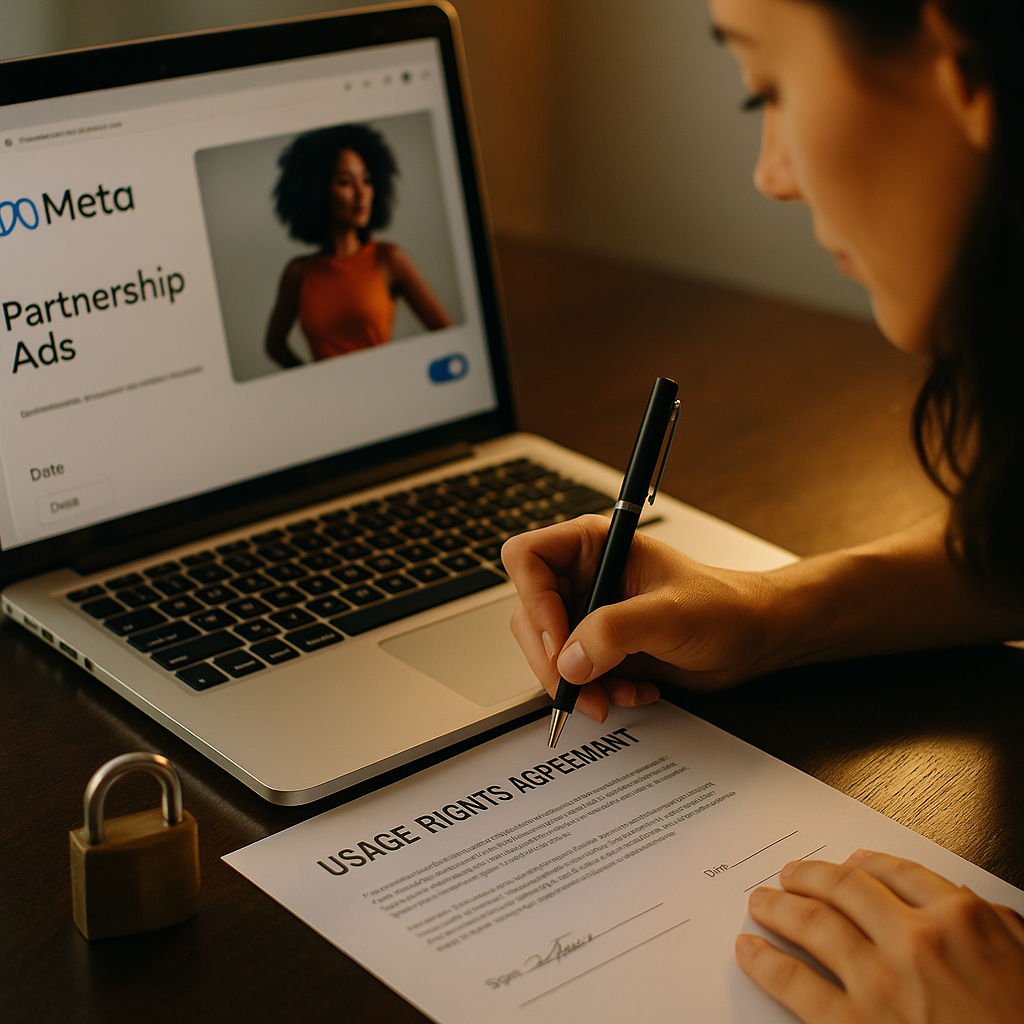
Meta shut down over 60,000 fraudulent ad accounts tied to unauthorized content use in a single enforcement sweep, according to Meta’s own transparency disclosures. Yet brands keep whitelisting creator content for paid media without a signed usage rights agreement in hand. If that sounds like your team, you’re one legal complaint away from a pulled campaign and a very awkward finance meeting. Getting Meta Partnership Ads setup right starts long before you touch Ads Manager, it starts with a contract.
Why Whitelisting Without Rights Is a Ticking Clock
Partnership Ads (the successor to Branded Content Ads) let brands run paid media directly through a creator’s handle, using their engagement history and social proof instead of a cold brand account. It’s a smart mechanic. Performance data from agencies running whitelisted creator content consistently shows lower CPMs and higher click-through rates compared to brand-only creative, because the audience trusts the face they already follow.
But the mechanic only works if the underlying usage rights are airtight. Partnership Ads requires the creator to grant the brand a “Partnership Ads” permission inside Meta Business Suite. That permission is a technical toggle, not a legal release. Toggling it on does not mean you own the content, it means Meta will let you spend against it. Those are two very different things, and conflating them is where brands get burned.
The Meta permission toggle grants technical access to run ads. It does not grant legal rights to use the content. Treating the two as the same thing is the single most common mistake in creator ad whitelisting.
Here’s the scenario that plays out more often than agencies admit: a creator posts organic content, the brand loves the performance, someone on the media buying team requests whitelisting access, the creator grants the Meta permission, and spend goes live that afternoon. No one checks whether the original contract even mentioned paid usage. Six weeks later the creator’s manager sends a cease and desist because the deal was for organic only. Now you’re pulling a live campaign mid-flight, eating the wasted spend, and explaining to your CMO why a “quick whitelisting request” turned into a legal escalation.
What Usage Rights Actually Need to Cover
A usage rights clause that only says “brand may promote this content” is not specific enough for a Meta Partnership Ads setup. Contracts need to nail down four things explicitly:
- Duration: How long can the brand run paid media against this asset? Thirty days? Ninety? In perpetuity? Meta allows Partnership Ads permissions to run indefinitely unless revoked, so your contract term needs to match, not exceed, your legal grant.
- Placement scope: Feed, Reels, Stories, Audience Network, or all of the above? Some creators negotiate narrower usage (Instagram only, no Facebook) and brands need to configure ad sets to respect that.
- Spend ceiling: Some contracts cap total media spend against a piece of content. If your finance team doesn’t know that cap exists, you’ll blow past it without realizing.
- Revocation terms: What happens if the creator wants out early? Does the brand get a grace period to wind down live campaigns, or does access terminate immediately?
Skipping any one of these turns a routine whitelisting request into a liability the legal team inherits later. For a broader look at how compliance frameworks are tightening across creator content labeling, see our branded content compliance playbook, which covers similar disclosure logic on YouTube.
The Sequence: Rights First, Whitelisting Second, Spend Third
Most operational failures in Meta Partnership Ads setup come down to sequencing. Teams whitelist first and paper the deal later, hoping nobody asks questions. Flip that order.
- Contract negotiation includes explicit paid media terms. Not a vague “brand may repurpose content” line. Name Partnership Ads specifically, define duration and placements.
- Legal sign-off happens before creative goes live organically. If the plan is to whitelist a post, that intent should be baked into the original agreement, not bolted on after the post performs well.
- Creator grants the Meta Business Suite permission. This is the technical step, and it should happen only after step one and two are locked.
- Media buyer builds the campaign in Ads Manager, referencing the specific post ID and confirming placement scope matches the contract.
- Compliance logs the agreement, including start date, end date, and spend cap, in a shared tracker accessible to media buying, legal, and finance.
That fifth step is the one most teams skip, and it’s the one that saves you when someone in finance asks “are we still allowed to be running this ad in Q3?” six months from now.
A Quick Gut Check Before You Hit Publish
Before whitelisting spend on any Partnership Ads campaign, ask three questions: Does the contract explicitly mention paid amplification? Does the Meta permission match the contracted duration? Is there a spend cap, and does your media plan respect it? If you can’t answer all three with confidence, pause the launch. A delayed campaign costs you a few days. A pulled campaign mid-flight costs you the media spend, the creative production cost, and the relationship with the creator.
Handling Multi-Platform Creators and Overlapping Rights
Creators rarely work exclusively on Instagram. A single influencer might have separate agreements for TikTok, YouTube, and Meta, each with different usage windows and exclusivity clauses. This gets complicated fast when a brand wants to repurpose the same asset across platforms.
Say a creator shoots a product demo, posts a version to Reels, and a longer cut to TikTok Shop. If your Meta usage agreement covers “content posted to Instagram” but the TikTok cut features different framing, you may not have rights to whitelist the TikTok version even under an identical brand deal. Rights are typically asset-specific and platform-specific, not blanket. Brands running cross-platform creator programs need a rights matrix, essentially a spreadsheet mapping each asset to its permitted platforms, duration, and spend ceiling. It’s not glamorous work, but it’s the difference between a clean audit and a compliance mess. For teams juggling similar cross-platform attribution questions, our piece on ad API performance across platforms covers how paid reach mechanics differ by channel, which is useful context when deciding where to allocate whitelisting budget in the first place.
Rights are asset-specific and platform-specific. A usage agreement for one Reels post does not automatically cover a repurposed cut on TikTok or YouTube, even from the same creator and the same campaign.
What Happens When You Get It Wrong
The FTC has been increasingly vocal about disclosure and consent failures in influencer marketing, and while most enforcement actions focus on undisclosed material connections rather than usage rights specifically, the reputational fallout from a rights dispute follows a similar pattern: public creator complaints, brand safety scrutiny, and internal finance clawbacks. Check the FTC’s guidance on endorsements for the disclosure side of this, and treat usage rights as the contractual twin of that same compliance discipline.
Beyond the legal exposure, there’s a simpler operational cost: wasted media spend. If Meta or the creator forces a pull mid-flight, you don’t get that budget back. Campaigns optimize over their flight window, and an interrupted campaign rarely gets to recoup its learning phase inefficiency. Agencies that have scaled whitelisted creator programs report that clean rights management correlates directly with campaign uptime, which correlates directly with performance stability. The full stack campaign data from Chtrbox makes a similar case for why operational discipline across a large creator roster pays off in aggregate performance, not just individual campaign wins.
Building the Internal Process That Scales
If you’re running five whitelisted campaigns a quarter, a shared doc and some diligence might suffice. If you’re running fifty, you need a system. Most mature brand teams now assign a single owner, usually someone in influencer marketing operations or legal ops, who signs off on every Partnership Ads request before it goes to media buying. That person checks the contract against the Meta permission, confirms the spend cap, and logs the agreement in a central tracker.
This isn’t bureaucracy for its own sake. According to eMarketer’s ongoing coverage of influencer marketing spend, brands are shifting larger shares of paid social budget toward creator-attributed content precisely because it outperforms brand-only creative. That shift means more dollars riding on rights that were often negotiated as an afterthought. The bigger the budget commitment, the more a single rights gap can cost you. Treat the sign-off process as insurance, not friction. For teams thinking about how creator-attributed spend intersects with checkout and attribution more broadly, our coverage of Instagram checkout attribution gaps is a useful companion read, since attribution and rights management both hinge on clean data trails.
A Practical Template for Contract Language
You don’t need a twenty-page legal document to cover this. A tight paragraph, reviewed by counsel, usually does the job. At minimum, include:
- A clause naming “Meta Partnership Ads” or “whitelisting” specifically, not just “paid promotion.”
- A defined start and end date for paid usage, separate from the organic posting date.
- Named placements (Feed, Reels, Stories, Audience Network) the brand may use.
- A maximum spend figure or a “brand will notify creator before exceeding $X in spend” clause.
- A revocation and wind-down provision giving the brand a reasonable window (commonly 5 to 10 business days) to pause live campaigns if the creator revokes access.
Run this past whoever handles your influencer contracts and get it standardized as boilerplate. Ad hoc negotiation on every single deal is how gaps creep in. Meta’s own guidance on Partnership Ads setup covers the technical permission flow well, but it says almost nothing about what your contract needs to contain, because that’s not Meta’s job. It’s yours.
FAQs
What is the difference between Meta whitelisting and Partnership Ads?
“Whitelisting” is the informal industry term for running paid media through a creator’s account. Partnership Ads is Meta’s current formal product for this, replacing the older Branded Content Ads tool. The terms are often used interchangeably, but Partnership Ads is the specific mechanism inside Meta Business Suite.
Does granting the Meta Partnership Ads permission mean the brand owns the content?
No. The permission is a technical setting that allows Meta to serve ads through the creator’s handle. Ownership and usage rights are governed entirely by the underlying contract between brand and creator, which must be negotiated separately.
How long can a brand run Partnership Ads before rights expire?
There’s no default expiration set by Meta, the permission can technically remain active indefinitely unless revoked. The actual usable duration is whatever the brand’s contract with the creator specifies, which is why contracts need explicit start and end dates for paid usage.
What should a brand do if a creator revokes Partnership Ads access mid-campaign?
Pause the campaign immediately and check the contract’s revocation clause for any agreed wind-down period. Without a wind-down provision, the safest move is to stop spend the moment access is revoked and document the timeline for legal review.
Can one usage rights agreement cover multiple platforms?
Only if the contract explicitly says so. Rights are typically asset-specific and platform-specific, so a single agreement covering an Instagram Reel does not automatically extend to a repurposed version on TikTok or YouTube without separate language.
Who should own the sign-off process for Partnership Ads requests internally?
At scale, most brands assign a single owner, often in influencer marketing operations or legal ops, to verify every whitelisting request against the signed contract before media buying activates spend. This prevents ad hoc approvals that skip the rights check entirely.
Lock the rights before you touch the toggle. Build a sign-off checkpoint into your workflow, standardize your contract language, and treat every Partnership Ads request as a compliance step, not a media buying formality.
FAQs
What is the difference between Meta whitelisting and Partnership Ads?
“Whitelisting” is the informal industry term for running paid media through a creator’s account. Partnership Ads is Meta’s current formal product for this, replacing the older Branded Content Ads tool. The terms are often used interchangeably, but Partnership Ads is the specific mechanism inside Meta Business Suite.
Does granting the Meta Partnership Ads permission mean the brand owns the content?
No. The permission is a technical setting that allows Meta to serve ads through the creator’s handle. Ownership and usage rights are governed entirely by the underlying contract between brand and creator, which must be negotiated separately.
How long can a brand run Partnership Ads before rights expire?
There’s no default expiration set by Meta, the permission can technically remain active indefinitely unless revoked. The actual usable duration is whatever the brand’s contract with the creator specifies, which is why contracts need explicit start and end dates for paid usage.
What should a brand do if a creator revokes Partnership Ads access mid-campaign?
Pause the campaign immediately and check the contract’s revocation clause for any agreed wind-down period. Without a wind-down provision, the safest move is to stop spend the moment access is revoked and document the timeline for legal review.
Can one usage rights agreement cover multiple platforms?
Only if the contract explicitly says so. Rights are typically asset-specific and platform-specific, so a single agreement covering an Instagram Reel does not automatically extend to a repurposed version on TikTok or YouTube without separate language.
Who should own the sign-off process for Partnership Ads requests internally?
At scale, most brands assign a single owner, often in influencer marketing operations or legal ops, to verify every whitelisting request against the signed contract before media buying activates spend. This prevents ad hoc approvals that skip the rights check entirely.
Top Influencer Marketing Agencies
The leading agencies shaping influencer marketing in 2026
Agencies ranked by campaign performance, client diversity, platform expertise, proven ROI, industry recognition, and client satisfaction. Assessed through verified case studies, reviews, and industry consultations.
Moburst

-
2

The Shelf
Boutique Beauty & Lifestyle Influencer AgencyA data-driven boutique agency specializing exclusively in beauty, wellness, and lifestyle influencer campaigns on Instagram and TikTok. Best for brands already focused on the beauty/personal care space that need curated, aesthetic-driven content.Clients: Pepsi, The Honest Company, Hims, Elf Cosmetics, Pure LeafVisit The Shelf → -
3

Audiencly
Niche Gaming & Esports Influencer AgencyA specialized agency focused exclusively on gaming and esports creators on YouTube, Twitch, and TikTok. Ideal if your campaign is 100% gaming-focused — from game launches to hardware and esports events.Clients: Epic Games, NordVPN, Ubisoft, Wargaming, Tencent GamesVisit Audiencly → -
4

Viral Nation
Global Influencer Marketing & Talent AgencyA dual talent management and marketing agency with proprietary brand safety tools and a global creator network spanning nano-influencers to celebrities across all major platforms.Clients: Meta, Activision Blizzard, Energizer, Aston Martin, WalmartVisit Viral Nation → -
5

The Influencer Marketing Factory
TikTok, Instagram & YouTube CampaignsA full-service agency with strong TikTok expertise, offering end-to-end campaign management from influencer discovery through performance reporting with a focus on platform-native content.Clients: Google, Snapchat, Universal Music, Bumble, YelpVisit TIMF → -
6

NeoReach
Enterprise Analytics & Influencer CampaignsAn enterprise-focused agency combining managed campaigns with a powerful self-service data platform for influencer search, audience analytics, and attribution modeling.Clients: Amazon, Airbnb, Netflix, Honda, The New York TimesVisit NeoReach → -
7

Ubiquitous
Creator-First Marketing PlatformA tech-driven platform combining self-service tools with managed campaign options, emphasizing speed and scalability for brands managing multiple influencer relationships.Clients: Lyft, Disney, Target, American Eagle, NetflixVisit Ubiquitous → -
8

Obviously
Scalable Enterprise Influencer CampaignsA tech-enabled agency built for high-volume campaigns, coordinating hundreds of creators simultaneously with end-to-end logistics, content rights management, and product seeding.Clients: Google, Ulta Beauty, Converse, AmazonVisit Obviously →