


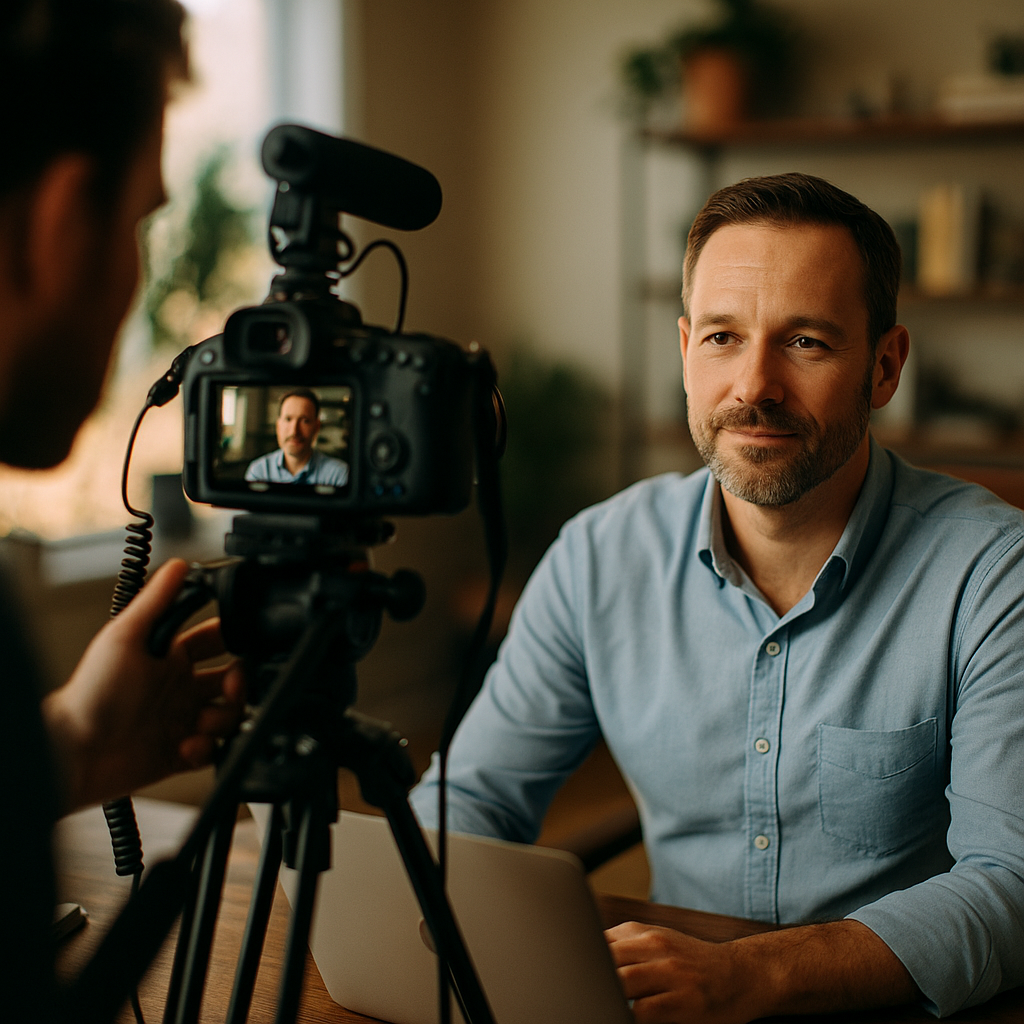
Only 4% of branded video content runs longer than three minutes, yet the long-form pieces that do get made are quietly outperforming 15-second ads on trust metrics. Why? Because a founder sitting in a factory, a warehouse, or a cluttered garage office for eight minutes says something a paid ad never can: this person built something real. That’s the entire premise behind mini documentary briefs, the long-form format brands are using to manufacture credibility instead of just buying attention.
This isn’t a trend piece about vibes. It’s an operational breakdown of how marketing teams are commissioning, scripting, and distributing founder documentaries, and why the format is becoming a fixture in B2B and DTC content calendars alike.
Why Founder Credibility Became a Line Item
Trust in advertising has been declining for years, and audiences have gotten scary good at spotting a script. A polished 30-second spot with a hired actor reads as marketing. A grainy eight-minute documentary where the founder stumbles over a sentence, admits a mistake, or shows the actual production floor reads as evidence.
That distinction matters more in categories where the buying decision is expensive or high-stakes: supplements, financial tools, industrial equipment, anything with a longer consideration cycle. Buyers in those categories aren’t looking for a jingle. They’re looking for proof the person behind the brand knows what they’re talking about and isn’t hiding anything.
A mini documentary doesn’t sell the product in the first ninety seconds, and that’s exactly the point. It sells the person, then lets the product ride the credibility.
Marketing teams have picked up on this. Instead of treating founder content as an occasional press hit or a LinkedIn video, they’re briefing it like a content pillar with its own budget, timeline, and distribution plan. This mirrors the approach outlined in founder video diaries, where ongoing personal footage builds familiarity over time. Mini documentaries do the same job in a single concentrated dose.
What a Mini Documentary Brief Actually Contains
A mini documentary brief is not a script. It’s closer to a shot list married to a narrative arc, built for a piece running anywhere from four to twelve minutes. Most briefs I’ve seen from agencies working this format include:
- A three-act structure: origin problem, the messy middle, the current state of the business
- A list of “proof beats,” specific moments (a customer call, a failed prototype, a factory tour) that get filmed as evidence rather than narrated as claims
- Interview questions designed to produce unscripted, quotable answers rather than polished soundbites
- A distribution plan that splits the long-form asset into cutdowns before a single frame is shot
That last point is where a lot of teams get it wrong. They commission an eight-minute documentary, publish it once on YouTube, and call it done. The smarter move treats the full-length piece as a content warehouse: one shoot, dozens of assets. That’s the same logic behind companion cutdowns for CTV spots, just applied to a founder narrative instead of a product ad.
The Interview Is the Product, Not the B-Roll
Here’s a mistake I see constantly: brands over-invest in cinematography and under-invest in interview prep. A drone shot of the headquarters is nice. It is not why anyone finishes watching a nine-minute video. What keeps people watching is whether the founder says something surprising, admits something vulnerable, or explains a decision in a way that sounds like a real conversation instead of a rehearsed pitch.
Good briefs build in a pre-interview, a casual thirty-minute conversation the week before filming where the director figures out which stories the founder tells naturally and which ones need coaxing. Skip this step and you end up with a founder reciting talking points on camera, which defeats the entire purpose of the format.
How Long Should the Format Actually Run?
There’s no single right answer, but the data gives some guardrails. Retention on branded long-form video tends to fall off a cliff after the six-minute mark unless the narrative earns its length with genuine stakes. YouTube’s own creator guidance consistently points to strong hooks in the first fifteen seconds as the single biggest lever for whether a long-form piece survives past the opening.
Practical benchmarks brands are using:
- Four to six minutes for a founder story aimed at a cold or mid-funnel audience
- Eight to twelve minutes for a documentary meant to run on the brand’s owned channels as a trust asset, often linked from the site or sales deck
- Under ninety seconds for the paid social cutdown that drives traffic back to the full piece
Notice the pattern: the full documentary rarely serves as the primary paid asset. It’s the destination. The cutdowns do the acquisition work, similar to the pacing logic covered in chaptered YouTube series, where chapter markers let viewers self-select the parts they care about instead of demanding a full watch.
Budget, Timeline, and the Risk Mitigation Nobody Talks About
A mini documentary is not a cheap format. Mid-tier production runs anywhere from $15,000 to $60,000 depending on crew size, travel, and edit complexity, and that’s before paid distribution. But the risk profile is different from a typical UGC or influencer campaign, and that’s worth understanding before you greenlight the budget.
There’s no third-party talent whose off-platform behavior can blow back on the brand. There’s no FTC disclosure ambiguity to manage, since the founder isn’t a paid endorser, they’re an employee speaking on the record. Legal review still matters, especially around claims made on camera, but it’s a fraction of the friction compared to managing dozens of creator contracts. That’s a meaningful operational advantage for teams already stretched thin managing disclosure compliance across a broader influencer roster.
The real cost isn’t the production budget, it’s the founder’s calendar. Getting six uninterrupted hours from a CEO is often the hardest line item to secure.
Timeline-wise, budget four to six weeks from brief to final cut for a documentary of this scope: two weeks for pre-production and location scouting, one to two days of shooting, and two to three weeks of edit and revisions. Rushing the edit is where most of these projects lose their edge, since the best moments usually get found in the assembly cut, not the shooting script.
Where the Format Falls Apart
Mini documentaries fail for a few predictable reasons, and it’s worth naming them before you commission one.
The founder isn’t actually comfortable on camera, and no amount of editing fixes a subject who freezes up or over-rehearses. The brand tries to cram product marketing into what should be a character piece, turning an eight-minute documentary into a glorified sales reel with worse production values than a normal ad. Or the distribution plan is an afterthought, so a genuinely good piece of content sits at 400 views on a corporate YouTube channel nobody visits.
The fix for that last problem is usually reformatting discipline. A documentary shot in widescreen for YouTube needs a real plan for vertical placements, not just a center crop. The reformatting checklist used for vertical to horizontal CTV conversions applies just as well in reverse here, since aspect ratio decisions made during the edit determine how many usable cutdowns you actually get out of the footage.
There’s also a category-fit question worth asking honestly. Founder documentaries work exceptionally well in industrial, financial, and specialty consumer categories where trust is the primary barrier to purchase, the same reason manufacturing content resonates with B2B buyers who want proof of real operations. They work less well in impulse-purchase categories where the audience never cared who the founder was in the first place. Match the format to the buying psychology, not to whichever brand happened to see a documentary go viral last quarter.
A Quick Gut Check Before You Commission One
Before greenlighting a mini documentary, ask three questions internally: does the founder have a story with actual tension in it, not just a highlight reel? Is the buying decision in your category expensive or complex enough that trust is a real conversion lever? And do you have a distribution plan that turns one shoot into a library of cutdowns, rather than a single video nobody finds? If the answer to all three is yes, the format earns its budget. Research from eMarketer and engagement benchmarks tracked by Sprout Social both point to the same conclusion: longer, authentic founder content consistently outperforms polished brand ads on trust and recall metrics, even when raw view counts are lower.
FAQs
How long should a mini documentary brief be for a founder video?
Most effective founder documentaries run between four and twelve minutes, with the full-length piece serving as an owned-channel trust asset while shorter cutdowns handle paid distribution and acquisition.
What’s the difference between a mini documentary and a founder video diary?
A mini documentary is a single, produced narrative piece built around a three-act arc, while a founder video diary is an ongoing series of shorter, lower-production clips released over time to build familiarity.
Do mini documentaries need FTC disclosure like influencer content?
Generally no, since the founder is an employee speaking on the record rather than a paid third-party endorser, though claims made on camera still require standard legal and compliance review.
How much does a founder mini documentary typically cost?
Mid-tier production budgets range from roughly $15,000 to $60,000 depending on crew size, location complexity, and edit scope, not including paid media to distribute the resulting cutdowns.
What makes a founder documentary fail?
The most common failure points are an uncomfortable or over-rehearsed founder, a script that turns into product marketing instead of a character story, and a distribution plan that never turns the shoot into more than one video.
Next step: before you write the brief, sit the founder down for an unscripted thirty-minute conversation and record it. If that conversation produces a story worth watching, you have a documentary. If it doesn’t, save the budget for a different format.
Top Influencer Marketing Agencies
The leading agencies shaping influencer marketing in 2026
Agencies ranked by campaign performance, client diversity, platform expertise, proven ROI, industry recognition, and client satisfaction. Assessed through verified case studies, reviews, and industry consultations.
Moburst

-
2

The Shelf
Boutique Beauty & Lifestyle Influencer AgencyA data-driven boutique agency specializing exclusively in beauty, wellness, and lifestyle influencer campaigns on Instagram and TikTok. Best for brands already focused on the beauty/personal care space that need curated, aesthetic-driven content.Clients: Pepsi, The Honest Company, Hims, Elf Cosmetics, Pure LeafVisit The Shelf → -
3

Audiencly
Niche Gaming & Esports Influencer AgencyA specialized agency focused exclusively on gaming and esports creators on YouTube, Twitch, and TikTok. Ideal if your campaign is 100% gaming-focused — from game launches to hardware and esports events.Clients: Epic Games, NordVPN, Ubisoft, Wargaming, Tencent GamesVisit Audiencly → -
4

Viral Nation
Global Influencer Marketing & Talent AgencyA dual talent management and marketing agency with proprietary brand safety tools and a global creator network spanning nano-influencers to celebrities across all major platforms.Clients: Meta, Activision Blizzard, Energizer, Aston Martin, WalmartVisit Viral Nation → -
5

The Influencer Marketing Factory
TikTok, Instagram & YouTube CampaignsA full-service agency with strong TikTok expertise, offering end-to-end campaign management from influencer discovery through performance reporting with a focus on platform-native content.Clients: Google, Snapchat, Universal Music, Bumble, YelpVisit TIMF → -
6

NeoReach
Enterprise Analytics & Influencer CampaignsAn enterprise-focused agency combining managed campaigns with a powerful self-service data platform for influencer search, audience analytics, and attribution modeling.Clients: Amazon, Airbnb, Netflix, Honda, The New York TimesVisit NeoReach → -
7

Ubiquitous
Creator-First Marketing PlatformA tech-driven platform combining self-service tools with managed campaign options, emphasizing speed and scalability for brands managing multiple influencer relationships.Clients: Lyft, Disney, Target, American Eagle, NetflixVisit Ubiquitous → -
8

Obviously
Scalable Enterprise Influencer CampaignsA tech-enabled agency built for high-volume campaigns, coordinating hundreds of creators simultaneously with end-to-end logistics, content rights management, and product seeding.Clients: Google, Ulta Beauty, Converse, AmazonVisit Obviously →