


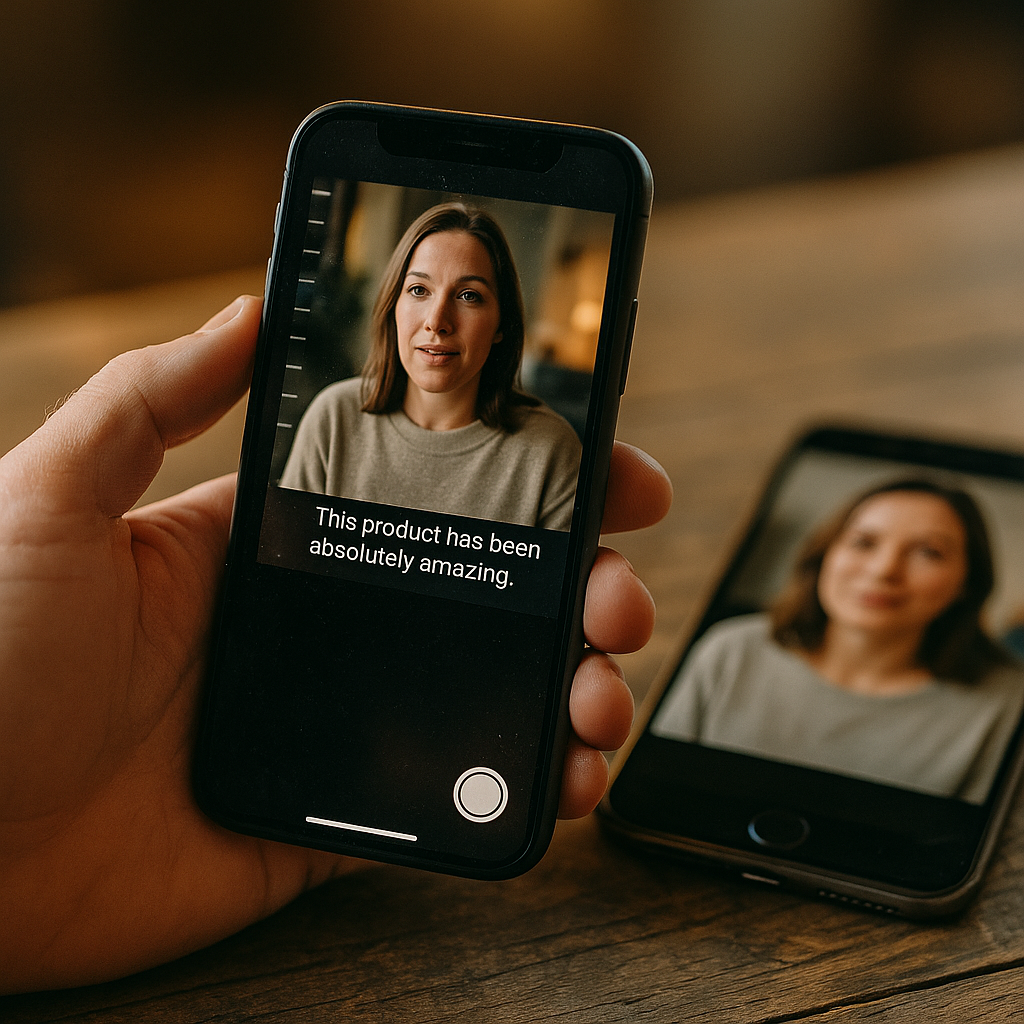
Testimonial reels with clean lighting, a hired talent, and a scripted VO are seeing engagement drop by double digits compared to shaky, text-overlay clips shot on someone’s actual phone. Why? Because audiences have learned to smell produced content from three seconds away, and they scroll past it before the CTA even loads. Text overlay testimonial reels, the format built on captions typed over raw, unpolished footage, are quietly becoming the highest-converting review format on the feed. Here’s why brands are shifting budget toward the messy version.
The Polish Problem
For years, “quality” meant production value. Good lighting, a confident voiceover, a brand-approved script. That formula still works for hero content and top-of-funnel awareness. But testimonials are a trust format, not an awareness format, and trust doesn’t respond to polish the way brand storytelling does.
When a viewer sees a testimonial that looks like an ad, their brain files it under “ad.” Skepticism kicks in immediately. Text overlay testimonial reels sidestep that filter entirely. No voiceover, no studio lighting, just a real person’s face, natural background noise, and typed-out text walking through the actual experience. It reads as a note from a friend, not a pitch from a brand.
Audiences don’t distrust testimonials because they’re fake. They distrust them because they look produced, and produced now signals “paid” faster than any disclosure hashtag ever could.
What the Format Actually Looks Like
Strip away the jargon and the format is simple. A creator films themselves, phone camera, minimal editing, and overlays short text captions that narrate their honest reaction in real time: “I was skeptical,” “three weeks later,” “did not expect this.” No talking-head monologue. No brand tagline read aloud. The visual carries the emotion, the text carries the plot.
- Handheld or propped phone footage, often in a bedroom, car, or kitchen
- Short, punchy text overlays timed to the footage, usually three to six lines per reel
- Minimal or no background music, sometimes just ambient sound
- A single clear before/after or expectation/reality arc
- No visible script reading, even if the beats were briefed in advance
This isn’t a new idea dressed up. It’s closer to the aesthetic covered in silent caption scripts, where the absence of narration forces the visual and text to do the persuading. Testimonial reels borrow that same restraint and apply it specifically to trust-building content.
Why the Numbers Favor the Raw Cut
Platforms reward watch time and completion rate above almost everything else, and raw testimonial formats consistently outperform on both metrics because they feel unpredictable. A polished review follows a predictable rhythm: intro, problem, solution, CTA. Viewers know exactly when to swipe away. Text overlay reels don’t follow that rhythm, so retention curves stay flatter for longer.
Marketers running side-by-side tests are finding that raw testimonial reels drive meaningfully higher save and share rates than scripted counterparts, even when the underlying product claim is identical. Sprout Social’s own research on social trust has repeatedly flagged authenticity as the top driver of purchase consideration on short-form video, ahead of production quality or influencer follower count.
There’s also a cost angle that finance teams love. Raw format testimonials require no studio booking, no professional editor, and often no paid talent fee beyond the standard creator rate. That’s a direct line to lower cost per asset and faster turnaround, which matters when a brand needs fifteen testimonial variants for a single product launch rather than one hero cut.
The Approval Trap Brands Keep Falling Into
Here’s where most brands sabotage their own format. Someone in legal or brand safety sees the raw footage, panics at the lack of polish, and sends it back for “cleanup.” Suddenly the creator is re-shooting with better lighting, softer language, and a script that sounds like it came from a deck. The authenticity that made the format work is gone by round three of revisions.
This is the same failure pattern explored in creative approval bottlenecks: the review cycle itself is what kills the raw energy the format depends on. Brands that succeed with text overlay testimonials treat the approval step as a compliance check, not a creative rewrite. Check the claims, check the disclosure, leave the footage alone.
The single biggest predictor of whether a text overlay testimonial performs isn’t the creator’s follower count. It’s how many rounds of internal revision the footage survived before posting.
Where Trust Meets Legal Risk
Raw doesn’t mean unregulated. A testimonial is still an endorsement in the eyes of regulators, and the informal look of the format doesn’t exempt it from disclosure rules. The FTC’s endorsement guidance applies exactly the same way to a shaky phone video as it does to a studio-produced ad. Brands running text overlay testimonial campaigns at scale need the same #ad or #partner disclosure baked into the caption or overlay text, ideally in the first frame rather than buried at the end.
This matters more, not less, because the format’s whole appeal is that it doesn’t look like advertising. Regulators and platforms are increasingly sensitive to formats that blur that line intentionally. Build disclosure into the brief from day one rather than treating it as an afterthought during legal review.
Briefing the Format Without Killing It
The trick to briefing raw testimonial content is giving creators a loose structure, not a script. Tell them the three beats you need covered (initial doubt, the moment it clicked, the result), and let them find their own words and pacing. This mirrors the approach detailed in loose-structure briefing, where over-specifying dialogue kills the natural delivery that makes UGC-style content convert.
A practical brief for this format usually includes:
- The three narrative beats to hit, described as outcomes, not lines
- Required disclosure language and where it needs to appear on screen
- A note on filming environment (natural light, no studio setup) so creators don’t over-produce by default
- Text overlay style guidance (font, timing) without dictating exact wording
- One approved product claim list, so legal review is fast and doesn’t touch the footage
Brands that have adapted hybrid UGC templates for this exact purpose report faster turnaround and fewer revision cycles, because the template already accounts for the tension between brand safety and raw authenticity before the creator ever hits record.
How This Fits Alongside Other Review Formats
Text overlay testimonials aren’t meant to replace every review format in a brand’s toolkit. Data-heavy comparisons still have a place, particularly in categories where specs and numbers drive the purchase decision. That’s the territory covered in data overlay vlogs, where numeric proof does the persuading instead of emotional narrative.
The smart play is running both in parallel and letting the funnel decide which does more work. Text overlay testimonials tend to win at the consideration stage, where a viewer needs to believe a product works before they’ll click through to specs. Data-driven formats close harder once that initial trust is established. Testing this split, rather than picking one format and running it everywhere, is what separates teams getting real lift from teams chasing a trend. Industry benchmarks from eMarketer continue to show short-form video budgets shifting toward exactly this kind of layered, funnel-aware creative strategy rather than single-format bets.
Text overlay testimonial reels work because they refuse to look like the thing they are. Brief the beats, protect the rawness through approval, disclose properly, and let the format do what polish never could: get believed.
Frequently Asked Questions
What are text overlay testimonial reels?
They’re short-form video testimonials where a creator films unpolished, phone-shot footage of themselves and adds typed text captions to narrate the experience, instead of speaking to camera or using a scripted voiceover.
Why do raw testimonial reels outperform polished reviews?
Polished production signals “advertisement” to viewers almost instantly, triggering skepticism and skip-throughs. Raw footage reads as personal and unscripted, which lowers the viewer’s guard and keeps them watching longer, driving higher completion, save, and share rates.
Do text overlay testimonials still need FTC disclosure?
Yes. The informal look of the footage doesn’t change the legal requirement. Any paid or gifted testimonial needs clear disclosure, ideally built into the text overlay or caption in the opening frames rather than added at the end.
How long should a text overlay testimonial reel be?
Most high-performing versions run between fifteen and forty-five seconds, long enough to hit three narrative beats (doubt, turning point, result) without dragging into filler.
Can brands script text overlay testimonials without losing authenticity?
Brands can brief the narrative beats and required disclosure, but scripting exact wording tends to flatten the delivery and make the footage feel produced again. Loose structure with clear guardrails works better than a word-for-word script.
Top Influencer Marketing Agencies
The leading agencies shaping influencer marketing in 2026
Agencies ranked by campaign performance, client diversity, platform expertise, proven ROI, industry recognition, and client satisfaction. Assessed through verified case studies, reviews, and industry consultations.
Moburst

-
2

The Shelf
Boutique Beauty & Lifestyle Influencer AgencyA data-driven boutique agency specializing exclusively in beauty, wellness, and lifestyle influencer campaigns on Instagram and TikTok. Best for brands already focused on the beauty/personal care space that need curated, aesthetic-driven content.Clients: Pepsi, The Honest Company, Hims, Elf Cosmetics, Pure LeafVisit The Shelf → -
3

Audiencly
Niche Gaming & Esports Influencer AgencyA specialized agency focused exclusively on gaming and esports creators on YouTube, Twitch, and TikTok. Ideal if your campaign is 100% gaming-focused — from game launches to hardware and esports events.Clients: Epic Games, NordVPN, Ubisoft, Wargaming, Tencent GamesVisit Audiencly → -
4

Viral Nation
Global Influencer Marketing & Talent AgencyA dual talent management and marketing agency with proprietary brand safety tools and a global creator network spanning nano-influencers to celebrities across all major platforms.Clients: Meta, Activision Blizzard, Energizer, Aston Martin, WalmartVisit Viral Nation → -
5

The Influencer Marketing Factory
TikTok, Instagram & YouTube CampaignsA full-service agency with strong TikTok expertise, offering end-to-end campaign management from influencer discovery through performance reporting with a focus on platform-native content.Clients: Google, Snapchat, Universal Music, Bumble, YelpVisit TIMF → -
6

NeoReach
Enterprise Analytics & Influencer CampaignsAn enterprise-focused agency combining managed campaigns with a powerful self-service data platform for influencer search, audience analytics, and attribution modeling.Clients: Amazon, Airbnb, Netflix, Honda, The New York TimesVisit NeoReach → -
7

Ubiquitous
Creator-First Marketing PlatformA tech-driven platform combining self-service tools with managed campaign options, emphasizing speed and scalability for brands managing multiple influencer relationships.Clients: Lyft, Disney, Target, American Eagle, NetflixVisit Ubiquitous → -
8

Obviously
Scalable Enterprise Influencer CampaignsA tech-enabled agency built for high-volume campaigns, coordinating hundreds of creators simultaneously with end-to-end logistics, content rights management, and product seeding.Clients: Google, Ulta Beauty, Converse, AmazonVisit Obviously →