


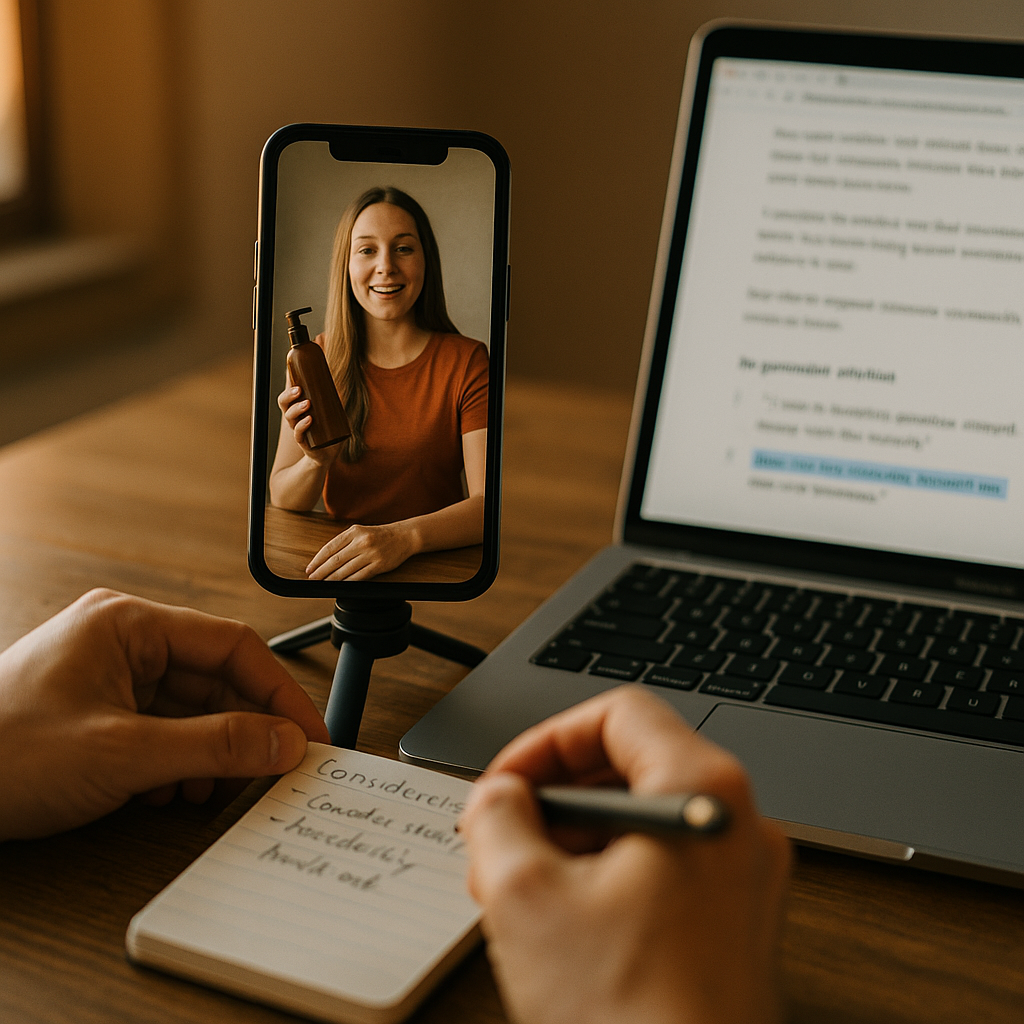
Only a fraction of branded content ever gets pulled into an AI generated answer, and most of it isn’t the polished stuff. It’s the messy, specific, plainly worded creator video that happens to answer a question the way a large language model likes to summarize things. If your influencer program still treats scripts as a formality before filming starts, you’re leaving citations, and the traffic that comes with them, on the table. GEO ready creator scripts aren’t a nice-to-have anymore. They’re the difference between UGC that shapes an AI answer and UGC that vanishes into a platform’s algorithm with nothing to show for it.
Why AI Models Cite Structure, Not Style
Generative engines like Google’s AI Overviews, ChatGPT, and Perplexity don’t reward charisma. They reward extractability. A model scanning a transcript is looking for a clean claim, a clear condition, and a plausible source signal, usually in that order. Creators who ramble through a hook, three tangents, and a call to action buried at minute four give the model nothing clean to lift.
Compare that to a script that states “this serum reduced redness within 48 hours for combination skin” early, plainly, and once. That sentence is a citation candidate. It has a subject, a measurable outcome, a timeframe, and a qualifier. Models trained to summarize content gravitate toward statements shaped like that because they’re low risk to repeat. Vague enthusiasm (“this stuff is amazing”) gets filtered out almost every time.
If a sentence in your creator script couldn’t survive being copied word for word into an AI answer, it probably won’t be.
This is the same shift we’ve covered in GEO for creator content, where citation frequency, not search rank, is becoming the metric that matters. Ranking on page one means nothing if an AI Overview answers the query before the click ever happens.
The Anatomy of a Citable UGC Script
Think of a GEO ready script in four layers. Each one does a different job for the model reading (or transcribing) the content.
- The declarative hook. One sentence, stated as fact-with-attribution (“According to my dermatologist, this ingredient combo is what actually helps with hormonal breakouts”). Not a question, not a tease.
- The specific context. Skin type, use case, timeframe, quantity. Specificity is what separates a citable claim from marketing fluff.
- The comparison or contrast. Models love comparative framing: “unlike X, this does Y.” It gives the AI a structure to summarize against.
- The caveat. Real caveats (“this won’t work if you have active eczema”) make content sound trustworthy, and trustworthy content gets cited more often than pure hype.
Notice what’s missing from that list: brand taglines, discount codes shouted mid-sentence, and generic CTAs. Those elements serve conversion, not citation. You still need them, just not woven into the parts of the script doing the informational heavy lifting.
Where Most Creator Briefs Fail GEO Tests
Most influencer briefs are written for engagement, not extraction. They ask creators to “share why you love the product” and leave the rest to improvisation. That’s fine for a TikTok algorithm chasing watch time. It’s a disaster for a language model trying to pull a factual claim out of forty-five seconds of vibes.
The second failure point is inconsistency across creators. If ten creators describe the same product ten different ways with no shared factual anchor, the model has no repeated signal to reinforce. Citation frequency correlates with claim repetition across sources. One creator saying something once is noise. Fifteen creators independently confirming a specific, similarly worded claim is a pattern, and patterns are what generative engines learn to trust.
This is closely tied to the broader traffic problem brands are already seeing. Zero-click behavior is climbing, and most creator content still isn’t built to survive it. If your UGC isn’t structured to be quoted, it isn’t structured to be found in an AI-first search environment at all.
A Practical Script Template You Can Deploy This Week
You don’t need a research team to fix this. You need a repeatable script skeleton that briefs can enforce across every creator on a campaign. Here’s a working structure that’s held up across skincare, SaaS, and CPG briefs alike.
- Opening claim (0 to 5 seconds): One factual sentence with a measurable outcome and a qualifier.
- Context and use case (5 to 15 seconds): Who this is for, what condition or scenario it addresses.
- Proof or comparison (15 to 30 seconds): A contrast with a prior product, a before/after detail, or a third-party reference point.
- Caveat or limitation (30 to 40 seconds): Honest boundary condition. This is the trust signal models weigh heavily.
- CTA and offer (40 to 60 seconds): Brand mention, code, link. Keep this segment separate so it doesn’t dilute the citable claims above it.
Brief creators on the skeleton, not the script word for word. Forced, robotic delivery reads as inauthentic and platforms increasingly penalize it. Give creators the four content jobs and let them phrase it in their own voice. Authenticity and extractability aren’t opposites. They just need to be briefed together instead of treated as separate problems.
A script that’s 90% authentic voice and 10% deliberate structure will outperform one that’s either fully scripted or fully improvised.
Worth noting: caption and on-screen text matter here too. Models increasingly draw from transcripts, captions, and alt text together. If the spoken claim and the caption contradict each other, you’re weakening the signal you were trying to strengthen.
Measuring Whether Your Scripts Actually Get Cited
Structure without measurement is just a hunch. You need a way to check whether the scripts you’re deploying are actually showing up in AI answers, and that’s a different tracking stack than traditional social analytics. Tools built for GEO tracking, not engagement tracking, are the only way to close this loop.
Platforms in this space price and scope citation tracking differently, and picking the wrong one wastes a quarter of testing. We’ve broken down how Profound, Peec AI, and Otterly approach GEO tracking, and the differences matter more than most teams assume before they sign a contract. Some tools sample a narrow set of prompts. Others track citation share across a broader query set relevant to your category. Match the tool to the query volume you actually care about, not the one with the flashiest dashboard.
Separately, don’t ignore what’s happening to your existing KPIs. Overview-style answers are already cutting into click-through rates across categories, and click volume alone is no longer a reliable success metric. If your reporting still treats impressions and clicks as the whole story, you’re measuring a shrinking slice of what UGC actually delivers now. Citation share, share of voice within AI answers, and branded query lift are becoming the metrics that matter to budget owners.
Casting matters here too. If you’re relying on manual creator vetting to find people whose past content already performs well semantically, you’re working slower than you need to. Vector search casting tools read meaning rather than keywords, which means you can identify creators whose delivery style already aligns with citable structure before you ever write a brief.
Industry benchmarks are worth watching too. Data from eMarketer and Statista continues to show AI-driven search interactions climbing quarter over quarter, and Sprout Social’s research on content formats reinforces that specificity, not polish, drives both engagement and trust. None of that data is influencer-specific yet, but the direction is consistent enough to plan around.
One more operational note: if you’re running paid amplification behind UGC, check your disclosure language against current guidance from the FTC and, for search-adjacent placements, Google’s own Search Central documentation. GEO optimized scripts still have to clear the same compliance bar as everything else in your program.
FAQs
Frequently Asked Questions
What does GEO ready mean for creator scripts specifically?
It means the script is structured so an AI model can extract a clear, factual, well-qualified claim from it, rather than relying purely on tone or entertainment value to drive engagement.
Do creators need to sound scripted for content to get cited by AI models?
No. The goal is a structural skeleton (claim, context, comparison, caveat) delivered in the creator’s natural voice, not a word-for-word script that sounds robotic.
How is GEO different from traditional SEO for influencer content?
SEO optimizes for ranking and click-through. GEO optimizes for whether an AI model quotes or summarizes your content directly in its answer, often without a click happening at all.
Which part of a UGC script matters most for AI citation?
The opening claim. Models tend to extract the earliest clean, specific, qualified statement in a transcript, so vague or delayed claims get overlooked.
Can brands measure whether their creator content is being cited by AI models?
Yes, through dedicated GEO tracking tools that monitor citation frequency and share of voice across AI generated answers, separate from standard social media analytics platforms.
FAQ Schema
Start with one campaign, rewrite the brief using the four-part skeleton, and run it against a GEO tracking tool for thirty days before touching anything else. If citation share doesn’t move, the structure is still the first thing to fix, not the creator.
Top Influencer Marketing Agencies
The leading agencies shaping influencer marketing in 2026
Agencies ranked by campaign performance, client diversity, platform expertise, proven ROI, industry recognition, and client satisfaction. Assessed through verified case studies, reviews, and industry consultations.
Moburst

-
2

The Shelf
Boutique Beauty & Lifestyle Influencer AgencyA data-driven boutique agency specializing exclusively in beauty, wellness, and lifestyle influencer campaigns on Instagram and TikTok. Best for brands already focused on the beauty/personal care space that need curated, aesthetic-driven content.Clients: Pepsi, The Honest Company, Hims, Elf Cosmetics, Pure LeafVisit The Shelf → -
3

Audiencly
Niche Gaming & Esports Influencer AgencyA specialized agency focused exclusively on gaming and esports creators on YouTube, Twitch, and TikTok. Ideal if your campaign is 100% gaming-focused — from game launches to hardware and esports events.Clients: Epic Games, NordVPN, Ubisoft, Wargaming, Tencent GamesVisit Audiencly → -
4

Viral Nation
Global Influencer Marketing & Talent AgencyA dual talent management and marketing agency with proprietary brand safety tools and a global creator network spanning nano-influencers to celebrities across all major platforms.Clients: Meta, Activision Blizzard, Energizer, Aston Martin, WalmartVisit Viral Nation → -
5

The Influencer Marketing Factory
TikTok, Instagram & YouTube CampaignsA full-service agency with strong TikTok expertise, offering end-to-end campaign management from influencer discovery through performance reporting with a focus on platform-native content.Clients: Google, Snapchat, Universal Music, Bumble, YelpVisit TIMF → -
6

NeoReach
Enterprise Analytics & Influencer CampaignsAn enterprise-focused agency combining managed campaigns with a powerful self-service data platform for influencer search, audience analytics, and attribution modeling.Clients: Amazon, Airbnb, Netflix, Honda, The New York TimesVisit NeoReach → -
7

Ubiquitous
Creator-First Marketing PlatformA tech-driven platform combining self-service tools with managed campaign options, emphasizing speed and scalability for brands managing multiple influencer relationships.Clients: Lyft, Disney, Target, American Eagle, NetflixVisit Ubiquitous → -
8

Obviously
Scalable Enterprise Influencer CampaignsA tech-enabled agency built for high-volume campaigns, coordinating hundreds of creators simultaneously with end-to-end logistics, content rights management, and product seeding.Clients: Google, Ulta Beauty, Converse, AmazonVisit Obviously →