


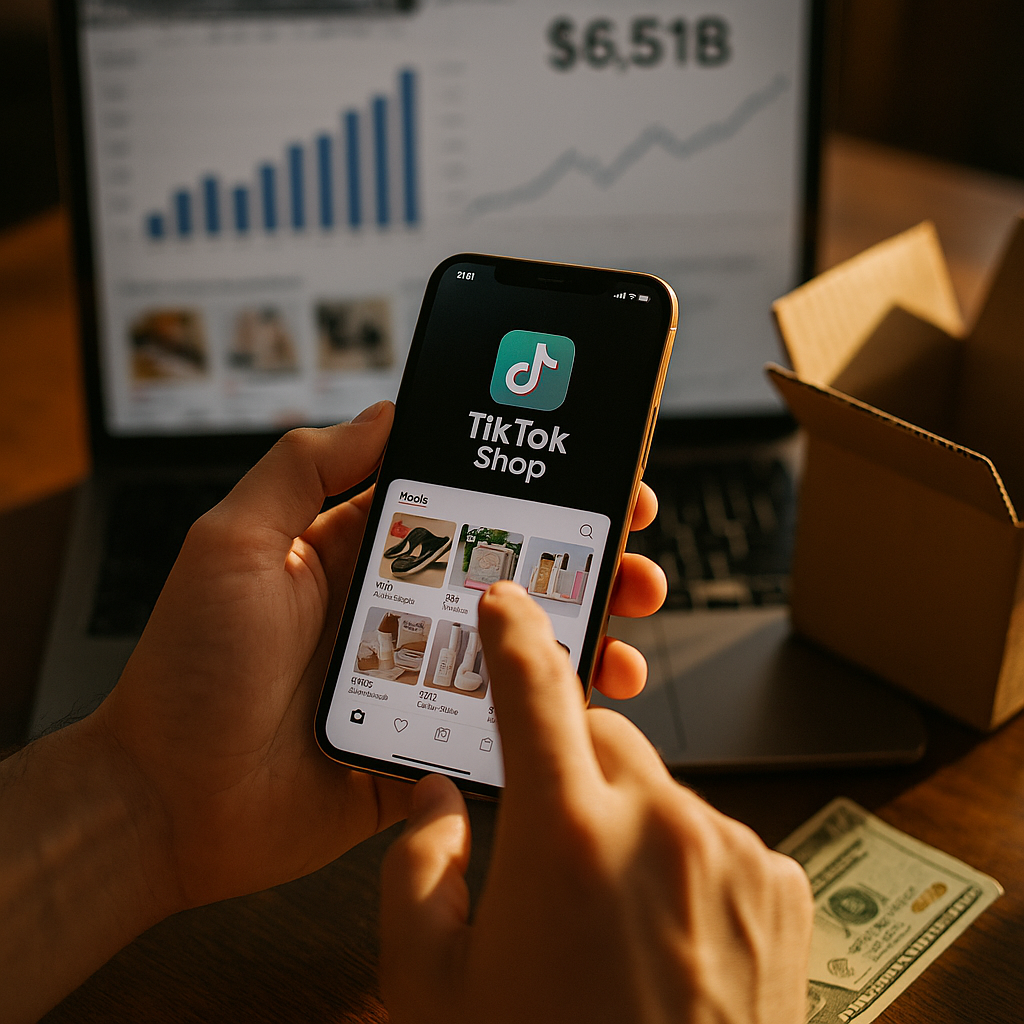
TikTok Shop just crossed $6.5 billion in cumulative U.S. sales, and the number that should worry traditional retail teams isn’t the total. It’s the velocity. Roughly half of that volume landed in the past two quarters alone. If your brand still treats TikTok Shop as a side experiment bolted onto a content calendar, the retail budget shift already happening around you is about to leave a mark on next year’s P&L.
This isn’t a story about a trendy app finally monetizing. It’s a story about where discretionary retail media dollars are actually going, and why finance teams are starting to ask influencer leads uncomfortable questions about channel mix.
The $6.5 Billion Number, In Context
Cumulative gross merchandise value crossing $6.5 billion sounds impressive in isolation, but the context matters more than the headline. TikTok Shop launched its full U.S. commerce infrastructure barely two years ago. Compare that ramp to Amazon Live or Instagram Shopping, both of which took considerably longer to reach comparable transaction volume with far larger built-in audiences.
What’s driving the acceleration isn’t ad spend. It’s affiliate commerce, live shopping events, and a creator commission structure that turns ordinary product videos into direct point-of-sale moments. A shopper doesn’t leave the app, doesn’t hit a landing page, doesn’t abandon a cart because checkout felt clunky. The entire funnel collapses into a fifteen-second clip and a tap.
The brands winning on TikTok Shop right now aren’t the ones with the biggest ad budgets. They’re the ones who rebuilt their creator sourcing and payout logic around commission-first economics instead of flat sponsorship fees.
Why Budgets Are Actually Moving
Ask a CMO in Q4 planning meetings where new social commerce dollars are coming from and you’ll hear the same answer: they’re being pulled from somewhere else. Usually it’s linear-adjacent digital display, sometimes it’s a slice of the Amazon advertising budget, occasionally it’s an entire influencer line item that used to fund top-of-funnel awareness content.
That reallocation is rational. Attribution on TikTok Shop is native and immediate. A brand can see, in near real time, which creator drove which sale, at what commission rate, with what return rate attached. Compare that to a traditional influencer sponsorship where a brand pays a flat fee upfront and hopes a promo code or affiliate link gets used weeks later. Wasted influencer spend has been a persistent industry problem, and TikTok Shop’s commission model is one of the few structures that makes waste mathematically harder to hide.
Finance teams like that. A lot. CFO-level scrutiny of creator spend has become standard practice at enterprise brands, and social commerce platforms that generate clean, closed-loop sales data are simply easier to defend in a budget review than reach-and-impressions decks.
Who’s Actually Capturing the Volume?
Not everyone. The GMV concentration on TikTok Shop skews heavily toward a few product categories: beauty, apparel, home goods, and increasingly supplements and wellness. Beauty brands shifting ad budgets to creators got a multi-year head start on this shift, and it shows in the sales data. Their creators already had the vetted content library, the trust signals, and the audience habits that convert on impulse.
There’s also a size dynamic worth flagging. Enterprise sellers with dedicated TikTok Shop teams and inventory pipelines built for flash-sale volume are pulling ahead fast, and it’s squeezing smaller players out of prime placement. That compression has been documented in enterprise compression on TikTok Shop, and it mirrors what happened on Amazon a decade ago: platform maturity favors whoever can move fastest at scale, not whoever got there first.
For mid-market brands, that means the sourcing playbook has to change. You can’t just throw a product at a mid-tier creator and hope for organic pickup anymore. Rethinking creator sourcing has become a survival tactic, not an optimization exercise.
Nano and Micro Creators Are Quietly Winning the Commission Game
Here’s the part most trade coverage misses: the creators driving disproportionate TikTok Shop volume aren’t the million-follower names. They’re nano and micro creators posting multiple times a day, each video generating small but consistent commission revenue. Nano creator ROI data has been trending this direction for a while, and TikTok Shop’s affiliate structure basically rewards volume and authenticity over reach.
Engagement rates support the theory too. Nano engagement benchmarks north of 2.6 percent consistently outperform macro tiers, and on a shoppable platform, engagement translates directly into add-to-cart behavior in a way it never quite did on static feed posts.
What This Means for Budget Allocation Next Quarter
If you’re building a channel mix for the upcoming fiscal cycle, treating TikTok Shop as a rounding error inside a broader “social” line item is a mistake. It deserves its own budget category, its own KPIs, and its own creator sourcing motion, separate from brand awareness influencer work.
- Shift a portion of flat-fee sponsorship budget toward commission-based affiliate structures, particularly for lower-funnel product categories.
- Build a rotating bench of nano and micro creators rather than relying on a handful of larger names for shoppable content.
- Track return rates and repeat purchase behavior by creator, not just GMV, since commission-driven volume can mask quality problems.
- Set aside inventory and fulfillment capacity specifically for flash-sale and livestream spikes, which behave nothing like steady-state ecommerce demand.
None of this requires abandoning traditional influencer partnerships. It requires acknowledging that social commerce and brand-building influencer work are now two different disciplines with different measurement standards, even when they run through the same creator relationships.
The Compliance Question Nobody’s Asking Loudly Enough
Fast-moving commission structures create fast-moving disclosure problems. When a creator earns a percentage of every sale, the incentive to blur the line between organic recommendation and paid promotion gets stronger, not weaker. The FTC’s endorsement guidelines still apply regardless of whether compensation comes as a flat fee or an affiliate commission, and brands remain on the hook for creator compliance even in high-volume, low-oversight affiliate programs.
This is where the finance-driven excitement about clean attribution can backfire. A brand that scales affiliate creator volume from a dozen partners to several hundred without scaling its disclosure auditing is building risk exposure at exactly the pace it’s building revenue. Compliance proof requirements in adjacent creator categories like finance offer a useful template: documentation and disclosure checks need to scale alongside spend, not lag behind it.
Is This Sustainable, or a Platform-Specific Spike?
Skeptics will point out that TikTok Shop’s growth is happening inside a single app with a uniquely young, impulse-driven user base, and that the model may not translate elsewhere. Fair point. But eMarketer’s social commerce forecasts have consistently underestimated the category’s growth rate over the past two years, and platforms including Instagram and YouTube are already testing similar in-app checkout and affiliate commission features in response.
The bigger signal isn’t TikTok Shop specifically. It’s that shoppable, creator-driven commerce has proven its unit economics well enough that competing platforms are racing to copy the model. Statista’s ecommerce data on social commerce penetration shows the category still capturing a small share of total retail, which actually argues for more budget movement ahead, not less. Early-stage categories with proven conversion mechanics tend to pull incremental dollars for years before growth flattens.
FAQs
Why is TikTok Shop growing faster than other social commerce platforms?
TikTok Shop compresses discovery and checkout into a single in-app experience, and its affiliate commission structure gives creators a direct financial incentive to drive sales rather than just impressions. That combination shortens the funnel in a way most competing platforms haven’t matched yet.
Should brands move budget away from traditional influencer sponsorships toward TikTok Shop?
Not entirely. Brand-building influencer work and lower-funnel social commerce serve different goals and should be measured differently. A blended approach that keeps some flat-fee sponsorship for awareness while shifting incremental dollars toward commission-based affiliate content tends to outperform an all-or-nothing switch.
Which product categories are driving most of the $6.5 billion in TikTok Shop sales?
Beauty, apparel, home goods, and wellness or supplement products account for the largest share of GMV, largely because these categories convert well on impulse and have deep libraries of creator-generated demo content.
What compliance risks come with scaling TikTok Shop affiliate programs?
As affiliate creator rosters grow into the hundreds, disclosure oversight often fails to scale at the same pace, creating FTC compliance exposure. Brands need documentation and spot-check processes that grow alongside affiliate volume, not after problems surface.
Are nano and micro creators more effective than larger influencers on TikTok Shop?
Data suggests yes for commerce-specific goals. Nano and micro creators post more frequently, maintain higher engagement rates, and their commission-based earnings align naturally with consistent, high-volume shoppable content in a way flat-fee macro influencer deals rarely replicate.
The takeaway: TikTok Shop’s $6.5 billion milestone isn’t a platform vanity metric, it’s evidence that retail budgets are actively migrating toward commission-based, creator-driven commerce. Brands that build a dedicated sourcing, measurement, and compliance process for this channel now will be negotiating from strength when the next platform copies the model.
FAQs
Why is TikTok Shop growing faster than other social commerce platforms?
TikTok Shop compresses discovery and checkout into a single in-app experience, and its affiliate commission structure gives creators a direct financial incentive to drive sales rather than just impressions. That combination shortens the funnel in a way most competing platforms haven’t matched yet.
Should brands move budget away from traditional influencer sponsorships toward TikTok Shop?
Not entirely. Brand-building influencer work and lower-funnel social commerce serve different goals and should be measured differently. A blended approach that keeps some flat-fee sponsorship for awareness while shifting incremental dollars toward commission-based affiliate content tends to outperform an all-or-nothing switch.
Which product categories are driving most of the $6.5 billion in TikTok Shop sales?
Beauty, apparel, home goods, and wellness or supplement products account for the largest share of GMV, largely because these categories convert well on impulse and have deep libraries of creator-generated demo content.
What compliance risks come with scaling TikTok Shop affiliate programs?
As affiliate creator rosters grow into the hundreds, disclosure oversight often fails to scale at the same pace, creating FTC compliance exposure. Brands need documentation and spot-check processes that grow alongside affiliate volume, not after problems surface.
Are nano and micro creators more effective than larger influencers on TikTok Shop?
Data suggests yes for commerce-specific goals. Nano and micro creators post more frequently, maintain higher engagement rates, and their commission-based earnings align naturally with consistent, high-volume shoppable content in a way flat-fee macro influencer deals rarely replicate.
Top Influencer Marketing Agencies
The leading agencies shaping influencer marketing in 2026
Agencies ranked by campaign performance, client diversity, platform expertise, proven ROI, industry recognition, and client satisfaction. Assessed through verified case studies, reviews, and industry consultations.
Moburst

-
2

The Shelf
Boutique Beauty & Lifestyle Influencer AgencyA data-driven boutique agency specializing exclusively in beauty, wellness, and lifestyle influencer campaigns on Instagram and TikTok. Best for brands already focused on the beauty/personal care space that need curated, aesthetic-driven content.Clients: Pepsi, The Honest Company, Hims, Elf Cosmetics, Pure LeafVisit The Shelf → -
3

Audiencly
Niche Gaming & Esports Influencer AgencyA specialized agency focused exclusively on gaming and esports creators on YouTube, Twitch, and TikTok. Ideal if your campaign is 100% gaming-focused — from game launches to hardware and esports events.Clients: Epic Games, NordVPN, Ubisoft, Wargaming, Tencent GamesVisit Audiencly → -
4

Viral Nation
Global Influencer Marketing & Talent AgencyA dual talent management and marketing agency with proprietary brand safety tools and a global creator network spanning nano-influencers to celebrities across all major platforms.Clients: Meta, Activision Blizzard, Energizer, Aston Martin, WalmartVisit Viral Nation → -
5

The Influencer Marketing Factory
TikTok, Instagram & YouTube CampaignsA full-service agency with strong TikTok expertise, offering end-to-end campaign management from influencer discovery through performance reporting with a focus on platform-native content.Clients: Google, Snapchat, Universal Music, Bumble, YelpVisit TIMF → -
6

NeoReach
Enterprise Analytics & Influencer CampaignsAn enterprise-focused agency combining managed campaigns with a powerful self-service data platform for influencer search, audience analytics, and attribution modeling.Clients: Amazon, Airbnb, Netflix, Honda, The New York TimesVisit NeoReach → -
7

Ubiquitous
Creator-First Marketing PlatformA tech-driven platform combining self-service tools with managed campaign options, emphasizing speed and scalability for brands managing multiple influencer relationships.Clients: Lyft, Disney, Target, American Eagle, NetflixVisit Ubiquitous → -
8

Obviously
Scalable Enterprise Influencer CampaignsA tech-enabled agency built for high-volume campaigns, coordinating hundreds of creators simultaneously with end-to-end logistics, content rights management, and product seeding.Clients: Google, Ulta Beauty, Converse, AmazonVisit Obviously →