


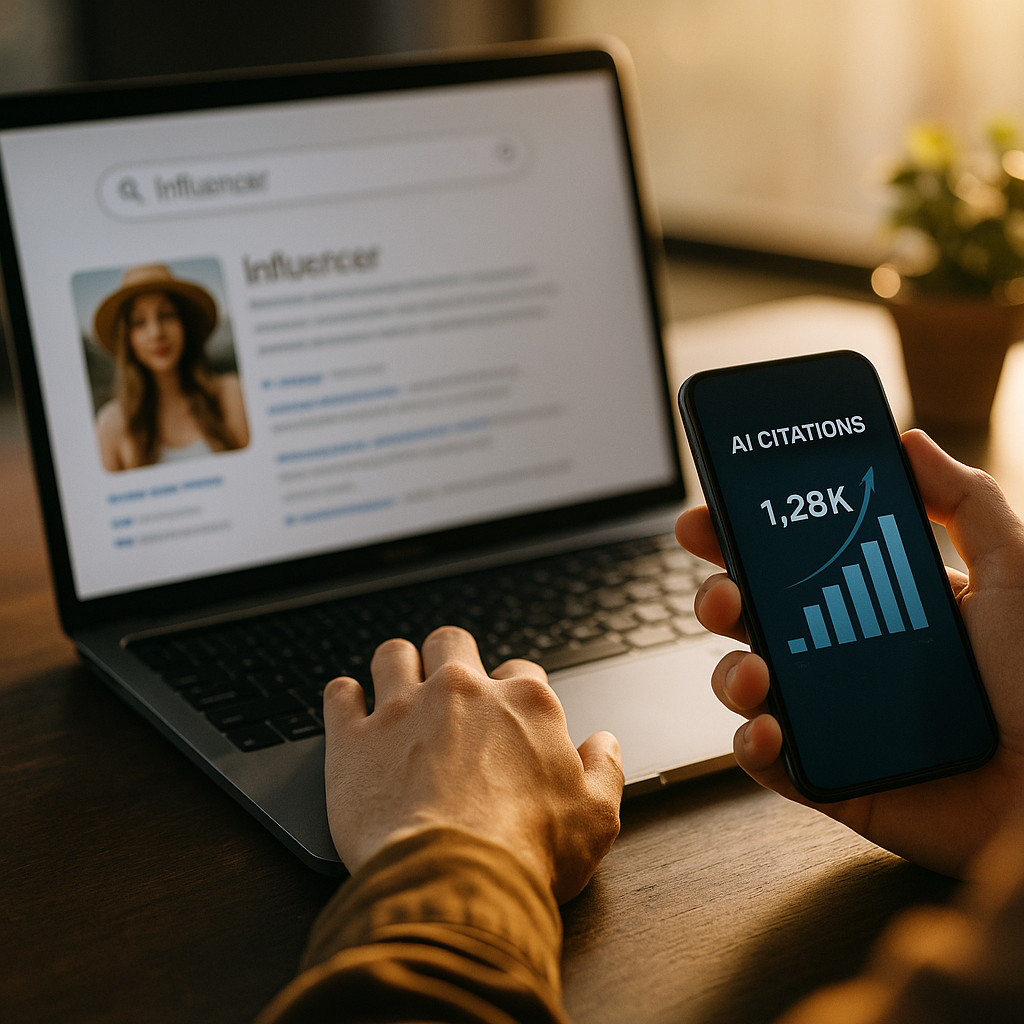
Zero click searches now account for roughly 60% of all Google queries, according to industry tracking cited by Sprout Social, and AI Overviews are eating the rest. So what happens to your influencer program when the click, the metric your entire reporting deck was built on, quietly stops mattering? You rebuild your influencer KPIs, or you keep reporting on a funnel nobody walks through anymore.
The Clickthrough Metric Is Dying, Here’s the Data
Let’s not sugarcoat it. Link clicks from influencer content have been in decline for years, but the shift accelerated hard once generative AI search results went mainstream. Consumers ask ChatGPT, Perplexity, or Google’s AI Overviews for a product recommendation and get a synthesized answer, complete with citations, without ever landing on a creator’s post or a brand’s site.
For brands still running influencer programs on a “link in bio, track the UTM” model, this is a slow bleed. Your creators are producing content that’s being ingested, summarized, and cited by AI systems, but your dashboard has no column for that. You’re measuring a behavior that’s shrinking while ignoring the one that’s growing.
If your influencer reporting still leads with clickthrough rate, you’re optimizing for a user behavior that’s disappearing in real time.
This isn’t a call to panic. It’s a call to stop treating clicks as the default proxy for influence and start measuring what actually drives outcomes in a zero click world: whether your brand shows up, favorably, in the answers people are getting.
What Replaces the Click? Enter AI Citations
AI citations are the new backlinks. When a large language model answers “what’s the best retinol serum for sensitive skin,” it’s pulling from a corpus that includes creator reviews, Reddit threads, and earned media, then citing (or silently absorbing) that content into its answer. Getting cited, or even just referenced as a training signal, is becoming the new visibility currency.
This mirrors what’s happening in SEO more broadly. Marketing teams are already reallocating SEO budget toward AI authority marketing, and influencer programs need the same reframe. The question isn’t “did they click the link.” It’s “did the AI system that answered this person’s question pull from content our creators produced, and did it represent our brand accurately.”
That second clause matters enormously. Being cited inaccurately, or having a competitor’s product recommended in an AI summary generated from your creator’s comparison video, is a real risk. Brands need to treat AI citation monitoring the way they treat social listening: continuously, not quarterly.
Building a New Influencer KPI Stack
So what actually goes on the dashboard now? Here’s a framework we’re seeing sophisticated in-house teams and agencies adopt as they move past clickthrough obsession.
- Share of AI answer: Across a defined set of category queries, how often does your brand or product get named in AI-generated responses compared to competitors? Tools built for generative engine optimization are starting to track this, similar to share of voice but for synthesized answers.
- Citation quality and accuracy: Not all mentions are equal. A citation that correctly names your product with accurate claims is worth far more than a vague or misattributed one. This requires manual spot checks, not just automated scraping.
- Content half life in AI training windows: How long does a piece of creator content keep surfacing in AI answers after publish date? Evergreen, well structured reviews tend to have longer citation lifespans than trend-chasing content.
- Branded search lift: Even without clicks, a strong AI citation strategy should still move branded search volume. This remains one of the more reliable proxies for influence, and it’s trackable through tools like HubSpot or standard analytics platforms.
- Creator authority score: A composite measure of how frequently a given creator’s content gets pulled into AI answers across the categories they cover. This becomes a genuine input into who you renew, not just their follower count or historical engagement rate.
None of these are perfect substitutes for a click. But together they paint a picture of actual influence, the kind that shapes purchase decisions even when no one ever taps a link.
Where Attribution Breaks, and How to Patch It
Here’s the uncomfortable truth: full-funnel attribution in a zero click environment is messier, not cleaner. You can’t stitch a click-to-purchase path when there’s no click. This is why the industry conversation has shifted from tool count to something more fundamental, as covered in our piece on attribution trust winning budget reviews. Executives don’t need a perfect model. They need a credible, consistently applied one.
Practically, this means leaning harder on mixed methods: media mix modeling, brand lift surveys, and incrementality testing (holding out a market or audience segment to isolate influencer impact) become more important, not less. Identity resolution infrastructure also matters here, because even imperfect signals need a clean backbone to be useful. Teams that have already invested in identity resolution for their CDPs are better positioned to connect fuzzy, zero click signals to actual revenue outcomes than teams still relying purely on last-click UTMs.
It’s also worth building experimental reserves into your budget specifically for testing new measurement approaches. If you’re not sure whether AI citation tracking or brand lift studies will actually predict revenue, treat it like any other emerging channel test, sized appropriately, as outlined in our experimental reserve framework.
Operationalizing the Shift: Team, Tools, Governance
Rebuilding KPIs isn’t just a spreadsheet exercise. It changes who does what.
Content strategy needs to shift toward formats that AI systems favor: structured comparisons, clear claims, specific product details, and content that reads well when summarized out of context. That’s a briefing change for creators, not just a reporting change for analysts. Programs using standardized UGC templates have an advantage here, since consistent structure makes content easier for both humans and language models to parse and cite accurately.
Governance matters too. If AI systems are citing creator content as fact, misinformation or unsubstantiated claims carry more downstream risk than they did in a world where a bad claim just sat in a post with modest reach. This is a natural extension of the work already happening around creator governance committees, and it should loop in legal review earlier in the content approval process, particularly for health, finance, and beauty claims where regulators like the FTC are already paying close attention to disclosure and substantiation.
Finally, reporting up the chain needs a translation layer. A CMO or board member doesn’t inherently care about “share of AI answer.” They care about revenue, risk, and efficiency. Frame new KPIs in language that fits your existing board level reporting templates, mapping AI citation metrics to the same efficiency and risk categories executives already understand.
A Quick Gut Check for Your Current Program
Ask three questions in your next reporting cycle. First, what percentage of your influencer reporting deck still leads with clicks or CTR? Second, do you have any visibility into whether your top creators’ content is being cited, correctly or incorrectly, by AI search tools? Third, has anyone on your team actually queried ChatGPT or an AI Overview for your top category terms this month?
If the honest answers are “most of it,” “no,” and “no,” you’re not alone, but you’re behind. Category leaders in beauty, wellness, and CPG are already running monthly AI citation audits alongside standard social reporting, treating it as seriously as they treat eMarketer’s quarterly platform benchmarks.
Frequently Asked Questions
FAQs
What are influencer KPIs in a zero click search environment?
They’re metrics that measure influence without relying on a link click, including share of AI answer, citation accuracy, branded search lift, and creator authority scores based on how often their content is pulled into AI-generated responses.
How do brands track AI citations from influencer content?
Most teams currently combine manual query audits (running category questions through AI search tools and logging results) with emerging generative engine optimization tools designed to monitor brand mentions across AI-generated answers at scale.
Should brands stop tracking clickthrough rate entirely?
No. Clickthrough rate is still useful for specific channels like shoppable content or affiliate links, but it should no longer be the primary or sole measure of influencer program success given how much discovery now happens without a click.
Does zero click search change how creators should structure their content?
Yes. Content with clear, specific claims, structured comparisons, and factual detail tends to get cited more accurately by AI systems than vague or heavily stylized content, so briefs should evolve accordingly.
How does this affect influencer contract and payment structures?
Programs are starting to weight creator value by authority and citation frequency in addition to engagement rate and follower count, which affects renewal decisions and rate negotiations over time.
Next step: pull your last quarterly influencer report, count how many of your top-line metrics depend on a click, and replace at least two of them with an AI citation or share of answer metric before your next review cycle. Small swap, but it changes what your team optimizes for.
Top Influencer Marketing Agencies
The leading agencies shaping influencer marketing in 2026
Agencies ranked by campaign performance, client diversity, platform expertise, proven ROI, industry recognition, and client satisfaction. Assessed through verified case studies, reviews, and industry consultations.
Moburst

-
2

The Shelf
Boutique Beauty & Lifestyle Influencer AgencyA data-driven boutique agency specializing exclusively in beauty, wellness, and lifestyle influencer campaigns on Instagram and TikTok. Best for brands already focused on the beauty/personal care space that need curated, aesthetic-driven content.Clients: Pepsi, The Honest Company, Hims, Elf Cosmetics, Pure LeafVisit The Shelf → -
3

Audiencly
Niche Gaming & Esports Influencer AgencyA specialized agency focused exclusively on gaming and esports creators on YouTube, Twitch, and TikTok. Ideal if your campaign is 100% gaming-focused — from game launches to hardware and esports events.Clients: Epic Games, NordVPN, Ubisoft, Wargaming, Tencent GamesVisit Audiencly → -
4

Viral Nation
Global Influencer Marketing & Talent AgencyA dual talent management and marketing agency with proprietary brand safety tools and a global creator network spanning nano-influencers to celebrities across all major platforms.Clients: Meta, Activision Blizzard, Energizer, Aston Martin, WalmartVisit Viral Nation → -
5

The Influencer Marketing Factory
TikTok, Instagram & YouTube CampaignsA full-service agency with strong TikTok expertise, offering end-to-end campaign management from influencer discovery through performance reporting with a focus on platform-native content.Clients: Google, Snapchat, Universal Music, Bumble, YelpVisit TIMF → -
6

NeoReach
Enterprise Analytics & Influencer CampaignsAn enterprise-focused agency combining managed campaigns with a powerful self-service data platform for influencer search, audience analytics, and attribution modeling.Clients: Amazon, Airbnb, Netflix, Honda, The New York TimesVisit NeoReach → -
7

Ubiquitous
Creator-First Marketing PlatformA tech-driven platform combining self-service tools with managed campaign options, emphasizing speed and scalability for brands managing multiple influencer relationships.Clients: Lyft, Disney, Target, American Eagle, NetflixVisit Ubiquitous → -
8

Obviously
Scalable Enterprise Influencer CampaignsA tech-enabled agency built for high-volume campaigns, coordinating hundreds of creators simultaneously with end-to-end logistics, content rights management, and product seeding.Clients: Google, Ulta Beauty, Converse, AmazonVisit Obviously →