


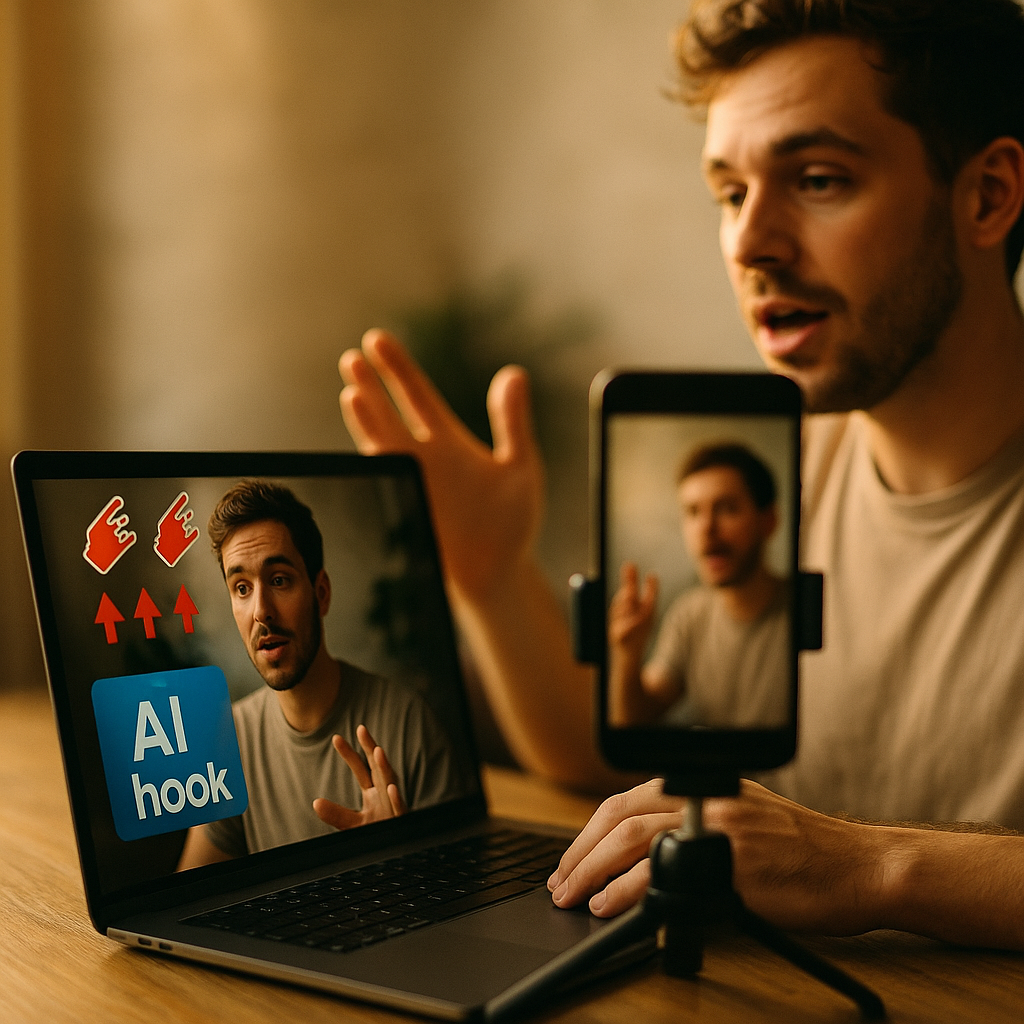
Seventy percent of a video’s fate is decided in the first three seconds. That single stat has quietly reshaped how brands brief creators, and it’s why AI hook generation tools have moved from novelty to line item in performance marketing budgets. Instead of guessing which opening line, visual, or sound will stop the scroll, brands are now running dozens of AI-generated hook variants through predictive models before a single creator ever picks up a camera.
The pitch is simple: why pay a creator to shoot five versions of an ad when you can simulate which version wins before production starts? The execution is where it gets interesting, and where a lot of brands are still getting it wrong.
Why Hook Testing Became a Budget Line Item
Creator deployment used to be an act of faith. A brand would brief a creator, wait two weeks, get a deliverable, and hope the algorithm liked it. That model doesn’t survive contact with a market where content costs keep rising and attention windows keep shrinking. Marketers running paid social at scale have watched cost-per-view creep up even as watch-through rates decline, and the finance team eventually asks the obvious question: what are we actually testing before we spend?
AI hook generation tools answer that question by front-loading the experimentation. Platforms built on large language models and synthetic video generation now produce dozens of hook variations, opening lines, thumbnail concepts, and pattern-interrupt visuals, then run them through predictive engagement scoring before a brand commits budget to a creator brief. Some tools go further, simulating audience retention curves based on historical performance data pulled from thousands of comparable videos.
Brands using pre-deployment hook testing report cutting wasted creator production spend by identifying underperforming concepts before filming, not after posting.
This isn’t just about saving money on reshoots. It’s about compressing the feedback loop from weeks to hours. A brand strategist who used to wait for a campaign to run for a full reporting cycle can now get a directional read on hook performance the same day the brief goes out.
How the Tools Actually Work
Most AI hook generation platforms fall into three functional categories, and understanding which one you’re buying matters more than the marketing copy suggests.
- Generative hook writers: LLM-based tools that produce scripted opening lines, captions, and voiceover hooks based on a brand’s product data, past top-performing content, and competitor benchmarks.
- Synthetic video simulators: Tools that generate rough video or storyboard mockups of different hook concepts, letting brands “see” a creator-style opening before any real filming happens.
- Predictive scoring engines: Models trained on historical watch-time, completion rate, and engagement data that assign a probability score to each hook variant, ranking which is most likely to stop a scroll.
Some vendors bundle all three into a single workflow. A brand uploads a product brief, gets ten AI-generated hook concepts, sees rough visual mockups, and receives a ranked list before anyone reaches out to a creator. Others specialize, and the smarter buyers are stitching together best-in-class tools rather than betting on one all-in-one platform. This mirrors what’s happening in adjacent areas of the martech stack, where predictive conversion engines are increasingly used to forecast creator ROI before a campaign even launches.
What Brands Are Actually Testing For
It’s tempting to think hook testing is purely about virality, but the practitioners doing this well are testing for something narrower and more useful: fit. Does this hook match the creator’s actual voice, or does it read like brand copy wearing a hoodie? Will this opening line trigger a platform’s content moderation flags? Does the pacing match what the target platform’s algorithm currently rewards?
TikTok, Instagram Reels, and YouTube Shorts each reward slightly different hook mechanics. A jump-cut visual gag that performs on TikTok can fall flat on YouTube Shorts, where retention curves behave differently because of how the platform surfaces content in its feed. Brands running cross-platform creator campaigns are using AI hook tools to generate platform-specific variants rather than one hook stretched across three feeds. That distinction alone has reportedly improved completion rates for some mid-market DTC brands testing the approach.
There’s also a compliance angle that doesn’t get enough attention. Hooks that lean on shock value, exaggerated claims, or ambiguous product statements can trigger regulatory scrutiny, particularly in categories like health, finance, and beauty. Running hook concepts through an AI simulation layer before creator deployment gives legal and compliance teams a chance to flag risky language before it’s live and monetized. That’s a meaningfully different risk posture than catching a problem after a creator has already posted and the FTC’s endorsement guidance becomes a live concern instead of a hypothetical one.
The Gap Between Predicted and Actual Performance
Here’s the part vendors don’t lead with: predictive scoring is directionally useful, not gospel. A hook that scores well in an AI model trained on historical data can still underperform because audiences shift, trends move, and creators bring a delivery style no model fully captures. The model knows what worked. It doesn’t know what a specific creator’s specific audience will do with a specific sound trending that specific week.
Smart brands treat AI-generated hook rankings as a shortlist tool, not a final verdict. The workflow that’s actually working looks like this: generate fifteen to twenty hook concepts, use predictive scoring to cut that down to four or five, then hand those finalists to the creator for a gut check and stylistic adaptation. The creator isn’t just an executor anymore. They’re a second filter, catching the tonal mismatches an algorithm can’t see.
This human-in-the-loop step matters more than most brands initially assume. A study pattern that’s shown up repeatedly across the industry: fully automated hook selection without creator input tends to produce technically sound but creatively flat content. Predictive engines optimize for pattern-matching against what already worked, which by definition can’t identify the next genuinely novel format. Similar dynamics have shown up in generative ad copy workflows, where speed gains from automation only hold up when paired with human review.
What This Means for Budget and Vendor Selection
If you’re evaluating AI hook generation tools for the first time, the vendor conversation should focus less on how many hooks a platform can generate and more on what data trained the scoring model. A tool trained primarily on beauty and fashion content will misfire badly if you’re marketing B2B SaaS or industrial equipment. Ask vendors directly what verticals their training data covers, and ask for a sample of prediction accuracy against actual campaign outcomes, not just engagement proxies.
Budget-wise, most mid-market brands are allocating hook testing as a pre-production line item rather than folding it into general creative costs. That distinction matters for reporting. When finance asks why creative testing costs went up, the answer should be that it’s replacing wasted production spend, not adding to it. Brands that can show a before-and-after on wasted reshoots or underperforming creator briefs have an easier time justifying the tool budget in the next planning cycle.
There’s also a growing case for integrating hook testing data with broader attribution systems. If a brand can tie a specific AI-predicted hook score to actual downstream conversion data, that closes a loop most creator programs currently leave open. Some of the more sophisticated real-time attribution setups are starting to pull hook-level testing data into the same dashboards used for full-funnel creator performance, which gives marketing leadership a much clearer view of where creative dollars are actually working.
The brands seeing the strongest results aren’t the ones generating the most hook variants. They’re the ones connecting hook-level predictions to actual conversion data downstream.
Where This Is Heading
Expect hook generation tools to keep converging with broader creator vetting and matching platforms. It’s a natural pairing: a brand that’s already using predictive matching for creator vetting is a short step away from wanting predictive scoring for the actual creative those creators will produce. The tools that win long-term will likely be the ones that connect hook testing, creator matching, and attribution into a single pipeline rather than three disconnected point solutions.
There’s also an open question around platform policy. As TikTok, Meta, and YouTube continue refining how they detect AI-assisted content, brands using synthetic hook mockups for internal testing need to make sure that testing layer stays clearly separated from anything that touches public-facing disclosure requirements. Testing internally is very different from publishing AI-simulated content, and the platforms are watching that line closely. Marketers should keep an eye on evolving guidance from Meta for Business and TikTok for Business as disclosure rules continue to tighten.
None of this replaces creative judgment. It sharpens where that judgment gets applied. The teams treating AI hook testing as a filter rather than a decision-maker are the ones seeing real efficiency gains without sacrificing the creative unpredictability that makes creator content work in the first place.
The Takeaway
Start small: pick one upcoming creator campaign, run the brief’s opening concepts through an AI hook tool alongside your normal creative process, and compare predicted scores against actual performance once it’s live. That single test will tell you more about whether this belongs in your permanent workflow than any vendor demo will.
Frequently Asked Questions
What are AI hook generation tools used for in influencer marketing?
They generate and score multiple opening-line, visual, and pacing concepts for creator content before production, helping brands predict which hook is most likely to stop viewers from scrolling past.
Do AI hook testing tools replace creator input?
No. The most effective workflows use AI to narrow a large set of hook concepts down to a shortlist, then rely on the creator to adapt the finalists to their own voice and audience.
How accurate are predictive hook scoring models?
Accuracy varies by vendor and depends heavily on the training data’s vertical relevance. Scores are directionally useful for ranking concepts but shouldn’t be treated as guaranteed performance outcomes.
Can AI hook testing help with brand safety and compliance?
Yes. Testing hook language and claims before creator deployment gives legal and compliance teams a chance to flag risky or misleading statements before content goes live and generates regulatory exposure.
How should brands budget for AI hook generation tools?
Most brands treat it as a pre-production testing cost that offsets wasted creator production spend, rather than an additive expense layered on top of existing creative budgets.
FAQs
What are AI hook generation tools used for in influencer marketing?
They generate and score multiple opening-line, visual, and pacing concepts for creator content before production, helping brands predict which hook is most likely to stop viewers from scrolling past.
Do AI hook testing tools replace creator input?
No. The most effective workflows use AI to narrow a large set of hook concepts down to a shortlist, then rely on the creator to adapt the finalists to their own voice and audience.
How accurate are predictive hook scoring models?
Accuracy varies by vendor and depends heavily on the training data’s vertical relevance. Scores are directionally useful for ranking concepts but shouldn’t be treated as guaranteed performance outcomes.
Can AI hook testing help with brand safety and compliance?
Yes. Testing hook language and claims before creator deployment gives legal and compliance teams a chance to flag risky or misleading statements before content goes live and generates regulatory exposure.
How should brands budget for AI hook generation tools?
Most brands treat it as a pre-production testing cost that offsets wasted creator production spend, rather than an additive expense layered on top of existing creative budgets.
Top Influencer Marketing Agencies
The leading agencies shaping influencer marketing in 2026
Agencies ranked by campaign performance, client diversity, platform expertise, proven ROI, industry recognition, and client satisfaction. Assessed through verified case studies, reviews, and industry consultations.
Moburst

-
2

The Shelf
Boutique Beauty & Lifestyle Influencer AgencyA data-driven boutique agency specializing exclusively in beauty, wellness, and lifestyle influencer campaigns on Instagram and TikTok. Best for brands already focused on the beauty/personal care space that need curated, aesthetic-driven content.Clients: Pepsi, The Honest Company, Hims, Elf Cosmetics, Pure LeafVisit The Shelf → -
3

Audiencly
Niche Gaming & Esports Influencer AgencyA specialized agency focused exclusively on gaming and esports creators on YouTube, Twitch, and TikTok. Ideal if your campaign is 100% gaming-focused — from game launches to hardware and esports events.Clients: Epic Games, NordVPN, Ubisoft, Wargaming, Tencent GamesVisit Audiencly → -
4

Viral Nation
Global Influencer Marketing & Talent AgencyA dual talent management and marketing agency with proprietary brand safety tools and a global creator network spanning nano-influencers to celebrities across all major platforms.Clients: Meta, Activision Blizzard, Energizer, Aston Martin, WalmartVisit Viral Nation → -
5

The Influencer Marketing Factory
TikTok, Instagram & YouTube CampaignsA full-service agency with strong TikTok expertise, offering end-to-end campaign management from influencer discovery through performance reporting with a focus on platform-native content.Clients: Google, Snapchat, Universal Music, Bumble, YelpVisit TIMF → -
6

NeoReach
Enterprise Analytics & Influencer CampaignsAn enterprise-focused agency combining managed campaigns with a powerful self-service data platform for influencer search, audience analytics, and attribution modeling.Clients: Amazon, Airbnb, Netflix, Honda, The New York TimesVisit NeoReach → -
7

Ubiquitous
Creator-First Marketing PlatformA tech-driven platform combining self-service tools with managed campaign options, emphasizing speed and scalability for brands managing multiple influencer relationships.Clients: Lyft, Disney, Target, American Eagle, NetflixVisit Ubiquitous → -
8

Obviously
Scalable Enterprise Influencer CampaignsA tech-enabled agency built for high-volume campaigns, coordinating hundreds of creators simultaneously with end-to-end logistics, content rights management, and product seeding.Clients: Google, Ulta Beauty, Converse, AmazonVisit Obviously →