


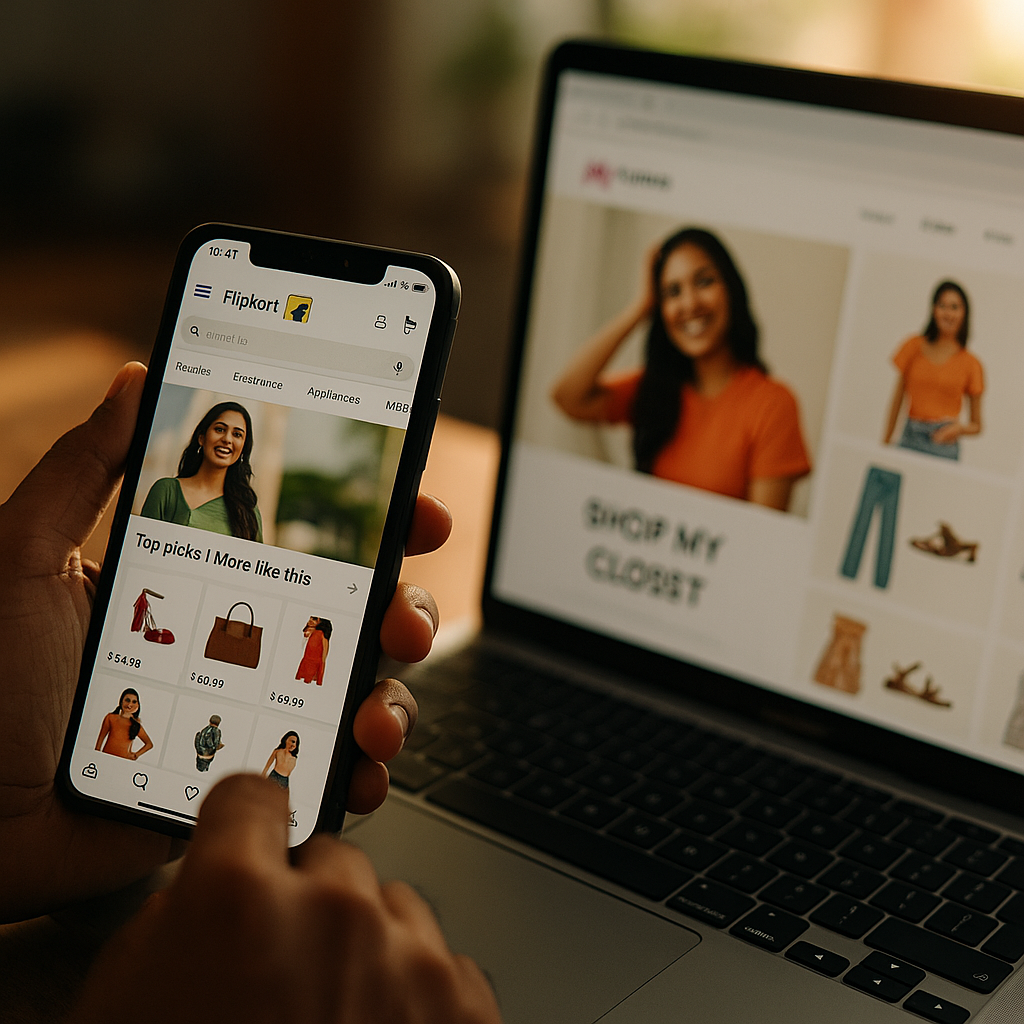
India’s creator commerce market just crossed a threshold most Western brands haven’t clocked yet: Flipkart and Myntra now let creators run branded storefronts with direct checkout, not just tagged posts. For international brands eyeing India as their next growth market, that’s a distribution channel worth more than another round of Instagram gifting. Get the setup wrong, though, and you’re looking at GST headaches, payout disputes, and creators who ghost mid-campaign.
This is the launch playbook we’d hand a CMO walking into India cold.
Why Flipkart and Myntra Even Matter to a Non-Indian Brand
Flipkart’s Video Commerce push and Myntra’s Creator Studio aren’t clones of TikTok Shop. They’re built on top of two of India’s largest retail marketplaces, which means the storefronts inherit existing logistics, returns infrastructure, and a customer base that already trusts the checkout flow. That’s a meaningfully different risk profile than launching a standalone D2C site in a new country.
For brands entering India, this matters because trust is the actual bottleneck, not traffic. A creator storefront on Myntra carries implicit platform credibility that a brand’s own Shopify store, no matter how polished, simply can’t replicate on day one. eMarketer’s retail media research has repeatedly shown that marketplace-embedded commerce converts at higher rates than off-platform funnels, largely because the friction of a new payment gateway or delivery promise disappears.
A creator storefront inside Flipkart or Myntra isn’t a marketing channel bolted onto retail. It’s a retail channel with a marketing engine attached, and that distinction should drive your entire budget allocation.
Step One: Vet Creators Like You’re Hiring a Regional Sales Rep
India’s creator ecosystem is fragmented across language, region, and platform. A creator with two million Instagram followers in Mumbai might mean nothing to a Tier-2 shopper in Indore who only trusts a regional YouTube reviewer. Brands used to Western-style follower count filtering need to recalibrate entirely.
What actually predicts storefront performance:
- Regional language content share. Creators publishing in Hindi, Tamil, Telugu, or Bengali alongside English typically show stronger conversion on Flipkart because the platform’s user base skews heavily beyond metro English speakers.
- Prior marketplace tagging history. Has this creator already tagged products on Myntra or Flipkart? Past conversion data beats projected reach every time.
- Return rate association. Myntra tracks this internally and will share it if you ask. A creator whose audience buys and keeps is worth more than one whose audience buys and returns.
- Category authenticity. Beauty and fashion dominate both platforms, so a creator’s actual niche credibility matters more than general influence.
Run this like a procurement process, not an outreach spree. If your team already has a vetting framework from other commerce platforms, the logic transfers well. Our creator vetting and payout guide for Shopify Collabs covers a due diligence checklist that applies almost directly here, swap the payment rails and you’re most of the way there.
Setting Up the Storefront: What the Brand Side Actually Controls
Brands don’t build the storefront, the creator does, but brands supply the product feed, pricing rules, and often the creative assets. Flipkart’s creator tools let brands set commission tiers per SKU, which is useful if you want to push slower-moving inventory through creator storefronts while keeping bestsellers on standard listings.
Myntra’s Creator Studio is more curated. Access typically runs through an invite or application process tied to your existing brand account, and the platform reviews creator-storefront pairings before they go live. That review layer adds friction but also reduces the brand-safety risk of a mismatched creator promoting your product to the wrong audience.
Practical setup checklist for international brands:
- Register your brand entity correctly for GST and import compliance before any creator goes live, not after.
- Localize product descriptions and sizing charts. Indian shoppers on Myntra abandon carts fast when sizing is ambiguous.
- Set commission structures that account for India’s typically thinner margins compared to US or UK marketplaces.
- Build a returns buffer into your unit economics. Fashion returns on Myntra run higher than most Western D2C brands are used to budgeting for.
- Assign a single point of contact for creator communication in-market, even if that person is a contracted local agency rather than a full-time hire.
Compliance Isn’t Optional, and India’s Rules Move Fast
India’s Advertising Standards Council and the Consumer Protection Act both require clear disclosure when a creator is paid or given free product. This isn’t dramatically different from FTC guidance in the US, but enforcement patterns and expected disclosure language differ, and getting it wrong on a marketplace-hosted storefront can trigger platform-level penalties, not just regulatory ones.
Brands entering from markets with mature influencer disclosure norms often assume compliance is a copy-paste job. It isn’t. Build local legal review into your creator contracts, not just brand-safety review. If your team already handles disclosure frameworks for other regions, cross-reference against FTC endorsement guidance as a baseline, then layer India-specific requirements on top rather than assuming parity.
The single most common compliance failure we see from international brands entering India isn’t fraud, it’s assuming their existing disclosure templates translate directly. They don’t, and platforms are increasingly checking.
Payouts and Reconciliation: Where Most Programs Actually Break
This is the unglamorous part nobody wants to plan for until it’s a mess. Flipkart and Myntra both operate commission structures that pay out on a delay tied to the return window, meaning a creator’s storefront sale in week one might not reconcile financially until week four or five once returns clear.
International brands running global creator programs often centralize payout in one currency and one cadence. India requires a separate reconciliation track, partly because of currency conversion timing and partly because GST invoicing has its own documentation requirements per transaction.
If you’re already managing cross-platform creator payouts elsewhere, the operational lessons transfer. Our payout reconciliation guide walks through the kind of ledger discipline that keeps creator finance teams sane when multiple platforms and currencies are in play simultaneously. The same logic (single source of truth, automated matching, delayed-return buffers) applies to a Flipkart or Myntra program running alongside your domestic creator budget.
Benchmarking ROI: What Good Actually Looks Like
Don’t import your US or UK conversion benchmarks wholesale. India’s average order values on fashion marketplaces run lower, but purchase frequency among engaged shoppers can be higher, especially around festival shopping seasons like Diwali and end-of-season sales. A creator storefront that looks underwhelming on AOV might still be outperforming on repeat purchase rate, which is the metric that actually matters for a brand trying to build a durable India presence rather than chase a single spike.
Track these four metrics from month one:
- Storefront-to-cart conversion rate, benchmarked against the creator’s own historical average, not a category average.
- Return rate by SKU, which tells you whether sizing or product-market fit issues are eating your margin.
- Repeat purchase rate within 90 days, the clearest signal of whether the creator’s audience is becoming your customer base or just a one-time impulse buyer.
- Cost per acquisition inclusive of returns processing, not just gross commission paid.
According to Statista’s e-commerce market data, India’s online fashion and beauty segment continues to post some of the fastest growth rates among major Asian markets, which is exactly why Flipkart and Myntra are investing in creator tooling now rather than waiting. Brands that treat this as a pilot with real measurement discipline will have a two-year head start on competitors still running one-off gifting campaigns.
Where This Fits Alongside Your Existing Creator Stack
If your brand already runs creator programs on TikTok Shop or Amazon Live, the temptation is to bolt India onto the same workflow. Resist that. The logistics, disclosure rules, and payout cadence are different enough that a copy-paste approach creates more risk than efficiency. That said, the strategic thinking transfers well: our storefront conversion playbook for Amazon Live covers a similar creator-to-checkout funnel logic, and the vendor governance principles in our TikTok Shop vendor governance piece are worth reviewing before you scale past your first few Flipkart or Myntra partnerships.
For cross-border logistics questions specifically, the operational lessons from cross-border expansion planning apply directly, even though the platform is different. Customs, local warehousing, and creator payout timing all rhyme across markets even when the specific rules don’t match exactly.
FAQs
Frequently Asked Questions
Do international brands need a local business entity to launch a creator storefront on Flipkart or Myntra?
In most cases, yes. Both platforms require GST registration and a compliant seller or brand account, which typically means either a registered Indian subsidiary or a local distribution partner handling the marketplace relationship on your behalf.
How is a Flipkart or Myntra creator storefront different from an Instagram shoppable post?
The storefront lives inside the marketplace app with native checkout, returns processing, and platform-backed trust signals, whereas an Instagram post typically redirects off-platform, adding friction and losing some of the marketplace’s built-in credibility.
What commission rates should brands expect to offer creators?
Rates vary by category, but fashion and beauty commissions on these platforms commonly sit in a range comparable to affiliate marketplace norms elsewhere, adjusted downward slightly to account for India’s thinner average margins.
How long does payout reconciliation typically take?
Expect a delay tied to the return window, often four to five weeks from sale to final reconciled payout, since commissions are usually confirmed only after the return period closes.
Can brands run the same creators across both Flipkart and Myntra simultaneously?
Yes, and many established creators do maintain presence on both, though brands should track performance separately since audience behavior and conversion patterns differ between the two platforms.
What’s the biggest compliance risk for international brands new to India?
Assuming existing disclosure templates and influencer contracts from other markets satisfy India’s advertising standards without local legal review. They usually don’t, and platforms increasingly flag mismatches.
Start small: pick one category, three vetted creators, and one full sales cycle before scaling budget, and let the reconciliation data (not the vanity metrics) decide whether Flipkart or Myntra becomes your primary India commerce channel.
Frequently Asked Questions
Do international brands need a local business entity to launch a creator storefront on Flipkart or Myntra?
In most cases, yes. Both platforms require GST registration and a compliant seller or brand account, which typically means either a registered Indian subsidiary or a local distribution partner handling the marketplace relationship on your behalf.
How is a Flipkart or Myntra creator storefront different from an Instagram shoppable post?
The storefront lives inside the marketplace app with native checkout, returns processing, and platform-backed trust signals, whereas an Instagram post typically redirects off-platform, adding friction and losing some of the marketplace’s built-in credibility.
What commission rates should brands expect to offer creators?
Rates vary by category, but fashion and beauty commissions on these platforms commonly sit in a range comparable to affiliate marketplace norms elsewhere, adjusted downward slightly to account for India’s thinner average margins.
How long does payout reconciliation typically take?
Expect a delay tied to the return window, often four to five weeks from sale to final reconciled payout, since commissions are usually confirmed only after the return period closes.
Can brands run the same creators across both Flipkart and Myntra simultaneously?
Yes, and many established creators do maintain presence on both, though brands should track performance separately since audience behavior and conversion patterns differ between the two platforms.
What’s the biggest compliance risk for international brands new to India?
Assuming existing disclosure templates and influencer contracts from other markets satisfy India’s advertising standards without local legal review. They usually don’t, and platforms increasingly flag mismatches.
Top Influencer Marketing Agencies
The leading agencies shaping influencer marketing in 2026
Agencies ranked by campaign performance, client diversity, platform expertise, proven ROI, industry recognition, and client satisfaction. Assessed through verified case studies, reviews, and industry consultations.
Moburst

-
2

The Shelf
Boutique Beauty & Lifestyle Influencer AgencyA data-driven boutique agency specializing exclusively in beauty, wellness, and lifestyle influencer campaigns on Instagram and TikTok. Best for brands already focused on the beauty/personal care space that need curated, aesthetic-driven content.Clients: Pepsi, The Honest Company, Hims, Elf Cosmetics, Pure LeafVisit The Shelf → -
3

Audiencly
Niche Gaming & Esports Influencer AgencyA specialized agency focused exclusively on gaming and esports creators on YouTube, Twitch, and TikTok. Ideal if your campaign is 100% gaming-focused — from game launches to hardware and esports events.Clients: Epic Games, NordVPN, Ubisoft, Wargaming, Tencent GamesVisit Audiencly → -
4

Viral Nation
Global Influencer Marketing & Talent AgencyA dual talent management and marketing agency with proprietary brand safety tools and a global creator network spanning nano-influencers to celebrities across all major platforms.Clients: Meta, Activision Blizzard, Energizer, Aston Martin, WalmartVisit Viral Nation → -
5

The Influencer Marketing Factory
TikTok, Instagram & YouTube CampaignsA full-service agency with strong TikTok expertise, offering end-to-end campaign management from influencer discovery through performance reporting with a focus on platform-native content.Clients: Google, Snapchat, Universal Music, Bumble, YelpVisit TIMF → -
6

NeoReach
Enterprise Analytics & Influencer CampaignsAn enterprise-focused agency combining managed campaigns with a powerful self-service data platform for influencer search, audience analytics, and attribution modeling.Clients: Amazon, Airbnb, Netflix, Honda, The New York TimesVisit NeoReach → -
7

Ubiquitous
Creator-First Marketing PlatformA tech-driven platform combining self-service tools with managed campaign options, emphasizing speed and scalability for brands managing multiple influencer relationships.Clients: Lyft, Disney, Target, American Eagle, NetflixVisit Ubiquitous → -
8

Obviously
Scalable Enterprise Influencer CampaignsA tech-enabled agency built for high-volume campaigns, coordinating hundreds of creators simultaneously with end-to-end logistics, content rights management, and product seeding.Clients: Google, Ulta Beauty, Converse, AmazonVisit Obviously →