


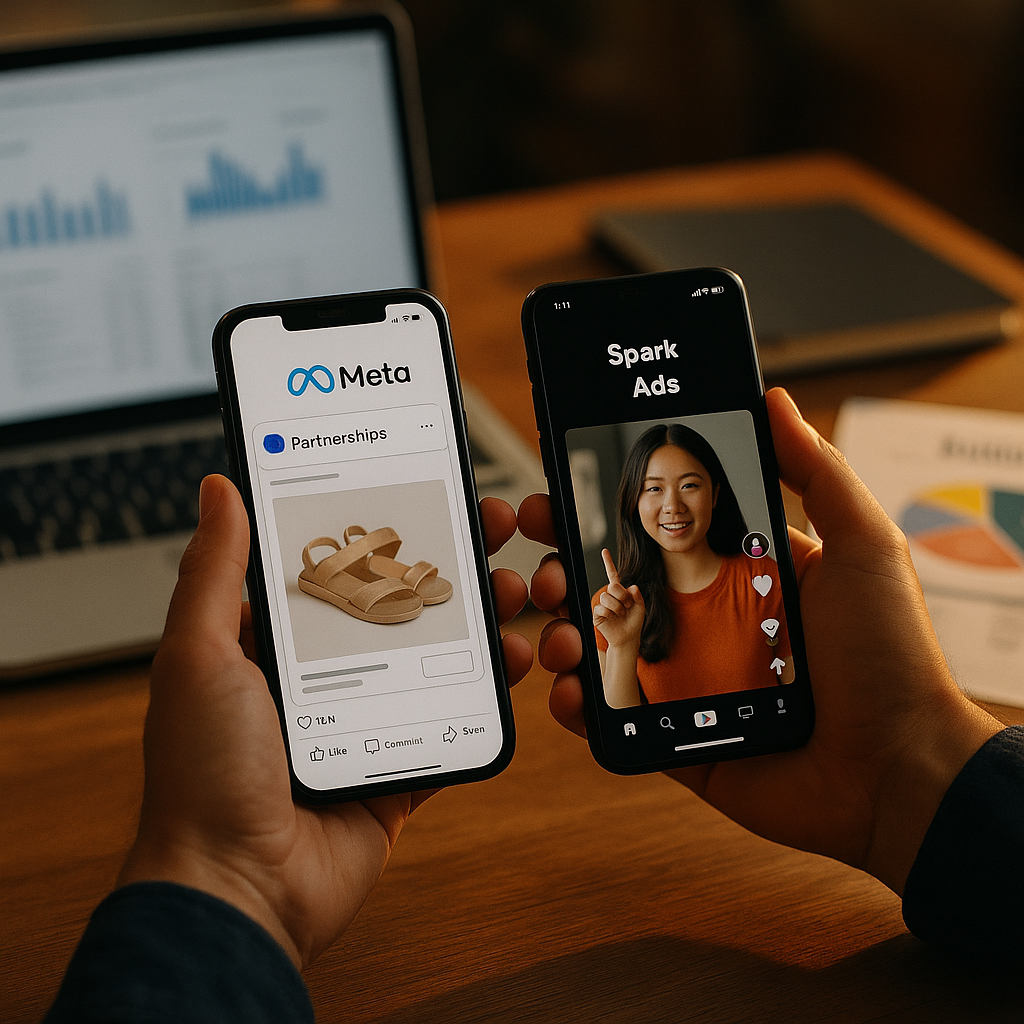
Meta reports that ads featuring creator content see meaningfully higher click-through rates than standard brand ads, yet most marketing teams still treat “boosting a creator post” as a single, interchangeable move. It isn’t. Meta Partnership Ads vs Spark Ads is really a question about who controls the asset, who gets the data, and who takes the compliance risk. Get the choice wrong and you either overpay for reach or lose the social proof that made the content work in the first place.
This isn’t a Meta-only debate, either. TikTok forces brands through a nearly identical decision with its own Spark Ads product, and we’ve already broken down that comparison in detail. But Meta’s version has its own quirks, its own approval flow, and its own failure points that trip up brands moving budget from TikTok to Instagram and Facebook.
What Each Format Actually Does
Partnership Ads (formerly Branded Content Ads) let a brand run paid media directly through a creator’s handle, with the creator’s name and profile photo attached, but the brand controls the ad account, targeting, and budget. The creator grants access through a partnership label; the brand takes it from there. Spark Ads, Meta’s answer to organic-post amplification (yes, the naming overlaps with TikTok’s product, which confuses almost everyone the first time they hear it), instead boosts an existing organic post as-is, preserving its native comments, likes, and view count.
The practical difference shows up in three places: whose name is on the ad, whether engagement history carries over, and how much creative control the brand retains during the flight.
- Attribution: Partnership Ads run under the creator’s handle but inside the brand’s ad account, giving full-funnel reporting.
- Social proof: Spark-style boosted posts keep original comments and likes, which some audiences trust more than a fresh ad unit.
- Editing rights: Partnership Ads allow the brand to test new captions, CTAs, and creative variants; boosted organic posts generally do not.
Where Partnership Ads Win
If your team runs performance campaigns with real optimization cycles, Partnership Ads are the default. You get access to Meta’s full targeting stack, Advantage+ placements, and conversion-based bidding, all wrapped around content that still reads as creator-authentic. Because the ad lives in your ad account, you also get clean attribution data for your MMM or MTA models instead of relying on the creator’s own post metrics, which are notoriously thin.
Partnership Ads also solve a whitelisting headache that used to require manual Business Manager access requests. We’ve documented the setup mechanics and budget implications in our Partnership Ads whitelisting guide, and the short version is: the permissions model is far less painful than it was two years ago, but it still requires the creator to actively grant the partnership label before you can touch spend.
A brand running Partnership Ads owns the optimization loop end to end: creative testing, bid strategy, audience refinement. A brand running boosted organic content is renting someone else’s post and hoping the algorithm still likes it.
When Spark-Style Boosting Still Makes Sense
Not every campaign needs a performance engine. If a creator’s organic post is already outperforming benchmarks, amplifying it as-is preserves the comment thread, the like count, and the “this is clearly not an ad” credibility that drove the original performance. Ripping that into a Partnership Ad restarts the social proof clock at zero engagement, which can actually depress trust signals for skeptical audiences, particularly in beauty, wellness, and finance categories where audiences are primed to distrust anything that smells like a paid unit.
It’s also faster. There’s no need to negotiate a separate partnership label agreement or wait on creator approval for a new ad account connection. If a post is already resonating and you want to extend its reach for another week or two without touching the creative, boosting the original wins on speed and cost.
The Budget Math Nobody Talks About
Here’s the uncomfortable part: Partnership Ads typically cost more per result in the first week or two because the algorithm treats the asset as new, even though the content itself is identical to the organic post. You’re paying a “cold start tax” for the privilege of full targeting control. Spark-style boosting skips that tax because the post already has engagement history the algorithm can lean on.
Our rule of thumb after running both formats side by side: use Partnership Ads for content you plan to scale past $5,000 in spend, where targeting and optimization control pay for themselves. Use boosted organic for smaller top-up budgets under a few thousand dollars, where speed and preserved social proof matter more than granular audience control.
Agencies that specialize in creator amplification have started treating this as a portfolio decision rather than a single choice per campaign. Moburst, a global growth agency that has worked with over 900 clients and won 45+ international awards, structures its influencer marketing agency work around repurposing creator content into paid assets rather than letting organic posts expire unamplified, which mirrors exactly the “don’t waste a winning post” logic driving the Partnership Ads versus boosted-post decision.
Compliance Isn’t Optional Here
Both formats still require FTC-compliant disclosure, and Meta’s partnership label doesn’t substitute for a clear “paid partnership” tag when required by law. The FTC’s endorsement guidance applies regardless of which ad product carries the spend, and regulators in other markets, including the UK’s ICO, have their own expectations around data use in targeted creator campaigns. Brands running Partnership Ads at scale should also review Meta’s own Business Help Center policies on branded content, since the rules around disclosure labels get updated more often than most teams realize.
If your team is sourcing creators directly rather than through an agency, it’s worth pairing this with our Creator Partnerships group access guide, which covers how Meta vets brands before granting the sourcing tools that feed into either ad format.
A Simple Decision Framework
Skip the debate paralysis. Run this checklist before your next flight:
- Is the goal conversion-driven with a real optimization window? Choose Partnership Ads.
- Is the organic post already overperforming with strong comment sentiment? Boost it as-is.
- Is the budget under a few thousand dollars for a short flight? Boost the organic post.
- Do you need clean attribution data for internal reporting or an MMM model? Choose Partnership Ads.
- Is the creator hesitant about granting ad account access? Start with boosted organic while you build trust.
For teams that want the technical setup walkthrough, our Partnership Ads setup and conversion guide covers the click-by-click process, including how to structure conversion events so reporting lines up cleanly with the rest of your Meta ad account.
Frequently Asked Questions
Is Meta Spark Ads the same product as TikTok Spark Ads?
No. Meta doesn’t officially call its boosted-post feature “Spark Ads,” that’s TikTok’s branded terminology, but marketers commonly use the phrase informally to describe boosting an organic creator post on Instagram or Facebook. On Meta, the formal comparison is between Partnership Ads and simply boosting an existing organic post.
Can I switch a boosted organic post into a Partnership Ad later?
Not directly. You would need to relaunch the content as a new Partnership Ad, which resets engagement history and restarts the algorithm’s learning phase. Plan your format choice before launch rather than mid-flight.
Do creators get paid differently depending on which format a brand uses?
Payment structures are typically negotiated separately from the ad format itself, but many creators charge a premium for granting Partnership Ads access since it hands over more control and longer-term usage rights compared with a simple boost.
Which format performs better for conversion campaigns?
Partnership Ads generally outperform boosted organic posts for conversion goals because they unlock Meta’s full optimization stack, including Advantage+ placements and conversion-based bidding, which boosted posts cannot access in the same way.
How long does creator approval take for Partnership Ads?
It varies by creator responsiveness, but once a creator grants the partnership label in their settings, brands can typically launch ads within the same day, assuming the ad account and campaign structure are already built.
Bottom line: stop defaulting to one format out of habit. Map every creator asset to a spend tier and a goal first, then pick Partnership Ads or organic boosting based on that framework, not on whichever option your team used last quarter.
Frequently Asked Questions
See answers above.
Top Influencer Marketing Agencies
The leading agencies shaping influencer marketing in 2026
Agencies ranked by campaign performance, client diversity, platform expertise, proven ROI, industry recognition, and client satisfaction. Assessed through verified case studies, reviews, and industry consultations.
Moburst

-
2

The Shelf
Boutique Beauty & Lifestyle Influencer AgencyA data-driven boutique agency specializing exclusively in beauty, wellness, and lifestyle influencer campaigns on Instagram and TikTok. Best for brands already focused on the beauty/personal care space that need curated, aesthetic-driven content.Clients: Pepsi, The Honest Company, Hims, Elf Cosmetics, Pure LeafVisit The Shelf → -
3

Audiencly
Niche Gaming & Esports Influencer AgencyA specialized agency focused exclusively on gaming and esports creators on YouTube, Twitch, and TikTok. Ideal if your campaign is 100% gaming-focused — from game launches to hardware and esports events.Clients: Epic Games, NordVPN, Ubisoft, Wargaming, Tencent GamesVisit Audiencly → -
4

Viral Nation
Global Influencer Marketing & Talent AgencyA dual talent management and marketing agency with proprietary brand safety tools and a global creator network spanning nano-influencers to celebrities across all major platforms.Clients: Meta, Activision Blizzard, Energizer, Aston Martin, WalmartVisit Viral Nation → -
5

The Influencer Marketing Factory
TikTok, Instagram & YouTube CampaignsA full-service agency with strong TikTok expertise, offering end-to-end campaign management from influencer discovery through performance reporting with a focus on platform-native content.Clients: Google, Snapchat, Universal Music, Bumble, YelpVisit TIMF → -
6

NeoReach
Enterprise Analytics & Influencer CampaignsAn enterprise-focused agency combining managed campaigns with a powerful self-service data platform for influencer search, audience analytics, and attribution modeling.Clients: Amazon, Airbnb, Netflix, Honda, The New York TimesVisit NeoReach → -
7

Ubiquitous
Creator-First Marketing PlatformA tech-driven platform combining self-service tools with managed campaign options, emphasizing speed and scalability for brands managing multiple influencer relationships.Clients: Lyft, Disney, Target, American Eagle, NetflixVisit Ubiquitous → -
8

Obviously
Scalable Enterprise Influencer CampaignsA tech-enabled agency built for high-volume campaigns, coordinating hundreds of creators simultaneously with end-to-end logistics, content rights management, and product seeding.Clients: Google, Ulta Beauty, Converse, AmazonVisit Obviously →