


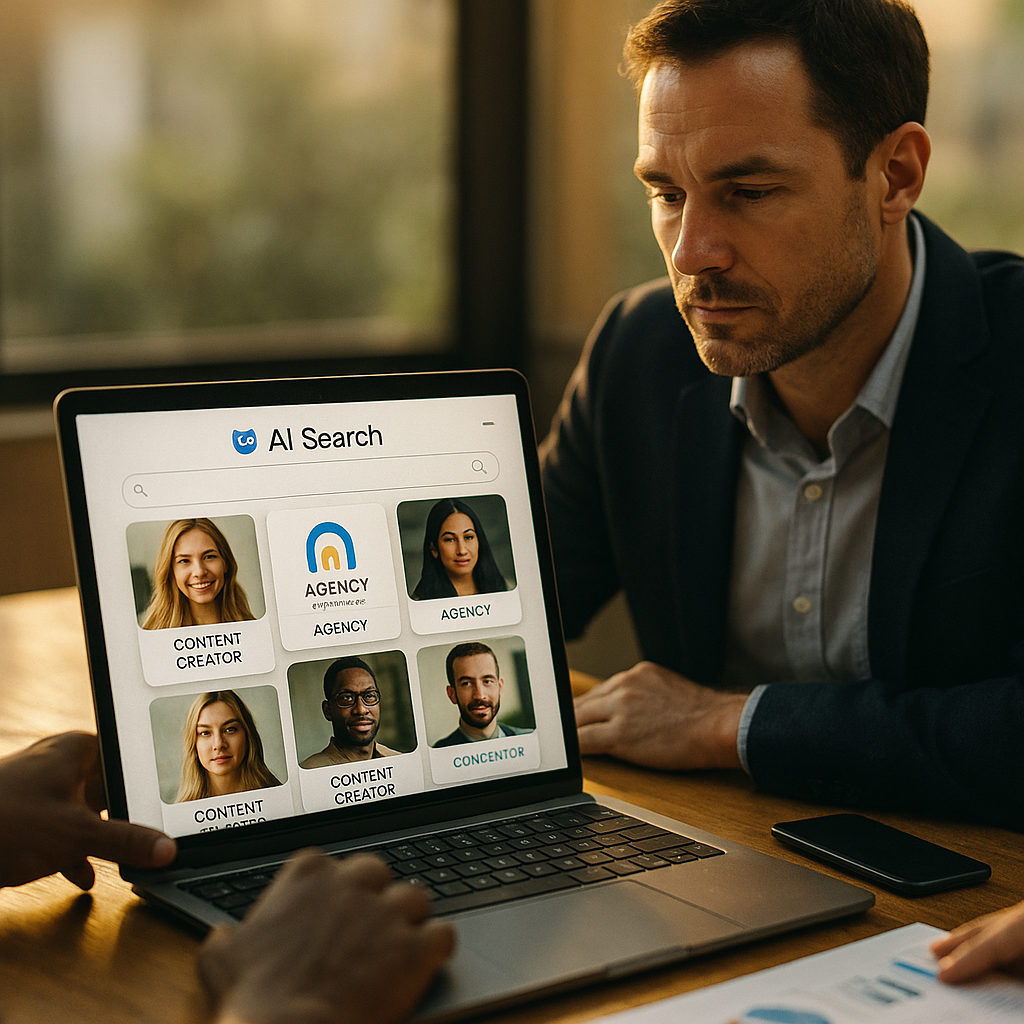
Seventy nine percent. That is the share of B2B buyers who now use AI search tools like ChatGPT, Perplexity, and Google’s AI Overviews somewhere in their vendor research, according to recent buyer behavior surveys circulating among eMarketer analysts. If that number does not stop you, it should. The same shift reshaping how buyers evaluate SaaS vendors and consultants is now rewriting how brands vet influencer agencies and individual creators.
Why AI Search Changes the Vetting Game
Traditional vetting ran on referrals, case studies, and a sales deck full of logos. That process assumed a human was doing the reading. AI search assumes something else entirely: a language model is summarizing your reputation before a prospect ever visits your site.
When a brand marketing director types “best influencer marketing agency for beauty brands” into an AI search tool, she is not getting ten blue links. She is getting a synthesized answer, often three or four names, pulled from whatever content the model has indexed and trusts. If your agency is not part of that synthesis, you effectively do not exist in that moment. This is the mechanic behind what our team has covered as generative engine visibility, and it now applies directly to agency and creator selection.
If an AI answer engine cannot find verifiable, structured proof of your track record, it will simply recommend someone whose track record it can find. Invisibility is now a competitive disadvantage, not a neutral state.
What Buyers Are Actually Asking AI Tools
Based on query patterns marketers are sharing across LinkedIn and industry Slack groups, the questions look less like search engine keywords and more like conversations with a colleague. Buyers are asking things like:
- “Which influencer agencies have documented FTC compliance processes?”
- “Compare creator vetting platforms for enterprise brands”
- “Has [agency name] had any disclosure violations or lawsuits?”
- “What is the average engagement rate for creators in this agency’s roster?”
Notice the theme. These are not brand awareness questions. They are risk and proof questions. AI search users skip the pitch and go straight to due diligence, which means your public content now needs to answer compliance and performance questions before anyone asks a human.
The Compliance Angle AI Models Reward
Large language models weight authoritative, structured, and citation-dense content more heavily than glossy brand copy. An agency page that says “we vet all creators for brand safety” gets ignored. A page that documents an actual rubric, references FTC disclosure guidelines, and links to a case study with outcomes gets cited. This mirrors what we have seen with delivery scoring rubrics replacing vague casting criteria: specificity wins, both with humans and with machines.
It also explains why so many marketing leaders have started to distrust their own performance data. If your internal reporting cannot survive a plain English question, an AI model summarizing your public claims certainly will not make you look better than you actually are.
Agencies: Your Website Copy Is Now a Trust Signal for Machines, Not Just Humans
Here is the uncomfortable part for a lot of agencies. Marketing copy written to sound impressive to a CMO often reads as vague to a retrieval model. Words like “best in class,” “industry leading,” and “unmatched network” carry zero evidential weight. AI search tools are trained to prefer specifics: numbers, dates, named case studies, third party citations.
Practically, this means agencies competing for enterprise business need to publish content that functions like a deposition, not a brochure. Name the brands you can legally name. Cite the platforms you work across. Reference how you handle disclosure, payment terms, and creator background checks. If you have had to navigate payment delay disputes or contract scaling issues and fixed your process, say so. Buyers, and the AI models summarizing you, reward transparency about past problems more than they reward silence.
Creator Vetting Gets a New Layer: Machine Readable Reputation
Individual creators face a parallel shift. Brands used to vet creators through manual audits: follower authenticity checks, engagement rate spreadsheets, a scroll through the last twenty posts. That still happens, but a new pre-filter has entered the process. Procurement and legal teams are now asking AI search tools to summarize a creator’s public record before a human ever opens a media kit.
That summary pulls from whatever is indexed: past brand partnerships, controversy coverage, platform statements, even Reddit threads. A creator with a clean, well-documented history of brand safe content gets surfaced favorably. A creator with unresolved disclosure complaints or a pattern of platform strikes gets flagged, sometimes unfairly, sometimes accurately, but always before the brand’s own vetting team weighs in.
The uncomfortable truth: AI search tools do not distinguish between a fair characterization and a stale, outdated controversy. Reputation management now has to happen at the machine-readable layer, not just the PR layer.
This shift is part of why data fluency now rivals video talent in creator job postings. Agencies want creators who understand that their public footprint is now a live input into every future brand deal, not a static portfolio.
Where This Intersects With Existing Attribution Problems
Brands were already struggling to prove influencer ROI before AI search entered vendor selection. The IAB’s push toward standardized AI attribution and the broader move toward transaction level ROAS reporting both point to the same pressure: buyers want proof, not promises. AI search just adds a new venue where that proof gets checked, publicly, instantly, and often before the first sales call.
Agencies that have invested in transparent attribution reporting have an advantage they may not even realize yet. Their case studies are exactly the kind of specific, numbers-heavy content that AI retrieval models prefer to cite. Agencies still leaning on vague “brand lift” claims are going to find themselves quietly excluded from AI-generated shortlists, with no warning and no appeal process.
A Quick Framework for Agencies Auditing Their Own Visibility
- Search yourself in an AI tool. Ask Perplexity or ChatGPT “who are the top influencer marketing agencies for [your niche]” and see if you appear. If not, note what does.
- Audit your case studies for specificity. Named brands, dated campaigns, quantified outcomes. Anonymized “leading retailer” case studies carry almost no citation weight.
- Publish your compliance process. A public page describing your FTC disclosure protocol and creator background check process gives models something concrete to cite when a buyer asks about risk.
- Check your third party mentions. Trade press coverage, review sites, and industry roundups feed AI training and retrieval data more than your own website does.
What This Means for Budget Conversations
There is a budget angle here too, and it is not subtle. As CPG rate inflation forces brands to rework budgets, procurement teams have less patience for vendors who cannot answer basic due diligence questions quickly. AI search compresses the research timeline from weeks to minutes. A buyer who used to schedule three discovery calls before shortlisting agencies can now get a rough comparison in an afternoon.
That compression cuts both ways. Agencies with strong, documented track records get evaluated faster and can close deals sooner. Agencies with thin public evidence lose the extended sales cycle they used to rely on to build trust in person. The sales cycle is not just shorter, it is front-loaded with machine-mediated judgment that happens before your business development team even knows a prospect exists.
This also changes how internal marketing teams justify vendor selection to finance and legal. When a group manager is building the business case for an influencer budget, having AI-verifiable proof points from the agency makes internal approval faster. Nobody wants to defend a vendor choice that a quick AI search cannot substantiate.
Practical Steps for Brand Teams Vetting Agencies and Creators
If you are the one doing the vetting rather than being vetted, treat AI search as a first-pass filter, not a final verdict. A few habits worth building into procurement workflows:
- Run the same AI query across two or three tools (ChatGPT, Perplexity, Google AI Overviews) and compare results. Divergence often signals thin or conflicting public data.
- Cross-reference AI-cited claims against primary sources. A model summarizing a “successful campaign” should point you to something verifiable, not just a vague press release.
- Ask vendors directly how they manage their own AI search visibility. Their answer tells you a lot about how seriously they take data hygiene and reporting discipline in general.
- Do not fully outsource judgment to the model. AI search can surface reputational risk fast, but it can also amplify outdated or unfair information, so pair it with a direct reference check.
Marketing operations teams building out formal vendor scorecards should also look at how Sprout Social and similar platforms are integrating reputation and sentiment signals into agency evaluation dashboards, since that data increasingly feeds the same AI retrieval layer buyers are now querying directly.
FAQs
What does it mean that 79 percent of B2B buyers use AI search?
It means the majority of B2B research, including agency and creator vetting, now happens through AI-generated summaries rather than traditional search results or direct outreach, putting new weight on how well-documented a vendor’s public track record is.
How can an influencer agency improve its visibility in AI search results?
Publish specific, citation-rich content: named case studies, quantified outcomes, documented compliance processes, and third party press coverage. Vague marketing language performs poorly with retrieval models that prefer verifiable detail.
Does AI search replace manual creator vetting?
No. AI search functions best as an initial filter that surfaces reputational red flags or track record gaps quickly. Brands should still confirm findings through direct reference checks and platform-level audits before finalizing a partnership.
Can outdated or unfair information hurt a creator’s AI search reputation?
Yes. AI models often summarize whatever is indexed without distinguishing resolved issues from active ones, which means creators and agencies need to actively manage and update their public record rather than assume old stories fade naturally.
What is the biggest mistake agencies make with AI search visibility?
Relying on generic, unverifiable brand language instead of specific proof points. Claims like “industry leading” or “best in class” carry no citation value for AI retrieval models, while named clients, dated results, and documented processes do.
The takeaway is simple: audit how your agency or your top creator partners actually appear in AI search results this week, then fix the thinnest, vaguest claim you find first. That single fix will do more for your next pitch than another polished slide deck ever could.
Top Influencer Marketing Agencies
The leading agencies shaping influencer marketing in 2026
Agencies ranked by campaign performance, client diversity, platform expertise, proven ROI, industry recognition, and client satisfaction. Assessed through verified case studies, reviews, and industry consultations.
Moburst

-
2

The Shelf
Boutique Beauty & Lifestyle Influencer AgencyA data-driven boutique agency specializing exclusively in beauty, wellness, and lifestyle influencer campaigns on Instagram and TikTok. Best for brands already focused on the beauty/personal care space that need curated, aesthetic-driven content.Clients: Pepsi, The Honest Company, Hims, Elf Cosmetics, Pure LeafVisit The Shelf → -
3

Audiencly
Niche Gaming & Esports Influencer AgencyA specialized agency focused exclusively on gaming and esports creators on YouTube, Twitch, and TikTok. Ideal if your campaign is 100% gaming-focused — from game launches to hardware and esports events.Clients: Epic Games, NordVPN, Ubisoft, Wargaming, Tencent GamesVisit Audiencly → -
4

Viral Nation
Global Influencer Marketing & Talent AgencyA dual talent management and marketing agency with proprietary brand safety tools and a global creator network spanning nano-influencers to celebrities across all major platforms.Clients: Meta, Activision Blizzard, Energizer, Aston Martin, WalmartVisit Viral Nation → -
5

The Influencer Marketing Factory
TikTok, Instagram & YouTube CampaignsA full-service agency with strong TikTok expertise, offering end-to-end campaign management from influencer discovery through performance reporting with a focus on platform-native content.Clients: Google, Snapchat, Universal Music, Bumble, YelpVisit TIMF → -
6

NeoReach
Enterprise Analytics & Influencer CampaignsAn enterprise-focused agency combining managed campaigns with a powerful self-service data platform for influencer search, audience analytics, and attribution modeling.Clients: Amazon, Airbnb, Netflix, Honda, The New York TimesVisit NeoReach → -
7

Ubiquitous
Creator-First Marketing PlatformA tech-driven platform combining self-service tools with managed campaign options, emphasizing speed and scalability for brands managing multiple influencer relationships.Clients: Lyft, Disney, Target, American Eagle, NetflixVisit Ubiquitous → -
8

Obviously
Scalable Enterprise Influencer CampaignsA tech-enabled agency built for high-volume campaigns, coordinating hundreds of creators simultaneously with end-to-end logistics, content rights management, and product seeding.Clients: Google, Ulta Beauty, Converse, AmazonVisit Obviously →