


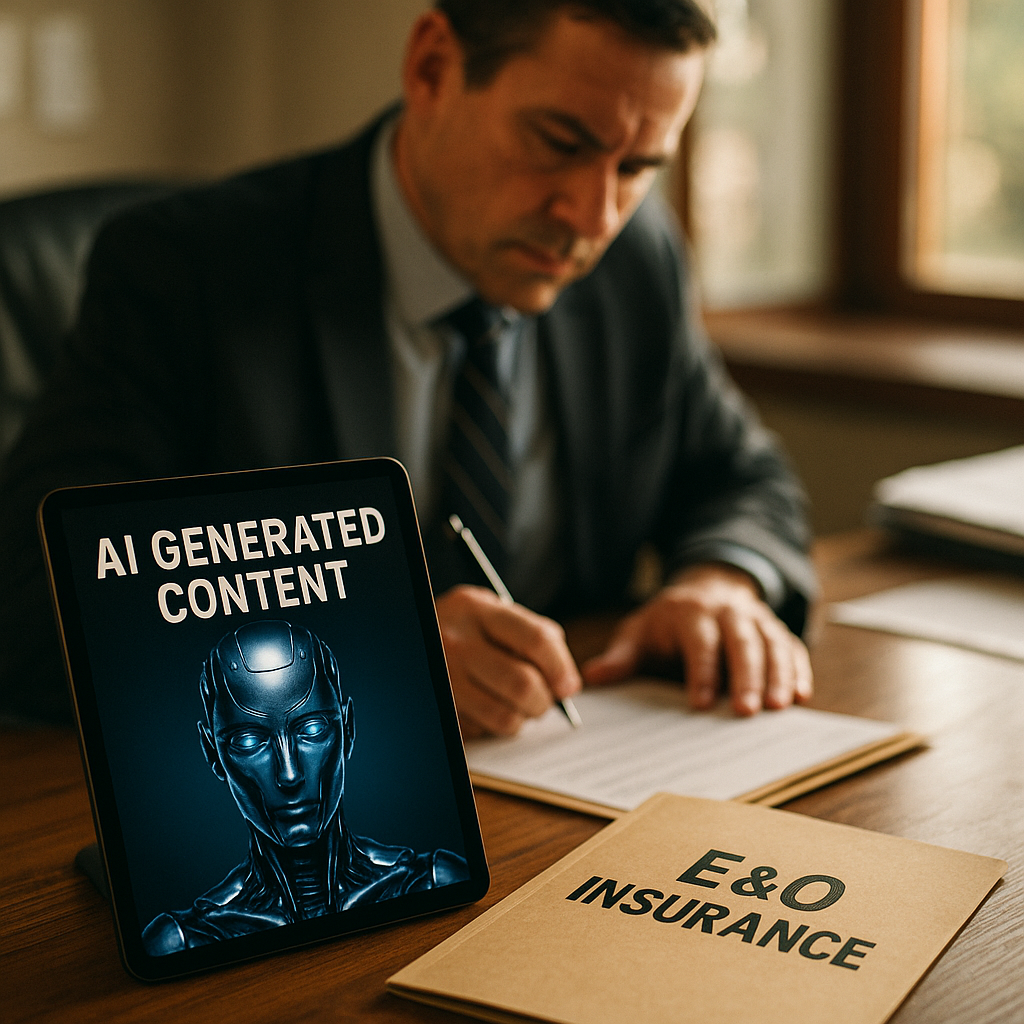
Roughly 73% of marketers now use generative AI somewhere in their content pipeline, yet most creator agency insurance policies were underwritten before that shift happened. That mismatch is not theoretical. When an AI-generated script lifts copyrighted lyrics, or a synthetic voiceover misrepresents a client’s product claims, agencies are discovering that their errors and omissions insurance for creator agencies has a hole shaped exactly like the tools they use every day. If your policy still defines “content” as something a human wrote, filmed, or edited, you are carrying risk nobody priced in.
The Coverage Gap Nobody Flagged Until a Claim Hit
Traditional E&O insurance was built for a predictable failure mode: a creator says something defamatory, misrepresents a product, or breaches a contract deliverable. Insurers know how to price that. What they have not fully priced is a large language model hallucinating a competitor’s trademark into an ad script, or an AI image generator producing an output that resembles a copyrighted photo it trained on without anyone’s knowledge.
Here’s the uncomfortable part. Many standard policies contain exclusions for “acts of a machine” or limit coverage to claims arising from “human professional services.” Some underwriters have quietly added AI-related carve-outs in the past renewal cycle, and agencies that haven’t reread their policy language in the last 12 months may not even know it happened.
An E&O policy that excludes AI-assisted work is not a discount, it’s a countdown clock to an uncovered claim.
Where the Exposure Actually Lives
Break down a typical creator agency workflow and you’ll find AI touchpoints stacked at nearly every stage: script generation, thumbnail creation, voice cloning for dubbing, auto-generated captions, and increasingly, fully synthetic brand spokespeople. Each touchpoint is a potential liability event.
- IP infringement: AI tools trained on scraped data can output content that echoes protected works, and the agency, not the AI vendor, usually gets named in the lawsuit.
- Defamation and false claims: Generative tools can fabricate statistics or product claims that sound authoritative but are entirely invented.
- Disclosure failures: Regulators are moving fast on labeling requirements for synthetic content, and a missed disclosure can trigger both an FTC action and a breach-of-contract claim from the brand.
- Deepfake misuse: Voice or likeness cloning without proper consent chains opens right of publicity claims that most legacy policies never contemplated.
If any of this sounds familiar, it’s because the regulatory side of this problem has been building for a while. Our coverage of deepfake disclosure laws and AI spokespeople in ads both point to the same conclusion: the compliance obligation exists whether or not your insurance backs you up.
Why Standard Policies Fall Short
Most E&O forms written for marketing and media agencies were drafted around a “professional services” definition that assumes a human is exercising judgment. AI complicates that assumption in two ways. First, there’s the question of whether AI-generated output even counts as a “professional service” under the policy’s wording. Second, there’s the causation problem: if an AI tool made an autonomous decision that led to a claim, was that a failure of the agency’s professional judgment, or a product defect in the AI tool itself?
Insurers are still arguing about this internally, which means your claim could end up as the test case. Nobody wants their agency to be the one that defines case law for an entire industry segment.
There’s also a scale problem. Traditional E&O assumed a handful of creators producing content at a manageable pace. AI has multiplied output volume by an order of magnitude. Agencies running AI-assisted content pipelines can generate hundreds of assets a week per client. More volume means more surface area for something to go wrong, and most legacy policy limits were never sized for that throughput.
The Contract Layer Makes It Worse
Even a well-worded policy can’t save an agency whose client contracts don’t address AI use at all. If your master service agreement is silent on who’s liable when an AI tool introduces IP risk, you’re negotiating that question during litigation instead of before signature. That’s a bad place to be. Our analysis of the IAB AI attribution framework covers how attribution language and contract terms need to move together, and it’s worth pairing that reading with your next insurance renewal conversation.
What “Closing the Gap” Actually Looks Like
Closing the AI content liability gap is not a single purchase decision. It’s a stack of four moves that reinforce each other.
- Audit your current policy language. Ask your broker directly: does this policy cover claims arising from AI-generated or AI-assisted content? Get the answer in writing, not a verbal assurance.
- Add or expand technology E&O riders. Some carriers now offer specific endorsements for AI-related media liability. These typically cost more, but the alternative is discovering the gap during a claim, which costs exponentially more.
- Tighten vendor and tool disclosure clauses. Require internal teams to log which AI tools touched each deliverable. This creates an audit trail that both your insurer and your legal counsel will want during a dispute.
- Update client contracts to allocate AI risk explicitly. Decide, in writing, who bears responsibility when an AI tool produces infringing or non-compliant output. Silence defaults to whichever party has deeper pockets, and that’s usually the agency.
A gap in your policy is a gap in your risk transfer strategy. If the insurer won’t pay, the agency does, dollar for dollar.
Underwriters Are Asking Harder Questions Now
Renewal season has gotten more invasive. Underwriters increasingly want to know which AI tools an agency uses, whether there’s human review before publication, and what the agency’s disclosure practices look like. Agencies that can answer confidently tend to get better terms. Agencies that shrug tend to get exclusions slapped onto their policy, or a premium increase that reflects the uncertainty.
This is where operational discipline pays off in a very literal sense. If you already have documented human-in-the-loop review processes, you have a stronger underwriting story. If your content ops are a black box even to your own compliance team, expect pushback. For agencies managing scripted or performance-based creator content, the review discipline described in our piece on scripted creator content is a useful template for building that documentation trail.
The Indemnification Question Nobody Wants to Answer
Here’s a scenario that keeps agency principals up at night. A brand client’s contract includes a broad indemnification clause requiring the agency to cover any IP or regulatory claim arising from campaign content. The agency used an AI tool to generate part of that content. The AI tool’s terms of service disclaim all liability for output infringement, pushing the risk entirely downstream. Now the agency is indemnifying the brand for a risk the AI vendor refuses to own, and the agency’s E&O policy excludes AI-related claims.
That’s not a hypothetical stack of bad luck. That’s the default posture of most AI vendor terms of service today. Agencies need to read those terms as carefully as they read their own insurance policy, because the two documents interact whether anyone planned for it or not. This mirrors the indemnification exposure we’ve covered around repurposed UGC indemnification, where the same logic applies: risk doesn’t disappear just because a contract shifts it, it just moves to whichever party has the weakest paperwork.
Practical Steps for the Next 90 Days
You don’t need a full insurance overhaul this quarter. You need a triage list.
- Pull your current E&O policy and search the document for the words “artificial intelligence,” “machine-generated,” and “automated.” If none of those terms appear, that’s not a good sign. It usually means the policy simply hasn’t been updated to address the risk, which cuts both ways in a dispute.
- Ask your broker for a comparison quote that includes a technology E&O or media liability rider specifically covering AI-generated content.
- Run an internal audit of which client-facing deliverables in the last quarter involved AI tools at any stage, script, image, voice, or edit.
- Add an AI disclosure and risk allocation clause to your standard client contract template going forward. Retrofitting old contracts is harder, but new ones should not go out without it.
Industry data on AI adoption in marketing workflows suggests this exposure is only growing, not leveling off, which means the agencies that move now are negotiating from a position of preparedness rather than damage control. For broader risk management context, resources from HubSpot’s marketing operations guidance and the FTC’s advertising guidance are worth bookmarking alongside your policy documents.
FAQs
Frequently Asked Questions
Does standard E&O insurance cover AI-generated content claims?
Usually not fully. Most legacy E&O policies were written before generative AI became part of standard agency workflows, and many contain exclusions or ambiguous language around machine-generated output. Agencies need to confirm coverage explicitly with their broker rather than assume it applies.
What is a technology E&O rider and do creator agencies need one?
A technology E&O rider is an endorsement added to a base policy that extends coverage to claims arising from software, automated tools, or AI systems used in delivering services. Agencies that use AI tools for scripting, editing, voice cloning, or image generation should evaluate whether this rider closes their specific coverage gaps.
Who is liable when an AI tool produces infringing content for a client campaign?
Liability typically falls on the agency or brand named in the client contract, not the AI vendor, since most AI tools disclaim output liability in their terms of service. This makes contract language allocating AI risk between agency and client essential before any claim arises.
How can an agency prove it exercised due diligence with AI-generated content?
Maintaining a documented human-in-the-loop review process, logging which AI tools touched each deliverable, and keeping disclosure records all strengthen an agency’s position with both insurers and regulators during a dispute.
Will using AI tools increase my agency’s insurance premiums?
It can, particularly if underwriters view your AI usage as undocumented or high-risk. Agencies with clear AI governance policies and review processes generally negotiate better terms than those that cannot answer basic questions about their tool usage.
The agencies that survive their first AI-related claim will be the ones who read their policy before they needed it, not after. Pull your E&O document this week, run the search terms, and get your broker on the phone before renewal season forces the conversation on someone else’s timeline.
Top Influencer Marketing Agencies
The leading agencies shaping influencer marketing in 2026
Agencies ranked by campaign performance, client diversity, platform expertise, proven ROI, industry recognition, and client satisfaction. Assessed through verified case studies, reviews, and industry consultations.
Moburst

-
2

The Shelf
Boutique Beauty & Lifestyle Influencer AgencyA data-driven boutique agency specializing exclusively in beauty, wellness, and lifestyle influencer campaigns on Instagram and TikTok. Best for brands already focused on the beauty/personal care space that need curated, aesthetic-driven content.Clients: Pepsi, The Honest Company, Hims, Elf Cosmetics, Pure LeafVisit The Shelf → -
3

Audiencly
Niche Gaming & Esports Influencer AgencyA specialized agency focused exclusively on gaming and esports creators on YouTube, Twitch, and TikTok. Ideal if your campaign is 100% gaming-focused — from game launches to hardware and esports events.Clients: Epic Games, NordVPN, Ubisoft, Wargaming, Tencent GamesVisit Audiencly → -
4

Viral Nation
Global Influencer Marketing & Talent AgencyA dual talent management and marketing agency with proprietary brand safety tools and a global creator network spanning nano-influencers to celebrities across all major platforms.Clients: Meta, Activision Blizzard, Energizer, Aston Martin, WalmartVisit Viral Nation → -
5

The Influencer Marketing Factory
TikTok, Instagram & YouTube CampaignsA full-service agency with strong TikTok expertise, offering end-to-end campaign management from influencer discovery through performance reporting with a focus on platform-native content.Clients: Google, Snapchat, Universal Music, Bumble, YelpVisit TIMF → -
6

NeoReach
Enterprise Analytics & Influencer CampaignsAn enterprise-focused agency combining managed campaigns with a powerful self-service data platform for influencer search, audience analytics, and attribution modeling.Clients: Amazon, Airbnb, Netflix, Honda, The New York TimesVisit NeoReach → -
7

Ubiquitous
Creator-First Marketing PlatformA tech-driven platform combining self-service tools with managed campaign options, emphasizing speed and scalability for brands managing multiple influencer relationships.Clients: Lyft, Disney, Target, American Eagle, NetflixVisit Ubiquitous → -
8

Obviously
Scalable Enterprise Influencer CampaignsA tech-enabled agency built for high-volume campaigns, coordinating hundreds of creators simultaneously with end-to-end logistics, content rights management, and product seeding.Clients: Google, Ulta Beauty, Converse, AmazonVisit Obviously →