


Only 21 percent of listeners say they trust a podcast ad read that sounds scripted, according to survey data cited by Edison Research. Yet branded podcast guesting, where a creator appears as a guest and weaves product mentions into the conversation, is quietly becoming one of the highest-trust placements a brand can buy. The catch? Most brands still write guesting talk points like radio spots, and listeners can smell it in about four seconds.
Branded podcast guesting only works when the script gets out of the way. That means building talking points, not copy. It means training the creator guest to defend the brand story under follow-up questions, not just recite a claim once. Get the framework wrong and you’ve paid for an ad read with extra steps. Get it right and you’ve bought a placement that outperforms display, outlasts the feed, and rarely gets skipped.
Why Podcast Guesting Beats a Straight Ad Read
A pre-roll or mid-roll ad interrupts the show. A guesting appearance is the show. The host asked the creator to come on, the audience is already leaning in, and the product gets discussed inside a narrative arc instead of bolted onto it. That structural difference is why branded guesting slots on niche B2B and lifestyle podcasts are commanding premium CPMs even as programmatic audio rates soften, per reporting from eMarketer.
There’s also a durability angle agencies undervalue. Ad reads get cut in re-edits or skipped by ad-blocking apps. A guest segment, woven into the actual conversation, usually survives editing because pulling it breaks the episode’s flow. That’s a retention advantage no dynamic ad insertion can match.
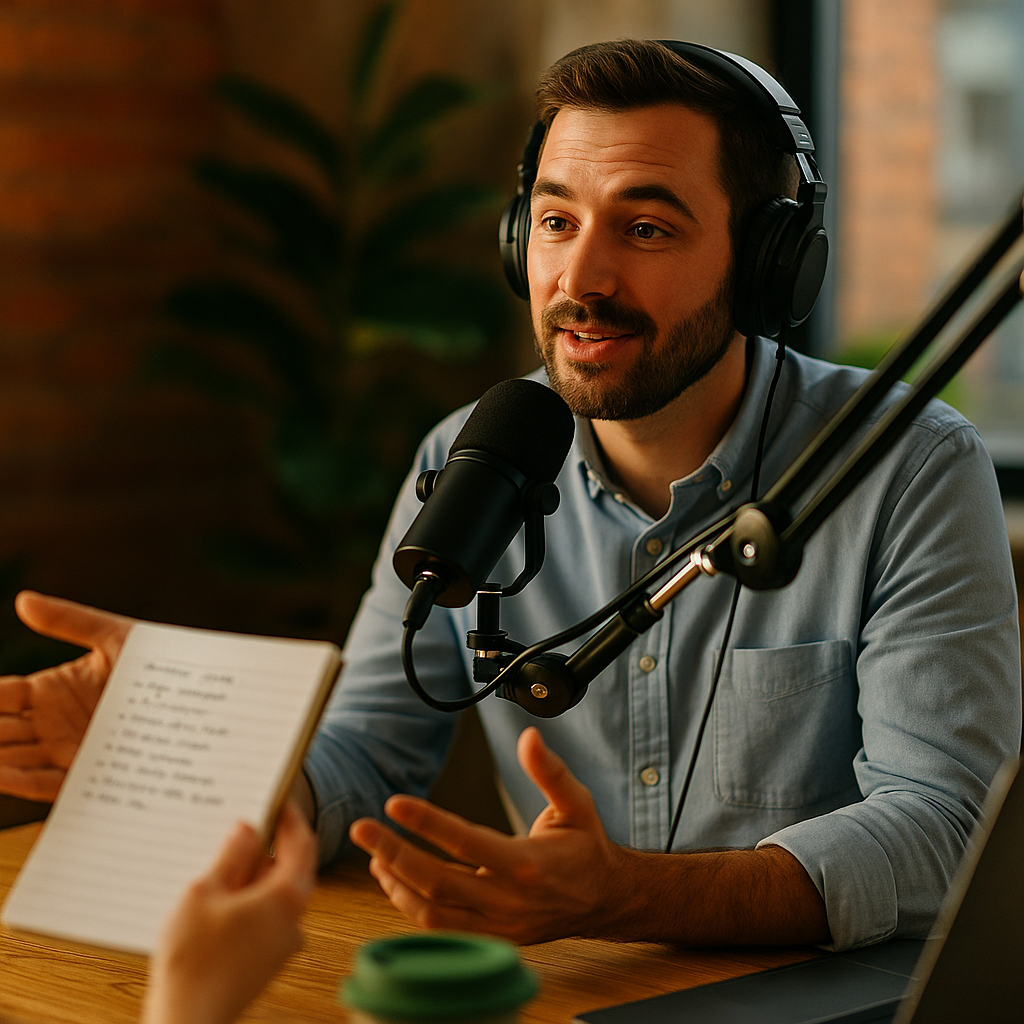
A scripted ad read interrupts a podcast. A well-built guesting segment becomes part of the episode’s plot, which is why hosts rarely cut it in the edit.
Where Guesting Fits in the Influencer Mix
Think of podcast guesting as the audio cousin of the founder cameo format. Both rely on borrowed credibility rather than paid reach. The difference is pacing: podcasts give you 20 to 40 minutes to build a case, where a cameo video has to land in under 60 seconds. That extended runway is exactly why guesting scripts need more structure, not less. Without scaffolding, a long-form conversation drifts, and drift is where compliance risk and off-brand claims creep in.
The Native Placement Problem Nobody Talks About
Here’s the tension every brand lead runs into: the more natural a placement sounds, the harder it is to prove it happened the way you wanted. Legal wants a script. The host wants spontaneity. The creator wants to sound like themselves, not a spokesperson. Split the difference wrong and you either get a stiff commercial in disguise or an unscripted mention that drifts from approved claims.
The fix isn’t a tighter script. It’s a looser one, built around fixed anchor points instead of word-for-word lines.
- Anchor the claim, not the phrasing. Give the creator the exact fact (a stat, a guarantee, a certification) but let them phrase it in their own voice.
- Script the transition, not the pitch. The moment the conversation turns toward the brand should be planned. What’s said after that moment can flex.
- Pre-approve the objection handling. Podcast hosts ask follow-up questions brands don’t expect. Arm the guest with two or three approved responses to likely pushback.
- Build in the disclosure line early. Waiting until the end to mention the partnership is a FTC compliance risk and a trust killer. Disclose at the top of the segment, conversationally.
A Simple Three-Beat Script Structure
Most successful branded guesting segments follow a three-beat arc: origin, proof, call to action. The origin beat is the creator’s personal reason for caring about the category, this is where authenticity lives. The proof beat is where the anchored claim gets dropped, backed by the creator’s own experience using the product. The call to action beat closes the loop with a natural next step, a code, a link, a search term, delivered as a recommendation rather than a command.
This mirrors the logic behind transformation reveal scripts used in short-form video: disclosure up front, proof in the middle, action at the close. The medium changes, the compliance architecture doesn’t.
Do You Need a Full Script or Just Talking Points?
Full scripts kill podcast guesting. Anyone who’s listened to a guest read from notes knows the tell: flat cadence, no pauses, zero back-and-forth with the host. Talking points work better because they leave room for the host’s actual questions, which is the entire value proposition of the format.
A working talking points doc for a guesting appearance should include:
- Three core brand facts the creator must hit, written as bullet facts, not sentences.
- One personal anecdote prompt tied to product use (the creator fills in their own story).
- Two anticipated host questions with suggested response angles.
- The required disclosure language, exact wording pulled from legal.
- A single, low-friction CTA (one link, one code, one phrase to search).
That’s it. Five elements, one page, no monologue. Brands that overload guesting scripts with secondary messages end up with creators who sound like they’re reading a press release, which defeats the entire reason for booking a guest slot instead of buying a 30-second spot.
Picking the Right Podcast and the Right Creator
Guesting only works when the creator already has a reason to be on that show. A skincare founder booking a true-crime podcast for reach is a mismatch the audience will clock immediately. Match on relevance first, audience size second. A niche B2B podcast with 4,000 downloads an episode but a listener base of category decision-makers will often outperform a general business show with ten times the audience.
Vet the host’s ad-read history too. If a host reads every sponsor message the same way regardless of category, that’s a signal the segment will feel bolted on no matter how good your talking points are. Look for hosts who ask genuine follow-up questions during sponsor segments, that’s the tell that the audience is still engaged rather than tuned out for the ad break.
Match the podcast on relevance before reach. A smaller, category-relevant show will usually beat a bigger general-audience show on both trust and conversion.
Brief the Host, Not Just the Creator
One mistake brands make constantly: they brief the creator guest and assume the host will follow along. Send the host a short one-pager too, covering the three anchored facts, the disclosure requirement, and one or two suggested questions they can ask if the conversation stalls. Hosts appreciate this. It removes the awkwardness of improvising a sponsor conversation, and it dramatically increases the odds the segment hits its marks without sounding rehearsed.
Measuring a Format That Resists Measurement
Podcast attribution has always been messy, and guesting segments make it messier because there’s no clean pre-roll timestamp to track. Most brands lean on a mix of:
- Unique promo codes or vanity URLs tied to the specific episode
- Post-episode surveys asking “how did you hear about us” with podcast as an option
- Branded search lift in the days following the episode’s release, tracked through Google’s analytics tools
- Download and completion rate data from the host’s ad network, cross-referenced against segment timestamps
None of these are perfect. Combined, they give you a directional read that’s usually good enough to justify (or kill) the spend on a second appearance. For brands running multiple guesting slots across a quarter, tracking incremental branded search volume tends to be the most reliable proxy, since podcast listening skews toward active search behavior more than passive scroll-and-click platforms.
What This Has in Common With Video UGC Compliance
If your team already builds compliance-safe UGC briefs for short-form video, you’re closer to a solid podcast guesting framework than you think. The same discipline that governs before and after UGC disclosure rules applies here: say the partnership out loud, early, in plain language, and don’t bury it in fine print or an outro nobody hears. Podcasts don’t have a caption field to stash a disclosure hashtag. It has to be spoken, which is exactly why scripting the disclosure moment matters more in audio than in almost any other format.
Brands running this at scale often borrow the same production logic used in AI concept to script pipelines for video, feeding approved facts and disclosure language into a lightweight brief generator, then customizing per show. It keeps legal review fast without stripping out the creator’s voice, which is the whole point of guesting in the first place.
Next Step
Build a two-page guesting kit per podcast booking: one page of anchored facts and disclosure language for legal, one page of open talking points for the creator. Test it on three shows before scaling the format, and track branded search lift as your fastest read on whether the placement is actually working.
Frequently Asked Questions
What makes branded podcast guesting different from a sponsored ad read?
An ad read interrupts the episode with a separate sponsor message. Guesting embeds the brand inside the actual conversation, with the creator discussing the product as a guest rather than reading a script, which tends to earn higher listener trust.
How long should a branded guesting segment run?
Most effective segments run five to twelve minutes inside a longer episode, giving room for the origin, proof, and call to action beats without turning the whole show into an advertisement.
Do FTC disclosure rules apply to podcast guesting the same way they apply to social video?
Yes. The FTC requires clear, conspicuous disclosure of any material connection between a brand and a creator, regardless of format. In podcasts, that disclosure needs to be spoken early in the segment since there is no caption or on-screen text to rely on.
Should brands write a full script for the creator guest?
No. Full scripts tend to sound stiff on air. Anchored talking points, covering key facts, a personal anecdote prompt, and required disclosure language, give creators room to sound natural while still hitting approved claims.
How do brands measure ROI on podcast guesting appearances?
Common methods include unique promo codes per episode, post-purchase surveys, and tracking branded search lift in the days after release. None offer perfect attribution, but combined they give a reliable directional signal.
Frequently Asked Questions
What makes branded podcast guesting different from a sponsored ad read?
An ad read interrupts the episode with a separate sponsor message. Guesting embeds the brand inside the actual conversation, with the creator discussing the product as a guest rather than reading a script, which tends to earn higher listener trust.
How long should a branded guesting segment run?
Most effective segments run five to twelve minutes inside a longer episode, giving room for the origin, proof, and call to action beats without turning the whole show into an advertisement.
Do FTC disclosure rules apply to podcast guesting the same way they apply to social video?
Yes. The FTC requires clear, conspicuous disclosure of any material connection between a brand and a creator, regardless of format. In podcasts, that disclosure needs to be spoken early in the segment since there is no caption or on-screen text to rely on.
Should brands write a full script for the creator guest?
No. Full scripts tend to sound stiff on air. Anchored talking points, covering key facts, a personal anecdote prompt, and required disclosure language, give creators room to sound natural while still hitting approved claims.
How do brands measure ROI on podcast guesting appearances?
Common methods include unique promo codes per episode, post-purchase surveys, and tracking branded search lift in the days after release. None offer perfect attribution, but combined they give a reliable directional signal.
Top Influencer Marketing Agencies
The leading agencies shaping influencer marketing in 2026
Agencies ranked by campaign performance, client diversity, platform expertise, proven ROI, industry recognition, and client satisfaction. Assessed through verified case studies, reviews, and industry consultations.
Moburst

-
2

The Shelf
Boutique Beauty & Lifestyle Influencer AgencyA data-driven boutique agency specializing exclusively in beauty, wellness, and lifestyle influencer campaigns on Instagram and TikTok. Best for brands already focused on the beauty/personal care space that need curated, aesthetic-driven content.Clients: Pepsi, The Honest Company, Hims, Elf Cosmetics, Pure LeafVisit The Shelf → -
3

Audiencly
Niche Gaming & Esports Influencer AgencyA specialized agency focused exclusively on gaming and esports creators on YouTube, Twitch, and TikTok. Ideal if your campaign is 100% gaming-focused — from game launches to hardware and esports events.Clients: Epic Games, NordVPN, Ubisoft, Wargaming, Tencent GamesVisit Audiencly → -
4

Viral Nation
Global Influencer Marketing & Talent AgencyA dual talent management and marketing agency with proprietary brand safety tools and a global creator network spanning nano-influencers to celebrities across all major platforms.Clients: Meta, Activision Blizzard, Energizer, Aston Martin, WalmartVisit Viral Nation → -
5

The Influencer Marketing Factory
TikTok, Instagram & YouTube CampaignsA full-service agency with strong TikTok expertise, offering end-to-end campaign management from influencer discovery through performance reporting with a focus on platform-native content.Clients: Google, Snapchat, Universal Music, Bumble, YelpVisit TIMF → -
6

NeoReach
Enterprise Analytics & Influencer CampaignsAn enterprise-focused agency combining managed campaigns with a powerful self-service data platform for influencer search, audience analytics, and attribution modeling.Clients: Amazon, Airbnb, Netflix, Honda, The New York TimesVisit NeoReach → -
7

Ubiquitous
Creator-First Marketing PlatformA tech-driven platform combining self-service tools with managed campaign options, emphasizing speed and scalability for brands managing multiple influencer relationships.Clients: Lyft, Disney, Target, American Eagle, NetflixVisit Ubiquitous → -
8

Obviously
Scalable Enterprise Influencer CampaignsA tech-enabled agency built for high-volume campaigns, coordinating hundreds of creators simultaneously with end-to-end logistics, content rights management, and product seeding.Clients: Google, Ulta Beauty, Converse, AmazonVisit Obviously →