


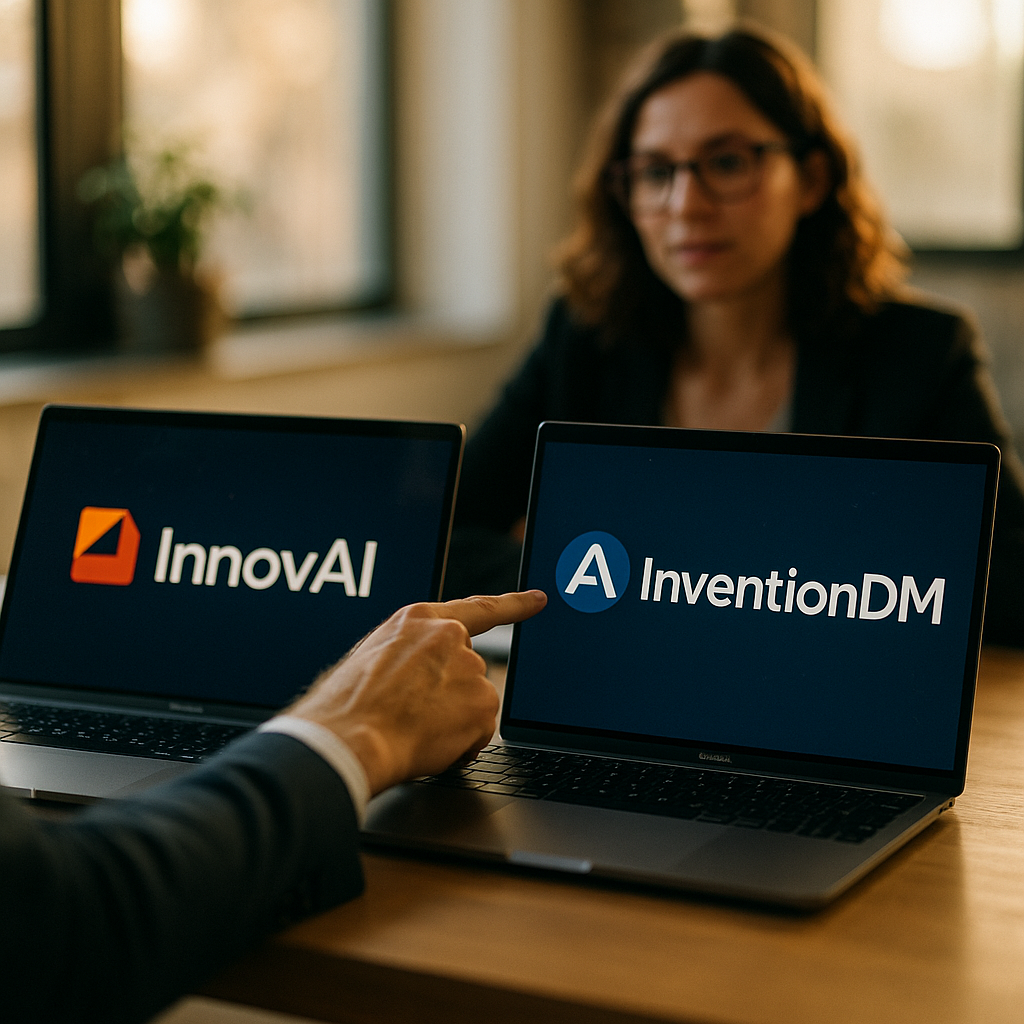
Only a fraction of B2B buyers now start their vendor research inside a search engine. More of them are asking ChatGPT, Perplexity, or Gemini to shortlist vendors for them. That shift has created a scramble among agencies claiming they can get your brand “recommended” by AI models, and two names keep surfacing in procurement conversations: InnovAit and InventionDM. Choosing between them isn’t cosmetic. It determines whether your brand shows up when an AI assistant answers a prospect’s question, or whether a competitor quietly eats that visibility instead.
This isn’t a theoretical debate. Marketing leaders are allocating real budget to AI visibility agency work right now, often carving it out of existing SEO or demand gen lines without much precedent to guide the spend. So let’s get specific about what InnovAit and InventionDM actually do, where they differ, and how a B2B brand should evaluate either one before signing a contract.
What an AI Visibility Agency Is Actually Selling
Strip away the jargon and an AI visibility agency sells one thing: influence over how large language models describe, rank, and recommend your brand. That might mean optimizing structured data so a model can parse your product claims accurately. It might mean building citation density across third-party sources that LLMs tend to crawl and trust. It might mean monitoring prompts where your category gets discussed and intervening when the model’s answer is wrong, outdated, or favors a competitor.
The problem is that “AI visibility” has become a catch-all term, similar to how “SEO” got stretched to cover everything from technical audits to link farms a decade ago. Some agencies are running rigorous, measurable programs. Others are repackaging old content marketing decks with “GEO” (generative engine optimization) stamped on the cover. Our GEO optimization buyers framework covers this distinction in more depth, but the short version is: demand proof of methodology before you buy the pitch.
If an agency can’t show you a before-and-after snapshot of actual model outputs for your brand’s category, they’re selling theory, not results.
InnovAit: Built Around Structured Data and Retrieval Signals
InnovAit positions itself as a technical-first shop. Its core offering centers on optimizing the retrieval layer that LLMs lean on: schema markup, knowledge graph entries, structured product and company data, and citation placement on high-authority domains. The pitch is straightforward. If retrieval-augmented generation models pull from a narrow set of trusted sources, your job is to make sure your brand’s data is clean, consistent, and present in those sources.
In practice, InnovAit’s engagements tend to start with an audit of how a brand currently appears across major AI assistants for a defined set of buyer-intent prompts. They then build a remediation roadmap: fixing inconsistent NAP (name, address, phone) data, cleaning up outdated Wikipedia or Crunchbase entries, strengthening structured data on the brand’s own site, and pursuing placements on sites that AI models cite frequently for the category. This is methodical work, closer to technical SEO than to content marketing, and it tends to appeal to brands with messy legacy data across multiple subsidiaries or product lines.
The tradeoff is speed. Structural fixes take months to propagate through model training and retrieval indexes. Clients expecting a quarter-over-quarter lift in “mentions” sometimes get frustrated with InnovAit’s longer timeline, even when the underlying work is sound. If your brand’s biggest issue is directly conflicting or fragmented data across the web, InnovAit’s approach solves a real root cause. If your issue is more about narrative and positioning, it may feel slow.
InventionDM: A Content and Narrative Play
InventionDM takes a different angle. Rather than treating AI visibility as a retrieval problem, it treats it as a narrative problem; the agency focuses on producing and distributing content specifically engineered to be quotable, citable, and favorable when models summarize a category. Think comparison pages, original research, and expert commentary designed to seed the kind of language that shows up verbatim in AI-generated answers.
InventionDM’s model relies heavily on earned and owned media distribution: getting commentary into trade publications, publishing proprietary survey data, and building out comparison content that directly answers the prompts buyers are likely to type. It’s a strategy that overlaps meaningfully with traditional digital PR and content marketing, just reframed for an AI-first discovery environment. For B2B brands with strong subject matter expertise but weak technical infrastructure, this can move the needle faster than a structural overhaul.
The risk here is control. Content-led visibility strategies depend on third parties picking up and republishing your narrative, which means InventionDM’s success metrics can be harder to isolate from general brand awareness lift. It’s also more vulnerable to model updates; a quotable stat that worked well in one model’s training window can lose relevance once the model refreshes its sources.
Where the Two Actually Overlap
Despite the different starting points, InnovAit and InventionDM converge on a few core practices, and it’s worth knowing these aren’t differentiators either way:
- Both run prompt-level monitoring to track how a brand is mentioned (or omitted) across ChatGPT, Gemini, Perplexity, and Copilot.
- Both recommend heavier investment in third-party review sites and comparison hubs, since models weight independent sources more heavily than brand-owned content.
- Both offer some version of a “share of model” metric, a rough analog to share of voice, though neither has a standardized industry definition yet.
- Neither can guarantee placement. Anyone promising guaranteed AI recommendations is overselling; models are probabilistic, and outputs shift with each update.
That last point matters more than it sounds. The same caution applies broadly across the AI visibility and search landscape right now, as covered in our piece on tracking AI visibility across platforms. Measurement tools are still maturing, and no vendor has a flawless attribution model yet.
The Real Decision Criteria for B2B Buyers
So how should a brand actually choose? Start by diagnosing your own weakness rather than the agency’s strength.
If your brand struggles with inconsistent data across multiple regional sites, acquired subsidiaries, or outdated directory listings, InnovAit’s structural approach addresses a problem that content alone won’t fix. No amount of great thought leadership offsets a Wikipedia entry listing the wrong founding year or a Crunchbase profile with stale funding data.
If your brand has strong internal expertise and existing media relationships but thin technical infrastructure, InventionDM’s narrative-first model will likely show movement faster, particularly in categories where buyers ask comparative or evaluative questions (“best X for mid-market manufacturers,” for example).
The agencies aren’t really competing on results as much as they’re competing on which root cause they assume is driving your visibility gap. Get that diagnosis wrong and neither approach will work.
A few practical questions to ask either vendor before signing:
- What specific prompts will you track, and how were they selected? Vague “brand category” monitoring isn’t sufficient; you need prompt sets tied to actual buyer journeys.
- How do you attribute pipeline or revenue impact, and how does that reconcile with existing attribution models in your CRM? This is where overlap with tools covered in our CRM and CDP comparison becomes relevant: if AI visibility data lives in a silo, it won’t inform broader go-to-market decisions.
- What happens when a model update changes your results? Neither agency controls the models themselves, so ask how they adapt when rankings shift unexpectedly.
- Can you show anonymized client data, not just case study summaries? Aggregate “mentions increased 40%” claims mean little without the underlying prompt set and time frame.
Budget and Contract Realities
Neither agency publishes flat-rate pricing, which is typical for this category since scope varies wildly by brand size and existing data hygiene. Expect InnovAit engagements to front-load cost into the audit and remediation phase, with a steep initial spend followed by lighter maintenance retainers. InventionDM’s model tends to spread cost more evenly across a content and distribution retainer, since the work is ongoing rather than front-loaded.
Contract length matters more than either agency will volunteer upfront. Because model retraining cycles and retrieval index updates happen on their own timelines, not yours, a three-month pilot rarely produces conclusive data. Push for a minimum six-month engagement with clearly defined checkpoints, and insist on a clause letting you exit if reporting doesn’t match the methodology promised in the sales process. This is the same due diligence rigor that applies when vetting identity resolution vendors or any data-dependent partner: the contract should protect you from paying for a black box.
It’s also worth checking how either agency handles compliance and disclosure, particularly if their recommendations touch sponsored content or influencer-adjacent placements that could fall under FTC disclosure guidance. AI visibility work increasingly intersects with influencer and affiliate content, and sloppy disclosure practices there create legal exposure well beyond a missed KPI.
What the Data Says About the Category Broadly
Industry estimates from firms like eMarketer and Statista point to rising adoption of AI-assisted research tools among B2B buyers, a trend most marketing leaders now treat as directional even where exact percentages vary by study. The practical implication: this isn’t a niche channel to monitor later. It’s becoming part of the standard buyer journey, sitting alongside organic search and LinkedIn research rather than replacing them.
That also means AI visibility agency selection shouldn’t happen in isolation from your broader martech stack. If your CRM, CDP, and attribution tooling can’t ingest signals about AI-driven traffic or mentions, you’ll end up with a report that looks impressive in a slide deck and tells you nothing about pipeline impact. Review your existing stack’s capacity for this before committing budget, similar to the groundwork covered in our comparison of AI data layers across CRM platforms.
Next Step
Before you sign with either InnovAit or InventionDM, run a two-week internal audit of how your brand currently appears across ChatGPT, Gemini, and Perplexity for ten real buyer prompts. That baseline will tell you whether your gap is structural (favoring InnovAit) or narrative (favoring InventionDM), and it gives you a concrete benchmark to hold either agency accountable to from day one.
FAQs
What is an AI visibility agency, exactly?
An AI visibility agency helps brands improve how they’re described, cited, and recommended by generative AI tools like ChatGPT, Gemini, and Perplexity. Work typically includes structured data optimization, third-party citation building, and prompt-level monitoring.
Is InnovAit or InventionDM better for B2B brands?
Neither is universally better. InnovAit suits brands with fragmented or inconsistent data across subsidiaries and directories. InventionDM suits brands with strong subject matter expertise but thin technical infrastructure. The right choice depends on diagnosing your specific visibility gap first.
How long does it take to see results from AI visibility work?
Structural fixes from agencies like InnovAit often take three to six months to propagate through model retrieval indexes. Content-led approaches like InventionDM’s can show faster movement, sometimes within six to eight weeks, but results are more vulnerable to model updates.
Can an agency guarantee my brand will be recommended by AI models?
No credible agency can guarantee this. AI model outputs are probabilistic and change with each update, so any vendor promising guaranteed placement should be treated with skepticism.
How do I measure ROI on an AI visibility agency contract?
Track a defined set of buyer-intent prompts before and after engagement, and tie any visibility gains back to pipeline data in your CRM or CDP. Avoid relying solely on vendor-reported “mentions” metrics without independent verification.
FAQs
What is an AI visibility agency, exactly?
An AI visibility agency helps brands improve how they’re described, cited, and recommended by generative AI tools like ChatGPT, Gemini, and Perplexity. Work typically includes structured data optimization, third-party citation building, and prompt-level monitoring.
Is InnovAit or InventionDM better for B2B brands?
Neither is universally better. InnovAit suits brands with fragmented or inconsistent data across subsidiaries and directories. InventionDM suits brands with strong subject matter expertise but thin technical infrastructure. The right choice depends on diagnosing your specific visibility gap first.
How long does it take to see results from AI visibility work?
Structural fixes from agencies like InnovAit often take three to six months to propagate through model retrieval indexes. Content-led approaches like InventionDM’s can show faster movement, sometimes within six to eight weeks, but results are more vulnerable to model updates.
Can an agency guarantee my brand will be recommended by AI models?
No credible agency can guarantee this. AI model outputs are probabilistic and change with each update, so any vendor promising guaranteed placement should be treated with skepticism.
How do I measure ROI on an AI visibility agency contract?
Track a defined set of buyer-intent prompts before and after engagement, and tie any visibility gains back to pipeline data in your CRM or CDP. Avoid relying solely on vendor-reported “mentions” metrics without independent verification.
Top Influencer Marketing Agencies
The leading agencies shaping influencer marketing in 2026
Agencies ranked by campaign performance, client diversity, platform expertise, proven ROI, industry recognition, and client satisfaction. Assessed through verified case studies, reviews, and industry consultations.
Moburst

-
2

The Shelf
Boutique Beauty & Lifestyle Influencer AgencyA data-driven boutique agency specializing exclusively in beauty, wellness, and lifestyle influencer campaigns on Instagram and TikTok. Best for brands already focused on the beauty/personal care space that need curated, aesthetic-driven content.Clients: Pepsi, The Honest Company, Hims, Elf Cosmetics, Pure LeafVisit The Shelf → -
3

Audiencly
Niche Gaming & Esports Influencer AgencyA specialized agency focused exclusively on gaming and esports creators on YouTube, Twitch, and TikTok. Ideal if your campaign is 100% gaming-focused — from game launches to hardware and esports events.Clients: Epic Games, NordVPN, Ubisoft, Wargaming, Tencent GamesVisit Audiencly → -
4

Viral Nation
Global Influencer Marketing & Talent AgencyA dual talent management and marketing agency with proprietary brand safety tools and a global creator network spanning nano-influencers to celebrities across all major platforms.Clients: Meta, Activision Blizzard, Energizer, Aston Martin, WalmartVisit Viral Nation → -
5

The Influencer Marketing Factory
TikTok, Instagram & YouTube CampaignsA full-service agency with strong TikTok expertise, offering end-to-end campaign management from influencer discovery through performance reporting with a focus on platform-native content.Clients: Google, Snapchat, Universal Music, Bumble, YelpVisit TIMF → -
6

NeoReach
Enterprise Analytics & Influencer CampaignsAn enterprise-focused agency combining managed campaigns with a powerful self-service data platform for influencer search, audience analytics, and attribution modeling.Clients: Amazon, Airbnb, Netflix, Honda, The New York TimesVisit NeoReach → -
7

Ubiquitous
Creator-First Marketing PlatformA tech-driven platform combining self-service tools with managed campaign options, emphasizing speed and scalability for brands managing multiple influencer relationships.Clients: Lyft, Disney, Target, American Eagle, NetflixVisit Ubiquitous → -
8

Obviously
Scalable Enterprise Influencer CampaignsA tech-enabled agency built for high-volume campaigns, coordinating hundreds of creators simultaneously with end-to-end logistics, content rights management, and product seeding.Clients: Google, Ulta Beauty, Converse, AmazonVisit Obviously →