


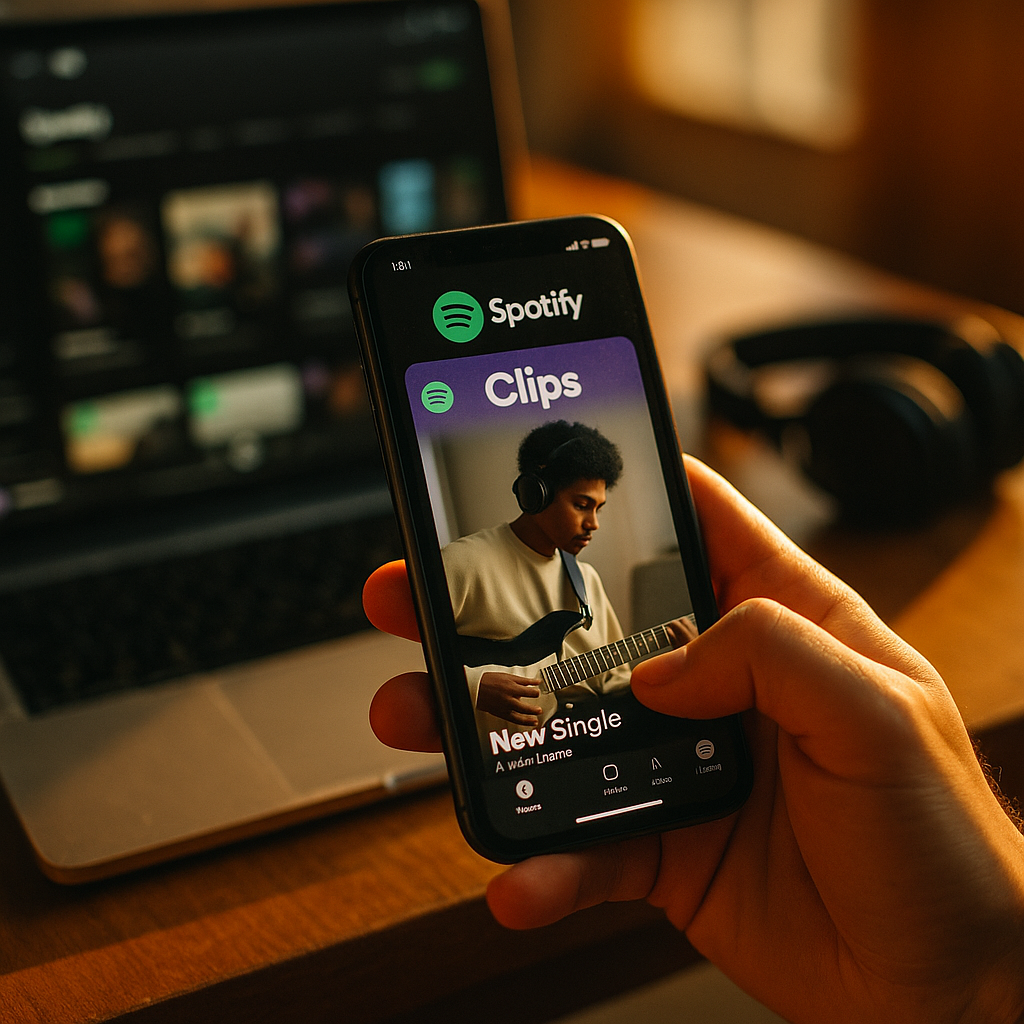
Spotify now serves more than 100 million podcast listeners a month, and it just handed creators a video feed inside an audio app. Spotify Clips lets podcasters post short, vertical video snippets that surface in a dedicated discovery tab, essentially bolting a TikTok-style feed onto the world’s biggest audio platform. If your influencer budget still treats Spotify as a “nice to have” distribution afterthought, you’re missing where attention is actually migrating.
What Spotify Clips Actually Is (And Why It’s Not Just Another Shorts Clone)
Clips are short video excerpts, typically 30 to 90 seconds, that creators pull from longer podcast episodes or record natively. They live on the creator’s show page and surface in Spotify’s algorithmic discovery feed, the one most listeners scroll while waiting for a download or killing time between episodes. Unlike YouTube Shorts or Instagram Reels, Clips are tethered to long-form audio content. The discovery mechanism rewards shows that already have engaged listenership, not just viral hooks.
That distinction matters for brand strategy. You’re not buying into a standalone short-video platform competing purely on scroll-stopping thumbnails. You’re buying into an ecosystem where a 60-second clip can funnel a listener into a 45-minute episode, and that episode can funnel them into a purchase decision. Audio listeners already show higher trust signals toward hosts than typical social feeds, according to research cited by Edison Research on podcast listener behavior. Clips just make that trust discoverable at scale.
Spotify Clips isn’t competing with TikTok for attention. It’s competing with YouTube Shorts for the moment a listener decides which podcast earns their next 30 minutes.
Why Audio First Discovery Changes the Math on Creator Deals
Most influencer budgets are still allocated by video-first logic: cost per view, cost per engagement, thumbnail click-through. Spotify Clips breaks that model because the real conversion event isn’t the clip view, it’s the episode download that follows. A brand mentioned in a clip that drives someone into a 40-minute episode gets far more exposure time than a 15-second TikTok ever delivers.
This is a fundamentally different attention economy. You’re not paying for a scroll-stop, you’re paying for a listening relationship. Brands running integrated reads or dynamic ad insertions inside podcasts already understand this. Clips simply gives that same audience an on-ramp that’s discoverable outside the dedicated listener base, which is the piece Spotify historically lacked compared to video platforms.
- Clips extend episode shelf life by surfacing older content to new listeners long after publish date.
- They reduce reliance on paid social to drive podcast downloads, lowering customer acquisition cost over time.
- They create a native retargeting surface: a listener who watches a clip and doesn’t convert can be served a follow-up ad inside the same app.
If your team already restructured budgets around short-form video shifts on other platforms, this will feel familiar. We covered a similar reallocation dynamic in our feed to Reels budget guide, and the underlying principle holds here too: discovery surfaces change faster than brand briefs do.
Building the Brief: What to Actually Ask Creators For
Podcasters aren’t trained video editors by default, and that’s fine. Spotify built Clips with lightweight, in-app editing specifically because the platform doesn’t expect every host to have a production team. Your brief needs to account for that reality instead of demanding broadcast-quality cuts.
A workable brief for Spotify Clips should specify:
- The exact moment to extract. Don’t leave it to chance. Tell the creator which segment of the episode contains the brand mention or product demo worth clipping.
- Disclosure placement. Spotify clips are still subject to the same endorsement guidance as any paid partnership. The FTC’s endorsement guidelines apply regardless of platform, and audio-to-video excerpts don’t get a pass just because they’re short.
- A call to action tied to the full episode, not just the clip. If the clip doesn’t nudge viewers toward the complete listen, you’ve wasted the funnel.
- Posting cadence across the show’s catalog, not a single one-off clip. Spotify’s discovery algorithm favors shows that post clips consistently, similar to how TikTok rewards posting frequency.
This mirrors brief rebuilds we’ve seen across other emerging formats. The same discipline we recommended in our B2B creator brief rebuild guide applies directly: specificity beats vague “make a clip about our product” instructions every time.
Risk Mitigation: Where Brands Get This Wrong
The biggest compliance risk with Spotify Clips isn’t disclosure, it’s context collapse. A 45-second clip pulled from a longer conversation can strip nuance from a brand mention, sometimes making a casual aside sound like an unqualified endorsement or, worse, a regulated claim (think supplements, financial products, skincare). Legal and compliance teams need sign-off on clip selection, not just the full episode script.
Brand safety teams should also watch for algorithmic surfacing outside the intended audience. Clips can appear in Spotify’s discovery feed to listeners who’ve never heard of the show, meaning your brand message reaches cold audiences without the trust context the host’s regular listeners already have. That’s a double-edged sword: more reach, less context.
A clip stripped of context can turn a casual mention into an unqualified claim. Compliance review for Spotify Clips should happen at the clip level, not just the episode level.
We’ve flagged similar context-collapse risks in platform discovery feeds before. Our compliance protection guide for algorithmic feeds walks through how brands can audit clip-level risk before a campaign goes live, and the same audit logic transfers cleanly to Spotify’s new format.
Measuring ROI When the Funnel Spans Two Formats
Attribution gets messy when a campaign lives partly in a 60-second clip and partly in a 40-minute episode. Spotify’s own ad analytics dashboard gives you clip view counts and episode download lifts, but tying a specific purchase back to “saw the clip, then listened, then bought” still requires brand-side tracking discipline: unique promo codes per show, UTM-tagged show notes links, and post-purchase survey attribution (“how did you hear about us”).
Don’t expect platform-native attribution to solve this for you. Spotify is not TikTok Shop, there’s no in-app checkout closing the loop. That means your measurement stack has to do more legwork. Brands already wrestling with cross-platform attribution gaps will recognize this pattern. It’s the same challenge we outlined in our GMV attribution guide, just transplanted into an audio-first environment where the “purchase moment” is further downstream.
Practical benchmarks to track:
- Clip view to episode download conversion rate (aim for context on what’s “good” by requesting historical data from the podcast before signing the deal).
- Episode download to promo code redemption rate.
- Follower/subscriber growth on the show’s Spotify page during the campaign window, a proxy for long-term brand lift.
Industry benchmarking resources like eMarketer and Statista are starting to track podcast video crossover metrics, worth monitoring quarterly as the format matures.
Budget Allocation: Where Clips Fit in the Mix
Treat Spotify Clips as a top-of-funnel discovery line item, not a replacement for your existing podcast ad buys or creator retainers. A sensible starting allocation for teams testing the format: 10 to 15 percent of your podcast-adjacent influencer budget, scaled up once you’ve validated clip-to-download conversion with a specific show.
Negotiate clip rights into existing podcast sponsorship deals rather than treating them as a separate line item. Most hosts are already producing clips for their own growth; asking them to tag your brand clearly and drive a CTA costs little incremental effort on their end, which should be reflected in pricing. If a creator tries to charge full video-production rates for a clip pulled from content they were already recording, push back. That’s a negotiation imbalance, not a fair market rate.
Quick Next Step
Pick one podcast partner you already sponsor, request their last 90 days of clip performance data before you renew, and build a single tracked promo code into their next three clips. That small test tells you more about Spotify’s discovery economics than any platform deck will.
Frequently Asked Questions
What is Spotify Clips and how is it different from podcast ads?
Spotify Clips is a short, vertical video feature that lets podcast hosts post excerpts from their episodes into a dedicated discovery feed inside the Spotify app. Unlike traditional podcast ads read inside an episode, clips are discoverable by new listeners browsing the feed and function more like a video trailer for the full episode.
Do brands need separate disclosure for Spotify Clips versus the full podcast episode?
Yes, functionally. The FTC’s endorsement guidance applies to any paid placement regardless of format or length, so a clip needs clear disclosure even if the full episode already discloses the partnership. Compliance teams should review clips individually since context can get lost in a shortened excerpt.
How do brands measure ROI on Spotify Clips campaigns?
Since Spotify doesn’t offer in-app checkout, brands need to layer their own tracking: unique promo codes per show, UTM-tagged links in episode show notes, and post-purchase attribution surveys. Track clip-to-download conversion and download-to-redemption rate as core benchmarks.
Should Clips replace traditional podcast sponsorship spend?
No. Clips work best as a discovery layer on top of existing podcast sponsorships, not a replacement. Start with a modest test allocation (10 to 15 percent of podcast-adjacent budget) with a show you already sponsor, and scale based on measured conversion.
What size creators perform best with Spotify Clips?
Shows with an established, engaged listener base tend to outperform larger but less-loyal audiences because Spotify’s discovery algorithm weighs completion and return-listener signals. A mid-tier podcast with high episode completion rates can outperform a larger show with casual, drop-off-heavy listenership.
Top Influencer Marketing Agencies
The leading agencies shaping influencer marketing in 2026
Agencies ranked by campaign performance, client diversity, platform expertise, proven ROI, industry recognition, and client satisfaction. Assessed through verified case studies, reviews, and industry consultations.
Moburst

-
2

The Shelf
Boutique Beauty & Lifestyle Influencer AgencyA data-driven boutique agency specializing exclusively in beauty, wellness, and lifestyle influencer campaigns on Instagram and TikTok. Best for brands already focused on the beauty/personal care space that need curated, aesthetic-driven content.Clients: Pepsi, The Honest Company, Hims, Elf Cosmetics, Pure LeafVisit The Shelf → -
3

Audiencly
Niche Gaming & Esports Influencer AgencyA specialized agency focused exclusively on gaming and esports creators on YouTube, Twitch, and TikTok. Ideal if your campaign is 100% gaming-focused — from game launches to hardware and esports events.Clients: Epic Games, NordVPN, Ubisoft, Wargaming, Tencent GamesVisit Audiencly → -
4

Viral Nation
Global Influencer Marketing & Talent AgencyA dual talent management and marketing agency with proprietary brand safety tools and a global creator network spanning nano-influencers to celebrities across all major platforms.Clients: Meta, Activision Blizzard, Energizer, Aston Martin, WalmartVisit Viral Nation → -
5

The Influencer Marketing Factory
TikTok, Instagram & YouTube CampaignsA full-service agency with strong TikTok expertise, offering end-to-end campaign management from influencer discovery through performance reporting with a focus on platform-native content.Clients: Google, Snapchat, Universal Music, Bumble, YelpVisit TIMF → -
6

NeoReach
Enterprise Analytics & Influencer CampaignsAn enterprise-focused agency combining managed campaigns with a powerful self-service data platform for influencer search, audience analytics, and attribution modeling.Clients: Amazon, Airbnb, Netflix, Honda, The New York TimesVisit NeoReach → -
7

Ubiquitous
Creator-First Marketing PlatformA tech-driven platform combining self-service tools with managed campaign options, emphasizing speed and scalability for brands managing multiple influencer relationships.Clients: Lyft, Disney, Target, American Eagle, NetflixVisit Ubiquitous → -
8

Obviously
Scalable Enterprise Influencer CampaignsA tech-enabled agency built for high-volume campaigns, coordinating hundreds of creators simultaneously with end-to-end logistics, content rights management, and product seeding.Clients: Google, Ulta Beauty, Converse, AmazonVisit Obviously →