


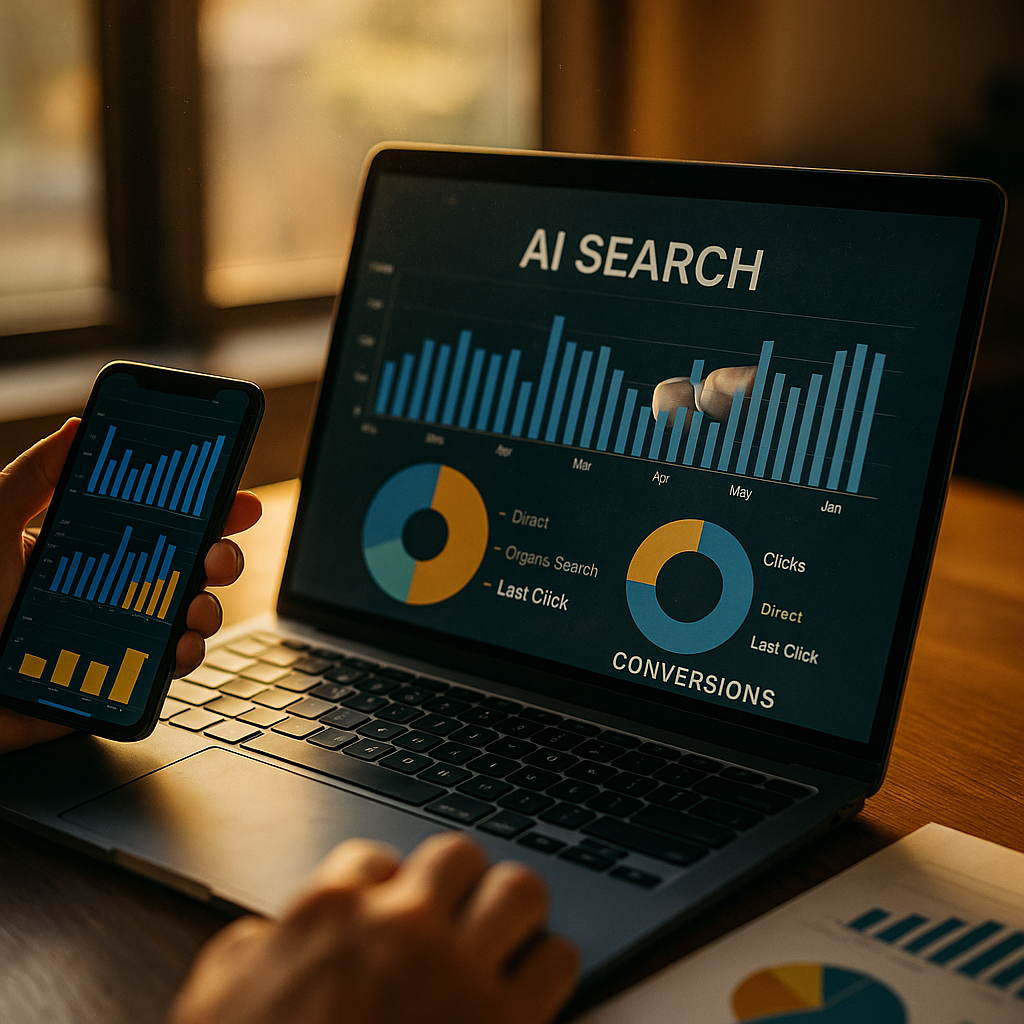
Here’s an uncomfortable number: when Semrush and other search analysts dug into referral patterns from AI answer engines earlier this year, they found that a meaningful share of sessions landing on brand sites after an AI search query never get tagged as such. They get bucketed as “direct.” Your attribution dashboard is lying to you, and it’s lying in a very specific direction: it’s starving the channels doing the most invisible work. That’s attribution collapse, and it’s about to reshape how smart brands justify budget.
The Last Click Problem Isn’t New, But AI Search Makes It Worse
Marketers have griped about last click attribution for over a decade. Multi-touch models, data-driven attribution in Google Ads, incrementality testing: all of these emerged because everyone knew last click was a blunt instrument. But the old flaws were manageable. You could live with undercounting display or social, because you had rough proxies (view-through windows, UTM chains, pixel data) to patch the gaps.
AI search breaks those patches. When a user asks ChatGPT, Perplexity, or Gemini a product question and gets a synthesized answer with a brand mention, there’s often no click at all in that moment. The user closes the app, opens a browser later, types the brand name directly, and converts. Your analytics sees a “direct” session with zero referral data. The AI engine that actually created the purchase intent gets zero credit.
This isn’t a hypothetical edge case. eMarketer and Statista have both tracked rising shares of product research starting inside AI chat interfaces rather than traditional search bars, and that share is climbing every quarter. If your attribution stack can’t see it, you’re making budget decisions on incomplete data, and probably cutting the exact programs that are quietly working.
A session tagged “direct” in your analytics might actually be the final step of a journey that started with an AI engine answering a product question three days earlier. Last click attribution has no way to know the difference, so it guesses wrong in the same direction every time.
Why the Undercounting Is Systematic, Not Random
If attribution errors were random noise, you could shrug them off. They’re not. The bias runs one way: toward undercounting AI-influenced sales and overcrediting whatever touchpoint happens to sit closest to the transaction.
Think about the mechanics. AI answer engines rarely pass referral strings the way search engines historically did. Some strip query parameters. Some operate inside native apps where no referrer header gets sent at all. Even when a click does happen, platforms like ChatGPT’s browsing feature or Perplexity’s citation links don’t always map cleanly to the UTM taxonomy your martech stack expects. Add dark social behavior (screenshotting an AI answer and texting it to a friend) and you’ve got a measurement blind spot that’s structurally built into how these tools work, not a bug your analytics team can patch with better tagging.
Compare this to the rise of prompt response citations as a visibility metric. Brands are already tracking how often they get cited inside AI answers because they recognize that citation itself has value, independent of whether it generates a trackable click. That’s a tacit admission that last click can’t capture this channel. The industry is building new measurement layers precisely because the old one failed.
What Gets Cut When the Data Lies
Here’s where it turns from an analytics curiosity into a budget problem. Finance teams and CMOs allocate spend based on attributed performance. If generative engine optimization (GEO) work, AI-focused PR, or creator content optimized for AI retrieval shows weak “last click” numbers, it gets deprioritized in the next planning cycle, even if it’s generating real demand. Meanwhile, bottom-funnel channels that happen to sit closest to conversion (branded search, retargeting, email) look artificially strong because they’re scooping up credit for demand someone else created.
This is the classic “last click steals credit” problem, just supercharged by a channel that’s structurally invisible to begin with. Brands running a GEO playbook to win citations in ChatGPT and Gemini often can’t prove the downstream revenue impact to a skeptical finance team, not because the work isn’t driving sales, but because the measurement tools were built for a search paradigm that no longer matches user behavior.
What Brands Are Doing Instead
Smart marketing teams aren’t waiting for platforms to fix referrer data. They’re building workarounds, some crude, some genuinely clever.
- Brand search lift tracking: Monitoring spikes in branded search volume and direct traffic that correlate with AI citation frequency, even without a clean click path.
- Survey-based attribution: Adding “how did you hear about us” fields at checkout or signup, specifically with an AI tool option, to capture what pixels miss.
- Incrementality testing: Running geo-based holdout tests where GEO and AI visibility investment is paused in one region to see if conversion rates drop relative to a control.
- Citation to pipeline mapping: Platforms like the one covered in MetricsMatter’s recent product update are attempting to connect AI visibility scores directly to pipeline stages, though vendors are careful to frame this as correlation, not proof of causation.
None of these are perfect. All of them beat pretending the problem doesn’t exist. The brands getting this right tend to run two or three of these methods in parallel and triangulate, rather than betting everything on one new metric that might itself be flawed.
The Compliance Angle Nobody’s Talking About
There’s a secondary risk here that risk and legal teams should care about. As brands lean harder into GEO tactics and AI-driven content strategies to win citations, some of that content gets drafted or approved with less human oversight than traditional campaigns received. Google’s push for human fact-checking in AI workflows is a direct response to this kind of risk, as covered in our piece on Google’s fact check mandate. If you’re optimizing content purely to win AI citations without attribution proof that it’s working, you may be taking on compliance risk for a channel you can’t even measure properly. That’s a bad trade twice over.
The same logic applies to influencer and creator content increasingly being surfaced inside AI search summaries. Reddit threads, for instance, now frequently outrank branded copy in AI search trust signals, according to recent analysis of AI search citations. If your influencer program is feeding that ecosystem, you need attribution that accounts for it, not a dashboard that quietly erases the contribution.
Building an Attribution Model That Accounts for AI Search
You don’t need to rip out your entire martech stack to start closing this gap. A few practical moves get you most of the way there.
First, separate “AI visibility” metrics from “AI attribution” metrics in your reporting, and stop conflating them. Citation frequency tells you whether you’re being seen. It doesn’t tell you revenue impact on its own. Treat it as a leading indicator, not a KPI you report to the board as if it were revenue.
Second, push your analytics or data team to build a custom channel grouping specifically for suspected AI-referred traffic. Even a rough heuristic (sessions with no referrer, landing on high-intent pages, within a defined window after a spike in AI citation volume) is better than lumping everything into “direct” and ignoring it.
Third, run quarterly incrementality tests rather than relying solely on always-on attribution. HubSpot and Sprout Social have both published guidance on incrementality testing methodology for exactly this reason: platform-level attribution is becoming less reliable across the board, not just for AI search.
If your attribution model can’t explain where “direct” traffic is actually coming from, you don’t have clean data. You have a gap dressed up as a channel.
Finally, loop this into broader AI governance conversations happening inside your org. Teams already building frameworks like the three bucket framework for AI risk should extend that thinking to measurement, not just content approval. Attribution accuracy is a risk and governance issue now, not just an analytics nuisance. Get your performance marketing, data, and legal teams in the same room before next year’s budget cycle starts, because the conversation about what counts as “proof” of AI search ROI is going to get contentious fast.
Frequently Asked Questions
What is attribution collapse in the context of AI search?
Attribution collapse refers to the growing gap between actual AI search driven influence on purchases and what traditional last click analytics tools can detect and credit, leaving a large share of conversions misclassified as direct or untracked.
Why does last click attribution undercount AI search driven sales specifically?
AI answer engines often don’t pass standard referrer data, operate inside native apps without browser headers, and generate delayed conversions where users return later via direct navigation, all of which make the original AI touchpoint invisible to last click models.
How can brands measure the ROI of generative engine optimization if attribution is broken?
Brands typically combine incrementality testing, branded search lift tracking, post-purchase surveys asking how customers discovered the brand, and citation frequency monitoring to triangulate impact without relying on a single flawed metric.
Is multi-touch attribution a solution to this problem?
Multi-touch attribution helps but doesn’t fully solve it, because the underlying data layer (referrer strings, UTM parameters, click tracking) is often missing entirely for AI search touchpoints, so there’s no touch to attribute in the first place.
Should marketing teams reduce investment in AI search visibility because it’s hard to measure?
No. Reducing investment based on incomplete attribution data risks cutting a channel that’s actually working. The better response is building supplementary measurement methods rather than defaulting to the flawed existing model.
The brands that win the next budget cycle won’t be the ones with the cleanest dashboards. They’ll be the ones who admit the dashboard is incomplete and build a second, scrappier measurement layer to catch what last click misses. Start with one incrementality test this quarter and see how far off your “direct” traffic numbers actually are.
Top Influencer Marketing Agencies
The leading agencies shaping influencer marketing in 2026
Agencies ranked by campaign performance, client diversity, platform expertise, proven ROI, industry recognition, and client satisfaction. Assessed through verified case studies, reviews, and industry consultations.
Moburst

-
2

The Shelf
Boutique Beauty & Lifestyle Influencer AgencyA data-driven boutique agency specializing exclusively in beauty, wellness, and lifestyle influencer campaigns on Instagram and TikTok. Best for brands already focused on the beauty/personal care space that need curated, aesthetic-driven content.Clients: Pepsi, The Honest Company, Hims, Elf Cosmetics, Pure LeafVisit The Shelf → -
3

Audiencly
Niche Gaming & Esports Influencer AgencyA specialized agency focused exclusively on gaming and esports creators on YouTube, Twitch, and TikTok. Ideal if your campaign is 100% gaming-focused — from game launches to hardware and esports events.Clients: Epic Games, NordVPN, Ubisoft, Wargaming, Tencent GamesVisit Audiencly → -
4

Viral Nation
Global Influencer Marketing & Talent AgencyA dual talent management and marketing agency with proprietary brand safety tools and a global creator network spanning nano-influencers to celebrities across all major platforms.Clients: Meta, Activision Blizzard, Energizer, Aston Martin, WalmartVisit Viral Nation → -
5

The Influencer Marketing Factory
TikTok, Instagram & YouTube CampaignsA full-service agency with strong TikTok expertise, offering end-to-end campaign management from influencer discovery through performance reporting with a focus on platform-native content.Clients: Google, Snapchat, Universal Music, Bumble, YelpVisit TIMF → -
6

NeoReach
Enterprise Analytics & Influencer CampaignsAn enterprise-focused agency combining managed campaigns with a powerful self-service data platform for influencer search, audience analytics, and attribution modeling.Clients: Amazon, Airbnb, Netflix, Honda, The New York TimesVisit NeoReach → -
7

Ubiquitous
Creator-First Marketing PlatformA tech-driven platform combining self-service tools with managed campaign options, emphasizing speed and scalability for brands managing multiple influencer relationships.Clients: Lyft, Disney, Target, American Eagle, NetflixVisit Ubiquitous → -
8

Obviously
Scalable Enterprise Influencer CampaignsA tech-enabled agency built for high-volume campaigns, coordinating hundreds of creators simultaneously with end-to-end logistics, content rights management, and product seeding.Clients: Google, Ulta Beauty, Converse, AmazonVisit Obviously →