


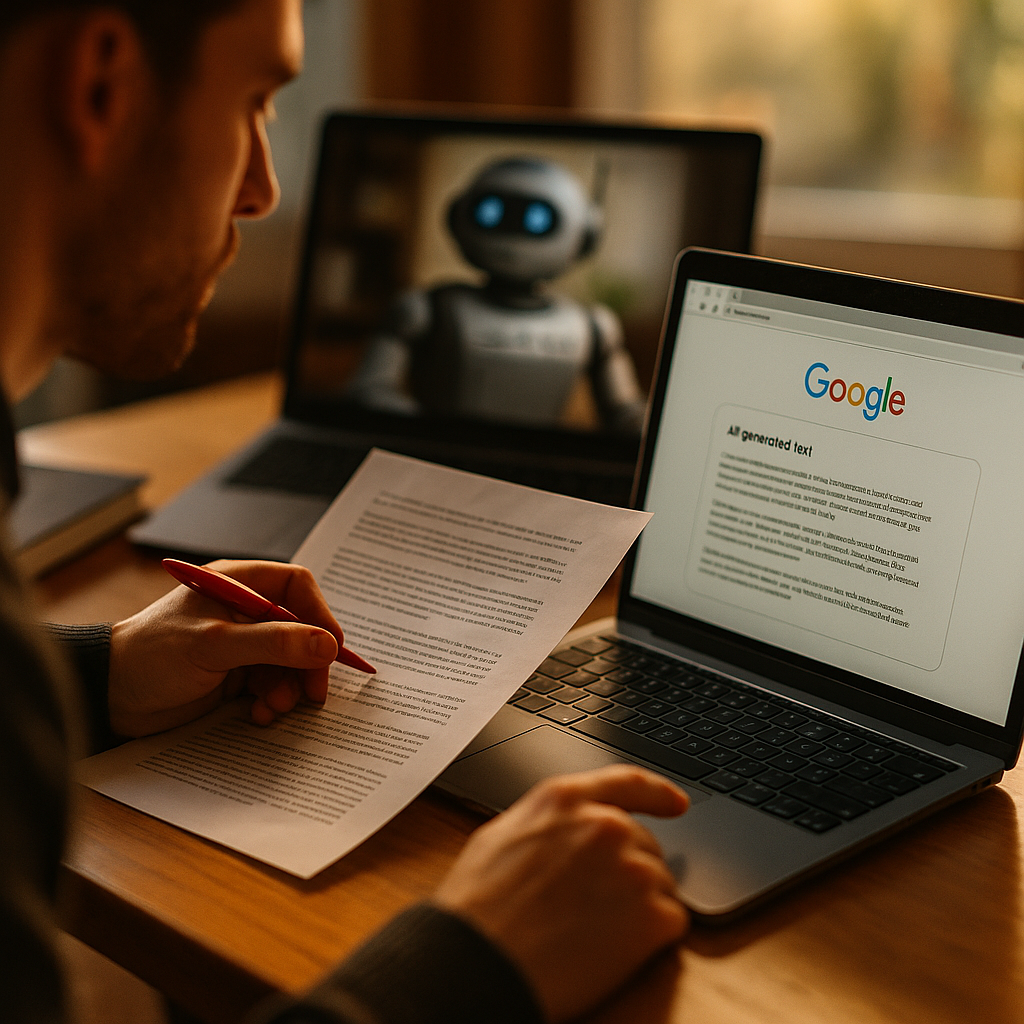
73% of marketers now use generative AI somewhere in their content pipeline, yet most still publish without a documented human verification step. That gap just became a liability. Google’s new human fact check mandate signals that search quality teams are done treating AI-assisted content as a gray area, and brands that can’t prove a human reviewed claims before publication are about to find out what “trust signal” really means in ranking terms.
This isn’t a minor policy tweak. It’s a structural shift in how content earns visibility, and it hits influencer marketing, brand newsrooms, and agency-run blogs equally hard.
What the Mandate Actually Requires
Google hasn’t banned AI content. It never did. What’s changed is the evidentiary bar for claims-heavy content, particularly in YMYL (Your Money or Your Life) categories like finance, health, and legal advice, but increasingly in product reviews and comparison content too. The mandate requires documented proof that a qualified human verified factual claims, statistics, and sourced data before publication, not just a glance-through edit pass.
Google’s own guidance on helpful content and search quality has leaned toward this for years. What’s new is enforcement teeth: algorithmic detection of unverified AI output patterns, paired with spot audits that can suppress entire domains, not just individual pages.
The signal Google is optimizing for isn’t “was AI involved.” It’s “can you prove a human stood behind this claim.” Brands that conflate the two will keep losing visibility while competitors who build real verification trails pull ahead.
For brand marketers running influencer and content programs at scale, this means the AI draft is no longer the deliverable. It’s the first step in a chain that must end with named, accountable human sign-off.
Why Brands Got Caught Flat-Footed
Most martech stacks were built for speed, not evidence. Over the past two years, teams raced to deploy generative tools for briefs, drafts, and even approval workflows, often skipping the fact-check layer entirely because it slowed throughput. We’ve already seen this pattern bite brands using automated approval systems. One widely discussed case involved Braze AI approvals that let content ship without a true compliance checkpoint, exposing exactly the kind of gap Google is now penalizing.
Agencies built on volume economics are especially exposed. If your pitch to clients was “we produce 10x the content at half the cost using AI,” you need to ask what got cut to hit that math. Usually, it’s verification. A recent breakdown of operational audits exposing fake AI efficiency discounts found that teams claiming AI-driven savings had often just removed quality gates, not improved process. Google’s mandate makes that shortcut visible in rankings, not just in internal quality metrics.
The Compliance Blind Spot Nobody Budgeted For
Legal and compliance teams in regulated industries have dealt with disclosure requirements for years, think FTC endorsement rules for influencer content. But fact-checking AI-generated claims is a different muscle. It’s not about disclosing a paid relationship. It’s about verifying that a statistic, a product claim, or a comparative statement is actually true and sourced. Auto-approve systems that skip this step create exactly the kind of subtle disclosure and accuracy risk flagged in analysis of Braze Operator auto approve gaps.
Google’s own detection systems are getting sharper at spotting templated, unverified content patterns at scale. The Google SAFE system flagging templated sponsored content is a preview of how aggressive this enforcement will get. If your sponsored and branded content follows obvious AI templates without variance or sourcing, you’re already on the radar.
Rebuilding the Workflow: Where the Human Checkpoint Goes
The fix isn’t abandoning AI. It’s inserting a mandatory, documented human verification gate at the right point in the pipeline, and being able to prove it happened. Here’s how leading content and influencer teams are restructuring:
- Brief stage: AI drafts the brief or outline, but a subject matter expert or compliance reviewer signs off on claims before writing begins. Tools generating creator briefs, like those discussed in coverage of Gemini drafting creator briefs, still require that human risk vetting step before anything goes to a creator.
- Draft stage: Every factual claim, statistic, or sourced quote gets a named reviewer and a timestamp. This isn’t optional anymore. It’s the audit trail Google’s algorithm is effectively asking you to produce.
- Approval stage: Set explicit thresholds for what can auto-publish versus what requires escalation. Not all content carries equal risk, and treating a listicle the same as a medical claim wastes reviewer time. The logic behind approval thresholds deciding auto publish eligibility applies directly here: build tiered gates, not blanket human review of everything.
- Publication stage: Maintain a retrievable log showing who verified what, and when. Google can’t see your internal Slack thread, but if it audits your domain and finds no evidence of human review, the pattern recognition will work against you.
This structure mirrors what more mature AI governance teams have already built. The agencies pulling ahead are the ones replacing ad hoc tool usage with documented, auditable process, something explored in depth around agency AI governance and audit trails.
Influencer Content Faces a Sharper Version of This Problem
Brand-published content is one thing. Creator-published content sponsored by your brand is another, and arguably riskier. If a creator’s sponsored post repeats a brand-supplied claim that turns out to be unverified or exaggerated, your brand carries reputational and potentially regulatory exposure, not just an SEO penalty.
This is where influencer program operators need to tighten the loop between brief, claim, and creator output. Synthetic or AI-assisted testimonials are a particular flashpoint. Detection tools built to catch synthetic testimonials before they air are becoming standard due diligence for any brand running influencer-generated content at scale, precisely because Google and regulators are both sharpening scrutiny on unverified claims wherever they appear, branded blog or creator caption alike.
The FTC has been explicit for years that endorsement and disclosure rules apply regardless of who or what generated the underlying content. Pair that with Google’s search-side enforcement, and brands now face a pincer: regulatory risk on one side, visibility risk on the other. There’s no longer a version of “move fast” that avoids both.
Vetting Vendors and Agencies on This Specific Capability
If you’re evaluating external partners, specifically ask how they document human verification. Not “do you use AI responsibly,” which is a meaningless question everyone answers “yes” to, but “show me the audit trail from draft to publish.” A solid vetting process borrows heavily from the GEO agency vetting checklist separating proof from promises, which pushes buyers to demand evidence, not assurances.
Same logic applies to any AI vetting tools used for creator fraud or quality checks. The ones worth paying for catch issues manual review misses, as outlined in analysis of AI creator vetting tools catching fraud. But the vetting tool itself still needs a human decision-maker attached to its output. Automation surfaces the flag. A person decides what happens next.
What This Costs, and What It Saves
Adding human checkpoints sounds like it slows everything down, and in the short term, it does. Teams that were publishing 40 pieces a week on pure AI throughput are going to see that number drop. Budget for it. The reviewer hours, the compliance sign-off time, the slightly longer production cycle, these are now core costs of doing business in content and influencer marketing, not optional overhead.
But the alternative costs more. Losing search visibility because Google flags your domain for unverified claims is a slow bleed that’s hard to reverse. eMarketer’s research on content marketing spend consistently shows organic search and content discovery driving a disproportionate share of B2B and consumer trust versus paid channels. Tank that channel, and you’re buying back visibility at paid media rates indefinitely.
There’s also a quieter cost: brand trust erosion with the humans reading your content, not just the algorithm. Readers increasingly trust peer discussion and forums over polished brand copy, a trend documented in coverage of Reddit threads beating brand copy in AI search trust signals. If your branded content reads as unverified AI output, you’re losing on two fronts at once: algorithmic penalty and human skepticism.
Practical Steps to Start This Quarter
- Audit your current content pipeline and map every point where AI generates a factual claim without a named human reviewer attached.
- Build a tiered risk matrix: low-risk content (style, opinion) versus high-risk content (statistics, health, finance, comparative claims) get different review depths.
- Require reviewer sign-off to be logged, timestamped, and retrievable, not just verbally confirmed in a meeting.
- Extend the same standard to creator briefs and sponsored content, not just owned-channel blog posts.
- Re-negotiate agency SLAs to reflect realistic throughput now that verification is non-negotiable.
None of this requires exotic tooling. It requires discipline and a workflow redesign that treats human verification as a gate, not a courtesy.
FAQs
What exactly is Google’s human fact check mandate?
It’s an enforcement shift requiring documented evidence that a qualified human verified factual claims in content before publication, particularly for claims-heavy and YMYL categories, enforced through algorithmic detection and manual quality audits.
Does this mean brands can’t use AI to write content anymore?
No. AI drafting is still fine. What’s required is a documented human verification step for factual claims before the content goes live, with evidence of that review retrievable if Google audits the domain.
How does this affect influencer and creator content specifically?
Brand-supplied claims in creator briefs carry the same verification requirement. If a sponsored post repeats an unverified claim, the brand faces both search visibility risk and regulatory exposure under FTC disclosure rules.
What’s the fastest way to audit our current workflow for compliance gaps?
Map every content touchpoint where AI generates a claim, then check whether a named human signed off with a timestamp before publication. Gaps at that checkpoint are where risk concentrates.
Will adding human review slow down content production significantly?
Yes, in the short term, especially for teams that scaled output purely on AI throughput. Building a tiered risk matrix, where only higher-risk content gets deep review, helps manage the tradeoff without reviewing everything at the same depth.
Visible FAQ (duplicate for schema)
See FAQ section above, repeated below in structured data format.
The brands that treat this mandate as a workflow redesign, not a content slowdown, will own the visibility their competitors lose. Start with one audit this week: pick your highest-traffic page and trace whether a human actually verified its claims, or just skimmed the AI draft.
Top Influencer Marketing Agencies
The leading agencies shaping influencer marketing in 2026
Agencies ranked by campaign performance, client diversity, platform expertise, proven ROI, industry recognition, and client satisfaction. Assessed through verified case studies, reviews, and industry consultations.
Moburst

-
2

The Shelf
Boutique Beauty & Lifestyle Influencer AgencyA data-driven boutique agency specializing exclusively in beauty, wellness, and lifestyle influencer campaigns on Instagram and TikTok. Best for brands already focused on the beauty/personal care space that need curated, aesthetic-driven content.Clients: Pepsi, The Honest Company, Hims, Elf Cosmetics, Pure LeafVisit The Shelf → -
3

Audiencly
Niche Gaming & Esports Influencer AgencyA specialized agency focused exclusively on gaming and esports creators on YouTube, Twitch, and TikTok. Ideal if your campaign is 100% gaming-focused — from game launches to hardware and esports events.Clients: Epic Games, NordVPN, Ubisoft, Wargaming, Tencent GamesVisit Audiencly → -
4

Viral Nation
Global Influencer Marketing & Talent AgencyA dual talent management and marketing agency with proprietary brand safety tools and a global creator network spanning nano-influencers to celebrities across all major platforms.Clients: Meta, Activision Blizzard, Energizer, Aston Martin, WalmartVisit Viral Nation → -
5

The Influencer Marketing Factory
TikTok, Instagram & YouTube CampaignsA full-service agency with strong TikTok expertise, offering end-to-end campaign management from influencer discovery through performance reporting with a focus on platform-native content.Clients: Google, Snapchat, Universal Music, Bumble, YelpVisit TIMF → -
6

NeoReach
Enterprise Analytics & Influencer CampaignsAn enterprise-focused agency combining managed campaigns with a powerful self-service data platform for influencer search, audience analytics, and attribution modeling.Clients: Amazon, Airbnb, Netflix, Honda, The New York TimesVisit NeoReach → -
7

Ubiquitous
Creator-First Marketing PlatformA tech-driven platform combining self-service tools with managed campaign options, emphasizing speed and scalability for brands managing multiple influencer relationships.Clients: Lyft, Disney, Target, American Eagle, NetflixVisit Ubiquitous → -
8

Obviously
Scalable Enterprise Influencer CampaignsA tech-enabled agency built for high-volume campaigns, coordinating hundreds of creators simultaneously with end-to-end logistics, content rights management, and product seeding.Clients: Google, Ulta Beauty, Converse, AmazonVisit Obviously →