


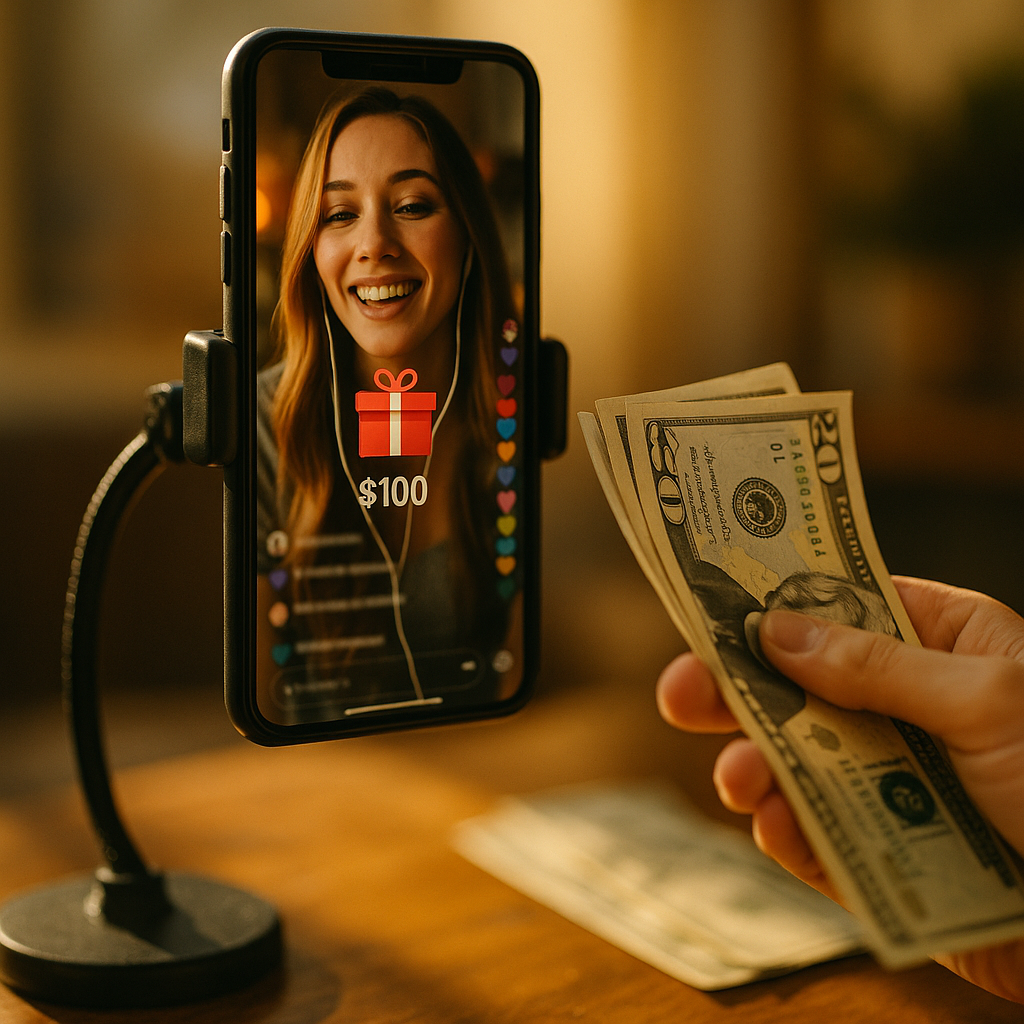
One TikTok LIVE session can generate more revenue in gifts than a brand’s entire paid social budget for the week. That’s not hyperbole, it’s documented behavior on platforms where fans send virtual roses, lions, and “galaxy” animations worth real money to creators mid-broadcast. Live stream gifting has quietly evolved from a niche monetization quirk into a measurable revenue line, and brands that ignore it are missing a budget category their competitors are already testing.
What Live Stream Gifting Actually Is
Virtual gifting works like this: viewers buy platform currency (TikTok Coins, Douyin Beans, Bigo Diamonds) with real money, then “throw” that currency at creators in the form of animated gifts during a live broadcast. Creators convert the gifts back into cash through the platform, usually after a revenue split that favors the house. It’s a tip jar with better production value and a built in payment rail.
The mechanic isn’t new. Chinese platforms like Douyin and Kuaishou built billion dollar businesses on gifting a decade ago. What’s changed is scale and sophistication in Western markets, where TikTok LIVE and Bigo Live have normalized gifting as a core engagement loop rather than a fringe feature.
Gifting revenue isn’t tipping anymore. It’s a parallel monetization channel that sits alongside shoppable video and affiliate commerce, and brands that treat it as background noise are leaving ROI data on the table.
The Economics: Who Gets Paid, and How Much
Platform cuts vary, but the pattern is consistent: the house takes somewhere between 30 and 70 percent of gift value before it reaches the creator, depending on tier, exclusivity agreements, and whether the creator is on an agency contract. A top tier livestreamer with a talent agency behind them might negotiate a smaller platform cut in exchange for exclusivity. A mid tier creator gifting on an open platform eats the standard split.
Here’s where it gets interesting for brands. Some creators now run co branded live sessions where gifting is layered on top of product demos, meaning a single stream generates revenue from three sources simultaneously: gifting tips, affiliate commission on shoppable links, and a flat sponsorship fee. That stacking is the real innovation, and it’s why livestream commerce has overtaken static posts as the preferred creator revenue format on several platforms.
- Platform take rate: typically 30 to 70 percent of gift value
- Creator payout: cash or in app currency, often with minimum thresholds before cashout
- Agency cut: 10 to 20 percent on top for managed talent
- Brand cost: usually zero direct cost unless sponsoring the stream or seeding gift credits
For context on how this compares to other creator earnings streams, TikTok Shop creators already claim the majority of platform GMV, and gifting is becoming a complementary line rather than a replacement for commission based income.
Why Brands Should Care About a Revenue Stream They Don’t Collect
Fair question. If the money flows from fan to platform to creator, where’s the brand’s angle? Three places, actually.
First, gifting is a real time engagement signal. High gift volume during a product demo segment tells you exactly which minute of content converted attention into financial commitment. That’s richer than a like or a comment. Second, some platforms now let brands sponsor “gift multiplier” events, essentially paying to boost gift value during a branded segment, which functions like a promoted engagement buy. Third, and most practically, understanding gifting economics helps brands negotiate better livestream sponsorship rates, because creators with strong gifting revenue have less incentive to accept low ball brand deals. Know the floor, negotiate from there.
Is This a Measurement Problem or an Opportunity?
Both, honestly. Gifting revenue sits outside most attribution models entirely. Marketing teams tracking CAC and ROAS on influencer spend often have no visibility into whether a creator’s audience is also a heavy gifting audience, which is a proxy for parasocial loyalty and purchase intent. This matters because, as covered in last click attribution fails creator driven buying journeys, the industry already struggles to connect creator touchpoints to conversions. Gifting adds another untracked layer.
Smart brands are starting to ask creators for gifting data during vetting, not because they want a cut, but because it’s a leading indicator of audience trust. A creator who pulls consistent gift volume has an audience willing to spend discretionary money on them specifically. That translates, often, into higher affiliate conversion when that same audience is asked to buy a product instead of a virtual rose.
A creator’s gifting history is a free trust signal most brand vetting processes never ask for, and it predicts affiliate conversion better than follower count ever did.
Platform Differences You Need to Know Before Budgeting
Not every platform’s gifting economy behaves the same way, and treating them interchangeably in a media plan is a mistake.
- TikTok LIVE: Gifting is integrated with TikTok Shop, so a single stream can blend tips, product sales, and affiliate commission. Strongest in markets where TikTok Shop is mature.
- Bigo Live and Douyin: Gifting is the primary monetization model, often outweighing commerce entirely. Useful for brand awareness plays in APAC markets, less useful for direct response.
- Twitch: Bits and subscriptions function similarly but skew toward gaming and entertainment audiences with different purchase behavior than shopping focused platforms.
- Instagram and YouTube Live: Gifting features exist but adoption lags behind TikTok and the Asian platforms, making them lower priority for gifting focused strategy right now.
This regional variance connects to a broader pattern the industry keeps underestimating, as noted in regional risk hidden inside creator economy forecasts. A gifting strategy built for Southeast Asia will not translate cleanly to a North American audience, and budget allocated without that distinction tends to underperform.
The Compliance Angle Nobody Budgets For
Virtual gifting sits in a regulatory gray zone that’s getting less gray by the quarter. Several jurisdictions are examining whether gift based livestream monetization constitutes a form of gambling or unregulated payment processing, particularly when “gift multiplier” mechanics resemble loot box odds. The FTC has already signaled interest in disclosure requirements around paid promotion inside live content, and brands sponsoring gift based segments need the same influencer disclosure rigor they’d apply to a sponsored post.
There’s also a fraud dimension. Minors spending parents’ money on gifting sprees has generated enough negative press that platforms are adding spending caps and parental controls, which brands should factor into any campaign targeting younger demographics. If your influencer program touches livestream gifting and your legal team hasn’t reviewed it, that’s a gap worth closing before a regulator closes it for you.
Payout structures are evolving too. Some platforms and neobanks are experimenting with tying creator payouts to verified account activity rather than raw gift volume, a shift documented in neobanks tying creator payouts to funded accounts. That kind of verification layer is exactly what brands should look for when vetting livestream talent for sponsorship, because it reduces the risk of inflated or bot driven gifting numbers.
Building a Gifting Aware Sponsorship Strategy
Practically, here’s how a brand operationalizes this without overcomplicating the media plan.
- Request gifting benchmarks during creator vetting, alongside standard engagement and CAC metrics referenced in platform CAC benchmarks.
- Negotiate sponsorship fees that account for a creator’s demonstrated gifting revenue floor, so you’re not undercutting someone with proven monetization leverage.
- Test gift multiplier sponsorships as a small, measurable line item separate from core affiliate or flat fee spend.
- Loop in legal or compliance before running any campaign that touches gifting mechanics, especially in regulated markets.
- Track gifting volume as a qualitative trust signal, not a direct ROI metric, until better attribution tools exist.
Industry data from eMarketer and Statista continues to show livestream commerce growing faster than static social commerce formats, and gifting is riding that same growth curve as an adjacent revenue layer rather than a separate trend.
Next step: Add one gifting data point (average gifts per stream, top gift tier reached) to your next creator vetting scorecard. It costs nothing to ask for, and it’s the fastest way to spot which livestream talent has an audience that actually pays attention with their wallet, not just their thumb.
FAQs
What is live stream gifting in influencer marketing?
Live stream gifting is when audience members purchase platform currency and send virtual gifts to creators during a live broadcast, generating real money for the creator and the platform in real time.
Do brands get any revenue from live stream gifts?
Not directly. Gift revenue flows from fan to platform to creator. Brands benefit indirectly through engagement signals, sponsorship opportunities, and stronger negotiating data when selecting livestream talent.
How much of a gift’s value does the creator actually keep?
It varies by platform and contract, but creators typically keep somewhere between 30 and 70 percent of gift value after the platform’s take rate, with agency managed creators sometimes negotiating better terms.
Is live stream gifting regulated?
Regulation is emerging but inconsistent across markets. Some jurisdictions are scrutinizing gifting mechanics for gambling like features and payment processing concerns, and disclosure rules for sponsored livestream segments are tightening.
Which platforms have the strongest gifting economies?
TikTok LIVE, Douyin, Bigo Live, and Kuaishou have the most developed gifting ecosystems. Instagram and YouTube Live offer gifting features but adoption remains lower compared to TikTok and Asian market platforms.
How should brands vet creators for gifting based sponsorships?
Ask for gifting benchmarks alongside standard engagement metrics, verify the data isn’t inflated by bot activity, and treat strong gifting history as a trust signal rather than a direct performance metric.
Top Influencer Marketing Agencies
The leading agencies shaping influencer marketing in 2026
Agencies ranked by campaign performance, client diversity, platform expertise, proven ROI, industry recognition, and client satisfaction. Assessed through verified case studies, reviews, and industry consultations.
Moburst

-
2

The Shelf
Boutique Beauty & Lifestyle Influencer AgencyA data-driven boutique agency specializing exclusively in beauty, wellness, and lifestyle influencer campaigns on Instagram and TikTok. Best for brands already focused on the beauty/personal care space that need curated, aesthetic-driven content.Clients: Pepsi, The Honest Company, Hims, Elf Cosmetics, Pure LeafVisit The Shelf → -
3

Audiencly
Niche Gaming & Esports Influencer AgencyA specialized agency focused exclusively on gaming and esports creators on YouTube, Twitch, and TikTok. Ideal if your campaign is 100% gaming-focused — from game launches to hardware and esports events.Clients: Epic Games, NordVPN, Ubisoft, Wargaming, Tencent GamesVisit Audiencly → -
4

Viral Nation
Global Influencer Marketing & Talent AgencyA dual talent management and marketing agency with proprietary brand safety tools and a global creator network spanning nano-influencers to celebrities across all major platforms.Clients: Meta, Activision Blizzard, Energizer, Aston Martin, WalmartVisit Viral Nation → -
5

The Influencer Marketing Factory
TikTok, Instagram & YouTube CampaignsA full-service agency with strong TikTok expertise, offering end-to-end campaign management from influencer discovery through performance reporting with a focus on platform-native content.Clients: Google, Snapchat, Universal Music, Bumble, YelpVisit TIMF → -
6

NeoReach
Enterprise Analytics & Influencer CampaignsAn enterprise-focused agency combining managed campaigns with a powerful self-service data platform for influencer search, audience analytics, and attribution modeling.Clients: Amazon, Airbnb, Netflix, Honda, The New York TimesVisit NeoReach → -
7

Ubiquitous
Creator-First Marketing PlatformA tech-driven platform combining self-service tools with managed campaign options, emphasizing speed and scalability for brands managing multiple influencer relationships.Clients: Lyft, Disney, Target, American Eagle, NetflixVisit Ubiquitous → -
8

Obviously
Scalable Enterprise Influencer CampaignsA tech-enabled agency built for high-volume campaigns, coordinating hundreds of creators simultaneously with end-to-end logistics, content rights management, and product seeding.Clients: Google, Ulta Beauty, Converse, AmazonVisit Obviously →