


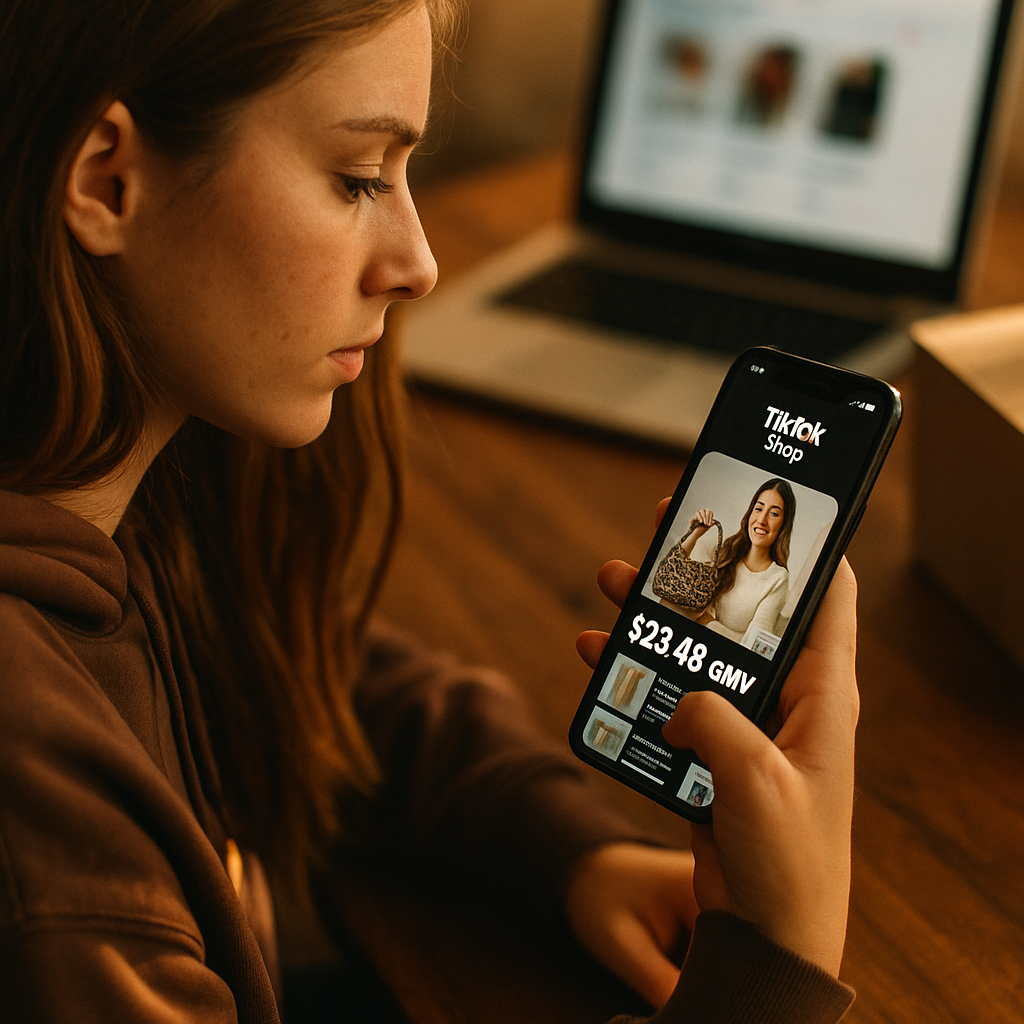
Three out of every four dollars spent on TikTok Shop now flow through a creator’s video, livestream, or affiliate link, not a brand’s own storefront. That’s the headline finding behind TikTok Shop’s reported $23.4 billion in annual GMV, and it should reframe how every brand marketer thinks about platform strategy. The TikTok Shop creator economy isn’t a nice-to-have anymore. It’s the distribution layer itself.
The Numbers Behind the Headline
$23.4 billion in gross merchandise value is a big number on its own. But the structure underneath it is the real story. Roughly 75% of that GMV, by TikTok’s own disclosures and industry trackers, traces back to creator-affiliated content: shoppable videos, LIVE sessions, and affiliate product links rather than brand-run shop pages or standard paid ads.
Compare that to Amazon, where influencer-driven sales still sit in the low single digits of total GMV despite years of creator program investment, or to Instagram Shopping, where creator attribution remains murky at best. TikTok built commerce and content into the same feed from day one. Creators aren’t a marketing layer bolted onto a storefront. They are the storefront.
When three-quarters of GMV runs through creators rather than brand-owned channels, “influencer marketing” stops being a line item and becomes the core sales motion.
Why Creators Captured the Majority of GMV
A few structural choices explain the shift. First, TikTok’s affiliate commission model pays creators directly on conversion, which means creators are economically incentivized to push product, not just post content. Second, GMV Max and similar auto-optimization tools reward creator content that converts, feeding more distribution to videos that already sell. Third, livestream shopping, which barely registered on Western platforms a few years ago, has become a dominant format on TikTok Shop. We covered this shift in detail in our piece on how livestream commerce overtakes static posts as the leading creator revenue format.
There’s also a trust mechanic at play. Shoppers increasingly treat creator demonstrations as product research, not advertising. That has real implications for attribution models built around last-click conversion, a problem we’ve unpacked in our analysis of why last-click attribution fails creator-driven buying journeys. If a creator’s video is the actual point of sale, crediting a later ad click for the conversion badly undercounts creator ROI.
What This Means for Budget Allocation
If creators drive 75% of GMV on a platform most brands still budget as a secondary channel, the math on spend allocation is broken. Marketers who still treat TikTok Shop as a side experiment are leaving conversion volume on the table. This mirrors a broader pattern we’ve tracked: 60% TikTok engagement share is already forcing budget reallocation across brand media plans, and GMV concentration is the next pressure point finance teams will have to reckon with.
This isn’t theoretical for category leaders. Supplement and wellness brands, which face intense customer acquisition cost pressure from saturated paid search and Meta ads, have been among the fastest movers. Our coverage of how supplement brands chase lower CAC through TikTok Shop pivots shows the pattern clearly: category after category is discovering that creator-led commerce converts at a lower cost than traditional performance media, provided the operational backend can keep up.
And that backend is no small thing. GMV Overtakes Engagement as the core KPI across influencer marketing generally, a shift detailed in our report on GMV as the core KPI. TikTok Shop just happens to be the clearest proof point. CFOs want GMV attached to spend, not vanity engagement metrics, and TikTok Shop’s affiliate model gives them exactly that: a direct, trackable line from creator video to transaction.
Sourcing and Fulfillment Become the Bottleneck
Here’s the part most marketing teams underestimate: creator-driven commerce at this scale creates a supply chain problem, not just a media problem. When tens of millions of product SKUs get pushed through creator affiliate links, inventory accuracy, fulfillment speed, and return handling become brand reputation issues just as much as creative quality does. Our analysis of how 33 million creator SKUs turn sourcing into supply chain work lays out exactly where this breaks for brands that scale creator programs faster than their ops teams can support them.
A viral creator video can generate more order volume in 48 hours than a quarterly paid campaign. Brands that can’t fulfill fast enough end up with the exact kind of backlash that erodes trust rather than building it, a dynamic examined in our piece on influencer programs without strategy. GMV growth without operational readiness is a liability, not a win.
Compliance Risk Scales With GMV
Here’s a question brand legal teams should be asking right now: who’s responsible when a creator’s shoppable video makes an unsubstantiated product claim? The FTC’s endorsement guidance applies regardless of whether the sale happened through a brand’s own ad or a creator’s affiliate link, and TikTok Shop’s scale means more creators, more claims, and more surface area for enforcement risk.
Disclosure consistency, creator vetting, and content review at this volume aren’t jobs a single social media manager can do by hand. That’s one reason enterprise brands increasingly favor consolidated platforms over a patchwork of point tools for managing creator relationships and compliance, a trend our team detailed in platforms over point solutions. It’s also why specialist agencies have become a sensible route for brands scaling creator commerce quickly. Moburst, a global full-service digital marketing agency that has worked with over 900 clients including Samsung, Reddit, and Calm, runs an influencer marketing partners practice that handles creator vetting, content production, and KPI reporting together rather than as separate workstreams, which matters when GMV concentration this high leaves little room for compliance gaps.
How Should Brands Structure Their TikTok Shop Strategy?
Three practical shifts matter most right now. First, stop measuring TikTok Shop creator content against the same engagement benchmarks used for brand-owned posts; GMV and CAC payback are the metrics that matter, a point reinforced by our coverage of CAC payback as the gatekeeper metric for influencer budgets broadly. Second, build reusable creative systems rather than one-off briefs, since the same creator content that drives organic GMV can be repurposed into paid assets, a practice we’ve covered in our piece on how reusable creative libraries cut production costs in half. Third, treat finance rigor as non-negotiable once creator spend crosses a meaningful share of total marketing budget, a threshold explored in our analysis of the 44% creator spend threshold.
Benchmarking tools like eMarketer’s platform data and Sprout Social’s industry reports are worth tracking quarterly, since TikTok Shop’s GMV mix shifts fast as new creator formats (think shoppable LIVE replays or AI-assisted affiliate storefronts) roll out.
The Takeaway
TikTok Shop’s $23.4 billion GMV figure isn’t a platform milestone to admire from the sidelines. It’s a signal that creator-led commerce has become the primary conversion channel on one of the world’s largest shopping platforms, and brands still budgeting it as a secondary tactic are underfunding their best-performing channel. Audit your current creator-to-GMV attribution this quarter, not next year.
Frequently Asked Questions
What percentage of TikTok Shop’s GMV comes from creators?
Approximately 75% of TikTok Shop’s reported $23.4 billion in GMV is attributed to creator-driven content, including affiliate links, shoppable videos, and livestream commerce, rather than brand-run storefronts or standard paid ads.
Why do creators drive more sales on TikTok Shop than on other platforms?
TikTok Shop integrates commerce directly into the content feed and pays creators commission on conversions, which incentivizes creators to actively sell rather than simply post. Livestream shopping and algorithmic tools like GMV Max also amplify content that already converts well.
How should brands measure ROI on TikTok Shop creator campaigns?
GMV and CAC payback period are more reliable indicators than engagement metrics like views or likes, since TikTok Shop’s affiliate structure provides a direct, trackable line between creator content and completed purchase.
What operational risks come with scaling TikTok Shop creator programs?
Fulfillment speed, inventory accuracy, and return handling become critical as creator-driven order volume spikes unpredictably. Compliance risk around endorsement disclosure and product claims also scales with the number of active creators.
Should brands work with an agency to manage TikTok Shop creator campaigns?
Many brands use specialist agencies to handle creator vetting, content production, and compliance together, particularly once creator-driven GMV becomes a significant share of total revenue and requires coordinated reporting across teams.
Top Influencer Marketing Agencies
The leading agencies shaping influencer marketing in 2026
Agencies ranked by campaign performance, client diversity, platform expertise, proven ROI, industry recognition, and client satisfaction. Assessed through verified case studies, reviews, and industry consultations.
Moburst

-
2

The Shelf
Boutique Beauty & Lifestyle Influencer AgencyA data-driven boutique agency specializing exclusively in beauty, wellness, and lifestyle influencer campaigns on Instagram and TikTok. Best for brands already focused on the beauty/personal care space that need curated, aesthetic-driven content.Clients: Pepsi, The Honest Company, Hims, Elf Cosmetics, Pure LeafVisit The Shelf → -
3

Audiencly
Niche Gaming & Esports Influencer AgencyA specialized agency focused exclusively on gaming and esports creators on YouTube, Twitch, and TikTok. Ideal if your campaign is 100% gaming-focused — from game launches to hardware and esports events.Clients: Epic Games, NordVPN, Ubisoft, Wargaming, Tencent GamesVisit Audiencly → -
4

Viral Nation
Global Influencer Marketing & Talent AgencyA dual talent management and marketing agency with proprietary brand safety tools and a global creator network spanning nano-influencers to celebrities across all major platforms.Clients: Meta, Activision Blizzard, Energizer, Aston Martin, WalmartVisit Viral Nation → -
5

The Influencer Marketing Factory
TikTok, Instagram & YouTube CampaignsA full-service agency with strong TikTok expertise, offering end-to-end campaign management from influencer discovery through performance reporting with a focus on platform-native content.Clients: Google, Snapchat, Universal Music, Bumble, YelpVisit TIMF → -
6

NeoReach
Enterprise Analytics & Influencer CampaignsAn enterprise-focused agency combining managed campaigns with a powerful self-service data platform for influencer search, audience analytics, and attribution modeling.Clients: Amazon, Airbnb, Netflix, Honda, The New York TimesVisit NeoReach → -
7

Ubiquitous
Creator-First Marketing PlatformA tech-driven platform combining self-service tools with managed campaign options, emphasizing speed and scalability for brands managing multiple influencer relationships.Clients: Lyft, Disney, Target, American Eagle, NetflixVisit Ubiquitous → -
8

Obviously
Scalable Enterprise Influencer CampaignsA tech-enabled agency built for high-volume campaigns, coordinating hundreds of creators simultaneously with end-to-end logistics, content rights management, and product seeding.Clients: Google, Ulta Beauty, Converse, AmazonVisit Obviously →